Youri Djorkaeff: ‘I Was in Love with England, Its Fans and Weather’

Youri Djorkaeff in action for Bolton in 2004. Photograph: Matthew Lewis/Getty Images
TT

Youri Djorkaeff: ‘I Was in Love with England, Its Fans and Weather’

Youri Djorkaeff in action for Bolton in 2004. Photograph: Matthew Lewis/Getty Images

Youri Djorkaeff played alongside some of the greatest footballers of his generation. “Zizou was amazing,” he says of Zinedine Zidane.

“We were teammates for 10 years and we had this chemistry to know exactly where each other was on the pitch, to play one touch, two touch. But the number one was Ronaldo. He was simply ‘Ó Fenómeno’.”

Djorkaeff played with Ronaldo at Inter in the mid-1990s and the pair teamed up recently as part of Djorkaeff’s current job as the CEO of the Fifa Foundation. Djorkaeff was in São Paulo and Brasilia to push the charity, so enlisted his old friend for support. “Ronnie said: ‘Whenever I’m needed, you can call me.’ Of course, this provides us with visibility as Ronaldo is Ronaldo.”

Ronaldo is one of a multitude of good connections the 52-year-old can call upon. “I have been in touch with David Beckham, who is keen to get involved. I went to Messi’s house, where we spoke for hours about links with his foundation. We spoke to Rashford. We are proud of what the players are doing today. It’s important to have all these ambassadors for the Fifa Foundation who appreciate the need to show humanity. They are all saying: ‘If you need me, I’m here to help.’ It’s not bullshit.”

Djorkaeff was an integral part of the France team that won the World Cup in 1998. His interest in Fifa’s charitable work was sparked at another World Cup in France 21 years later. “I met president Gianni Infantino at the Women’s World Cup in Paris and we started to talk about the work of the foundation. We had a couple of follow-up meetings and I really liked what he said about his vision for the foundation and how it could be a tool for good. Previously, there had been a lot of requests about sustainable responsibility but these were not high on the agenda. But it is now crucially important for clubs, federations and Fifa themselves to be active in supporting social responsibility.”

Over the last year Djorkaeff has built up a team of a dozen people.

“We have been working on a 10-year strategic plan and we are aligning ourselves with organisations such as the UN. Our aim is to reach 700 million children.” It sounds like an extremely ambitious target, but Djorkaeff is adamant it can be achieved. “Throughout my life, whether it has been playing football or in my current position, my philosophy has always been that nothing is impossible.”

As soon as Djorkaeff retired from playing, he set up the Youri Djorkaeff Foundation in New York with the objective of giving both boys and girls – particularly refugees – a chance to build a solid foundation for their lives: to improve their health, discipline, self-confidence, academic success and aspirations for the future. He gave up his own foundation when he took on his full-time role at Fifa’s headquarters in Zurich in September 2019. He was just beginning to travel the world for his new role, visiting 29 countries in the space of three months, when the Covid-19 pandemic struck.

“Through the power of football I gained incredible access to heads of state and ministers, where we could open up a dialogue about the work of the foundation. For example, I met the President of China, but also got to meet people on the ground. The most important aspect of this initiative is to listen to people – whether they are a head of state or a grassroots coach with only a few balls to practice – to find out what they need.”

Djorkaeff has been focusing on the Football for Schools Program, a joint venture between Fifa, Unesco and the World Food Program that aims to provide children in Fifa’s 211 member associations with 11 million footballs. “I met with Unesco in Paris and we reached an agreement very quickly as together we realised how important it is to create a link between teachers, kids and parents. So we are now creating a tool to help schools run coaching sessions,” says Djorkaeff.

“There will be an app that hosts 300 coaching sessions all at different levels. The most important thing is to have 50% of these sessions dedicated to life skills. As pupils are taking a break, they will be taught subjects such as gender equality, the importance of community and neighborhood. We expect to launch the app from February as a free program for governments and schools. We will also provide them with equipment – balls, shirts, bibs etc. This is not about becoming a professional, but it’s all about enjoying football with your friends, regardless of ability.”

Djorkaeff played for various clubs across the world – he won the French Cup with Monaco under Arsène Wenger, the Cup Winners’ Cup with PSG and the Uefa Cup with Inter before finishing is career at the New York Red Bulls – but he is perhaps best known in England for his time with Bolton. How on earth did he end up making his way from the Bundesliga to Bolton in 2002? “I had some difficulty with my coach at Kaiserslautern and I had dinner with Sam Allardyce in Germany and we talked about anything and everything. He told me about the situation at the club and how they were near relegation. I saw this tough guy and his passion for this club and their fans and it got to me.”

“I thought like a chevalier: let’s conquer England, let’s cross Le Manche. When I had been playing, my attitude to England was the same as all French people; it was hate-like-hate-like. But I was crazy about Liverpool and remember cheering them on when they were playing St Étienne in 1977 in the European Cup. All these guys with their crazy hair and those red shirts. I bought lots of Liverpool shirts and hats all the time – not wearing them, just collecting. I was fascinated by the clubs and the fans.

“I was talking to Liverpool, Manchester United and Bolton all at the same time. I spoke to Gérard Houllier, who was a great friend, but he said I cannot promise you to be playing all the time. We were approaching the 2002 World Cup and I spoke to Roger Lemerre, the French national coach, who told me I needed to be playing to be considered. It was the same with Sir Alex. So, I thought: ‘I’ll go to Bolton for the last 12 games.’ I didn’t know what to expect but I was in love with England, in love with its shitty weather, the people, the fans.”

Bolton were in the relegation places when Djorkaeff arrived in February 2002. At the time Allardyce called him “perhaps the biggest signing in the club’s history”. Djorkaeff did not disappoint. He helped steer the club to safety and decided to stay for two more seasons.

Allardyce loved him. When asked to pick a best XI from the best players he had managed a few years ago, he was quick to include the Frenchman. “Youri was top-class, a brilliant human being as well as a brilliant footballer,” said Allardyce. “His nickname was ‘The Snake’ because you never knew when he was going to strike – that came from Arsène Wenger by the way. He knew how to set the standards. He used to get very upset about the lads not training correctly, or not hitting the standards he was looking for, and he had a terrific three years with us at Bolton.”

Wenger gave Djorkaeff his nickname at Monaco three decades ago. Now they are working together again at Fifa. Wenger, Ronaldo, Messi, Beckham, Rashford and Allardyce will be cheering on Djorkaeff over the next decade as he tries to match his achievements on the pitch with those off it.

The Guardian Sport


Turkish Central Bank Total Reserves Fell Nearly $6 Bln Last Week, Bankers Say 

People walk with the Suleymaniye Mosque in the background ahead of the holy month of Ramadan in Istanbul, Wednesday, Feb. 18, 2026. (AP)
TT

Turkish Central Bank Total Reserves Fell Nearly $6 Bln Last Week, Bankers Say 

People walk with the Suleymaniye Mosque in the background ahead of the holy month of Ramadan in Istanbul, Wednesday, Feb. 18, 2026. (AP)

The Turkish Central Bank's total reserves are expected to have decreased by around $5.8 billion last week to $206 billion, due to a eurobond redemption, bankers ‌said.

Three bankers ‌consulted by ‌Reuters ⁠calculated that net reserves ⁠decreased by $7 billion to $89 billion in the week ending February 20.

Bankers estimated that ⁠an increase in ‌gold ‌prices in the week ‌to February 20 ‌had an upward impact of around $1 billion on reserves. According to ‌the calculations, the central bank sold $3 ⁠billion ⁠in the market last week.

The reserve calculations are based on preliminary data from the central bank. Official data will be released on Thursday.


Despite Drop in 2025, Russian Oil Exports Exceed Pre-war Volumes

Russia relies on a shadow fleet of tankers to get past Western restrictions on its oil exports. Damien MEYER / AFP/File
TT

Despite Drop in 2025, Russian Oil Exports Exceed Pre-war Volumes

Russia relies on a shadow fleet of tankers to get past Western restrictions on its oil exports. Damien MEYER / AFP/File

While Russian oil exports dropped last year, Russia is still exporting higher volumes than before its invasion of Ukraine in 2022, researchers said Tuesday, calling for stricter sanctions enforcement.

The volume of Russian crude oil exports remained six percent above pre-invasion levels in the fourth year of the war, despite Western sanctions aimed at curbing Russia's "shadow fleet," according to a report by Finnish think tank Center for Research on Energy and Clean Air (CREA).

Russia's shadow fleet consists of ageing tankers, with often opaque ownership, used to circumvent sanctions imposed by the European Union, the United States and the G7 group of nations.

However, oil revenues, which are fueling Moscow's war chest, have dropped below pre-invasion levels, as Russia has been forced to adopt price discounts, the report said.

"We've seen a significant drop in Russian fossil fuel export earnings as a result of new measures and greater enforcement," Isaac Levi, a CREA analyst and co-author of the report, told AFP.

But he added that "there are still significant loopholes and areas that have been unaddressed by sanctioning countries", allowing volumes to remain high.

Loopholes include the false flagging of ships but also the issue of re-exportation of refined fuels made from Russian crude oil to sanctioning countries.

"We propose a ban of imports from any refinery or storage terminal that has received a shipment of Russian oil in the previous six months," Levi said.

- Crude to China, India, Türkiye-

Russian revenues from crude oil exports -- one of Russia's main exports -- decreased by 18 percent to 85.5 billion euros in the 12 months leading up to February 24, compared to the year before, according to the report.

Meanwhile volumes fell by six percent to 215 million tons, for the same period, according to the report.

Ninety-three percent of Russian crude was exported to China, India and Türkiye.

The report urged the EU and UK to "detain Russian shadow fleet vessels that pose huge environmental and security threats to European and UK coastlines".

The European Union lists 598 vessels suspected of being part of the "shadow fleet" that are banned from European ports and maritime services.

It also called for an end to Hungary's and Slovakia's continued imports of Russian crude oil.

The two countries, which were exempted from EU sanctions on Russian oil imports, imported 11 percent more Russian crude oil in the first 10 months of 2025 compared to the same period a year earlier, the report stated.


Ukraine Marks Four Years Since Russian Invasion 

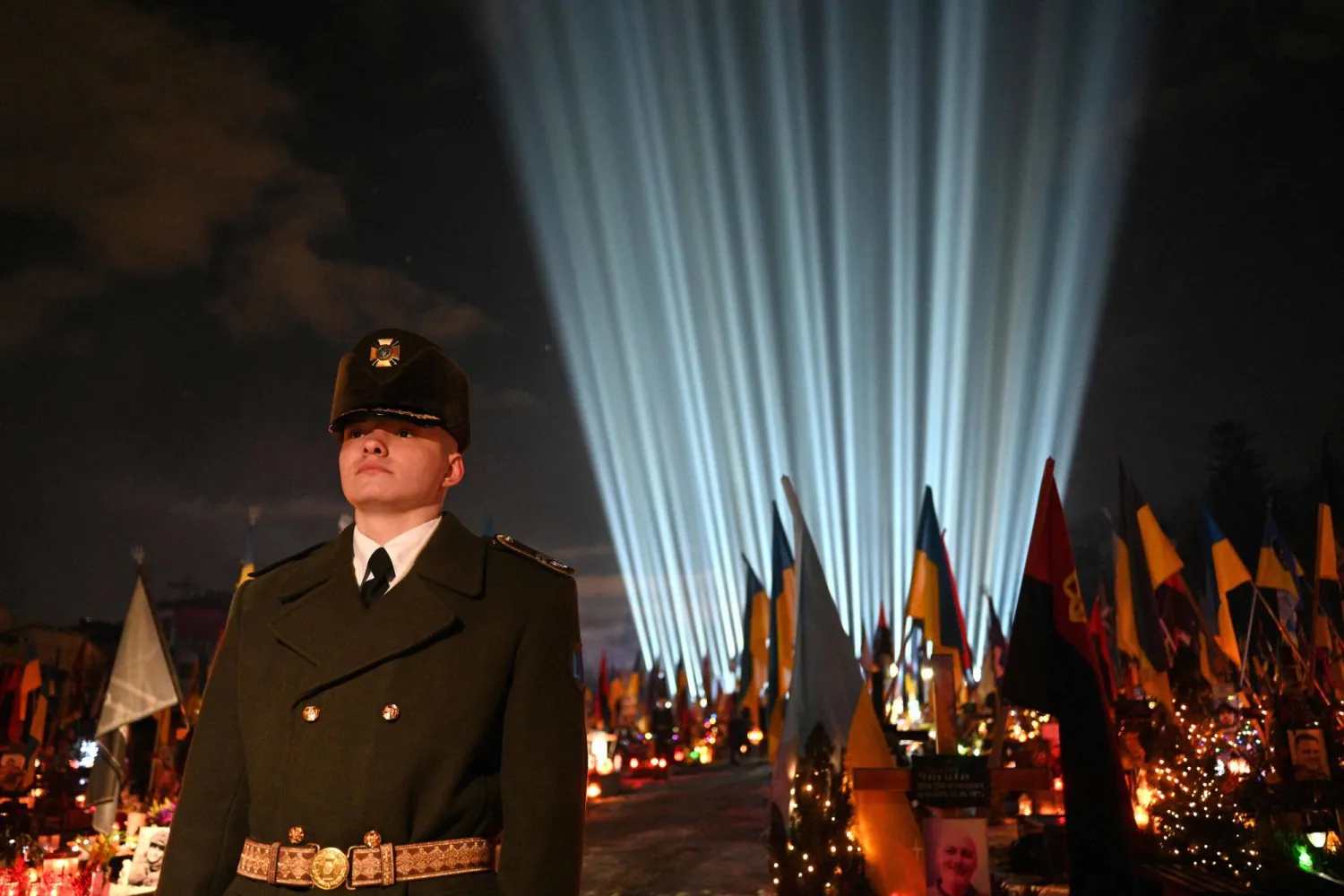
A Ukrainian Honor Guard stands as a symbolic illumination entitled "Rays of Memory" is projected over the graves of Ukrainian soldiers who died in the war with Russia, at Lychakiv Military Cemetery in Lviv on February 23, 2026, ahead of the fourth anniversary of Russia's invasion of Ukraine. (AFP)
TT

Ukraine Marks Four Years Since Russian Invasion 

A Ukrainian Honor Guard stands as a symbolic illumination entitled "Rays of Memory" is projected over the graves of Ukrainian soldiers who died in the war with Russia, at Lychakiv Military Cemetery in Lviv on February 23, 2026, ahead of the fourth anniversary of Russia's invasion of Ukraine. (AFP)

Ukraine marked the fourth anniversary of Russia's full-scale invasion on Tuesday with a show of solidarity from its staunchest allies, but with no end in sight to Europe's bloodiest conflict since World War II.

Tens of thousands of lives have been lost since the Kremlin ordered troops into Ukraine on February 24, 2022, confident of a quick victory but not expecting the fierce resistance that followed.

The worldwide fallout of the war has been immense, with many European countries increasing their own defense spending in anticipation of a possible confrontation of their own with Russia.

Talks between the two sides, relaunched last year by the United States, have so far failed to halt the fighting, which has devastated Ukraine and left it facing the mammoth task of reconstruction.

European Commission chief Ursula von der Leyen was in Kyiv to mark the occasion, posting a video saying she was visiting for the tenth time since the war began to reaffirm that Europe stood "unwaveringly with Ukraine, financially, militarily, and through this harsh winter".

"And to send a clear message to the Ukrainian people and to the aggressor alike: we will not relent until peace is restored. Peace on Ukraine's terms," she said.

She is expected to take part in a "commemoration ceremony" and visit a Ukrainian energy facility damaged by Russian strikes before meeting President Volodymyr Zelensky.

Von der Leyen will also take part in a videoconference with Kyiv's allies, including Britain, France and Germany.

- Impasse -

Russia, which currently occupies nearly 20 percent of Ukrainian territory, bombs civilian areas and infrastructure on a daily basis.

The bombardment has sparked the worst energy crisis since the start of the invasion, with plunging winter temperatures adding to the suffering.

Kyiv's allies have slapped heavy sanctions on Moscow, forcing it to redirect its key oil exports towards new markets, particularly in Asia.

Despite heavy losses, Russian troops have in recent months advanced slowly on the front line, particularly in the eastern Donbas region, which Moscow wants to annex.

US-brokered talks are ongoing, with Zelensky unwavering in his demands for security guarantees from Washington before any talk of "compromise", including on territory, with Russia.

Russia, though, has rejected Ukrainian proposals for the deployment of European troops in Ukraine after any ceasefire deal.

President Vladimir Putin has repeatedly warned that he will pursue his objectives by force if diplomacy fails.

- Reconstruction -

The grinding four-year war has devastated Ukraine, which even before the fighting was one of the poorest countries in Europe.

According to a joint World Bank, European Union and United Nations report with Kyiv, published on Monday, the cost of post-war reconstruction is estimated at around $558 billion over the next decade.

Russia justified sending troops into Ukraine to prevent Ukraine's ambition to join NATO, arguing that Kyiv's membership of the transatlantic alliance would threaten its own security.

On Monday, during a medal ceremony to mark "Defenders of the Fatherland Day", Putin insisted that his soldiers were defending Russia's "borders" to ensure "strategic parity" between powers and fight for the country's "future".

Ukraine, a former Soviet republic, considers the war to be a resurgence of Russian imperialism aimed at subjugating the Ukrainian people.

In an interview with the BBC broadcast on Sunday, Zelensky said he believed Putin had "already started" World War III.

"Russia wants to impose on the world a different way of life and change the lives people have chosen for themselves," he told the British public broadcaster.