


Ukraine Marks Four Years Since Russian Invasion 

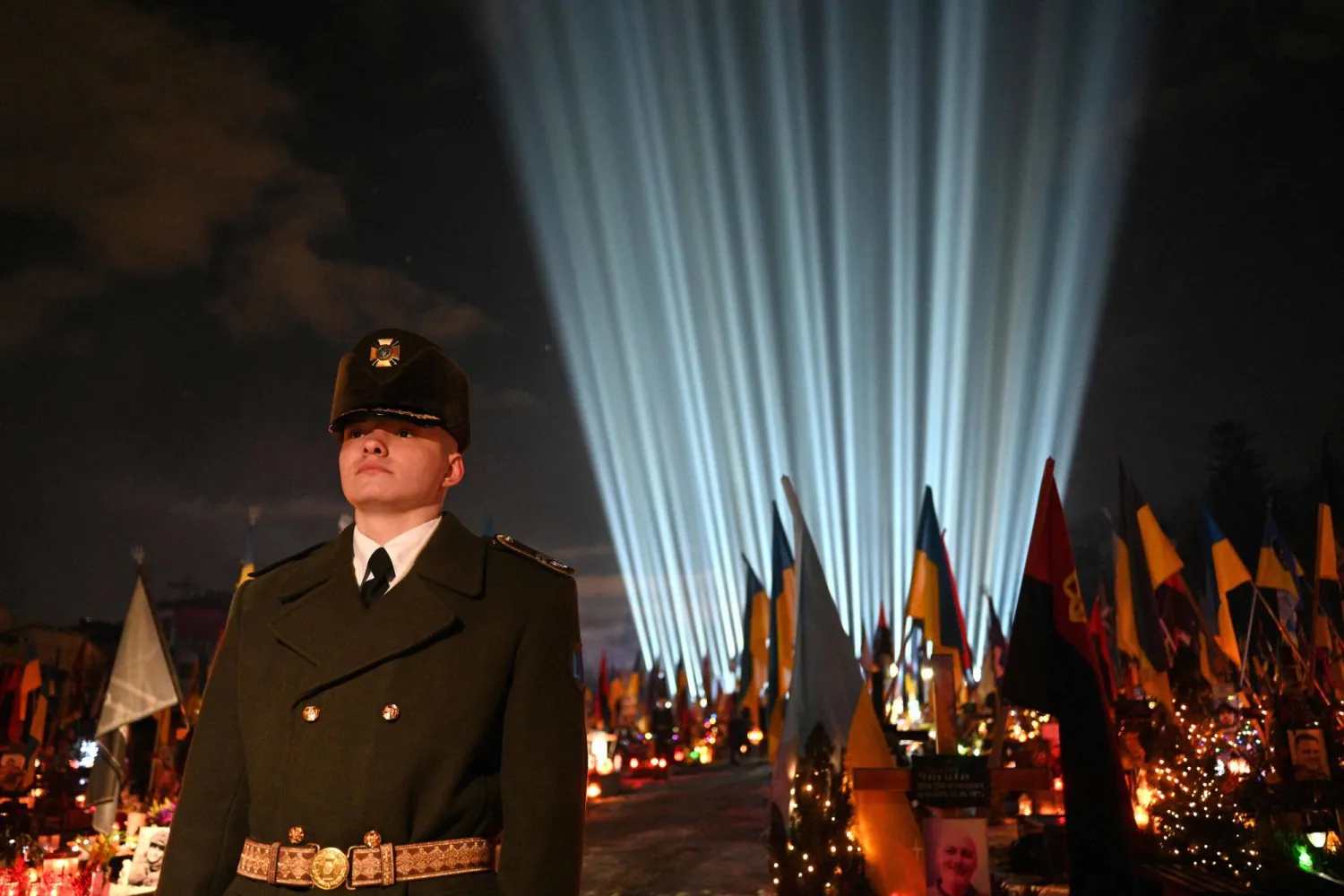
A Ukrainian Honor Guard stands as a symbolic illumination entitled "Rays of Memory" is projected over the graves of Ukrainian soldiers who died in the war with Russia, at Lychakiv Military Cemetery in Lviv on February 23, 2026, ahead of the fourth anniversary of Russia's invasion of Ukraine. (AFP)
TT

Ukraine Marks Four Years Since Russian Invasion 

A Ukrainian Honor Guard stands as a symbolic illumination entitled "Rays of Memory" is projected over the graves of Ukrainian soldiers who died in the war with Russia, at Lychakiv Military Cemetery in Lviv on February 23, 2026, ahead of the fourth anniversary of Russia's invasion of Ukraine. (AFP)

Ukraine marked the fourth anniversary of Russia's full-scale invasion on Tuesday with a show of solidarity from its staunchest allies, but with no end in sight to Europe's bloodiest conflict since World War II.

Tens of thousands of lives have been lost since the Kremlin ordered troops into Ukraine on February 24, 2022, confident of a quick victory but not expecting the fierce resistance that followed.

The worldwide fallout of the war has been immense, with many European countries increasing their own defense spending in anticipation of a possible confrontation of their own with Russia.

Talks between the two sides, relaunched last year by the United States, have so far failed to halt the fighting, which has devastated Ukraine and left it facing the mammoth task of reconstruction.

European Commission chief Ursula von der Leyen was in Kyiv to mark the occasion, posting a video saying she was visiting for the tenth time since the war began to reaffirm that Europe stood "unwaveringly with Ukraine, financially, militarily, and through this harsh winter".

"And to send a clear message to the Ukrainian people and to the aggressor alike: we will not relent until peace is restored. Peace on Ukraine's terms," she said.

She is expected to take part in a "commemoration ceremony" and visit a Ukrainian energy facility damaged by Russian strikes before meeting President Volodymyr Zelensky.

Von der Leyen will also take part in a videoconference with Kyiv's allies, including Britain, France and Germany.

- Impasse -

Russia, which currently occupies nearly 20 percent of Ukrainian territory, bombs civilian areas and infrastructure on a daily basis.

The bombardment has sparked the worst energy crisis since the start of the invasion, with plunging winter temperatures adding to the suffering.

Kyiv's allies have slapped heavy sanctions on Moscow, forcing it to redirect its key oil exports towards new markets, particularly in Asia.

Despite heavy losses, Russian troops have in recent months advanced slowly on the front line, particularly in the eastern Donbas region, which Moscow wants to annex.

US-brokered talks are ongoing, with Zelensky unwavering in his demands for security guarantees from Washington before any talk of "compromise", including on territory, with Russia.

Russia, though, has rejected Ukrainian proposals for the deployment of European troops in Ukraine after any ceasefire deal.

President Vladimir Putin has repeatedly warned that he will pursue his objectives by force if diplomacy fails.

- Reconstruction -

The grinding four-year war has devastated Ukraine, which even before the fighting was one of the poorest countries in Europe.

According to a joint World Bank, European Union and United Nations report with Kyiv, published on Monday, the cost of post-war reconstruction is estimated at around $558 billion over the next decade.

Russia justified sending troops into Ukraine to prevent Ukraine's ambition to join NATO, arguing that Kyiv's membership of the transatlantic alliance would threaten its own security.

On Monday, during a medal ceremony to mark "Defenders of the Fatherland Day", Putin insisted that his soldiers were defending Russia's "borders" to ensure "strategic parity" between powers and fight for the country's "future".

Ukraine, a former Soviet republic, considers the war to be a resurgence of Russian imperialism aimed at subjugating the Ukrainian people.

In an interview with the BBC broadcast on Sunday, Zelensky said he believed Putin had "already started" World War III.

"Russia wants to impose on the world a different way of life and change the lives people have chosen for themselves," he told the British public broadcaster.



Suspected Measles Cases Kill Nearly 1,000 as Bangladesh Struggles to Contain Outbreak

A child receives treatment for measles, at Bangladesh Shishu Hospital & Institute in Dhaka on September 3, 2026. (Photo by Salahuddin Ahmed / AFP)
TT

Suspected Measles Cases Kill Nearly 1,000 as Bangladesh Struggles to Contain Outbreak

A child receives treatment for measles, at Bangladesh Shishu Hospital & Institute in Dhaka on September 3, 2026. (Photo by Salahuddin Ahmed / AFP)

Eight-month-old Rojatun Jannat Ramisa is struggling to breathe in a hospital in Bangladesh’s capital as her parents sit helplessly beside her. She's one of thousands of children sickened by a measles outbreak that's sweeping across the country and has killed hundreds of children following setbacks to the country's vaccine program.

Ramisa’s mother Ranu Akhter traveled hundreds of kilometers (miles) after doctors in eastern Bangladesh referred her to a specialized child hospital in Dhaka to seek treatment for the life-threatening condition, The Associated Press said.

“Fourteen days ago, when we were at the district hospital, there were other children being treated alongside my daughter. I saw that those children also had red rashes on their bodies, sores in their mouths and fevers,” Akhter told The Associated Press at Dhaka Shishu Hospital.

“It made me realize how widespread the measles outbreak is,” she said.

Every day, the death toll is rising.

Bangladesh races to vaccinate children Bangladesh has been racing to halt the outbreak's spread since March, when more than 100 children died in less than a month. By Tuesday, the death toll from suspected measles cases reached 999 since the start of the year, according to the government’s Directorate General of Health Services.

Since March, the country has recorded more than 166,000 suspected measles cases, including 19,835 laboratory-confirmed infections, according to the Ministry of Health.

The government launched an emergency vaccination drive in March together with the World Health Organization, the UN children’s agency and the Gavi vaccine alliance. It began with a focus on children from 6 months to 5 years old and later expanded nationwide in phases.

Measles is a highly contagious airborne disease that causes fever, respiratory symptoms and a characteristic rash. It can sometimes have severe or fatal complications, especially in young children, according to the WHO.

Two doses of a vaccine provide strong protection against measles, but the WHO says 95% of the population has to be vaccinated in order to stop the disease from spreading — which protects children like Ramisa who are too young to be vaccinated as well as immunocompromised people.

The pandemic and political upheaval set back vaccinations

A few years ago, Bangladesh had measles largely under control, with a vaccination program that was credited for decades for protecting children and mothers from the deadly diseases of tuberculosis, diphtheria, whooping cough, tetanus, poliomyelitis and measles. Between 2021 and 2025, the country recorded just 100 to 300 cases per year, down from 2,410 cases in 2020.

But in the last few years, disruptions to the vaccine program have left a growing number of children unvaccinated.

First the pandemic interrupted routine vaccinations, and then in 2024 the government largely missed a vaccination campaign previously carried out every four years.

Atiqul Islam, a neonatal and child specialist at Bangladesh Shishu Hospital and Institute, said during the pandemic period in 2021 and 2022, many did not take their children to get vaccinated.

“So, if you look at children who are now four or five years old, many of them missed their vaccinations. That created a gap. During the previous interim government, vaccines were also unavailable at many vaccination centers,” he said.

Rival politicians trade blame for vaccine shortfall Bangladesh's current government, headed by Prime Minister Tarique Rahman, said the failures in planning under ousted Prime Minister Sheikh Hasina and interim leader Muhammad Yunus left the country with shortages of vaccines and far behind on coverage.

The 2024 measles vaccination campaign was disrupted during the political upheaval that led to Hasina’s ouster. She left the country in the face of a mass uprising in August 2024, and was followed by Yunus, who led an interim administration that transferred power to an elected government after an election in February.

From exile in India, Hasina blamed the Yunus-led government for the disaster.

Doctor says things are getting better, but not fast enough At Bangladesh Shishu Hospital, Islam said the situation has improved, but not enough.

The doctor said his colleagues are struggling to treat infected children who often arrive at the hospital with serious complications like pneumonia, diarrhea and encephalitis, or brain swelling.

“For the past six months, we have been treating measles patients continuously, and we are exhausted,” he said.


Merz Says Disaster Narrowly Averted in Russia-Prepared Drone Attack at Airport

German Chancellor Friedrich Merz looks on during a debate at the German parliament, the Bundestag, in Berlin, Germany, 09 September 2026. (EPA)
TT

Merz Says Disaster Narrowly Averted in Russia-Prepared Drone Attack at Airport

German Chancellor Friedrich Merz looks on during a debate at the German parliament, the Bundestag, in Berlin, Germany, 09 September 2026. (EPA)

German Chancellor Friedrich Merz said on Wednesday that an attempted drone attack at Leipzig/Halle airport had been prepared in Russia over an extended period and that a disaster was only narrowly ‌averted.

"This attack ‌was planned in ‌Russia ⁠for months and ⁠was specifically targeted at Germany, and only by pure chance was major material damage and harm to people ⁠prevented," Merz told the lower ‌house ‌of parliament.

Merz spoke after ‌the far-right Alternative for ‌Germany scored a major victory in a state election in Saxony-Anhalt on Sunday, running ‌on a platform that includes calls for ⁠closer ties ⁠with Moscow.

Russia has rejected any involvement in the drone incident at Leipzig airport, and its foreign minister has said these accusations were "the start of a real war".


UK Rejects Israel’s ‘Damaging’ Sanctions Retaliation

A view shows the British Consulate General in East Jerusalem, 09 September 2026. (EPA)
TT

UK Rejects Israel’s ‘Damaging’ Sanctions Retaliation

A view shows the British Consulate General in East Jerusalem, 09 September 2026. (EPA)

British foreign minister Ed Miliband on Wednesday condemned as "regrettable and damaging" Israel's decision to order the closure of the UK's consulate in Jerusalem as retaliation for London-led Western sanctions over settler violence. 

"We anticipated this might happen because we saw other countries, the Dutch, for example, who had announced sanctions, who had seen these reprisals from Israel. I think they're regrettable and damaging," Miliband told BBC Radio. 

Israel on Tuesday ordered the closure after 12 countries including Britain, Canada and France announced they would sanction trade with Israeli settlements in the West Bank, following a surge in settler attacks against Palestinians in the occupied West Bank. 

Israel said it would also expel British representatives at a center monitoring the US-brokered ceasefire plan in Gaza, bar British training for Palestinian Authority forces and ban 12 Britons, mostly members of parliament, from visiting the country. 

Miliband rejected suggestions that the sanctions would impact intelligence cooperation with Israel. 

"We have important intelligence and security relationships with Israel, and I'm confident they will continue," he said, declining to go into details. 

"And I was very clear yesterday that we do believe in working with our Israeli partners when it comes to the threats they face from Iran," he added. 

Miliband also dismissed the criticism of the sanctions by Britain's chief rabbi. 

Ephraim Mirvis on Tuesday called the measures "little more than political flag-bearing". 

He said it was a "truly a dark day for British Jews", predicting that the measures "will succeed only in bolstering the very extremism they seek to target". 

Several antisemitic attacks in London this year have targeted synagogues and other Jewish sites.