

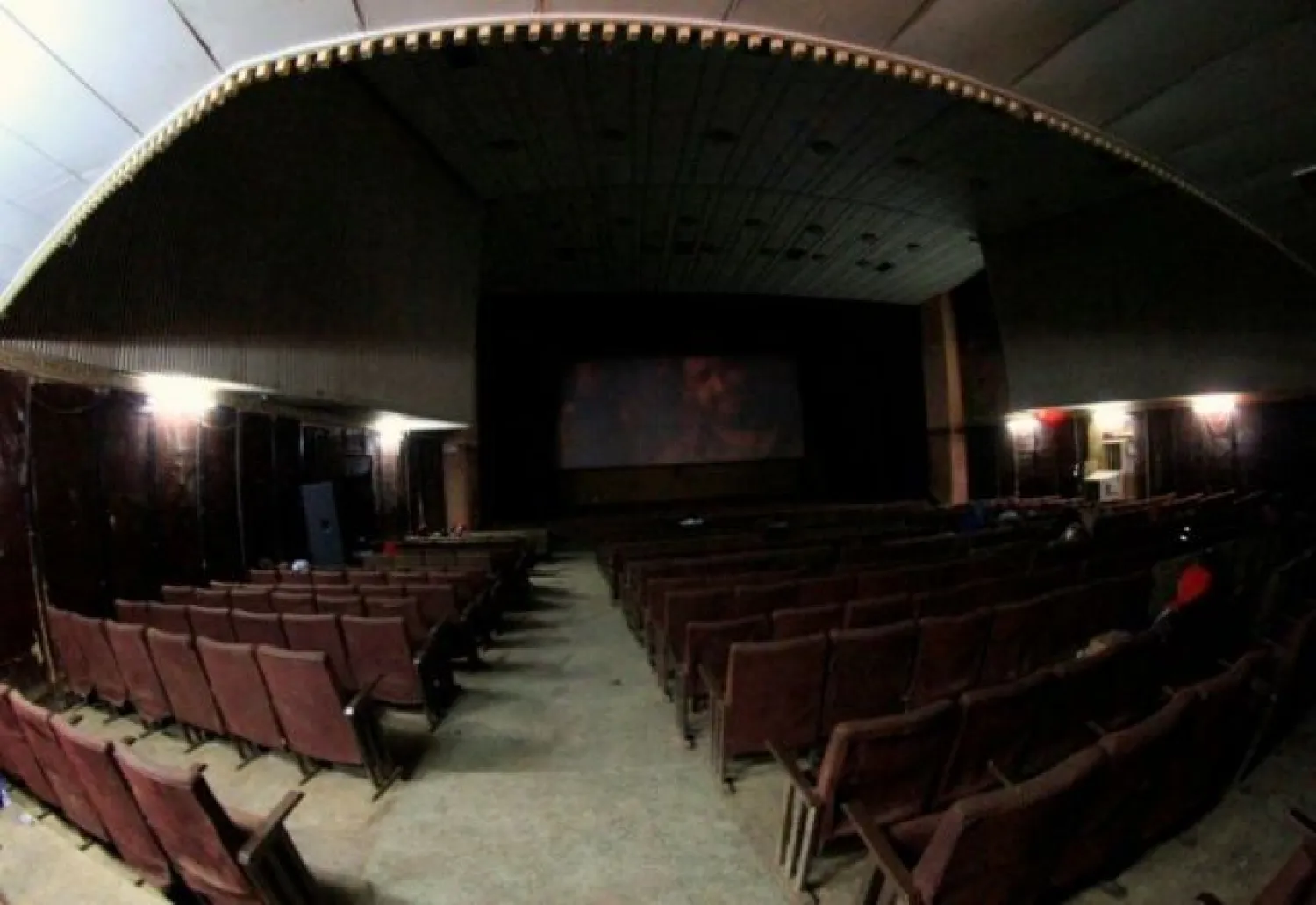

Sudan Cinema Takes Inspiration From Revolution

Many cinemas were shut and homegrown filmmaking languished in Sudan under Omar al-Bashir's regime- AFP
TT

Sudan Cinema Takes Inspiration From Revolution

Many cinemas were shut and homegrown filmmaking languished in Sudan under Omar al-Bashir's regime- AFP

Sudanese filmmakers who celebrated the end of stifling restrictions following the ouster of autocrat Omar al-Bashir have won multiple international awards but are yet to enjoy the same recognition at home.

Cinema languished in the North African country through three decades of authoritarian rule by Bashir.

But Sudanese took to the streets to demand freedom, peace and social justice, and Bashir's ironfisted rule came to an end in a palace coup by the army in April 2019.

"We started realizing how much our society needs our dreams," said director Amjad Abou Alala, AFP reported.

His 2019 film "You Will Die at Twenty" was both Sudan's first Oscar entry and the first Sudanese film broadcast on Netflix, winning prizes at international film festivals including Italy's Venice and Egypt's El Gouna.

The film tells the story of a young man a mystic predicts will die at age 20.

As Sudan undergoes a precarious political transition, the country's filmmakers have found more space to operate, Alala said.

Young filmmakers act "without the complexes, the lack of self-confidence or the frustration that we suffered in previous generations", he added.

Talal Afifi, director of the Khartoum-based Sudan Film Factory program, has trained hundreds of young people in filmmaking.

Afifi began work long before the 2019 revolution, with advances in digital camera technology making filmmaking far more accessible.

The filmmaker attended a 2008 short film festival in Munich, where the winning film -- an Iraqi documentary shot on a handy-cam -- inspired him to return home and set up a training center and production house.

In the past decades, the Film Factory has organized some 30 screenwriting, directing and editing workshops -- and produced more than 60 short films, honored in international festivals from Brazil to Japan.

Afifi says the roots of Sudan's innovative cinema was born from the "hard work dating from before" Bashir's overthrow, when many cinemas were closed.

Today, cinemas are allowed -- big budget Hollywood films, as well as Indian and Egyptian movies are popular -- but moves to reopen them have been frustrated by restrictions to stem the spread of the novel coronavirus.

The Sudanese National Museum organized screenings of films, including "You Will Die at Twenty", but they were not screened in large theaters.

Filmmakers still face challenges. Hajooj Kuka, director of the acclaimed 2014 "Beats of the Antonov" was jailed for two months last year for causing a "public nuisance" -- for what he said was an acting workshop.

Other Sudanese films have also garnered international attention, including the 2019 documentary "Talking About Trees" by Suhaib Gasmelbari, which tells the story of four elderly Sudanese filmmakers with a passion for movies.

The quartet and their "Sudanese Film Club" work to reopen an open-air cinema in Omdurman, the city across the Nile from the capital Khartoum.

It won prizes ranging from the Berlin International Film Festival to awards from Istanbul, Athens and Mumbai.

Another film, director Marwa Zein's award-winning 2019 documentary "Khartoum Offside", tackles sexism in the conservative country through the story of young female footballers determined to play professionally.

Many leading Sudanese directors have lived abroad for years, some shuttling between the Egyptian capital Cairo and Khartoum, like Zein and Gasmelbari.

"We are children of the diaspora, which is why our analysis of the affairs of the Sudanese is critical," said Dubai-based Alala.

But if international recognition is seen as a sign of success, Alala fears the new boom in Sudanese cinema will amount to a "leap into the void" because it has not benefited from "any official support or suitable infrastructure".

He understands that this is in part due to the many challenges facing Sudan, as it struggles with a dire economic crisis and seeks to implement a recent peace deal with rebels to end decades of civil war.

While Alala says government support is necessary for the film industry to flourish, he admits that it "would be unfair to ask the new government to shoulder this burden when the economy is devastated".



Isiah Whitlock Jr., Actor from ‘The Wire,’ ‘Veep’ and Spike Lee Films, Dies at 71

US actor Isiah Whitlock Jr. attends the Out-of-This-World Premiere of Disney and Pixar's "Lightyear" at the El Capitan Theater on June 8, 2022 in Hollywood, California. (AFP)
TT

Isiah Whitlock Jr., Actor from ‘The Wire,’ ‘Veep’ and Spike Lee Films, Dies at 71

US actor Isiah Whitlock Jr. attends the Out-of-This-World Premiere of Disney and Pixar's "Lightyear" at the El Capitan Theater on June 8, 2022 in Hollywood, California. (AFP)

Isiah Whitlock Jr., an actor who made frequent memorable appearances on the HBO series “The Wire” and “Veep” and in five films with director Spike Lee, died Tuesday. He was 71.

Whitlock's manager Brian Liebman told The Associated Press in an email that the actor died in New York after a short illness.

Whitlock played openly corrupt state Sen. Clay Davis on 25 episodes across the five seasons of “The Wire.”

Davis, a fan-favorite character, was known for his profane catchphrase delivered by Whitlock in moments of triumph and blunt honesty. The actor first used the phrase in his first film with Lee, 2002's “The 25th Hour," when his detective character discovers a cache of drugs hidden in a couch.

“It’s a big, big, big loss,” Lee said in a phone call with the AP on Tuesday night. “I’m going to miss him for the rest of my life.”

Whitlock went on to appear in four other Lee films, including 2004's “She Hate Me,” 2012's “Red Hook Summer,” 2015's “Chi-Raq,” 2018's “BlacKkKlansman” and 2020's “Da 5 Bloods.”

“We vibed over all those years,” Lee said. “We clicked from the jump.”

Lee said he has especially sweet memories of the extended time he spent with Whitlock shooting “Da 5 Bloods” on location in Thailand, and he fondly remembered the last time he saw Whitlock — Lee and his daughter, Satchel, sat with him at a screening of “Kiss of the Spider Woman” earlier this year.

“He was just a beautiful, beautiful soul,” Lee said. “If you were around him, he made everybody feel good in his presence. He would radiate. I would put that over his acting.”

Lee pointed to Whitlock's comic talents both on screen and off.

"He was hilarious," Lee said. “That was just his nature, he made people laugh. Everybody was in on the joke."

Whitlock is the second significant star of “The Wire” to die in recent weeks after the death of actor James Ransone.

A native of South Bend, Indiana, Whitlock went to Southwest Minnesota State University, where he played football and studied theater. Injuries pushed him to study acting, and he moved to San Francisco to work in theater.

He began appearing in small television guest roles on shows including “Cagney and Lacy” in the late 1980s, and he had very small roles in the 1990 films “Goodfellas” and “Gremlins 2: The New Batch.”

After “The Wire,” Whitlock moved on to another HBO show, the political satire “Veep,” where he played Secretary of Defense George Maddox for three seasons. The character ran against Julia Louis-Dreyfus' Selina Meyer in presidential primaries.

“The Wire” creator David Simon also paid tribute to Whitlock in a post on Bluesky.

“As fine an actor as he was," Simon said, “Isiah was an even better spirit and the greatest gentleman.”


George Clooney, His Wife Amal and Their Children Obtain French Citizenship

Actor George Clooney and Amal Clooney host their annual fundraiser "The Albie Awards" in London, Britain, October 3, 2025. (Reuters)
TT

George Clooney, His Wife Amal and Their Children Obtain French Citizenship

Actor George Clooney and Amal Clooney host their annual fundraiser "The Albie Awards" in London, Britain, October 3, 2025. (Reuters)

Hollywood star George Clooney and his wife, human rights lawyer Amal Clooney, have obtained French citizenship, along with ​their two children, official French government documents show.

Clooney told broadcaster RTL earlier this month that it was essential for him and his wife that their eight-year-old twins Alexander and Ella could live in a place where they had ‌a chance to ‌live a normal ‌life.

“Here, ⁠they ​don’t ‌take photos of kids. There aren’t any paparazzi hidden at the school gates. That’s number one for us,” he told RTL on December 2.

The couple purchased a house on a vineyard, with an estimated value ⁠of around 9 million euros ($10.59 million), in the southern ‌French town of Brignoles ‍in 2021.

The property ‍also includes a swimming pool and ‍a tennis court, according to French media.
"We also have a house in the United States, but our happiest place is on this farm ​where the kids can have fun," he said.

US film director Jim Jarmusch ⁠on Friday told France Inter radio that he would also make an application to obtain French citizenship.

"I would like to have another place to escape from America if necessary," he told France Inter.

"And France, and Paris, and French culture are very deep in me. So I think I would be very honored if I ‌could have a French passport," he said.


France Split over Bardot Tribute

Portraits of late French actress Brigitte Bardot and flowers are displayed on barriers at the entrance of "La Madrague" house, property of late Brigitte Bardot in Saint-Tropez, southeastern France on December 28, 2025. (AFP)
TT

France Split over Bardot Tribute

Portraits of late French actress Brigitte Bardot and flowers are displayed on barriers at the entrance of "La Madrague" house, property of late Brigitte Bardot in Saint-Tropez, southeastern France on December 28, 2025. (AFP)

French politicians were divided on Monday over how to pay tribute to the late Brigitte Bardot, who despite her screen legend courted controversy and convictions in later life with her far-right views.

The film star died on Sunday aged 91 at home in the south of France. Media around the globe splashed iconic images of her and tributes following the announcement.

Bardot shot to fame in 1956 and went on to appear in about 50 films, but turned her back on cinema in 1973 to throw herself into fighting for animal rights.

Her links to the far-right stirred controversy however.

Bardot was convicted five times for hate speech, mostly about Muslims, but also the inhabitants of the French island of Reunion whom she described as "savages".

She slipped away before dawn on Sunday morning with her fourth husband Bernard d'Ormale, a former adviser to the far right, by her side.

"She whispered a word of love to him ... and she was gone," Bruno Jacquelin, a representative of her foundation for animals, told BFM television.

- 'Cynicism' -

President Emmanuel Macron hailed the actor as a "legend" of the 20th century cinema who "embodied a life of freedom".

Far-right figures were among the first to mourn her.

Marine le Pen, whose National Rally party is riding high in polls called her "incredibly French: free, untamable, whole".

Bardot backed Le Pen for president in 2012 and 2017, and described her as a modern "Joan of Arc" she hoped could "save" France.

Conservative politician Eric Ciotti suggested a national farewell like one organized for French rock legend Johnny Hallyday who died in 2017.

He launched a petition online that had garnered just over 7,000 signatures on Monday.
But few left-wing politicians have spoken about Bardot's passing.

"Brigitte Bardot was a towering figure, a symbol of freedom, rebellion, and passion," Philippe Brun, a senior Socialist party deputy, told Europe 1 radio.

"We are sad she is gone," he said, adding he did not oppose a national homage.

But he did hint at her controversial political views.

"As for her political commitments, there will be time enough -- in the coming days and weeks -- to talk about them," he said.

Communist party leader Fabien Roussel called Bardot a divisive figure.

But "we all agree French cinema created BB and that she made it shine throughout the world," he wrote on X.

Greens lawmaker Sandrine Rousseau was more critical.

"To be moved by the fate of dolphins but remain indifferent to the deaths of migrants in the Mediterranean -- what level of cynicism is that?" she quipped on BlueSky.

- Garden burial? -

Bardot said she wanted to be buried in her garden with a simple wooden cross above her grave -- just like for her animals -- and wanted to avoid "a crowd of idiots" at her funeral.

Such a burial is possible in France if local authorities grant permission.

Born on September 28, 1934 in Paris, Bardot was raised in a well-off traditional Catholic household.

Married four times, she had one child, Nicolas-Jacques Charrier, with her second husband, actor Jacques Charrier.

After quitting the cinema, Bardot withdrew to her home in the Saint-Tropez to devote herself to animal rights.

Her calling apparently came when she encountered a goat on the set of her final film, "The Edifying and Joyous Story of Colinot". To save it from being killed, she bought the animal and kept it in her hotel room.

"I'm very proud of the first chapter of my life," she told AFP in a 2024 interview ahead of her 90th birthday.

"It gave me fame, and that fame allows me to protect animals -- the only cause that truly matters to me."