


Why Idris Elba Chose Comedy to Tell His Most Personal Story

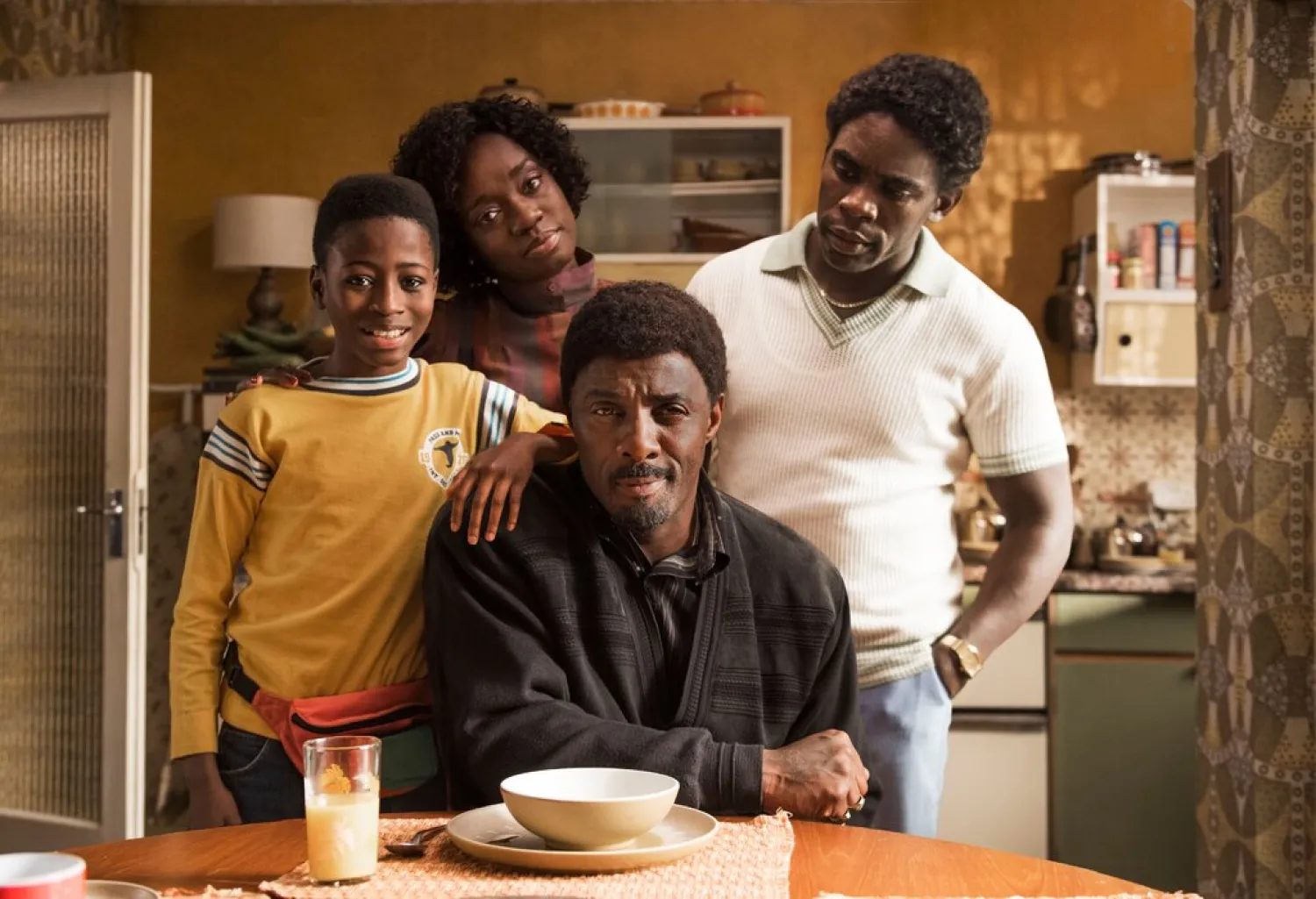
“In the Long Run” was inspired by Elba’s childhood in the Hackney borough of London. With, clockwise from left, Sammy Kamara, Madeline Appiah and Jimmy Akingbola. (Starz)
TT

Why Idris Elba Chose Comedy to Tell His Most Personal Story

“In the Long Run” was inspired by Elba’s childhood in the Hackney borough of London. With, clockwise from left, Sammy Kamara, Madeline Appiah and Jimmy Akingbola. (Starz)

“In the Long Run,” a sweetly comic series set in 1980s London, is based on the real-life childhood of an actor best known for intense dramas like “The Wire” and “Mandela: Long Walk to Freedom.”

“In the Long Run,” which just wrapped up its third season on Starz, is a comedy based on the actor Idris Elba’s childhood in the Holly Street Estate, a racially diverse public housing community in the Hackney borough of London. Set in the fictionalized Eastbridge Estate in the early ’80s, Elba, who created the series for Britain’s Sky One, plays Walter Easmon, who, like Elba’s actual father, Winston, immigrated to England from Sierra Leone and worked in a nearby American-owned car parts factory.

But this story of migration and integration isn’t told exclusively from the perspectives of Walter or his 13-year-old British-born son, Kobna (Sammy Kamara), who is based on Elba. Instead, the show is a broad, upbeat portrayal of a community, a story about interracial working-class Britons and West African immigrant families living together in London right after the infamous Brixton race riots in 1981, during the heyday of Prime Minister Margaret Thatcher’s conservatism.

Adding to this lively mix of characters is Agnes (Madeline Appiah), Walter’s Ghanaian stay-at-home wife turned community organizer and corporate secretary; his brother Valentine (Jimmy Akingbola), a former professional football player who arrives in England only to refuse a steady gig in the factory and become a local DJ; Walter’s white best friend and neighbor, the curmudgeonly yet cuddly Bagpipes (Bill Bailey); and Bagpipes’ peppy and entrepreneurial wife, Kirsty (Kellie Shirley). All three seasons are streaming on Starz, which picked up the show in 2019.

Elba is known mainly for more serious roles, both in TV shows like “The Wire” and “Luther” and in movies like “Beasts of No Nation,” “Thor” and “Mandela: Long Walk to Freedom”. But the gently comedic “In the Long Run” better reflects who he is as a person. It’s an intimate portrait of his childhood, made possible by his illustrious career.

It is also part of a string of recent works, produced by his company Green Door Pictures, that highlight his love of Black music. Like his real-life uncle and the character Valentine, Elba is also a DJ, who as DJ Big Driis spun records at the wedding reception of Prince Harry and Meghan Markle, in 2018, and at Coachella in 2019.

Elba’s directorial debut, the 2019 crime drama “Yardie,” follows its main character, a Jamaican drug courier named D (Aml Ameen), as he moves to London to avenge the murder of his brother, a DJ who died trying to unite warring gangs with his music. That same year, Elba starred in “Turn Up Charlie,” a comedy series he created with Gary Reich about a down-on-his-luck British DJ who ends up taking care of his best friend’s 11-year-old white daughter, Gabrielle (Frankie Hervey).

Neither received much critical love, and Netflix canceled “Turn Up Charlie” after one season. (“He’s just not funny,” Mike Hale, a New York Times TV critic, wrote of Elba in his review.)

“In the Long Run,” however, debuted to plenty of praise in Britain in 2018. Elba is really funny in it and routinely cedes the spotlight to his dynamic co-stars, and the show shifts focus smoothly between sobering topics — racial profiling, gentrification, AIDS activism — and sillier ones, like Jheri curls, schoolboy crushes and missed DJ sets.

Currently in Australia filming George Miller’s “Three Thousand Years of Longing” with Tilda Swinton, Elba spoke in a video call last week about the cultural vibrancy of the African and Caribbean communities of 1980s London and why he, as a generally private person, wanted to see his parents’ love story on TV. These are edited excerpts from the conversation.

How did “In the Long Run” come about?
Just working backward, this show came to life as an idea about four years ago. I had this yearning to do some comedy, and since I’m considered a dramatic actor, the roles weren’t coming in. Kevin Hart was stealing all of them! So I just thought, I’ve got to do something to put myself in this marketplace. My kids think I’m funny; my family thinks I’m funny; let’s go for it. And because my dad was one of the funniest storytellers I had come across, I wanted to find a way to tell his story and honor my parents. It was just the three of us, my mom, my dad and me, and they came from West Africa to the UK with a whole bunch of lively stories and experiences. I wanted to harness our lives together into something relatable and turn their hardships and integration into the UK into stories that were lighthearted.

Many Americans first saw your comedic side when you played Michael Scott’s boss on “The Office.” Why did you choose comedy here to tell this very personal story? Do you really believe people don’t think you’re funny?
I had to write my own show to get some comedy! “The Office” was amazing, but essentially, my character wasn’t comedic. He was kind of like the tough guy. I find that a lot of the writing about Black culture tends to be about hardships, crime, or tends to have scenarios that feel worthy of a dramatic lens. And when people think about Africa, they tend to think in doom and gloom or stereotypes, which I am not keen to keep fueling. We don’t make light of the racism and adversities at the time on our show, but sometimes with comedy you can cover a bit more ground in a lighter way.

“In the Long Run” just finished its third season. How did your series anticipate some of the issues that “The Crown” and “Small Axe,” which are also set in 1980s Britain, explore? What unique perspective are you hoping to show about that time period?
When you think about the ’80s, you think about Margaret Thatcher but also neon lights and Jheri curls. It was definitely a time of incredible evolution and expansion. And it was also a real political narrowing in Britain that was undeniably Thatcher led. The show is about the life that spawned, fizzled and nurtured people my age underneath all of that.

But our lens is very specific to African, Caribbean and Asian cultures that were the majority in these council clusters, homes that were designed for low-income residents. Those homes were an incubator of life, and there’s a mountain of culture, politics, thinkers, books and people that were born in that era and in those communities that are coming to middle life now. As a kid born in the early ’70s who was a teenager in the ’80s, I look back at that era with fondness. “In the Long Run” is a love letter to that time period.

With “I May Destroy You” and “Bridgerton” doing so well, there seems to be new excitement for shows about Black British life here in the United States. Do you think it is a trend or a transformation?
Over the last 10 years in the UK, there have been real strides to put a lens on Black culture in a dramatic way. We’ve seen lots of young writers and producers coming out and telling their stories, and then you’ve got people like Steve McQueen who’s telling these big stories, me telling another story in “Yardie.” I think that in general, everyone’s lenses are starting to widen out. I’m so excited that there is an appetite for UK Black cultures in a way that penetrates the world. I also want to see the same for French, German or Belgian shows because these are also places where Black people migrated from Africa or the Caribbean. We’re everywhere.

Music is a big part of the show, and in each episode a teenage boy suddenly breaks into an R&B song right in the middle of a scene. Where did that idea come from?
You’re talking about the singing boy? He is a texture that I distinctly remember from growing up in the Holly Street Estate — these sprawling projects in Hackney that on one side had the tower blocks where we lived, and on the other side were the lower flats that were notorious for crime and gangsters. My mom used to hate me going down there, but every time I went there to see my friends, there was always someone singing. I never knew who he was, but it was a kid who had a wicked voice, or just could rap. And he would just sing out of his window and was like a peace siren. When he was singing, there were no issues in the hood. So in the show, I wanted it to be a small character and part of the fabric of how I remember what was going on back then. Just a lovely memory.

The New York Times


‘Godfather’ and ‘Apocalypse Now’ Actor Robert Duvall Dead at 95 

Actor Robert Duvall arrives at the 72nd Golden Globe Awards in Beverly Hills, California January 11, 2015. (Reuters)
TT

‘Godfather’ and ‘Apocalypse Now’ Actor Robert Duvall Dead at 95 

Actor Robert Duvall arrives at the 72nd Golden Globe Awards in Beverly Hills, California January 11, 2015. (Reuters)

Robert Duvall, who played the smooth mafia lawyer in "The Godfather" and stole the show with his depiction of a surfing-crazed colonel in "Apocalypse Now," has died at the age of 95, his wife said Monday.

His death Sunday was confirmed by his wife Luciana Duvall.

"Yesterday we said goodbye to my beloved husband, cherished friend, and one of the greatest actors of our time. Bob passed away peacefully at home," she wrote.

Blunt-talking, prolific and glitz-averse, Duvall won an Oscar for best actor and was nominated six other times. Over his six decades-long career, he shone in both lead and supporting roles, and eventually became a director. He kept acting in his 90s.

"To the world, he was an Academy Award-winning actor, a director, a storyteller. To me, he was simply everything," Luciana Duvall said. "His passion for his craft was matched only by his deep love for characters, a great meal, and holding court."

Duvall won his Academy Award in 1983 for playing a washed-up country singer in "Tender Mercies."

But his most memorable characters also included the soft-spoken, loyal mob consigliere Tom Hagen in the first two installments of "The Godfather" and the maniacal Lieutenant Colonel William Kilgore in Francis Ford Coppola's 1979 Vietnam War epic "Apocalypse Now."

"It was an honor to have worked with Robert Duvall," Oscar winner Al Pacino, who acted alongside Duvall in "The Godfather" films, said in a statement.

"He was a born actor as they say, his connection with it, his understanding and his phenomenal gift will always be remembered. I will miss him."

As Colonel Kilgore, Duvall earned an Oscar nomination and became a bona fide star after years playing lesser roles, in a performance where he utters what is now one of cinema's most famous lines.

"I love the smell of napalm in the morning," his war-loving character -- bare chested, cocky and sporting a big black cowboy hat -- muses as low-flying US warplanes bomb a beachfront tree line where he wants to go surfing.

That character was originally created to be even more over the top -- his name was at first supposed to be Colonel Carnage -- but Duvall had it toned down, demonstrating his meticulous approach to acting.

"I did my homework," Duvall told veteran talk show host Larry King in 2015. "I did my research."

Cinema giant Francis Ford Coppola -- who directed Duvall in "Apocalypse Now" and "The Godfather" -- called his loss "a blow."

"Such a great actor and such an essential part of American Zoetrope from its beginning," Coppola said in a statement on Instagram.

- A 'vast career' -

Duvall was sort of a late bloomer in Hollywood -- he was already 31 when he delivered his breakout performance as the mysterious recluse Boo Radley in the 1962 film adaptation of Harper Lee's novel "To Kill a Mockingbird."

He would go on to play myriad roles -- a bullying corporate executive in "Network" (1976), a Marine officer who treats his family like soldiers in "The Great Santini" (1979), and then his star turn in "Tender Mercies."

Duvall often said his favorite role, however, was one he played in a 1989 TV mini-series -- the grizzled, wise-cracking Texas Ranger-turned-cowboy Augustus McCrae in "Lonesome Dove," based on the novel by Larry McMurtry.

British actress Jane Seymour, who worked with Duvall on the 1995 film "The Stars Fell on Henrietta," took to Instagram to share a heartfelt tribute to the star.

"We were able to share in his love of barbecue and even a little tango," Seymour captioned a photo of herself with Duvall. "Those moments off camera were just as memorable as the work itself."

US actor Alec Baldwin made a short video tribute to Duvall, speaking about the star's "vast career."

"When he did 'To Kill A Mockingbird' he just destroyed you with his performance of Boo Radley, he used not a single word of dialogue, not a single word, and he just shatters you," Baldwin said.

Film critic Elaine Mancini once described Duvall as "the most technically proficient, the most versatile, and the most convincing actor on the screen in the United States."


Songwriter Billy Steinberg Dies at 75

Grammy-winning songwriter Billy Steinberg (L) was behind several top hits of the 1980s and 1990s including Madonna's 'Like A Virgin'. Paul A. Hebert / GETTY IMAGES NORTH AMERICA/AFP/File
TT

Songwriter Billy Steinberg Dies at 75

Grammy-winning songwriter Billy Steinberg (L) was behind several top hits of the 1980s and 1990s including Madonna's 'Like A Virgin'. Paul A. Hebert / GETTY IMAGES NORTH AMERICA/AFP/File

Award-winning US songwriter Billy Steinberg, who wrote several top hit songs including Madonna's "Like a Virgin," died Monday at age 75, according to media reports.

Steinberg wrote some of the biggest pop hits of the 1980s and 1990s and was behind songs performed by singers from Whitney Houston and Celine Dion to Madonna and Cyndi Lauper.

He died following a battle with cancer, his attorney told the Los Angeles Times and BBC News.

"Billy Steinberg's life was a testament to the enduring power of a well-written song -- and to the idea that honesty, when set to music, can outlive us all," his family said in a statement to the outlets.

Steinberg was born in 1950 and grew up in Palm Springs, California, where his family had a table grape business. He attended Bard College in New York and soon began his career in songwriting.

He helped write five number one singles on the Billboard Hot 100 list. Among those was "Like a Virgin," co-written with Tom Kelly, which spent six consecutive weeks at the top of the charts.

Steinberg won a Grammy Award in 1997 for his work on Celine Dion's "Falling Into You."

He was inducted into the Songwriters Hall of Fame in 2011.


'Train Dreams,' 'The Secret Agent' Nab Spirit Wins to Boost Oscars Campaigns

'Train Dreams' director Clint Bentley speaks to the audience after his film grabbed best feature at the Film Independent Spirit Awards, as it continues its best picture Oscars campaign. KEVIN WINTER / GETTY IMAGES NORTH AMERICA/AFP
TT

'Train Dreams,' 'The Secret Agent' Nab Spirit Wins to Boost Oscars Campaigns

'Train Dreams' director Clint Bentley speaks to the audience after his film grabbed best feature at the Film Independent Spirit Awards, as it continues its best picture Oscars campaign. KEVIN WINTER / GETTY IMAGES NORTH AMERICA/AFP

Period drama "Train Dreams" took home the Spirit Awards win for best feature Sunday, as both it and "The Secret Agent" gathered momentum ahead of the Academy Awards.

"The Secret Agent" notched best international film as its team hopes to win in the same category at the Oscars next month.

The annual Film Independent Spirit Awards ceremony only celebrates movies made for less than $30 million.

"Train Dreams," director Clint Bentley's adaptation of the Denis Johnson novella, follows a railroad worker and the transformation of the American northwest across the 20th century.

The film won three of its four categories, also grabbing wins for best director and best cinematography. The movie's lead, Joel Edgerton, however, did not take home best actor, which went to Rose Byrne for "If I Had Legs I'd Kick You."

"Train Dreams" producer Teddy Schwarzman told AFP the film "is a singular journey, but it hopefully helps bring people together to understand all that life entails: love, friendship, loss, grief, healing and hope."

"Train Dreams" will compete for best picture at the Oscars, among other honors.

Big win for Brazil

After "The Secret Agent" nabbed best international film, director Kleber Mendonca Filho hailed the win as one that hopefully "gives more visibility to Brazilian cinema."

The film follows a former academic pursued by hitmen amid the political turmoil of Brazil under military rule.

It prevailed Sunday over contenders including rave-themed road trip movie "Sirat," which will compete alongside "The Secret Agent" for best international feature film at the Oscars, capping Hollywood's awards season.

"The Secret Agent" will also be up for best picture, best actor and best casting.

Brazil's "I'm Still Here" won best international feature at the Oscars last year.

Other Spirit winners on Sunday included "Lurker," for best first screenplay and best first feature film.

"Sorry, Honey" nabbed best screenplay and "The Perfect Neighbor" scored best documentary.

The Academy Awards will be presented on March 15.
