


Why Idris Elba Chose Comedy to Tell His Most Personal Story

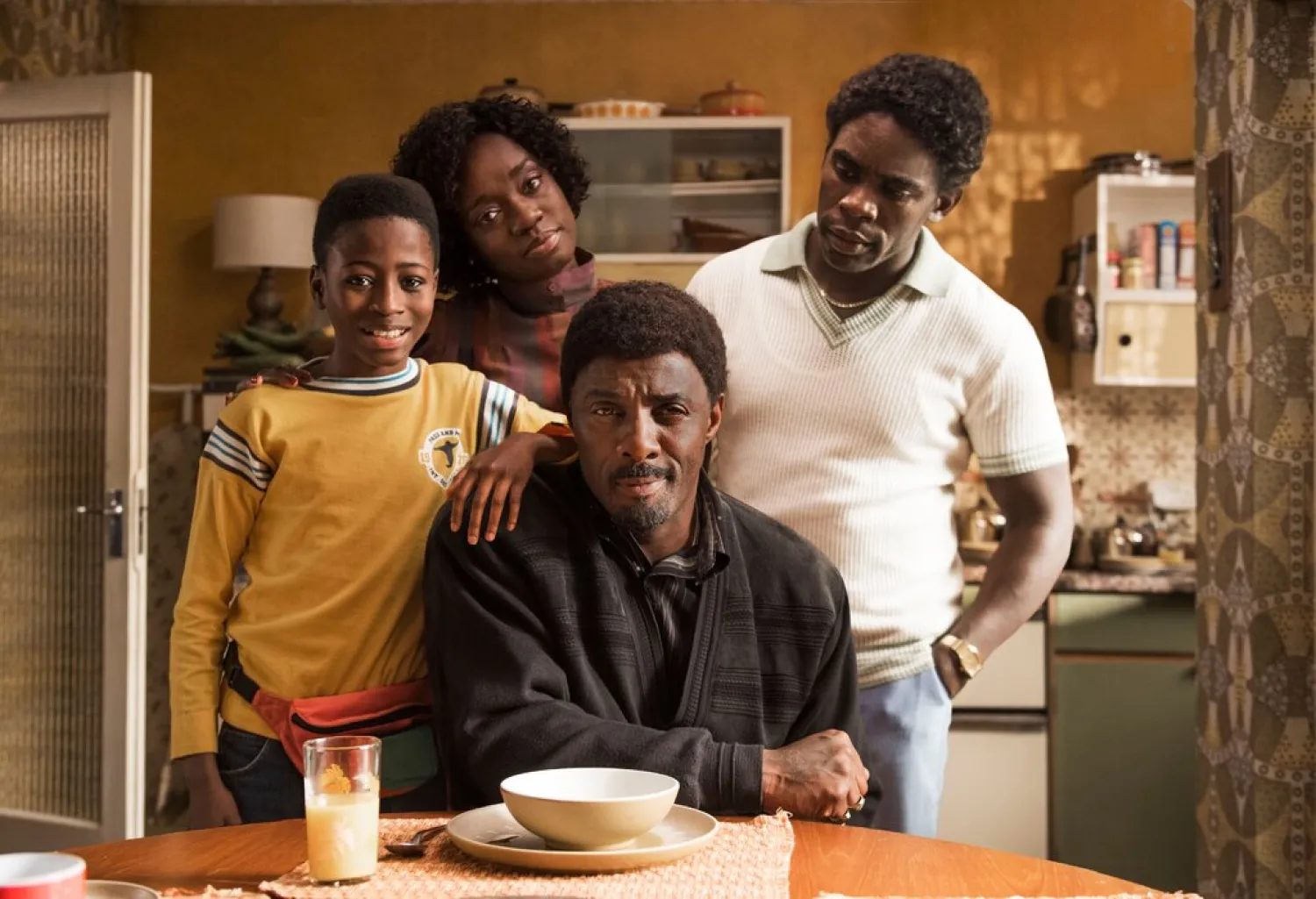
“In the Long Run” was inspired by Elba’s childhood in the Hackney borough of London. With, clockwise from left, Sammy Kamara, Madeline Appiah and Jimmy Akingbola. (Starz)
TT

Why Idris Elba Chose Comedy to Tell His Most Personal Story

“In the Long Run” was inspired by Elba’s childhood in the Hackney borough of London. With, clockwise from left, Sammy Kamara, Madeline Appiah and Jimmy Akingbola. (Starz)

“In the Long Run,” a sweetly comic series set in 1980s London, is based on the real-life childhood of an actor best known for intense dramas like “The Wire” and “Mandela: Long Walk to Freedom.”

“In the Long Run,” which just wrapped up its third season on Starz, is a comedy based on the actor Idris Elba’s childhood in the Holly Street Estate, a racially diverse public housing community in the Hackney borough of London. Set in the fictionalized Eastbridge Estate in the early ’80s, Elba, who created the series for Britain’s Sky One, plays Walter Easmon, who, like Elba’s actual father, Winston, immigrated to England from Sierra Leone and worked in a nearby American-owned car parts factory.

But this story of migration and integration isn’t told exclusively from the perspectives of Walter or his 13-year-old British-born son, Kobna (Sammy Kamara), who is based on Elba. Instead, the show is a broad, upbeat portrayal of a community, a story about interracial working-class Britons and West African immigrant families living together in London right after the infamous Brixton race riots in 1981, during the heyday of Prime Minister Margaret Thatcher’s conservatism.

Adding to this lively mix of characters is Agnes (Madeline Appiah), Walter’s Ghanaian stay-at-home wife turned community organizer and corporate secretary; his brother Valentine (Jimmy Akingbola), a former professional football player who arrives in England only to refuse a steady gig in the factory and become a local DJ; Walter’s white best friend and neighbor, the curmudgeonly yet cuddly Bagpipes (Bill Bailey); and Bagpipes’ peppy and entrepreneurial wife, Kirsty (Kellie Shirley). All three seasons are streaming on Starz, which picked up the show in 2019.

Elba is known mainly for more serious roles, both in TV shows like “The Wire” and “Luther” and in movies like “Beasts of No Nation,” “Thor” and “Mandela: Long Walk to Freedom”. But the gently comedic “In the Long Run” better reflects who he is as a person. It’s an intimate portrait of his childhood, made possible by his illustrious career.

It is also part of a string of recent works, produced by his company Green Door Pictures, that highlight his love of Black music. Like his real-life uncle and the character Valentine, Elba is also a DJ, who as DJ Big Driis spun records at the wedding reception of Prince Harry and Meghan Markle, in 2018, and at Coachella in 2019.

Elba’s directorial debut, the 2019 crime drama “Yardie,” follows its main character, a Jamaican drug courier named D (Aml Ameen), as he moves to London to avenge the murder of his brother, a DJ who died trying to unite warring gangs with his music. That same year, Elba starred in “Turn Up Charlie,” a comedy series he created with Gary Reich about a down-on-his-luck British DJ who ends up taking care of his best friend’s 11-year-old white daughter, Gabrielle (Frankie Hervey).

Neither received much critical love, and Netflix canceled “Turn Up Charlie” after one season. (“He’s just not funny,” Mike Hale, a New York Times TV critic, wrote of Elba in his review.)

“In the Long Run,” however, debuted to plenty of praise in Britain in 2018. Elba is really funny in it and routinely cedes the spotlight to his dynamic co-stars, and the show shifts focus smoothly between sobering topics — racial profiling, gentrification, AIDS activism — and sillier ones, like Jheri curls, schoolboy crushes and missed DJ sets.

Currently in Australia filming George Miller’s “Three Thousand Years of Longing” with Tilda Swinton, Elba spoke in a video call last week about the cultural vibrancy of the African and Caribbean communities of 1980s London and why he, as a generally private person, wanted to see his parents’ love story on TV. These are edited excerpts from the conversation.

How did “In the Long Run” come about?
Just working backward, this show came to life as an idea about four years ago. I had this yearning to do some comedy, and since I’m considered a dramatic actor, the roles weren’t coming in. Kevin Hart was stealing all of them! So I just thought, I’ve got to do something to put myself in this marketplace. My kids think I’m funny; my family thinks I’m funny; let’s go for it. And because my dad was one of the funniest storytellers I had come across, I wanted to find a way to tell his story and honor my parents. It was just the three of us, my mom, my dad and me, and they came from West Africa to the UK with a whole bunch of lively stories and experiences. I wanted to harness our lives together into something relatable and turn their hardships and integration into the UK into stories that were lighthearted.

Many Americans first saw your comedic side when you played Michael Scott’s boss on “The Office.” Why did you choose comedy here to tell this very personal story? Do you really believe people don’t think you’re funny?
I had to write my own show to get some comedy! “The Office” was amazing, but essentially, my character wasn’t comedic. He was kind of like the tough guy. I find that a lot of the writing about Black culture tends to be about hardships, crime, or tends to have scenarios that feel worthy of a dramatic lens. And when people think about Africa, they tend to think in doom and gloom or stereotypes, which I am not keen to keep fueling. We don’t make light of the racism and adversities at the time on our show, but sometimes with comedy you can cover a bit more ground in a lighter way.

“In the Long Run” just finished its third season. How did your series anticipate some of the issues that “The Crown” and “Small Axe,” which are also set in 1980s Britain, explore? What unique perspective are you hoping to show about that time period?
When you think about the ’80s, you think about Margaret Thatcher but also neon lights and Jheri curls. It was definitely a time of incredible evolution and expansion. And it was also a real political narrowing in Britain that was undeniably Thatcher led. The show is about the life that spawned, fizzled and nurtured people my age underneath all of that.

But our lens is very specific to African, Caribbean and Asian cultures that were the majority in these council clusters, homes that were designed for low-income residents. Those homes were an incubator of life, and there’s a mountain of culture, politics, thinkers, books and people that were born in that era and in those communities that are coming to middle life now. As a kid born in the early ’70s who was a teenager in the ’80s, I look back at that era with fondness. “In the Long Run” is a love letter to that time period.

With “I May Destroy You” and “Bridgerton” doing so well, there seems to be new excitement for shows about Black British life here in the United States. Do you think it is a trend or a transformation?
Over the last 10 years in the UK, there have been real strides to put a lens on Black culture in a dramatic way. We’ve seen lots of young writers and producers coming out and telling their stories, and then you’ve got people like Steve McQueen who’s telling these big stories, me telling another story in “Yardie.” I think that in general, everyone’s lenses are starting to widen out. I’m so excited that there is an appetite for UK Black cultures in a way that penetrates the world. I also want to see the same for French, German or Belgian shows because these are also places where Black people migrated from Africa or the Caribbean. We’re everywhere.

Music is a big part of the show, and in each episode a teenage boy suddenly breaks into an R&B song right in the middle of a scene. Where did that idea come from?
You’re talking about the singing boy? He is a texture that I distinctly remember from growing up in the Holly Street Estate — these sprawling projects in Hackney that on one side had the tower blocks where we lived, and on the other side were the lower flats that were notorious for crime and gangsters. My mom used to hate me going down there, but every time I went there to see my friends, there was always someone singing. I never knew who he was, but it was a kid who had a wicked voice, or just could rap. And he would just sing out of his window and was like a peace siren. When he was singing, there were no issues in the hood. So in the show, I wanted it to be a small character and part of the fabric of how I remember what was going on back then. Just a lovely memory.

The New York Times


Taylor Swift Bags Best-selling Artist of 2025 Award

FILE PHOTO: Taylor Swift poses at the red carpet during the 67th Annual Grammy Awards in Los Angeles, California, US, February 2, 2025. REUTERS/Daniel Cole/File Photo
TT

Taylor Swift Bags Best-selling Artist of 2025 Award

FILE PHOTO: Taylor Swift poses at the red carpet during the 67th Annual Grammy Awards in Los Angeles, California, US, February 2, 2025. REUTERS/Daniel Cole/File Photo

US pop star Taylor Swift was crowned the biggest-selling global artist of 2025, industry body IFPI announced Wednesday, the fourth consecutive year and sixth time she has claimed its annual prize.

The 36-year-old's success was turbo-charged by the October release of her latest album, "The Life of a Showgirl", which set several streaming records, as well as the release of a docuseries about her record-breaking The Eras tour.

"2025 was another landmark year (for Swift), driven by exceptional worldwide engagement across streaming, physical and digital formats with the release of her 12th album ... and the documentary of her tour," IFPI said.

The body, which represents the recorded music industry worldwide, noted Swift had now won its top annual artist prize as many times as all other artists combined over the past 10 years, AFP.

IFPI hands out the Global Artist of the Year Award after calculating an artist's or group's worldwide sales across streaming, downloads and physical music formats during the calendar year and covers their entire body of work.

Swift beat out Korean group Stray Kids, which came in second -- its highest-ever ranking and the third consecutive year in the global top five.

Fresh from his Super Bowl halftime show, Puerto Rican artist Bad Bunny placed fifth in the rankings, his sixth consecutive year in the chart.

American rapper Tyler, The Creator marked his first appearance on the chart, in 12th place, with IFPI noting he had "continued to generate strong vinyl sales across his catalogue".

Meanwhile Japanese rock band Mrs. Green Apple entered the rankings for the first time one place below him, following what IFPI called "the success of their anniversary album '10'".


Berlin Film Festival Rejects Accusation of Censorship on Gaza

Berlinale Festival Director Tricia Tuttle speaks during the Berlinale Camera award ceremony honoring British composer Max Richter during the 76th Berlin International Film Festival, in Berlin, Germany, 18 February 2026. (EPA)
TT

Berlin Film Festival Rejects Accusation of Censorship on Gaza

Berlinale Festival Director Tricia Tuttle speaks during the Berlinale Camera award ceremony honoring British composer Max Richter during the 76th Berlin International Film Festival, in Berlin, Germany, 18 February 2026. (EPA)

The director of the Berlin Film Festival on Wednesday rejected accusations from more than 80 film industry figures that the festival had helped censor artists who oppose Israel's actions in Gaza.

In an open letter published on Tuesday, Oscar-winning actors Javier Bardem and Tilda Swinton were among dozens who criticized the Berlinale's "silence" on the issue and said they were "dismayed" at its "involvement in censoring artists who oppose Israel's ongoing genocide against Palestinians in Gaza".

In an interview with Screen Daily, the Berlinale's director, Tricia Tuttle, said the festival backs "free speech within the bounds of German law".

She said she recognized that the letter came from "the depth of anger and frustration about the suffering of people in Gaza".

However, she rejected accusations of censorship, saying that the letter contained "misinformation" and "inaccurate claims about the Berlinale" made without evidence or anonymously.

The row over Gaza has dogged this year's edition of the festival since jury president Wim Wenders answered a question on the conflict by saying: "We cannot really enter the field of politics."

The comments prompted award-winning novelist Arundhati Roy, who had been due to present a restored version of a film she wrote, to withdraw from the festival.

Tuttle said the festival represents "lots of people who have different views, including lots of people who live in Germany who want a more complex understanding of Israel's positionality than maybe the rest of the world has right now".

German politicians have been largely supportive of Israel as Germany seeks to atone for the legacy of the Holocaust.

However, German public opinion has been more critical of Israeli actions in Gaza.

Commenting on the row to the Welt TV channel, German Culture Minister Wolfram Weimer defended Wenders and Tuttle from criticism, saying they were running the festival "in a very balanced way, very sensitively".

"Artists should not be told what to do when it comes to politics. The Berlinale is not an NGO with a camera and directors," Weimer said.

Gaza has frequently been a topic of controversy at the Berlinale in recent years.

In 2024, the festival's documentary award went to "No Other Land", which follows the dispossession of Palestinian communities in the Israeli-occupied West Bank.

German government officials criticized "one-sided" remarks about Gaza by the directors of that film and others at that year's awards ceremony.


Over 80 Berlin Film Festival Alumni Sign Open Letter Urging Organizers to Take Stance on Gaza 

12 February 2026, Berlin: President of the Berlinale jury Wim Wenders waves to the audience on the opening night of the 76th Berlin International Film Festival, before the premiere of the opening film "No Good Men" at the Berlinale Palast. (dpa)
TT

Over 80 Berlin Film Festival Alumni Sign Open Letter Urging Organizers to Take Stance on Gaza 

12 February 2026, Berlin: President of the Berlinale jury Wim Wenders waves to the audience on the opening night of the 76th Berlin International Film Festival, before the premiere of the opening film "No Good Men" at the Berlinale Palast. (dpa)

More than 80 actors, directors and other ‌artists who have taken part in the Berlin Film Festival, including Tilda Swinton and Javier Bardem, signed an open letter to the organizers published on Tuesday calling for them to take a clear stance on Israel's war in Gaza.

"We call on the Berlinale to fulfil its moral duty and clearly state its opposition to Israel's genocide, crimes against humanity and war crimes against Palestinians," said the open letter, which was published in full in entertainment industry magazine Variety.

Multiple human rights experts, scholars and a UN inquiry say Israel's assault on Gaza amounts to genocide. Israel calls its actions self-defense after Hamas' October 2023 attack on Israel.

"We are appalled by Berlinale's institutional silence," ‌said the letter, which ‌was also signed by actors Adam McKay, Alia Shawkat and ‌Brian ⁠Cox, and director ⁠Mike Leigh.

It said organizers had not met demands to issue a statement affirming Palestinians' right to life and committing to uphold artists' right to speak out on the issue.

"This is the least it can - and should - do," the letter said.

The festival did not immediately respond to an emailed request for comment.

THE MOST POLITICAL FESTIVAL

The Berlin Film Festival is considered the most political of its peers, Venice and Cannes, and ⁠prides itself on showing cinema from under-represented communities and young ‌talent. However, it has been repeatedly criticized by pro-Palestinian activists ‌for not taking a stand on Gaza, in contrast to the war in Ukraine ‌and the situation in Iran.

Calls have also previously been made for the ‌entertainment industry to take a stance on Gaza.

Last year, over 5,000 actors, entertainers, and producers, including some Hollywood stars, signed a pledge to not work with Israeli film institutions that they saw as being complicit in the abuse of Palestinians by Israel.

Paramount studio later condemned that ‌pledge and said it did not agree with such efforts.

ROY PULLS OUT

Tuesday's letter also condemned statements by this year's ⁠jury president, German director ⁠Wim Wenders, that filmmakers should stay out of politics, writing: "You cannot separate one from the other."

Wenders' comments prompted Indian novelist Arundhati Roy, winner of the Booker Prize in 1997 for her novel "The God of Small Things", to pull out of the festival earlier this week.

Roy, who had been due to present "In Which Annie Gives It Those Ones", a 1989 film which she wrote, in the Berlinale's Classics section, characterized Wenders' comments as "unconscionable."

In response, festival director Tricia Tuttle issued a note on Saturday defending artists' decision not to comment on political issues.

"People have called for free speech at the Berlinale. Free speech is happening at the Berlinale," she said.

"But increasingly, filmmakers are expected to answer any question put to them," she wrote, and are criticized if they do not answer, or answer "and we do not like what they say."
