

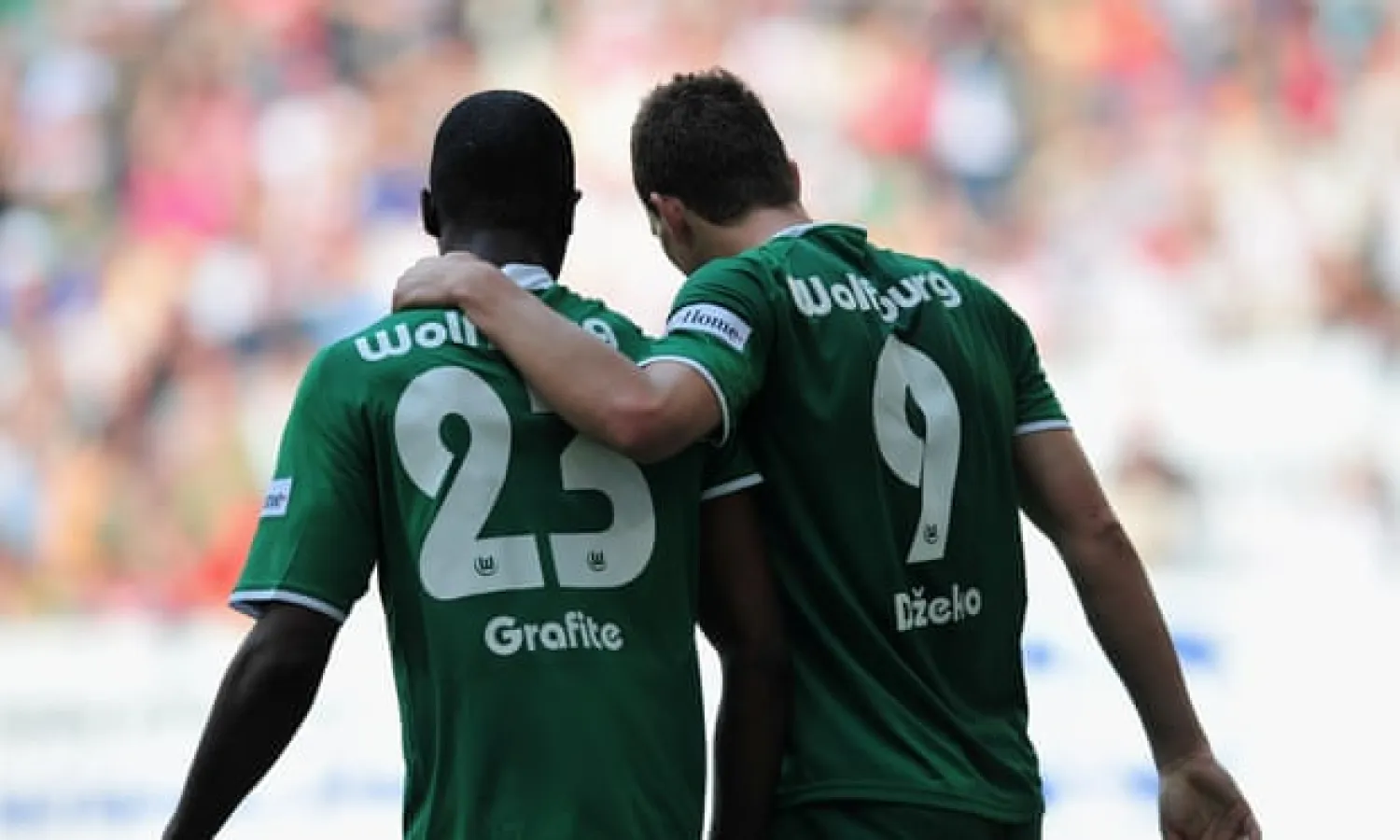

Edin Dzeko and Grafite: The Last of the Bundesliga's Great Strike Partnerships

Edin Dzeko and Grafite scored 68% of Wolfsburg’s goals when they won the Bundesliga in 2008-09. Photograph: Stuart Franklin/Bongarts/Getty Images
TT

Edin Dzeko and Grafite: The Last of the Bundesliga's Great Strike Partnerships

Edin Dzeko and Grafite scored 68% of Wolfsburg’s goals when they won the Bundesliga in 2008-09. Photograph: Stuart Franklin/Bongarts/Getty Images

Now that league titles have become a mandatory requirement at Bayern Munich, Robert Lewandowski has turned his attention to breaking records. He recently became the first player to score more than 20 goals in the first half of a Bundesliga season and he is now third on the league’s all-time list of scorers, only a handful of goals away from Klaus Fischer in second place. Whether Lewandowski sticks around long enough to surpass Gerd Müller as the most prolific striker in Bundesliga history remains to be seen, but he has his sights set on breaking Müller’s record of 40 league goals in a season, set back in 1971-72. Lewandowski came close last season, with 34 goals, and he has already scored 24 this time around.

Not only is Müller the league’s most prolific goalscorer but, for a long time, he was also one half of its highest-scoring strike partnership. That record was broken 12 years ago – not by Lewandowski, or even a Bayern Munich player, but by a Bosnian and a Brazilian: Edin Džeko and Edinaldo Batista Libânio, better known as Grafite, who enjoyed a magical season together at Wolfsburg.

Felix Magath signed the strikers at the start of the 2007-08 season for a combined cost of €10m, with Džeko arriving from FK Teplice in the Czech league and Grafite following soon after from Le Mans in Ligue 1. Magath was not only the new Wolfsburg manager, but he also took on the roles of CEO and director of football, giving him carte blanche in the transfer market. He took full advantage and made a host of signings. The changes paid off and Wolfsburg reached the semi-finals of the DFB Pokal and finished fifth in the league, an impressive 10 places higher than the previous season. The strike duo scored 19 goals in their maiden campaign at Wolfsburg. An impressive return, but hardly a sign of what was to come.

Magath once again pulled out his chequebook in the summer of 2008, signing Dzeko’s international teammate Zvjezdan Misimovic from newly relegated FC Nürnberg for just €4m. The aim was to take a run at reigning champions Bayern Munich, whose forward line included Miroslav Klose, Lukas Podolski, Franck Ribéry and Luca Toni. Bayern had undergone significant changes themselves, with Ottmar Hitzfield leaving to coach Switzerland at Euro 2008 and club captain Oliver Kahn hanging up his gloves. Their respective replacements, Jürgen Klinsmann and Michael Rensing, lacked the experience of their predecessors and would struggle.

Wolfsburg did not exactly hit the ground running. They won just three of their first eight matches before suffering a 4-2 defeat at the Allianz Arena against Bayern. Džeko and Grafite scored just six goals between them in those nine matches, two of which came in Munich. Their form remained inconsistent as autumn gave way to winter, but at least Grafite found his touch, ending the first half the season with 11 league goals. Džeko, on the other hand, had started slowly.

At the halfway point of the season, Wolfsburg were the picture of mid-table mediocrity in ninth and all the talk was about Ralf Rangnick’s high-flying Hoffenheim, who had excelled in their first Bundesliga campaign, outscoring the rest of the league thanks to goals from Demba Ba and Dzeko’s Bosnia strike partner, Vedad Ibisevic. However, the winter break curtailed their momentum and, to make matters worse, a serious knee injury to Ibisevic in a friendly ruled him out for the rest of the season.

Bayern Munich were second in the table at the midway point but not all was well at the club. Klinsmann was trying to implement conceptual changes on and off the pitch, and not everything was going smoothly. His team won just one of their first five league games after Christmas. Wolfsburg were on an altogether different trajectory. After a draw at FC Köln, with Grafite on the scoresheet again, they won 10 league games on the bounce. Dzeko was firing in the goals. By the time Bayern Munich came to Wolfsburg at the beginning of April, Grafite and Dzeko had 31 league goals between them. At least one of them had made it on to the scoresheet in every league game since the turn of the year.

The match between Wolfsburg and Bayern in April was not exactly a title shootout but it was set up nicely. The teams were level on points with identical goal difference. As with many much-hyped matches, it took a while to get going and the sides went in at half-time 1-1. What happened in the second half not only set up Wolfsburg for the title and Klinsmann for the sack, but it also lit the fuse on an explosive finish to the season for Wolfburg’s front two. Dzeko hit a three-minute brace to put Wolfsburg 3-1 up with 20 minutes to play. And then Grafite took the stage.

His first goal put the victory beyond doubt. His second brought the house down. Grafite took a pass on the left, about 40 yards from Bayern’s goal and ran at the right-back Andreas Ottl, twisting him one way and then the other, before jinking between him and Christian Lell and heading for Rensing’s six-yard line. As Rensing rushed out to Grafite, the Bayern centre-back Breno raced to cover the goal behind his keeper. Grafite shifted the ball away from Rensing’s grasp, leaving the keeper stranded. Philipp Lahm and Breno rushed to close him down but, before they could get near him, he did what neither of them were expecting.

He turned away from the goal, put his head down and backheeled the ball delicately, putting just enough pace on his shot for it to evade the three defenders between him and the goal. The ball rolled in so slowly that Rensing was already back on his feet, staring wide-eyed back towards his own goal as Lell threw himself after the ball. As the back four looked at each other and the ground in disbelief, Grafite raced off towards the home fans and into Wolfsburg folklore.

If anyone had doubted Wolfsburg’s title credentials, this game and that goal made it seem almost inevitable. Wolfsburg ended the weekend top of the table and didn’t budge. Grafite and Džeko were not done either. They went on to score 16 goals in the last five games of the season, Džeko hitting two hat-tricks and a brace.

This all made for a breathtaking second half of the season. Magath’s team won 14 of their 17 league games, scoring 45 goals. Grafite and Džeko provided 37 of them. By the time Wolfsburg had smashed Werder Bremen 5-1 at home to win their first, and so far only league title, the prolific double act had cemented themselves as the league’s highest-scoring strike partnership ever, going one better than the 53 goals scored by Müller and Uli Hoeness for Bayern Munich in 1973. Not only that, but Grafite finished the league’s top scorer with 28 goals, just two ahead of Džeko, who had scored 21 since Christmas. If that was the icing on the cake, then the cherry on top was Grafite’s wonder goal against Bayern being voted the best of the season.

Even amid the celebrations it was hard to imagine the stars aligning in such a way again. Magath left for Schalke at the end of the season and, despite a largely unchanged squad, the team reverted back to hovering around mid-table before battling against relegation a season later.

As for the front two, they had reached a fork in the road. Dzeko kicked on, succeeding Grafite as the league’s top scorer in 2009-10, and soon established himself as one of the most sought-after strikers in Europe. Grafite, on the other hand, had enjoyed his landmark season and his influence began to wane. Two years after romping to the title, Wolfsburg clung on to their Bundesliga status with a last-day victory, finishing just one place above the relegation play-off.

Dzeko had outgrown the struggling team and moved to Manchester City for £27m in January 2011, becoming the most expensive transfer out of the Bundesliga. Grafite followed him out of the club at the end of the season, joining Al-Ahli on a two-year contract. He racked up the goals in the Middle East before returning to Brazil to finish his career, retiring in 2018. Dzeko and Grafite were heading in different directions when they met at Wolfsburg. Still, for a brief period, the combination of Grafite’s nous, skill and eye for goal, alongside Dzeko’s power and raw ability made them unstoppable.

As remarkable as Lewandowski has been in the Bundesliga over the last decade, his one-man pursuit of goalscoring records also highlights the relative dearth of strike partnerships, largely down to tactical and formation shifts. While Thomas Müller, Serge Gnabry, Leroy Sané and Kingsley Coman chip in with goals, none of them really operates as Lewandowski’s strike partner. Müller comes closest, with 11 goals this season. He and Lewandowski may surpass Grafite and Džeko’s total of 54 goals, but the fact that the Wolfsburg duo were a real partnership somehow makes it more special. Lewandowski could yet leave the Bundesliga as its greatest ever goalscorer, but what Dzeko and Grafite achieved with Wolfsburg may never be surpassed.

The Guardian Sport


Sinner Sees off Popyrin to Reach Doha Quarters

 Italy's Jannik Sinner greets the fans after defeating Australia's Alexei Popyrin in their men's singles match at the Qatar Open tennis tournament in Doha on February 18, 2026. (AFP)
Italy's Jannik Sinner greets the fans after defeating Australia's Alexei Popyrin in their men's singles match at the Qatar Open tennis tournament in Doha on February 18, 2026. (AFP)
TT

Sinner Sees off Popyrin to Reach Doha Quarters

 Italy's Jannik Sinner greets the fans after defeating Australia's Alexei Popyrin in their men's singles match at the Qatar Open tennis tournament in Doha on February 18, 2026. (AFP)
Italy's Jannik Sinner greets the fans after defeating Australia's Alexei Popyrin in their men's singles match at the Qatar Open tennis tournament in Doha on February 18, 2026. (AFP)

Jannik Sinner powered past Alexei Popyrin in straight sets on Wednesday to reach the last eight of the Qatar Open and edge closer to a possible final meeting with Carlos Alcaraz.

The Italian, playing his first tournament since losing to Novak Djokovic in the Australian Open semi-finals last month, eased to a 6-3, 7-5 second-round win in Doha.

Sinner will play Jakub Mensik in Thursday's quarter-finals.

Australian world number 53 Popyrin battled gamely but failed to create a break-point opportunity against his clinical opponent.

Sinner dropped just three points on serve in an excellent first set which he took courtesy of a break in the sixth game.

Popyrin fought hard in the second but could not force a tie-break as Sinner broke to grab a 6-5 lead before confidently serving it out.

World number one Alcaraz takes on Frenchman Valentin Royer in his second-round match later.


Ukraine's Officials to Boycott Paralympics over Russian Flag Decision

Milano Cortina 2026 Winter Olympics - Skeleton - Interview with Ukraine Youth and Sports minister Matvii Bidnyi - N H Hotel, Milan, Italy - February 12, 2026 Ukraine Youth and Sports Minister Matvii Bidnyi speaks after the disqualification of Ukrainian skeleton racer Vladyslav Heraskevych from the Winter Games. REUTERS/Kevin Coombs
TT

Ukraine's Officials to Boycott Paralympics over Russian Flag Decision

Milano Cortina 2026 Winter Olympics - Skeleton - Interview with Ukraine Youth and Sports minister Matvii Bidnyi - N H Hotel, Milan, Italy - February 12, 2026 Ukraine Youth and Sports Minister Matvii Bidnyi speaks after the disqualification of Ukrainian skeleton racer Vladyslav Heraskevych from the Winter Games. REUTERS/Kevin Coombs

Ukrainian officials will boycott the Paralympic Winter Games, Kyiv said Wednesday, after the International Paralympic Committee allowed Russian athletes to compete under their national flag.

Ukraine also urged other countries to shun next month's Opening Ceremony in Verona on March 6, in part of a growing standoff between Kyiv and international sporting federations four years after Russia invaded.

Six Russians and four Belarusians will be allowed to take part under their own flags at the Milan-Cortina Paralympics rather than as neutral athletes, the Games' governing body confirmed to AFP on Tuesday.

Russia has been mostly banned from international sport since Moscow invaded Ukraine. The IPC's decision triggered fury in Ukraine.

Ukraine's sports minister Matviy Bidny called the decision "outrageous", and accused Russia and Belarus of turning "sport into a tool of war, lies, and contempt."

"Ukrainian public officials will not attend the Paralympic Games. We will not be present at the opening ceremony," he said on social media.

"We will not take part in any other official Paralympic events," he added.

Ukrainian Foreign Minister Andriy Sybiga said he had instructed Kyiv's ambassadors to urge other countries to also shun the opening ceremony.

"Allowing the flags of aggressor states to be raised at the Paralympic Games while Russia's war against Ukraine rages on is wrong -- morally and politically," Sybiga said on social media.

The EU's sports commissioner Glenn Micallef said he would also skip the opening ceremony.

- Kyiv demands apology -

The IPC's decision comes amid already heightened tensions between Ukraine and the International Olympic Committee, overseeing the Winter Olympics currently underway.

The IOC banned Ukrainian skeleton racer Vladyslav Heraskevych for refusing to ditch a helmet depicting victims of the war with Russia.

Ukraine was further angered that the woman chosen to carry the "Ukraine" name card and lead its team out during the Opening Ceremony of the Games was revealed to be Russian.

Media reports called the woman an anti-Kremlin Russian woman living in Milan for years.

"Picking a Russian person to carry the nameplate is despicable," Kyiv's foreign ministry spokesman Georgiy Tykhy said at a briefing in response to a question by AFP.

He called it a "severe violation of the Olympic Charter" and demanded an apology.

And Kyiv also riled earlier this month at FIFA boss Gianni Infantino saying he believed it was time to reinstate Russia in international football.

- 'War, lies and contempt' -

Valeriy Sushkevych, president of the Ukrainian Paralympic Committee told AFP on Tuesday that Kyiv's athletes would not boycott the Paralympics.

Ukraine traditionally performs strongly at the Winter Paralympics, coming second in the medals table four years ago in Beijing.

"If we do not go, it would mean allowing Putin to claim a victory over Ukrainian Paralympians and over Ukraine by excluding us from the Games," said the 71-year-old in an interview.

"That will not happen!"

Russia was awarded two slots in alpine skiing, two in cross-country skiing and two in snowboarding. The four Belarusian slots are all in cross-country skiing.

The International Paralympic Committee (IPC) said earlier those athletes would be "treated like (those from) any other country".

The IPC unexpectedly lifted its suspension on Russian and Belarusian athletes at the organisation's general assembly in September.


'Not Here for Medals', Nakai Says after Leading Japanese Charge at Olympics

Ami Nakai of Japan competes during the women's short program figure skating at the 2026 Winter Olympics, in Milan, Italy, Tuesday, Feb. 17, 2026. (AP Photo/Ashley Landis)
TT

'Not Here for Medals', Nakai Says after Leading Japanese Charge at Olympics

Ami Nakai of Japan competes during the women's short program figure skating at the 2026 Winter Olympics, in Milan, Italy, Tuesday, Feb. 17, 2026. (AP Photo/Ashley Landis)

Ami Nakai entered her first Olympics insisting she was not here for medals — but after the short program at the Milano Cortina Games, the 17-year-old figure skater found herself at the top, ahead of national icon Kaori Sakamoto and rising star Mone Chiba.

Japan finished first, second, and fourth on Tuesday, cementing a formidable presence heading into the free skate on Thursday. American Alysa Liu finished third.

Nakai's clean, confident skate was anchored by a soaring triple Axel. She approached the moment with an ease unusual for an Olympic debut.

"I'm not here at this Olympics with the goal of achieving a high result, I'm really looking forward to enjoying this Olympics as much as I can, till the very last moment," she said.

"Since this is my first Olympics, I had nothing to lose, and that mindset definitely translated into my results," she said.

Her carefree confidence has unexpectedly put her in medal contention, though she cannot imagine herself surpassing Sakamoto, the three-time world champion who is skating the final chapter of her competitive career. Nakai scored 78.71 points in the short program, ahead of Sakamoto's 77.23.

"There's no way I stand a chance against Kaori right now," Nakai said. "I'm just enjoying these Olympics and trying my best."

Sakamoto, 25, who has said she will retire after these Games, is chasing the one accolade missing from her resume: Olympic gold.

Having already secured a bronze in Beijing in 2022 and team silvers in both Beijing and Milan, she now aims to cap her career with an individual title.

She delivered a polished short program to "Time to Say Goodbye," earning a standing ovation.

Sakamoto later said she managed her nerves well and felt satisfied, adding that having three Japanese skaters in the top four spots "really proves that Japan is getting stronger". She did not feel unnerved about finishing behind Nakai, who also bested her at the Grand Prix de France in October.

"I expected to be surpassed after she landed a triple Axel ... but the most important thing is how much I can concentrate on my own performance, do my best, stay focused for the free skate," she said.

Chiba placed fourth and said she felt energised heading into the free skate, especially after choosing to perform to music from the soundtrack of "Romeo and Juliet" in Italy.

"The rankings are really decided in the free program, so I'll just try to stay calm and focused in the free program and perform my own style without any mistakes," said the 20-year-old, widely regarded as the rising all-rounder whose steady ascent has made her one of Japan's most promising skaters.

All three skaters mentioned how seeing Japanese pair Riku Miura and Ryuichi Kihara deliver a stunning comeback, storming from fifth place after a shaky short program to capture Japan's first Olympic figure skating pairs gold medal, inspired them.

"I was really moved by Riku and Ryuichi last night," Chiba said. "The three of us girls talked about trying to live up to that standard."
