


Lebanon's COVID-19 Vaccine Drive Hit by Row over MPs' Queue-Jumping

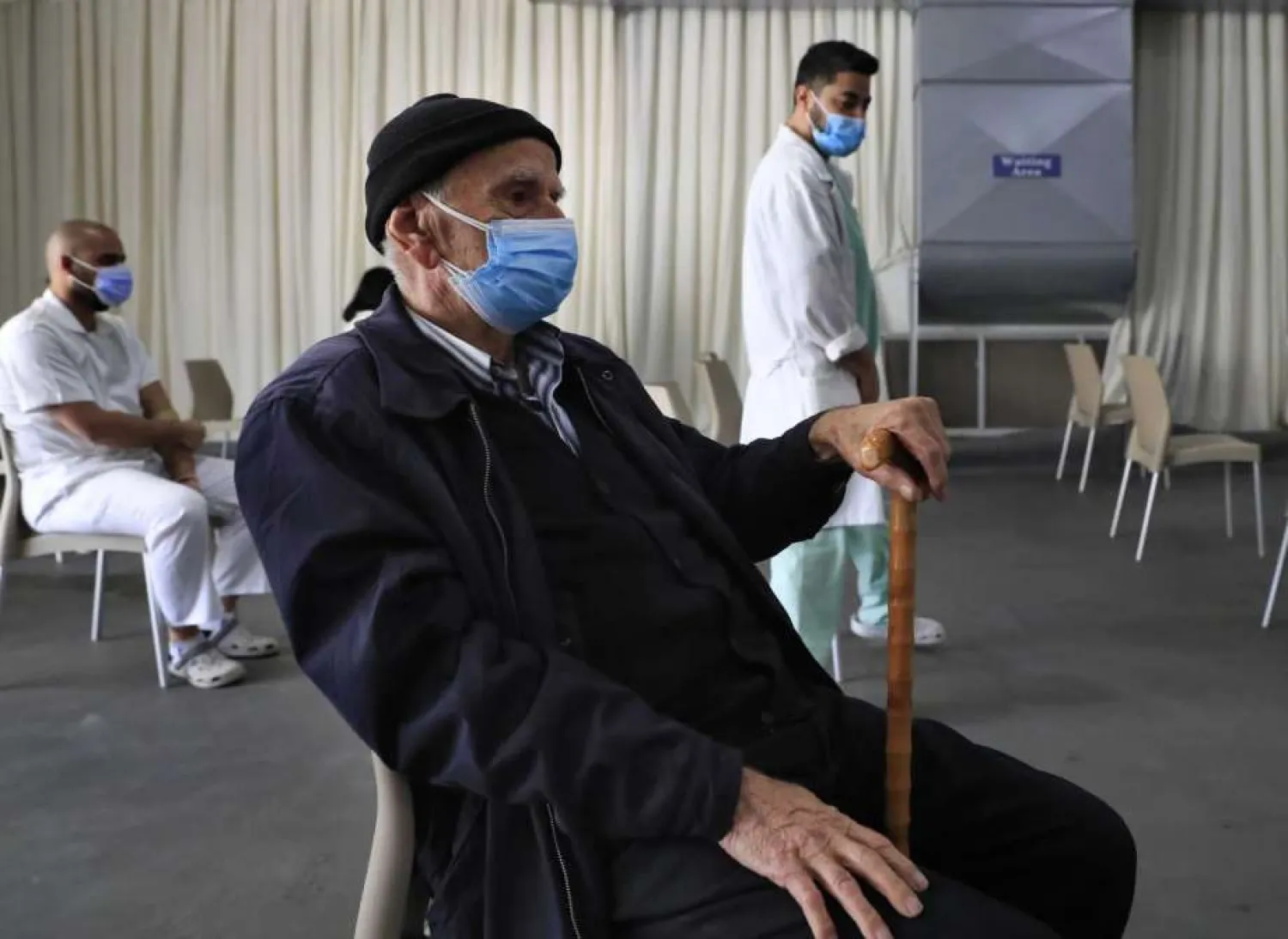
A man waits his turn to receive the Pfizer-BioNTech COVID-19 vaccine during a nationwide vaccination campaign, at the Saint George Hospital, in Beirut, Lebanon, Tuesday, Feb. 16, 2021. 7(AP Photo/Hussein Malla)
TT

Lebanon's COVID-19 Vaccine Drive Hit by Row over MPs' Queue-Jumping

A man waits his turn to receive the Pfizer-BioNTech COVID-19 vaccine during a nationwide vaccination campaign, at the Saint George Hospital, in Beirut, Lebanon, Tuesday, Feb. 16, 2021. 7(AP Photo/Hussein Malla)

A row over Lebanese lawmakers jumping the queue for COVID-19 vaccinations erupted on Tuesday with the World Bank threatening to pull its funding for the inoculation drive and human rights campaigners accusing authorities of mismanagement.

The spat broke out after a correspondent from the Thomson Reuters Foundation tweeted confirmation from parliament’s secretary general that lawmakers aged over 75 would get their shots in the legislature in Beirut on Tuesday.

That led the World Bank’s middle east regional head, Saroj Kumar Jha, to respond: “This is not in line with the national plan agreed with @WorldBank and we would record it breach of terms and conditions agreed with us for fair and equitable vaccination.”

He added that the lender “may suspend financing for vaccines and support for COVID19 response across Lebanon!!” if the violation was confirmed.

“I appeal to all, I mean all, regardless of your position, to please register and wait for your turn.”

The health ministry did not immediately respond to a request for comment.

Last month, the bank agreed to provide Lebanon with a $34 million loan to fund vaccinations for roughly a third of the country’s six million people, amid a surge in new COVID-19 cases that it said was exacerbating a deep economic crisis.

Lebanon kicked off vaccinations on Feb. 14, giving first priority to healthcare workers and the over-75s who registered on an online platform.

But in the first week of the roll-out, 40% of vaccination sites breached those regulations, according to the International Federation of Red Cross and Red Crescent Societies, which is monitoring the vaccine campaign along with the World Bank.

That raised fears of favoritism in a country that regularly ranks among the most corrupt in the world, and rights groups warned that Tuesday’s incident would further damage public confidence in the vaccination program and state institutions.

“Even before the COVID-19 pandemic and the COVID crisis, Lebanese public confidence in government institutions has been exceedingly low,” said Lama Fakih, a Beirut-based crisis and conflict director at Human Rights Watch.

“This has only declined given the mismanagement of this crisis,” she said.

‘What’s the big deal?’
A total of 16 MPs (members of parliament) and five parliamentary staff received their vaccines on Tuesday, said Secretary-General Adnan Daher.

He initially said there had been no violation of the program’s regulations, but later conceded that some of the group were in fact under 75 and therefore not in the top priority group.

One lawmaker, who asked not to be named, said several older current and former lawmakers, as well as administrative staff, were vaccinated in the parliament hall without media coverage.

“What's the big deal?” he said.

He said doses were sent last week to the Baabda palace for President Michel Aoun and others.

The president's office confirmed that Aoun, 86, got a shot as did his wife and 10 people from his close team. The statement said they were registered on the online vaccines platform without clarifying whether they were in the high-risk categories.

‘Grave infraction’
The head of the country’s COVID-19 vaccination committee, Abdel-Rahman Bizri, said earlier he would quit over the incident but later vowed to stay on to keep the inoculation program from unravelling.

He told a news conference the MPs’ queue-jumping was “a grave infraction that cannot be repeated”.

The lawmakers’ vaccinations also fueled concerns that vulnerable groups - such as thousands of migrant workers and a million refugees - might be left out.

“While (authorities) say they will cover everyone in Lebanon, plans in place will not make that happen,” Fakih said, noting that a government mandate to bring ID for vaccination could result in the exclusion of undocumented people.

Syrian refugees in Lebanon died from COVID-19 at a rate more than four times the national average, some 4.5% compared to around 1% nationally, according to UN data obtained exclusively by the Thomson Reuters Foundation.

With nine out of 10 refugees living in extreme poverty, a spokeswoman for the UN refugee agency (UNHCR) in Lebanon said fear of movement restrictions and other socio-economic considerations were likely to blame.

Lebanon has had one of the region’s highest infection rates, and ordinary people took to social media to express their anger and frustration over the pace of the vaccination program and Tuesday’s events in parliament.

Deputy parliament speaker Elie Ferzli, who is 71, tweeted that he got a shot.

Around the nation, outrage spread.

“My grandfather is an 85-year-old decent man suffering from heart problems. My grandfather is a priority and he still did not get the vaccine,” tweeted Jad al-Hamawi.

“What are you? Bunch of hypocrites. Selfish. Criminals.”

Pop star Elissa tweeted: “Shame on this country and its leaders ... Are these MPs more important than the people?”

Another Lebanese, Jonathan Dagher, wrote on Facebook: “As our loved ones gasp for oxygen in COVID-19 wards, MPs cut the line today to take the vaccine.”

“My 92-year-old grandpa, who uses an oxygen machine, till date didn’t receive an sms and they’re getting theirs! Messed up!” Twitter user Jessica Kassab wrote.

Even before news of the lawmakers broke, the head of Lebanon's doctors syndicate, Charaf Abou Charaf, warned on Tuesday of “many violations”. He said people who were neither registered nor high-risk had received vaccines while some medical workers and elderly Lebanese still waited.



Egypt’s Prime Minister and FM Head to Washington for Trump Peace Council Meeting

Egyptian Foreign Minister Badr Abdelatty speaks during a joint press conference with Kenyan Prime Cabinet Secretary/Cabinet Secretary for Foreign Diaspora Affairs Musalia Mudavadi in Nairobi, Kenya, Monday, Feb. 16, 2026. (AP)
TT

Egypt’s Prime Minister and FM Head to Washington for Trump Peace Council Meeting

Egyptian Foreign Minister Badr Abdelatty speaks during a joint press conference with Kenyan Prime Cabinet Secretary/Cabinet Secretary for Foreign Diaspora Affairs Musalia Mudavadi in Nairobi, Kenya, Monday, Feb. 16, 2026. (AP)

Egypt's Prime Minister Mostafa Madbouly headed to Washington on Tuesday ‌to ‌participate in ‌the inaugural ⁠meeting of a "Board of Peace" established by US President Donald ⁠Trump, the ‌cabinet ‌said.

Madbouly is ‌attending ‌on behalf of President Abdel ‌Fattah al-Sisi and is accompanied by ⁠Foreign ⁠Minister Badr Abdelatty.

Foreign Minister Gideon Saar will represent Israel at the inaugural meeting, his office said on Tuesday.

Hamas, meanwhile, called on the newly-formed board to pressure Israel to halt what it described as ongoing violations of the ceasefire in Gaza.

The Board of Peace, of which Trump is the chairman, was initially designed to oversee the Gaza truce and the territory's reconstruction after the war between Hamas and Israel.

But its purpose has since morphed into resolving all sorts of international conflicts, triggering fears the US president wants to create a rival to the United Nations.

Saar will first attend a ministerial level UN Security Council meeting in New York on Wednesday, and on Thursday he "will represent Israel at the inaugural session of the board, chaired by Trump in Washington DC, where he will present Israel's position", his office said in a statement.

It was initially reported that Prime Minister Benjamin Netanyahu might attend the gathering, but his office said last week that he would not.

Ahead of the meeting, Hamas spokesman Hazem Qassem told AFP that the Palestinian movement urged the board's members "to take serious action to compel the Israeli occupation to stop its violations in Gaza".

"The war of genocide against the Strip is still ongoing -- through killing, displacement, siege, and starvation -- which have not stopped until this very moment," he added.

He also called for the board to work to support the newly formed Palestinian technocratic committee meant to oversee the day-to-day governance of post-war Gaza "so that relief and reconstruction efforts in Gaza can commence".

Announcing the creation of the board in January, Trump also unveiled plans to establish a "Gaza Executive Board" operating under the body.

The executive board would include Turkish Foreign Minister Hakan Fidan and Qatari diplomat Ali Al-Thawadi.

Netanyahu has strongly objected to their inclusion.

Since Trump launched his "Board of Peace" at the World Economic Forum in Davos in January, at least 19 countries have signed its founding charter.


Palestinian Child Dies After Stepping on Mine in West Bank

Israeli troops conduct a military raid in the village of Al-Yamoun, west of Jenin, West Bank, 17 February 2026. (EPA)
TT

Palestinian Child Dies After Stepping on Mine in West Bank

Israeli troops conduct a military raid in the village of Al-Yamoun, west of Jenin, West Bank, 17 February 2026. (EPA)

A Palestinian child died after stepping on a mine near an Israeli military camp in the occupied West Bank on Tuesday, the Palestinian Red Crescent said, with an Israeli defense ministry source confirming the death.

"Our crews received the body of a 13-year-old child who was killed after a mine exploded in one of the old camps in Jiftlik in the northern Jordan Valley," the Red Crescent said in a statement.

A source at COGAT, the Israeli defense ministry's agency in charge of civilian matters in the Palestinian territories, confirmed the death to AFP and identified the boy as Mohammed Abu Dalah, from the village of Jiftlik.

Israel's military had previously said in a statement that three Palestinians were injured "as a result of playing with unexploded ordnance", without specifying their ages.

It added that the area of the incident, Tirzah, is "a military camp in the area of the Jordan Valley", near Jiftlik and close to the Jordanian border.

"This area is a live-fire zone and entry into it is prohibited," the military said.

Jiftlik village council head Ahmad Ghawanmeh told AFP that three children, the oldest of whom was 16, were collecting herbs near the military base when they detonated a mine.

Jiftlik as well as the nearby Tirzah base are located in the Palestinian territory's Area C, which falls under direct Israeli control.

Israel has occupied the West Bank since 1967.

Much of the area near the border with Jordan -- which Israel signed a peace deal with in 1994 -- remains mined.

In January, Israel's defense ministry said it had begun demining the border area as part of construction works for a new barrier it says aims to stem weapons smuggling.


Hezbollah Rejects Disarmament Plan and Government’s Four-Month Timeline

29 July 2024, Iran, Tehran: Then Hezbollah deputy leader Sheikh Naim Qassem is pictured during a meeting in Tehran. (Iranian Presidency/dpa)
TT

Hezbollah Rejects Disarmament Plan and Government’s Four-Month Timeline

29 July 2024, Iran, Tehran: Then Hezbollah deputy leader Sheikh Naim Qassem is pictured during a meeting in Tehran. (Iranian Presidency/dpa)

Hezbollah rejected on Tuesday the Lebanese government's decision to grant the army at least four months to advance the second phase of a nationwide disarmament plan, saying it would not accept what it sees as a move serving Israel.

Lebanon's cabinet tasked the army in August 2025 with drawing up and beginning to implement a plan to bring all armed groups' weapons under state control, a bid aimed primarily at disarming Hezbollah after its devastating ‌war with ‌Israel in 2024.

In September 2025 the cabinet formally ‌welcomed ⁠the army's plan to ⁠disarm the Iran-backed Shiite party, although it did not set a clear timeframe and cautioned that the military's limited capabilities and ongoing Israeli strikes could hinder progress.

Hezbollah Secretary-General Sheikh Naim Qassem said in a speech on Monday that "what the Lebanese government is doing by focusing on disarmament is a major mistake because this issue serves the goals of Israeli ⁠aggression".

Lebanon's Information Minister Paul Morcos said during a press ‌conference late on Monday after ‌a cabinet meeting that the government had taken note of the army's monthly ‌report on its arms control plan that includes restricting weapons in ‌areas north of the Litani River up to the Awali River in Sidon, and granted it four months.

"The required time frame is four months, renewable depending on available capabilities, Israeli attacks and field obstacles,” he said.

Hezbollah lawmaker Hassan ‌Fadlallah said, "we cannot be lenient," signaling the group's rejection of the timeline and the broader approach to ⁠the issue of ⁠its weapons.

Hezbollah has rejected the disarmament effort as a misstep while Israel continues to target Lebanon, and Shiite ministers walked out of the cabinet session in protest.

Israel has said Hezbollah's disarmament is a security priority, arguing that the group's weapons outside Lebanese state control pose a direct threat to its security.

Israeli officials say any disarmament plan must be fully and effectively implemented, especially in areas close to the border, and that continued Hezbollah military activity constitutes a violation of relevant international resolutions.

Israel has also said it will continue what it describes as action to prevent the entrenchment or arming of hostile actors in Lebanon until cross-border threats are eliminated.