


Former US Official: Trump Administration Tried to Engage Houthis before their Terror Designation

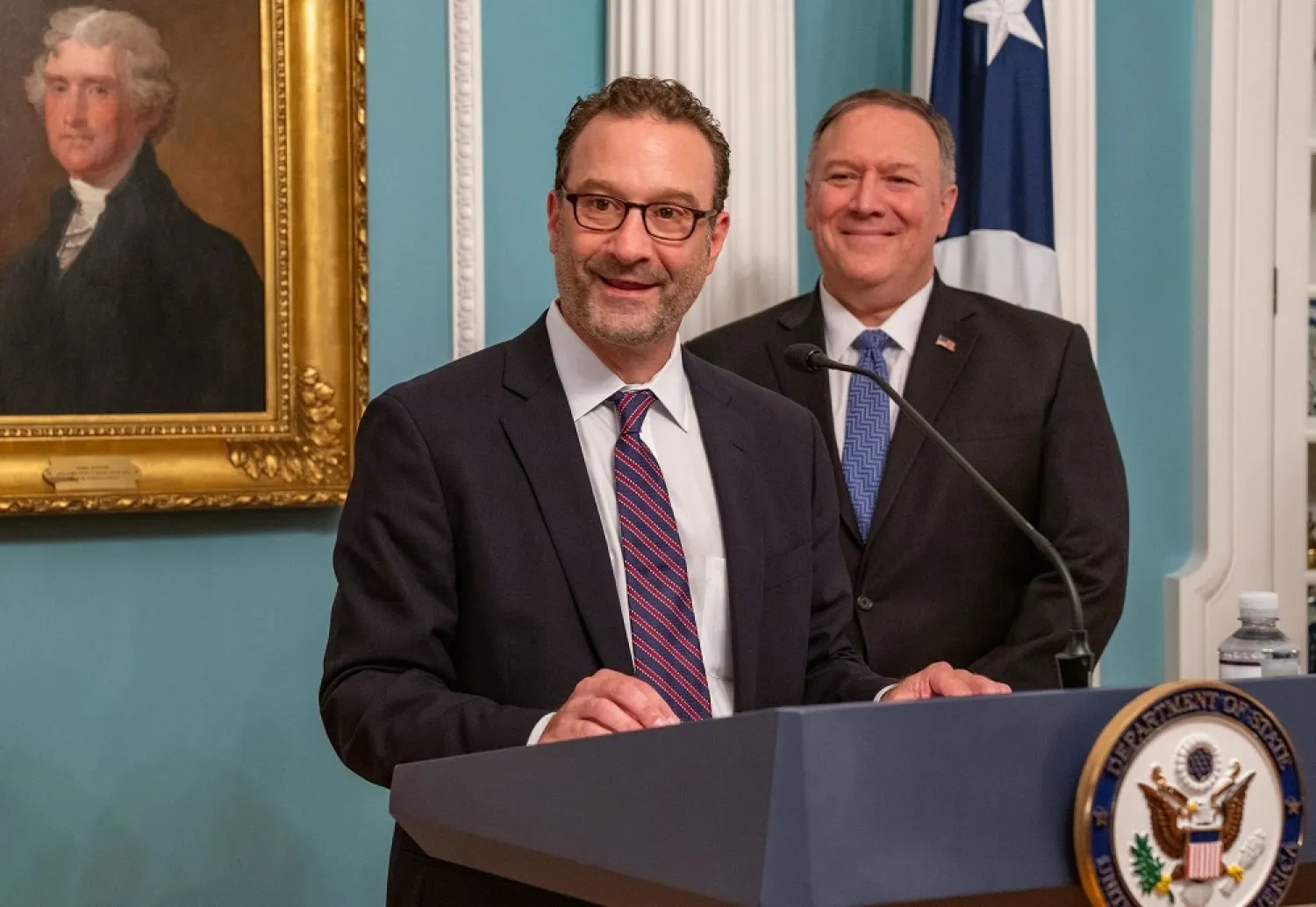
Former Assistant Secretary of State for Near Eastern Affairs David Schenker and ex-Secretary of State Mike Pompeo. (US Department of State)
TT

Former US Official: Trump Administration Tried to Engage Houthis before their Terror Designation

Former Assistant Secretary of State for Near Eastern Affairs David Schenker and ex-Secretary of State Mike Pompeo. (US Department of State)

Former US assistant secretary of Near Eastern Affairs, David Schenker revealed that the administration of ex-President Donald Trump had tried to hold direct talks with the Iran-backed Houthis in Yemen before designating the militias a terrorist in January.

In an interview with Robert Sotloff for the Washington Institute, he said that the administration tried to hold the talks with the Houthis, through an Omani mediator, in late December 2020. The militias, however, rejected the proposal.

“As to the controversy surrounding the designation of the Houthis, as of December 30, [then US Secretary of State Mike] Pompeo was I believe still considering the designation and was engaged with the ngo community,” which expressed concern over the designation, said Schenker.

“We felt we could mitigate the impact of the sanctions through waivers. The US Department of Justice would never prosecute humanitarian organizations for inadvertent leakage to the Houthis,” he added.

“And then on December 30 the Houthis carried out a missile attack against Aden airport in an attempt to kill the entire new Yemeni government just then arriving my plane. And that was it. They were designated,” he stressed.

“The Houthis meet the criteria of a foreign terrorist organization,” he said, citing the direct support they receive from the Iranian Revolutionary Guards, targeting of Yemeni civilians, Saudi infrastructure and oilfields and members of the legitimate Yemeni government, abduction of officials and civilians, recruitment of children and killing of innocents.

He said Yemen has suffered several tragedies due to the Iranian support for the Houthis, adding that he has worked tirelessly, during his time at the State Department, with Saudi officials, including Ambassador to the US Princess Reema bint Bandar bin Sultan bin Abdulaziz and Deputy Defense Minister Prince Khalid bin Salman.

“Along the way, Saudi Arabia announced a few unilateral ceasefires (…) and also donated several hundred million dollars to help feed Yemenis. The problem wasn’t the Saudis, it was and remains the Houthis, who one, lie, two, don’t keep agreements, and three, are committed to winning this war militarily,” Schenker stated.

On the designation, he remarked: “This was not about Secretary Pompeo salting the earth. I tried to meet with the Houthis during my trip to Oman in December. Abdulmalek al-Houthi gave the Omanis the message to me that they were not interested in engaging directly at that time with the administration.”

“As for critics who warned that the designation would drive the Houthis into the arms of Iran, it is a little late. The Houthis are already firmly in bed with the IRGC and for those keeping score, the Houthis have responded to their delisting by increasing escalation exponentially their operational tempo of their attacks on Saudi Arabia. Get ready, they eventually may look to target Israel,” he revealed.

He cited the constant optimism of UN envoy to Yemen Martin Griffiths, noting that he is now joined newly-appointed US envoy and veteran diplomat Tim Lenderking.

“I am optimistic about the combination,” said Schenker.

Meanwhile, Jonathan Schanzer, senior vice president for research at the Foundation for Defense of Democracies, said that President Joe Biden’s measures will not help end the war in Yemen “because the US does not have concessions to offer to the Houthis, who now have less incentive than before to make compromises.”

In televised remarks, he noted: ““What the Biden administration has done is, it has taken the military option off the table for the United States, even by way of proxy through the Saudis.”

The US also removed the Houthis from being designated as a foreign terrorist organization, and took them off the Specially Designated Global Terrorist list.

“What is left right now is diplomacy,” Schanzer said, according to CNBC.

“The reality that we are now facing is that we’ve taken really all of our other leverage off the table, and we’re simply going to hope that an Iran-backed militia will come to the table and act reasonably,” he said. “Unfortunately, I think this is wishful thinking.”

He noted that the Houthis have stepped up strikes even though the US special envoy to Yemen, Timothy Lenderking, has implored them to negotiate.

Schanzer said Saudi Arabia’s continued military operations could be “one of the few pieces of leverage” that the US could use in discussions with the Houthis.

Still, he acknowledged that there is an aversion to being involved in the conflict. “It looks … as if the Biden administration has itself tied in knots a bit,” he added.



Rafah Crossing Traffic Lags Two Weeks after Reopening

Humanitarian and relief aid crosses Rafah Crossing (Egyptian Red Crescent)
TT

Rafah Crossing Traffic Lags Two Weeks after Reopening

Humanitarian and relief aid crosses Rafah Crossing (Egyptian Red Crescent)

Despite nearly two weeks since the reopening of the Rafah crossing in both directions, the number of people and humanitarian aid entering the Gaza Strip falls short of what was agreed under the “Gaza ceasefire agreement,” according to an official from the Egyptian Red Crescent in North Sinai.

The daily movement of individuals to and from Gaza does not exceed 50 people, Khaled Zayed, head of the Egyptian Red Crescent in North Sinai, told Asharq Al-Awsat. He said this figure represents only one-third of what was agreed upon in the ceasefire deal.

He added that truck traffic stands at about 100 per day, despite Gaza’s population requiring the entry of around 600 trucks daily.

On Feb. 2, Israel reopened the Rafah crossing on the Palestinian side for individual travel, allowing Palestinians to leave and return to the enclave. Indicators show that most of those departing Gaza are patients and wounded individuals, who are being received at Egyptian hospitals.

This comes as Egyptian Foreign Minister Badr Abdelatty stressed the need to “ensure the unhindered delivery of humanitarian aid and not obstruct movement through the Rafah crossing.”

In his remarks during a ministerial Security Council session on developments in the Middle East on Wednesday, he underscored the importance of “halting all measures aimed at displacing residents or altering the demographic character of the occupied Palestinian territories.”

Israel took control of the Rafah border crossing in May 2024, about nine months after the outbreak of the war in Gaza. The reopening of the crossing was part of the first phase of the ceasefire agreement that entered into force last October, though the deal remains fragile.

The Egyptian Red Crescent announced the departure of the 14th group of wounded, sick, and injured Palestinians arriving and leaving through the crossing.

In a statement on Thursday, it said humanitarian efforts to receive and see off Palestinians include a comprehensive package of relief services, psychological support for children, distribution of suhoor and iftar meals, and heavy clothing, in addition to providing “return bags” for those heading back to Gaza.

At the same time, the Red Crescent dispatched the 142nd “Zad Al-Ezza” convoy, which includes 197,000 food parcels and more than 235 tons of flour as part of the “Iftar for One Million Fasters” campaign in Gaza.

The convoy also carries more than 390 tons of medicines, relief, and personal care supplies, as well as about 760 tons of fuel, according to the organization’s statement.

Zayed said the daily number of individuals crossing through Rafah over the past two weeks does not compare with what was stipulated in the ceasefire agreement.

With the reopening of the Rafah crossing on the Palestinian side, Israel’s Arabic-language public broadcaster Makan reported that 150 people were expected to leave Gaza, including 50 patients, while 50 people would be allowed to enter the enclave.

Despite what he described as Israeli obstacles, Zayed said allowing the movement of individuals and the wounded represents “an unsatisfactory breakthrough in the humanitarian situation in Gaza,” stressing the need to fulfill the ceasefire’s obligations and advance early recovery efforts inside the territory.

The total number of Palestinians who have left through the Rafah crossing since it reopened on both sides does not exceed 1,000, according to Salah Abdel Ati, head of the International Commission to Support Palestinian Rights.

He said around 20,000 wounded and sick Palestinians require urgent evacuation, and that Israeli restrictions are hindering access to medical care, adding that the humanitarian situation requires continued pressure by mediators on Israel.

Abdelatty told Asharq Al-Awsat he was counting on the outcome of the first meeting of the Board of Peace to adopt easing measures, including lifting Israeli restrictions and establishing guarantees for the ceasefire in the Palestinian territories, as well as securing the funding needed for Gaza’s early recovery, in line with US President Donald Trump’s peace plan for the enclave.

According to a statement by the Egyptian Red Crescent, Egypt continues relief efforts at all logistical hubs to facilitate the entry of humanitarian aid, which has exceeded 800,000 tons, with the participation of more than 65,000 volunteers from the Egyptian Red Crescent.


US Slaps Sanctions on Sudan’s RSF Commanders over El-Fasher Killings

FILE - A Sudanese child, who fled el-Fasher city with family after Sudan's RSF attacked the western Darfur region, receives treatment at a camp in Tawila, Sudan, Nov. 2, 2025. (AP Photo/Mohammed Abaker, File)
TT

US Slaps Sanctions on Sudan’s RSF Commanders over El-Fasher Killings

FILE - A Sudanese child, who fled el-Fasher city with family after Sudan's RSF attacked the western Darfur region, receives treatment at a camp in Tawila, Sudan, Nov. 2, 2025. (AP Photo/Mohammed Abaker, File)

The United States announced sanctions on Thursday on three Sudanese Rapid Support Forces (RSF) commanders over their roles in the "horrific campaign" of the siege and capture of El-Fasher.

The US Treasury said the RSF carried out "ethnic killings, torture, starvation, and sexual violence" in the operation.

Earlier Thursday, the UN's independent fact-finding mission on Sudan said the siege and seizure of the city in Darfur bore "the hallmarks of genocide."

Its investigation concluded that the seizure last October had inflicted "three days of absolute horror," and called for those responsible to be brought to justice.

"The United States calls on the Rapid Support Forces to commit to a humanitarian ceasefire immediately," US Treasury Secretary Scott Bessent said in a statement.

"We will not tolerate this ongoing campaign of terror and senseless killing in Sudan."

The Treasury noted that the three sanctioned individuals were part of the RSF's 18-month siege of and eventual capture of El-Fasher.

They are RSF Brigadier General Elfateh Abdullah Idris Adam, Major General Gedo Hamdan Ahmed Mohamed and field commander Tijani Ibrahim Moussa Mohamed.

Bessent warned that Sudan's civil war risks further destabilizing the region, "creating conditions for terrorist groups to grow and threaten the safety and interests of the United States."

The UN probe into the takeover of El-Fasher -- after the 18-month siege -- concluded that thousands of people, particularly from the Zaghawa ethnic group, "were killed, raped or disappeared."


Israel's Netanyahu Says No Reconstruction of Gaza before Demilitarization

Israel’s Prime Minister Benjamin Netanyahu - File Photo/AFP
TT

Israel's Netanyahu Says No Reconstruction of Gaza before Demilitarization

Israel’s Prime Minister Benjamin Netanyahu - File Photo/AFP

Israeli Prime Minister Benjamin Netanyahu said on Thursday there would be no reconstruction of war-shattered Gaza before the disarmament of Hamas, as the "Board of Peace" convened for its inaugural meeting in Washington.

Around two dozen world leaders and senior officials met for the first meeting of the board, which was set up after the United States, Qatar and Egypt negotiated a ceasefire in October to halt two years of war in the Gaza Strip.

"We agreed with our ally the US there will be no reconstruction of Gaza before the demilitarization of Gaza," Netanyahu said during a televised speech at a military ceremony on Thursday, AFP reported.

The meeting in Washington will also look at how to launch the International Stabilization Force (ISF) that will ensure security in Gaza.

One of the most sensitive issues before the board is the future of the Islamist movement Hamas, which fought the war with Israel and still exerts influence in the territory.

Disarmament of the group is a central Israeli demand and a key point in negotiations over the ceasefire's next stage.

US officials including Steve Witkoff, Trump's friend and roving negotiator, have insisted that solid progress is being made and that Hamas is feeling pressure to give up weapons.

Israel has suggested sweeping restrictions including seizing small personal rifles from Hamas.

It remains unclear whether, or how, the Palestinian technocratic committee formed to handle day-to-day governance of Gaza will address the issue of demilitarization.

The 15-member National Committee for the Administration of Gaza (NCAG) will operate under the supervision of the "Board of Peace", and its head, Ali Shaath, is attending the meeting in Washington on Thursday.