


Once Held in Iranian Jail, Ex-Marine Fights Espionage Claims

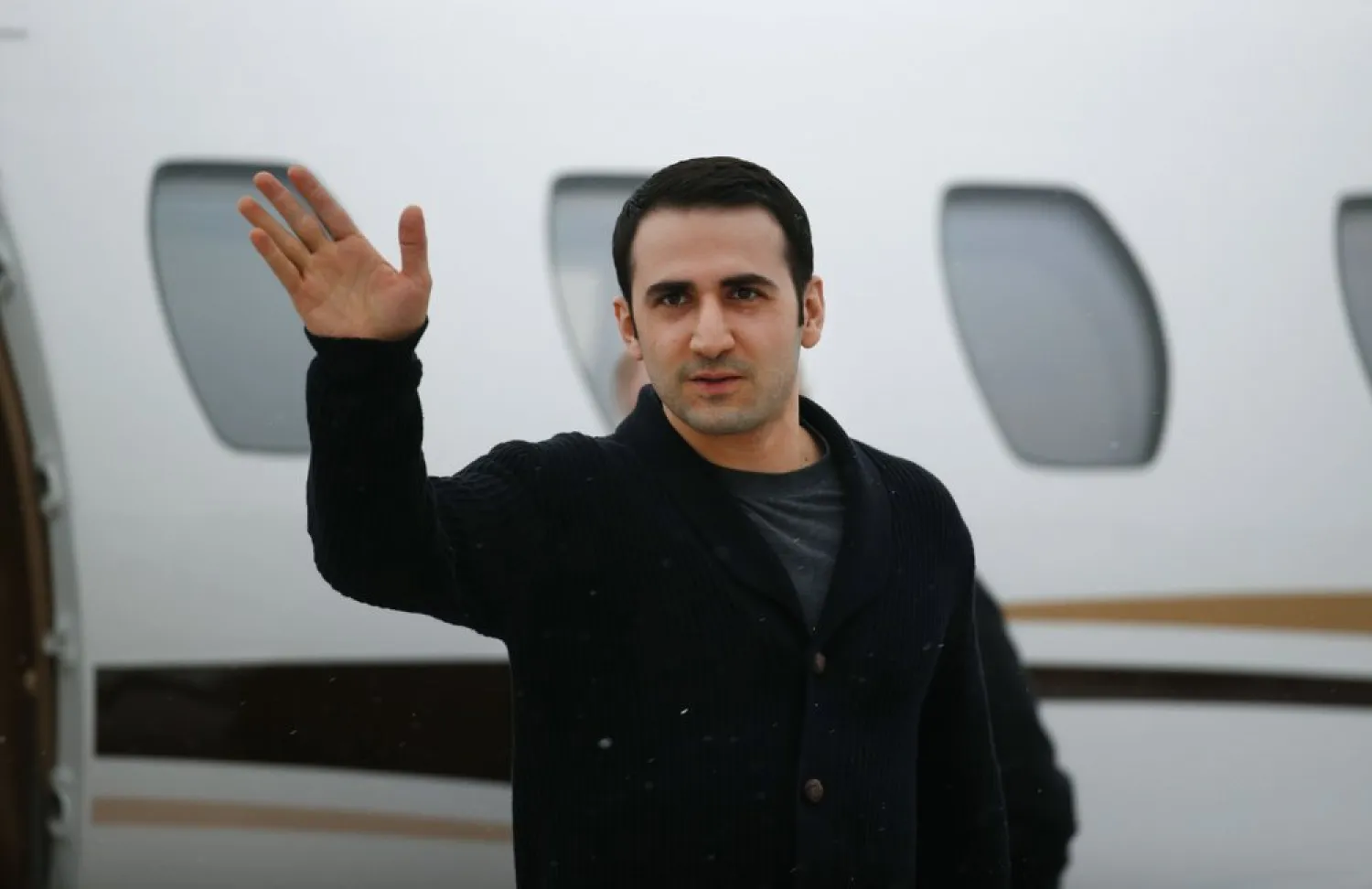
In this Jan. 21, 2016, file photo, Amir Hekmati waves after arriving on a private flight at Bishop International Airport in Flint, Mich. (AP)
TT

Once Held in Iranian Jail, Ex-Marine Fights Espionage Claims

In this Jan. 21, 2016, file photo, Amir Hekmati waves after arriving on a private flight at Bishop International Airport in Flint, Mich. (AP)

After Amir Hekmati was released from Iranian custody in a 2016 deal trumpeted as a diplomatic breakthrough, he was declared eligible for $20 million in compensation from a special US government fund.

But payday never arrived, leaving Hekmati to wonder why.

The answer has finally arrived: Newly filed court documents reviewed by The Associated Press reveal FBI suspicions that he traveled to Iran to sell classified secrets — not, as he says, to visit his grandmother. Hekmati vigorously disputes the allegations, has never faced criminal charges and is challenging a special master's conclusion that he lied about his visit to Iran and is therefore not entitled to the money.

The FBI investigation helps explain the government's refusal for more than two years to pay Hekmati and muddies the narrative around a US citizen, Marine and Iraq war veteran whose release was championed at the US government's highest levels, including by Joe Biden, then the vice president, and John Kerry, then the secretary of state. The documents offer radically conflicting accounts of Hekmati's purpose in visiting Iran and detail the simmering, behind-the-scenes dispute over whether he is entitled to access a fund that compensates victims of international terrorism.

Hekmati said in a sworn statement that allegations he sought to sell out to Iran are ridiculous and offensive. His lawyers say the government's suspicions, detailed in FBI reports and letters from the fund's special master denying payments, are groundless and based on hearsay.

“In this case, the US government should put up or shut up,” said Scott Gilbert, a lawyer for Hekmati. “If the government believes they have a case, indict Amir. Try Amir. But you, the US government, won't do that because you can't do that. You don't have sufficient factual evidence to do that.”

Gilbert declined to make Hemkati available for an interview while Hekmati's lawsuit seeking compensation is pending.

The FBI and Justice Department declined to comment, but details from the investigation emerge in hundreds of pages of documents filed in the case.

The documents show the FBI opened an espionage investigation into Hekmati as far back as 2011, the same year he was detained in Iran on suspicion he was spying for the CIA.

Hekmati, who was raised in Michigan and served as an infantryman and interpreter in Iraq before being honorably discharged from the Marines in 2005, says he went to Iran to visit an ailing grandmother after a brief, unsatisfying stint as a Defense Department contractor conducting intelligence analysis in Afghanistan.

But the FBI concluded that he went there intent on selling Iran classified information, according to an unsigned five-page summary of their investigation.

The assessment is based partly on accounts from four independent but unnamed witnesses who say Hekmati approached Iranian officials offering classified information, as well as the fact he abruptly resigned his contracting position before his contract was up and left for Iran without telling friends and colleagues, the FBI says. An FBI computer forensics search concluded that while in Afghanistan, he accessed hundreds of classified documents on Iran that agents believe were outside the scope of his job responsibilities, the documents say.

Hekmati, the son of Iranian immigrants, says he researched Iran openly to cultivate an expertise on Iranian influence in Afghanistan. “Everyone knew” about the work he was doing, he said at a hearing last year, and supervisors didn't place restrictions. He says he'd already quit his job when he left for Iran and therefore wasn't obligated to tell colleagues of his trip. At no point in Iran, he said, did he meet with any Iranian officials or tried to sell government secrets.

Hekmati's lawyers say the FBI's suspicions are impossible to square with the treatment he endured in prison, which they say included torture and being forced to record a coerced but bogus confession. Were he actually spying for Iran, Gilbert said, “You’d think the guy would have been a valuable asset, they actually would have wanted to do something with him" rather than abuse him.

He was initially sentenced to life, but the punishment was cut to 10 years.

Hekmati enjoyed support from senior-level officials, including Kerry, who demanded his release, and Biden, who met with his family in Michigan. In January 2016, after four-and-a-half years behind bars, he was freed with several other American citizens, including Washington Post journalist Jason Rezaian, as the Obama administration entered its final year eager for signs of improving relations after the controversial nuclear deal with Iran.

Months later, Hekmati sued Iran over his torture. A federal judge in Washington entered a $63.5 million default judgment after Iran failed to contest the claims. Hekmati subsequently applied to collect through a Justice Department-run fund for terror victims financed by assets seized from US adversaries. He was awarded the statutory maximum of $20 million, his lawyers say.

The fund’s special master then was Kenneth Feinberg, renowned for overseeing payments to victims of the Sept. 11 attacks. In December 2018, he authorized an initial payment of more than $839,000.

But for months, no money came. After Hekmati's lawyers warned they'd have to sue, the Justice Department cryptically indicated it was seeking a reconsideration of the award.

In January 2020, Feinberg formally revoked Hekmati's eligibility for the fund, saying his application contained errors and omissions and that information from the Justice Department supported the conclusion that Hekmati visited Iran with the intent of selling classified information.

A second letter last December didn't repeat that precise allegation, but said Hekmati had given “evasive, false and inconsistent statements” during three FBI interviews, failed to “credibly refute” that most of the classified information he accessed related to Iran and “traveled to Iran for primary purposes other than to visit his family.”

Feinberg declined to comment, saying his decision “speaks for itself.”

The correspondence had been secret until January when Hekmati’s lawyers filed it in the Court of Federal Claims in Washington as part of its lawsuit. Hundreds of additional pages of documents have since been filed outlining the investigation.

The documents include summaries of FBI interviews from 2016 in Germany, on Hekmati's way home from Iran, and in Michigan that show FBI agents grilling him with increasing suspicion.

One summary says Hekmati refused to answer when asked if he'd ever accessed classified information on Iran and replied the FBI could figure it out itself. In a follow-up interview, an agent confronted Hekmati with the FBI's assessment that he went to Afghanistan to obtain classified information that he could sell to Iran. After a back-and-forth, Hekmati told the FBI that he accessed the material to become a subject matter expert on the topic.

Hekmati and his lawyers state the FBI interviews shouldn't be considered credible in part because he was suffering from the effects of post-traumatic stress at the time.

The status of any investigation is unclear, as are Hekmati's prospects of ever receiving payment. But Gilbert, Hekmati's lawyer, says he hopes the decision gets a fresh look by the new Justice Department.

“I am hopeful that we will see the appropriate outcome here and be able to put this saga to bed.”



Trump to Travel to China Next Month, with US Trade Policy in Focus

US President Donald Trump arrives at Joint Base Andrews in Maryland, US, February 19, 2026. (Reuters)
TT

Trump to Travel to China Next Month, with US Trade Policy in Focus

US President Donald Trump arrives at Joint Base Andrews in Maryland, US, February 19, 2026. (Reuters)

US President Donald Trump will travel to China from March 31 to April 2 for a highly anticipated meeting between the world's two biggest economies, following the Supreme Court's decision to overturn Trump's sweeping tariffs against imported goods.

A White House official confirmed the trip on Friday, just before the highest US court struck down many of the tariffs Trump has used to manage sometimes-tense relations with China.

Trump is expected to visit Beijing and meet Chinese President Xi Jinping as part of a lavish, extended visit. Trump was last in China in 2017, ‌the most ‌recent trip by a US president.

A key topic had been whether ‌to ⁠extend a trade ⁠truce that kept both countries from further hiking tariffs. After Friday's ruling, however, it was not immediately clear whether - and under what legal authority - Trump would restore tariffs on imports from China.

TRUMP SEES TRADE IMBALANCE AS NATIONAL EMERGENCY

The administration has said the tariffs were necessary because of national emergencies related to trade imbalances and China's role in producing illicit fentanyl-related chemicals.

"That's going to be a wild one," Trump told foreign leaders visiting Washington on Thursday ⁠about the trip. "We have to put on the biggest display you've ‌ever had in the history of China."

The Chinese ‌embassy in Washington did not immediately respond to a request for comment. Beijing has not ‌confirmed the trip.

The visit would be the leaders' first talks since February and their first ‌in-person visit since an October meeting in South Korea. At that October meeting, Trump agreed to trim tariffs on China in exchange for Beijing cracking down on the fentanyl trade, resuming US soybean purchases and keeping rare earth minerals flowing.

While the October meeting largely sidestepped the sensitive issue of ‌Taiwan, Xi raised US arms sales to the island in February.

Washington announced its largest-ever arms sales deal with Taiwan in December, ⁠including $11.1 billion in ⁠weapons that could ostensibly be used to defend against a Chinese attack. Taiwan expects more such sales.

China views Taiwan as its own territory, a position Taipei rejects. The United States has formal diplomatic ties with China, but it maintains unofficial ties with Taiwan and is the island's most important arms supplier. The United States is bound by law to provide Taiwan with the means to defend itself.

Xi also said during the February call that he would consider further increasing soybean purchases, according to Trump.

Struggling US farmers are a major political constituency for Trump, and China is the top soybean consumer.

Although Trump has justified several hawkish policy steps from Canada to Greenland and Venezuela as necessary to thwart China, he has eased policy toward Beijing in the past several months in key areas, from tariffs to advanced computer chips and drones.


Diplomacy Is Still the Only Viable Path to Peace in Ukraine, UN Refugee Chief Barham Salih Says

UNCHR High Commissioner Barham Salih talks during an interview with The Associated Press in Kyiv, Ukraine, Friday, Feb. 20, 2026. (AP)
TT

Diplomacy Is Still the Only Viable Path to Peace in Ukraine, UN Refugee Chief Barham Salih Says

UNCHR High Commissioner Barham Salih talks during an interview with The Associated Press in Kyiv, Ukraine, Friday, Feb. 20, 2026. (AP)

There are many obstacles to a peace deal in Ukraine, but a diplomatic solution remains the only viable option, the newly appointed head of the UN refugee agency said Friday, warning that humanitarian operations are increasingly overstretched because of multiple global crises.

Barham Salih, Iraq’s former president who was elected UNHCR high commissioner in December, made his first visit to Ukraine since taking office.

After traveling to Ukraine’s front-line cities, including Kharkiv and Zaporizhzhia, he met with President Volodymyr Zelenskyy and discussed the latest in efforts to secure a peace deal. He also discussed the future of UNHCR operations as Ukraine endures Russian attacks on its energy grid during a harsh winter.

“You have to be hopeful, but I do understand the difficulties in the situation, and it’s clear, of course, there are many, many impediments along the way, but at the end of the day, there is no military solution. There needs to be peace, a durable and just peace so that people can go back to their lives,” he said, speaking to The Associated Press in an interview in Kyiv.

“Things are not necessarily easy, definitely not easy, but let’s redouble the effort to make sure that diplomacy has a chance and really bring about a durable and just peace to this war that has been going on for far too long,” he added.

Of the agency’s $470 million appeal for Ukraine, only $150 million has been pledged. The shortfall reflects deep cuts across the humanitarian sector, making it increasingly difficult to deliver aid across multiple crises.

There are 3.7 million Ukrainians displaced within the country and nearly 6 million Ukrainians outside the country who have become refugees in Europe and elsewhere, he said.

“This tells you the gap between what is needed and what is available,” he said. “My appeal to the international community is, really, this is not the moment to walk away, this is not a moment to look the other way round. These vulnerable populations need support. We should deliver this help to them.”

The UN agency in Ukraine predicts 10.8 million Ukrainians will require humanitarian assistance in 2026, according to a report from the agency. The most critical needs are concentrated along the war’s front lines in the eastern and southern parts of Ukraine, as well as in the northern border region. Intensified hostilities produce fresh waves of displacement.

The agency’s Ukraine appeal competes with large-scale conflicts in Sudan and Gaza. Since his appointment, Salih has spent only one week in his Geneva office, traveling to Kenya, Chad, Türkiye and Jordan before visiting Ukraine.

Drastic cuts to US humanitarian funding under President Donald Trump has accelerated the erosion of global humanitarian infrastructure and severely undermined the ability of organizations to deliver aid.

There are 117 million displaced people worldwide, including at least 42 million refugees, Salih said. Two-thirds face protracted displacement and remain dependent on humanitarian assistance.

Deciding where to prioritize given shrinking resources is “difficult” he said.

“It’s really very difficult to prioritize given the scale of the problem. I was in Kenya and I was in Chad recently and I was in Türkiye and in Jordan talking to refugees from Syria. And of course, now in Ukraine, these are all pressing issues, pressing requirements,” he said.

“We need to be there to help people, but also I have to say we really need to look at durable solutions too as well. It’s not a matter of sustaining dependency or humanitarian assistance,” he added.

In his meeting with Zelenskyy, Salih said they discussed the need to focus on the “recovery phase and sustainable solutions and self reliance as we go forward,” he said.


Israel Army Says on ‘Defensive Alert’ Regarding Iran but No Change to Public Guidelines

Israeli air defense system fires to intercept missiles during an Iranian attack over Tel Aviv, Israel, Thursday, June 19, 2025. (AP)
TT

Israel Army Says on ‘Defensive Alert’ Regarding Iran but No Change to Public Guidelines

Israeli air defense system fires to intercept missiles during an Iranian attack over Tel Aviv, Israel, Thursday, June 19, 2025. (AP)

The Israeli army said it was on "defensive alert" as the United States threatens potential military action against Iran, but insisted there were no changes in its guidelines for the public.

"We are closely monitoring regional developments and are aware of the public discourse concerning Iran. The (Israeli military) is on defensive alert," army spokesman Brigadier General Effie Defrin said in a video statement published Friday.

"Our eyes are wide open in all directions, and our finger is more than ever on the trigger in response to any change in the operational reality," he added, but emphasized "there is no change in the instructions".