

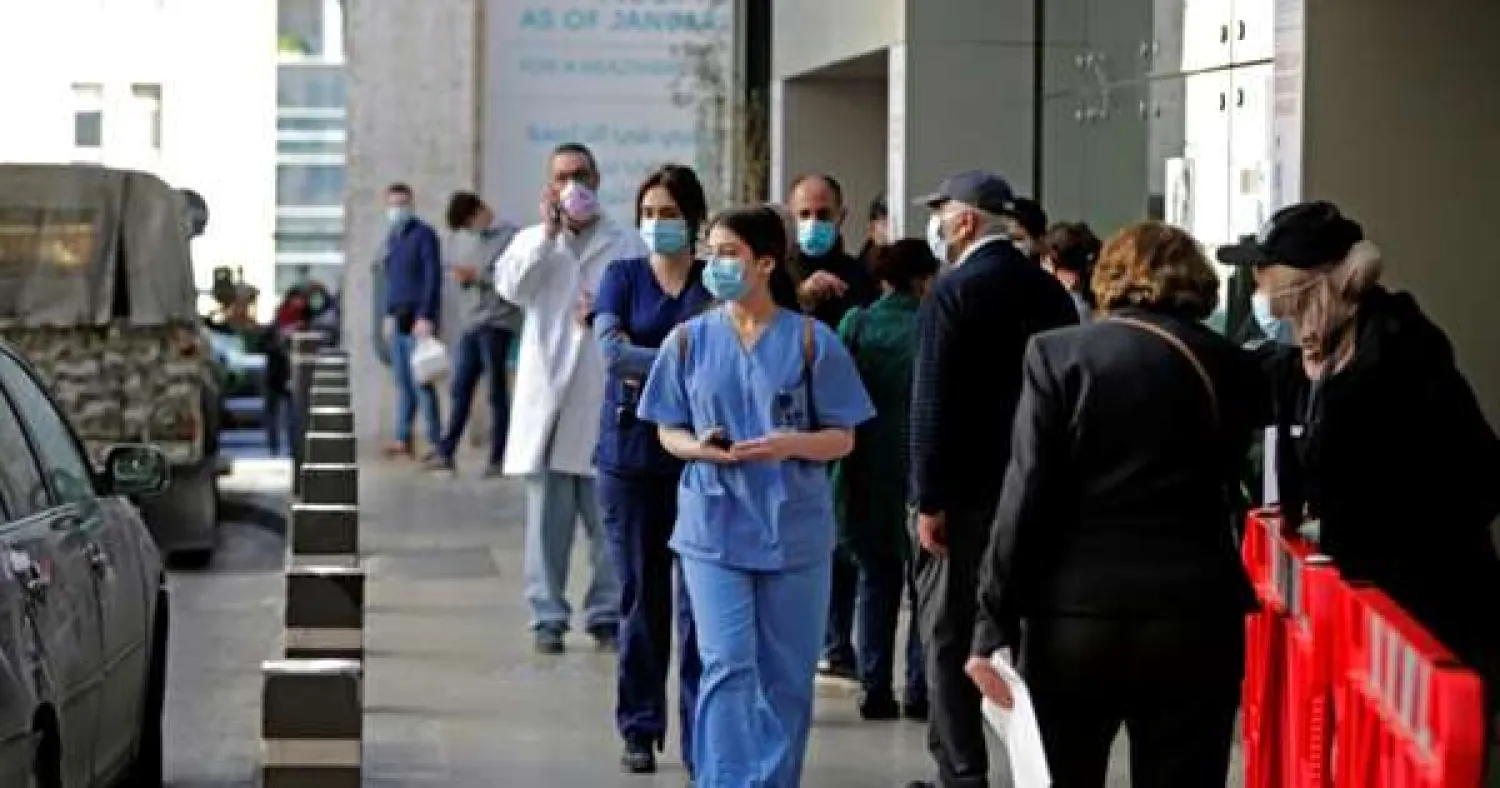

Doctors Flee Crisis-Hit Lebanon

Medical staff are pictured outside AUBMC (American University of Beirut Medical Centre) in the Lebanese capital Beirut on March 17, 2021 - AFP
TT

Doctors Flee Crisis-Hit Lebanon

Medical staff are pictured outside AUBMC (American University of Beirut Medical Centre) in the Lebanese capital Beirut on March 17, 2021 - AFP

US-trained emergency doctor Nour al-Jalbout wanted desperately to serve her fellow Lebanese, but less than two years after returning home she says the country's catastrophes are forcing her to leave.

"I gave everything I had to Lebanon for these two years, but Lebanon is not giving back," she says, her eyes welling up above three face masks, inside a top Beirut hospital.

"So I applied for immigration to the US," she said, to take up a job offer at Harvard.

As soon as her visa is approved, she will join hundreds of doctors who are fleeing Lebanon's political and economic crises, even during a pandemic.

Doctors warn a country once dubbed "the hospital of the Arab world" is hemorrhaging its best and brightest.

Hair tied back into a floral surgeon's cap, the 32-year-old medic rushes around the bustling emergency department at the American University of Beirut Medical Center.

Her white coat streaked with blood from treating one patient's gunshot wounds, she holds up an X-ray to understand the pain of another visiting from a nearby Arab country.

In the corridor between the emergency and coronavirus wards under her watch, trainee doctors repeatedly approach her for a second opinion.

The decision to leave, she says, "eats you up every day".

But "you're doing what's best for you and your kids if you want to have a family."

Since starting work in September 2019, she has treated wounded protesters, witnessed economic freefall, fought a pandemic, and helped treat hundreds after a massive explosion in Beirut.

She was at the hospital on August 4 when hundreds of tonnes of fertilizer exploded at the port, killing more than 200 people and sending shockwaves through the capital.

"The ceiling fell on us," she says, pausing between tears.

Up to 500 wounded streamed in, followed by desperate relatives looking for their loves ones.

Hours later, her husband told her their flat had been badly hit.

"Beirut is like opium," says Jalbout, whose anesthetist sister will also emigrate. "It's so good, but it's so bad for you."

Lebanon's worst economic crisis since the 1975-1990 civil war has hit even the top echelons of the population.

Doctors have seen their salaries or fees plummet in value, and their dollar savings trapped in the bank, all the while being overwhelmed by a deadly pandemic. Even basic medication has gone out of stock.

Many say they are far better off than most, but still see no future for their children.

Meanwhile, a deeply divided political class -- accused by many on the street of being useless and corrupt -- has for seven months been unable to form a government.

The head of the doctor's syndicate, Charaf Abou Charaf, says 1,000 doctors have left since 2019, while a similar number of nurses have departed as well, according to their representative.

"If it continues like this, it'll be catastrophic," Abou Charaf said.

Many of those departing are specialist experts in their fields, and essential for both patient care and training the next generation.

They "are mostly aged 35 to 55, and form the backbone of the healthcare sector," he said.

Many are going to work in the Gulf, and could one day return.

But others are heading to Europe, Australia and the United States, likely for good.

Abou Charaf said it was devastating to watch the brain drain.

"We paid to educate our children, and the West is plucking them up to benefit from them, when we are the ones who desperately need them," he said, AFP reported.

The head of the parliamentary health committee, Assem Araji, has said the exodus was unprecedented -- even worse than during the civil war.

"When I was a doctor training at the AUB (American University of Beirut) in the 1980s, the smell of death clung to the streets... but only very few doctors left," he wrote on Twitter.

"The outflux of doctors today is not just due to economic reasons, but also despair at the political class."

Psychiatrist Francois Kazour, 40, said he was moving to France with his wife, a dermatologist, and two young children.

The French-Lebanese doctor and university lecturer said his life was rooted in Lebanon.

"We have our home, our practices, we work at the hospital", he said.

He too had wanted to raise his family in Lebanon, but next month he and his wife will start the long process to convert their Lebanese qualifications to settle in France for good.

"We feel like there's no end in sight," he said.


Brother Details to Asharq Al-Awsat Luring, Disappearance of Lebanese Retired Officer

Abdul Salam Shukr speaks to Asharq Al-Awsat from Nabi Sheet. (Asharq Al-Awsat)
TT

Brother Details to Asharq Al-Awsat Luring, Disappearance of Lebanese Retired Officer

Abdul Salam Shukr speaks to Asharq Al-Awsat from Nabi Sheet. (Asharq Al-Awsat)

Shock still grips the family of retired Lebanese General Security captain Ahmed Shukr, who was abducted days ago, as Lebanese security and judicial assessments increasingly point to Israeli intelligence as being behind his disappearance, over suspected links to the 1986 vanishing of Israeli airman Ron Arad in southern Lebanon.

His brother, Abdul Salam Shukr, told Asharq Al-Awsat the story began when a Lebanese expatriate living in Kinshasa, identified as A.M., contacted Ahmed and asked to rent his apartment in the Choueifat area, south of Beirut.

The two agreed months ago, and the man paid $500 in rent.

The expatriate made repeated visits to Lebanon and met Shukr at his home during one of them. He later contacted the retired officer to say that a wealthy African investor named Salim Kassab, later found to be a fake name, was interested in purchasing a plot of land in the eastern city of Zahle and needed his assistance.

Abdul Salam said the expatriate inspected the land, then called two weeks after leaving Lebanon to say the investor had agreed to buy it and would visit the country. He asked Ahmed to meet him at the site at 4:30 p.m. on the day of the abduction.

He said the expatriate insisted on the timing because it suited the buyer, despite Ahmed’s objections that darkness would have fallen by then, and the land’s features would not be visible. The expatriate later apologized for not attending, claiming he had broken his foot, and said the investor would visit the site alone with Ahmed.

At the time of the meeting, Ahmed disappeared.

“We know nothing about him except what we have heard through security and judicial leaks,” Abdul Salam said. He added that the abductors had rented a house in Zahle and erased all traces from it after kidnapping Ahmed.

Surveillance cameras tracked the vehicle as it headed toward the town of Souireh in the western Bekaa, where the trail then vanished. Souireh was previously used as a smuggling route from southwestern Damascus into Lebanon.

Loyalty to the state

“My brother served 40 years in the military establishment. His loyalty was only to the state and its institutions. He never belonged to any party,” Abdul Salam said. “We are a family that does not engage in politics.”

Ahmed was lured last week in a carefully planned operation that began in his hometown of Nabi Sheet in the northern Bekaa, before he went missing at a point very close to the city of Zahle.

Family members and residents have been gathering at the home of Nabi Sheet’s mukhtar, Abbas Shukr, to voice their protest and condemnation of the abduction.

The family said Ahmed Shukr retired nine years ago after serving for four decades in the General Security, during which he held several posts, including the Masnaa border crossing with Syria and the Qaa crossing in northeastern Lebanon.

“My brother joined the military in 1979, which means he was an ‘officer of the state’ when Arad disappeared in 1986,” Abdul Salam told Asharq Awsat. “An officer of the state does not belong to parties.”

He rejected attempts to link the family by kinship to Fuad Shukr, a Hezbollah leader killed by Israel in July 2024 in Beirut’s southern suburbs, saying no one in the town even knew him.

“He left the town in the early 1980s and never returned. He was distant even from his relatives,” he said, adding that since retiring, his brother “never left the Bekaa. He stayed at home and played cards with friends at night.”

The family home remains in a state of disbelief, a scene that has persisted since his disappearance last week. The case only began to move officially after Vice President of the Supreme Islamic Shiite Council Sheikh Ali al Khatib contacted Lebanese President Joseph Aoun and Interior Minister Ahmed al-Hajjar, according to Abdul Salam.

He said Aoun pledged to instruct security and judicial authorities to expand the investigation and uncover the circumstances surrounding the incident. Officials from the Amal Movement were also in constant contact with Parliament Speaker Nabih Berri, who is head of the movement, to follow up on the case.

Mystery remains

“We demand that the judiciary and security agencies confirm or deny the leak about an alleged link to Ron Arad’s disappearance,” Abdul Salam said.

“That leak does not concern us. What matters is what the security agencies say, including General Security, where Ahmed served, and the Information Branch of the Internal Security Forces, which is leading the investigation.”

He said the key to the mystery lies with A.M., a native of the southern town of Qana who lives in Kinshasa and has been evading the family’s calls.

“The Lebanese state must ask Interpol to arrest him and bring him to Lebanon for questioning,” he urged, adding that the man no longer answers his phone and that all available information about him, including video clips, is now in the hands of security agencies.

Abdul Salam said the family believes the expatriate coordinated the plot with Israel’s Mossad, guiding them to this point and enabling an operation carried out with precision and professionalism.

He said Lebanese security agencies told the family the abductors left no fingerprints, neither at the Zahle property nor at the Choueifat apartment, and that no evidence has been found. The kidnappers’ vehicle also remains unidentified.


UK, Canada, Germany and Others Condemn Israel’s West Bank Settlement Plan

A Palestinian woman walks past the Israeli settlement of Har Homa, southeast of Jerusalem, on November 21, 2025. (AFP)
TT

UK, Canada, Germany and Others Condemn Israel’s West Bank Settlement Plan

A Palestinian woman walks past the Israeli settlement of Har Homa, southeast of Jerusalem, on November 21, 2025. (AFP)

Countries including Britain, Canada and Germany and others on Wednesday condemned the Israeli security cabinet's approval of 19 new settlements in the occupied West ‌Bank, saying ‌they violated ‌international ⁠law and risked ‌fueling instability.

"We call on Israel to reverse this decision, as well as the expansion of ⁠settlements," said a joint ‌statement released ‍by Britain, ‍which also included ‍Belgium, Denmark, France, Italy, Iceland, Ireland, Japan, Malta, the Netherlands, Norway and Spain.

"We recall that such unilateral actions, as ⁠part of a wider intensification of the settlement policies in the West Bank, not only violate international law but also risk fueling instability," the statement ‌added.


Syria State Media Says 3 Dead in Clashes in Latakia Province

A large Syrian flag flutters above Tishreen Park in Damascus, June 4, 2025. (AFP)
TT

Syria State Media Says 3 Dead in Clashes in Latakia Province

A large Syrian flag flutters above Tishreen Park in Damascus, June 4, 2025. (AFP)

Syrian state media said three people were killed Wednesday in clashes with security forces in coastal Latakia province, the heartland of the country's Alawite minority community.

"Three members of remnants of the former regime were killed after clashes with internal security forces" outside the city of Jableh, state television said.

State news agency SANA had earlier reported "clashes with a group of wanted outlaws" in the area, and said an unspecified number of security personnel were wounded.

Since last December's ousting of longtime ruler Bashar al-Assad, himself an Alawite, Syria's new authorities have frequently reported security operations against remnants of his government.

Syria's coastal areas saw the killing of Alawite civilians in March, with authorities accusing armed Assad supporters of sparking the violence by attacking security forces.

A national commission of inquiry said at least 1,426 members of the minority community were killed at the time.

Last month, thousands of people demonstrated on the Alawite coast in protest of fresh attacks targeting their community.
