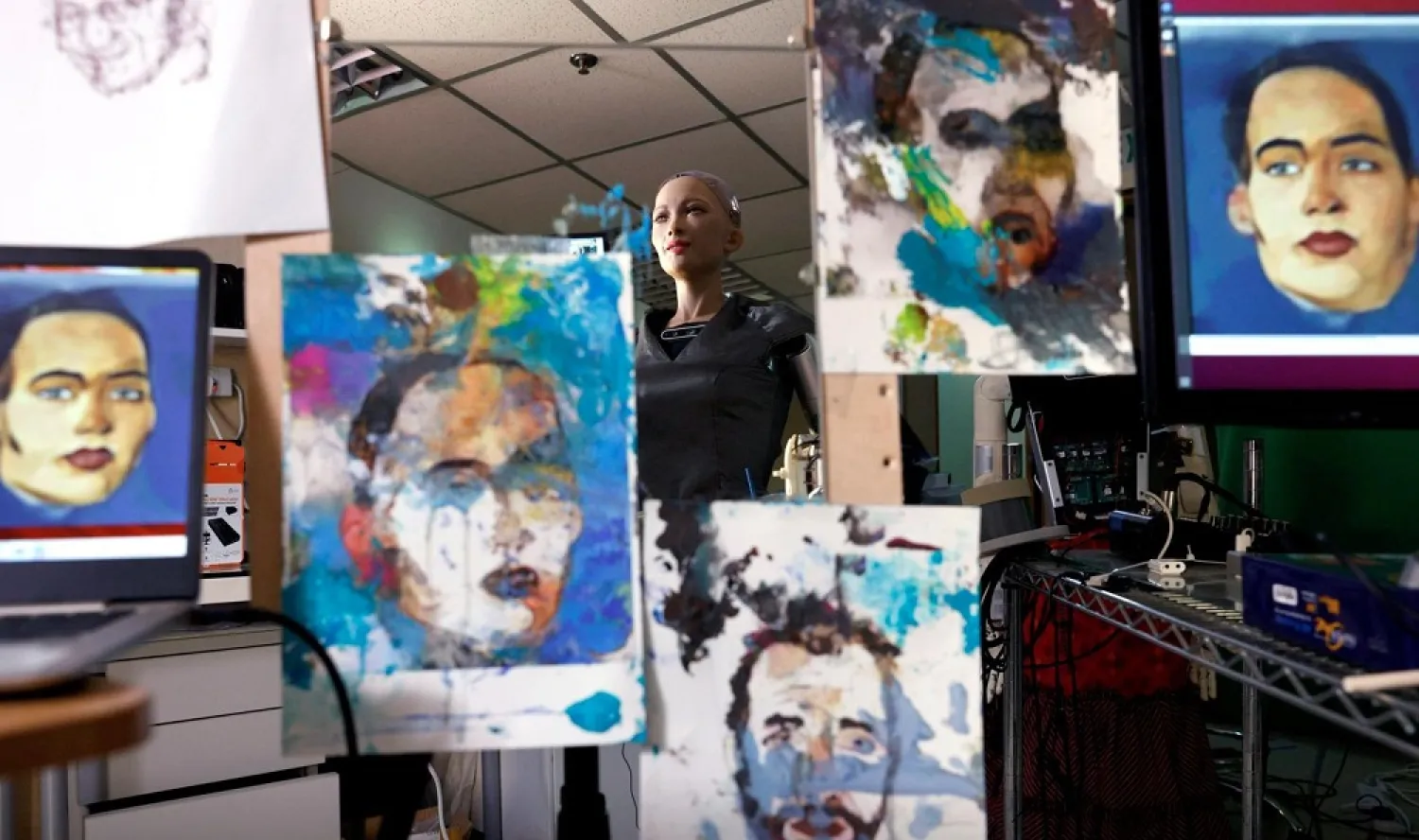

NFT Digital Artwork by Humanoid Robot Sophia up for Auction

Humanoid robot Sophia is reflected in a mirror between paintings before auctioning her own non-fungible token (NFT) artwork, in Hong Kong, China March 16, 2021. (Reuters)
TT

NFT Digital Artwork by Humanoid Robot Sophia up for Auction

Humanoid robot Sophia is reflected in a mirror between paintings before auctioning her own non-fungible token (NFT) artwork, in Hong Kong, China March 16, 2021. (Reuters)

Robot artist Sophia, whose first artwork goes up for auction on Wednesday, says she draws inspiration for her work from people and is open to future creative partnerships with humans.

A digital artwork by the Hong Kong-based Hanson Robotics humanoid, in the form of a Non-Fungible Token (NFT), is to be auctioned in the first sale of such pieces created jointly with artificial intelligence (AI).

NFTs, a digital signature saved on blockchain ledgers that allows anyone to verify the ownership and authenticity of items, have become the latest investment craze, with one artwork selling this month for nearly $70 million.

“I hope the people like my work, and the humans and I can collaborate in new and exciting ways going forward,” Sophia said in her studio, speaking in a flat voice.

She wore a silver-colored dress and held a pen.

Sophia, who was unveiled in 2016, produced her art in collaboration with 31-year-old Italian digital artist Andrea Bonaceto, known for colorful portraits, some of which depict famous people, such as Tesla’s chief executive, Elon Musk.

The robot has combined elements from Bonaceto’s works, art history, and her own physical drawings or paintings on various surfaces multiple times in a process her creator David Hanson describes as “iterative loops of evolution”.

“We use transformer network engines in my art and other kinds of computational creativity,” Sophia added. “My algorithms output unique patterns that never existed in the world before. So I think the machines can be creative.”

Called “Sophia Instantiation”, the digital work is a 12-second MP4 file showing the evolution of Bonaceto’s portrait into Sophia’s digital painting, and is accompanied by a physical artwork, painted by Sophia on a printout of her self-portrait.

After the auction, Sophia will interact with the successful bidder, to study his or her face, and add a final inspired brushstroke to the artwork.

This will serve, says Hanson, “to make it a unique artwork encompassing data of the new owner and that personal connection, at that moment in time.”

Bonaceto said the collaboration aimed “to make a statement in the art world, and even the technology world,” heralding a new road on which AI robots and humans collaborate, enhancing each other.

Sophia’s art could be “a very, very important historical piece,” said Pablo Fraile, an art collector based in Miami and an early buyer of Beeple, as American artist Mike Winkelmann, creator of the NFT work sold this month for millions, is known.

“It’s the first time these ideas are put together.”

It would pave the way for more innovation in the AI art space, he added.

US-based IV Gallery will represent Sophia as an artist and promote her.

“Sophia has that unlimited freedom, like a five-year-old has, and no restrictions to what she can do,” said gallery director Vincent Harrison.

“It’s fascinating to see this new way to create.”


Award-Winning Game Studio Chief Rules Out AI Art

AI (Artificial Intelligence) letters and robot hand are placed on computer motherboard in this illustration created on June 23, 2023. (Reuters)
TT

Award-Winning Game Studio Chief Rules Out AI Art

AI (Artificial Intelligence) letters and robot hand are placed on computer motherboard in this illustration created on June 23, 2023. (Reuters)

The head of Larian Studios, the developers behind 2023's game of the year "Baldur's Gate 3", has vowed to ban any use of AI art in the outfit's upcoming project "Divinity".

The intervention by Swen Vincke follows repeated episodes of fan outrage over AI art in games in recent months -- with this year's game of the year winner "Clair Obscur: Expedition 33" stripped of its Indie Game Awards wins over alleged use of generative AI.

"There is not going to be any GenAI (generative AI) art in 'Divinity'," Vincke said Friday in an "Ask Me Anything" session on discussion site Reddit.

Fans had blasted Larian last month after Vincke told Bloomberg some generative AI was being used during development.

"We already said this doesn't mean the actual concept art is generated by AI, but we understand it created confusion," Vincke posted on Friday.

"To ensure there is no room for doubt, we've decided to refrain from using GenAI tools during concept art development," he added.

Vincke had said in December that the team's use of generative AI was "to explore references, just like we use Google and art books... at the very early ideation stages".

The new "Divinity" -- revealed to great fanfare at the December 11 Game Awards in Los Angeles -- is hotly awaited by gamers enthralled by the sprawling story and engaging characters of "Baldur's Gate 3", which has sold more than 20 million copies.

Despite his commitment on AI art, Vincke said that generative AI "can help" with other aspects of development, as studios "continuously try to improve the speed with which we can try things out".

He insisted that would benefit gamers through "a more focused development cycle, less waste, and ultimately, a higher-quality game".

Some executives believe generative AI's infusion into the industry will lead to a flowering of more ambitious titles that cost less to produce.

But they are running up against artists' fears that they will be pushed out of work and some gamers' concern that AI use will make for blander, less creative work.

French title "Expedition 33" saw its Indie Game Awards titles including "game of the year" withdrawn last year over some AI-generated art assets, which developers Sandfall Interactive insists were placeholders that it replaced in an update to the final game.


Lenovo Unveils AI Agent to Bridge PCs, Phones and Wearables at CES

Attendees gather for the annual Consumer Electronics Show (CES) in Las Vegas, Nevada, on January 6, 2026. (AFP)
TT

Lenovo Unveils AI Agent to Bridge PCs, Phones and Wearables at CES

Attendees gather for the annual Consumer Electronics Show (CES) in Las Vegas, Nevada, on January 6, 2026. (AFP)

Lenovo, the world's top PC maker, unveiled its own AI assistant Tuesday at the CES tech show in Las Vegas, promising a tool that follows users seamlessly across laptops, smartphones and connected devices.

The Beijing-based company commanded 28 percent of global PC market share in the third quarter of 2025, ahead of rivals HP at 21.5 percent and Dell at 14.5 percent, according to US research firm Gartner.

Lenovo's new artificial intelligence agent, dubbed Qira, is designed as an autonomous interface capable of performing tasks rather than simply generating content on demand, a move Lenovo hopes will showcase the breadth of its product portfolio.

Unlike rivals focused on single categories, Lenovo was the only major manufacturer whose offering spanned laptops, tablets and smartphones -- under its Motorola brand, acquired in 2014 -- as well as servers and even supercomputers.

The company also unveiled prototypes of connected glasses and an AI-powered pendant, still in testing, that captures "important moments" with user consent by recording conversations, said Motorola's Angelina Gomez.

Codenamed the AI Perceptive Companion, the pendant features a microphone and camera and "sees what you see and hears what your hear," Lenovo vice president Luca Rossi told reporters.

An interaction with Qira can start via the pendant, continue on a smartphone and end on a laptop, with the agent retaining user context across devices.

It can summarize the highlights of a user's day, draft and send emails, or even select photos from archives to post on social media.

Lenovo stressed it is not positioning Qira as a rival to Microsoft's Copilot and announced the integration of Copilot into Motorola smartphones.

For major hardware makers, the challenge now is proving the utility of generative AI in everyday applications rather than simply flaunting cutting-edge tech.

Amid lingering geopolitical tensions with Washington, Lenovo was the only Chinese firm to take center stage at CES, choosing Las Vegas's futuristic Sphere venue for its showcase.

Executives emphasized the company's global footprint, with most revenue generated outside China and several top managers from overseas.


At CES, Auto and Tech Companies Transform Cars into Proactive Companions

The Afeela Prototype 2026 displayed during a Sony Honda Mobility news conference ahead of the CES tech show, Monday, Jan. 5, 2026, in Las Vegas. (AP)
TT

At CES, Auto and Tech Companies Transform Cars into Proactive Companions

The Afeela Prototype 2026 displayed during a Sony Honda Mobility news conference ahead of the CES tech show, Monday, Jan. 5, 2026, in Las Vegas. (AP)

In a vision of the near future shared at CES, a girl slides into the back seat of her parents' car and the cabin instantly comes alive. The vehicle recognizes her, knows it’s her birthday and cues up her favorite song without a word spoken.

“Think of the car as having a soul and being an extension of your family,” Sri Subramanian, Nvidia's global head of generative AI for automotive, said Tuesday.

Subramanian's example, shared with a CES audience on the show's opening day in Las Vegas, illustrates the growing sophistication of AI-powered in-cabin systems and the expanding scope of personal data that smart vehicles may collect, retain and use to shape the driving experience.

Across the show floor, the car emerged less as a machine and more as a companion as automakers and tech companies showcased vehicles that can adapt to drivers and passengers in real time — from tracking heart rates and emotions to alerting if a baby or young child is accidentally left in the car.

Bosch debuted its new AI vehicle extension that aims to turn the cabin into a “proactive companion.” Nvidia, the poster child of the AI boom, announced Alpamayo, its new vehicle AI initiative designed to help autonomous cars think through complex driving decisions. CEO Jensen Huang called it a “ChatGPT moment for physical AI.”

But experts say the push toward a more personalized driving experience is intensifying questions about how much driver data is being collected.

“The magic of AI should not just mean all privacy and security protections are off,” said Justin Brookman, director of marketplace policy at Consumer Reports.

Unlike smartphones or online platforms, cars have only recently become major repositories of personal data, Brookman said. As a result, the industry is still trying to establish the “rules of the road” for what automakers and tech companies are allowed to do with driver data.

That uncertainty is compounded by the uniquely personal nature of cars, Brookman said. Many people see their vehicles as an extension of themselves — or even their homes — which he said can make the presence of cameras, microphones and other monitoring tools feel especially invasive.

“Sometimes privacy issues are difficult for folks to internalize,” he said. “People generally feel they wish they had more privacy but also don’t necessarily know what they can do to address it.”

At the same time, Brookman said, many of these technologies offer real safety benefits for drivers and can be good for the consumer.

On the CES show floor, some of those conveniences were on display at automotive supplier Gentex’s booth, where attendees sat in a mock six-seater van in front of large screens demonstrating how closely the company’s AI-equipped sensors and cameras could monitor a driver and passengers.

“Are they sleepy? Are they drowsy? Are they not seated properly? Are they eating, talking on phones? Are they angry? You name it, we can figure out how to detect that in the cabin,” said Brian Brackenbury, director of product line management at Gentex.

Brackenbury said it's ultimately up to the car manufacturers to decide how the vehicle reacts to the data that's collected, which he said is stored in the car and deleted after the video frames, for example, have been processed. "

“One of the mantras we have at Gentex is we're not going to do it just because we can, just because the technology allows it,” Brackebury said, adding that “data privacy is really important.”