Iran, China Sign 25-Year Cooperation Accord

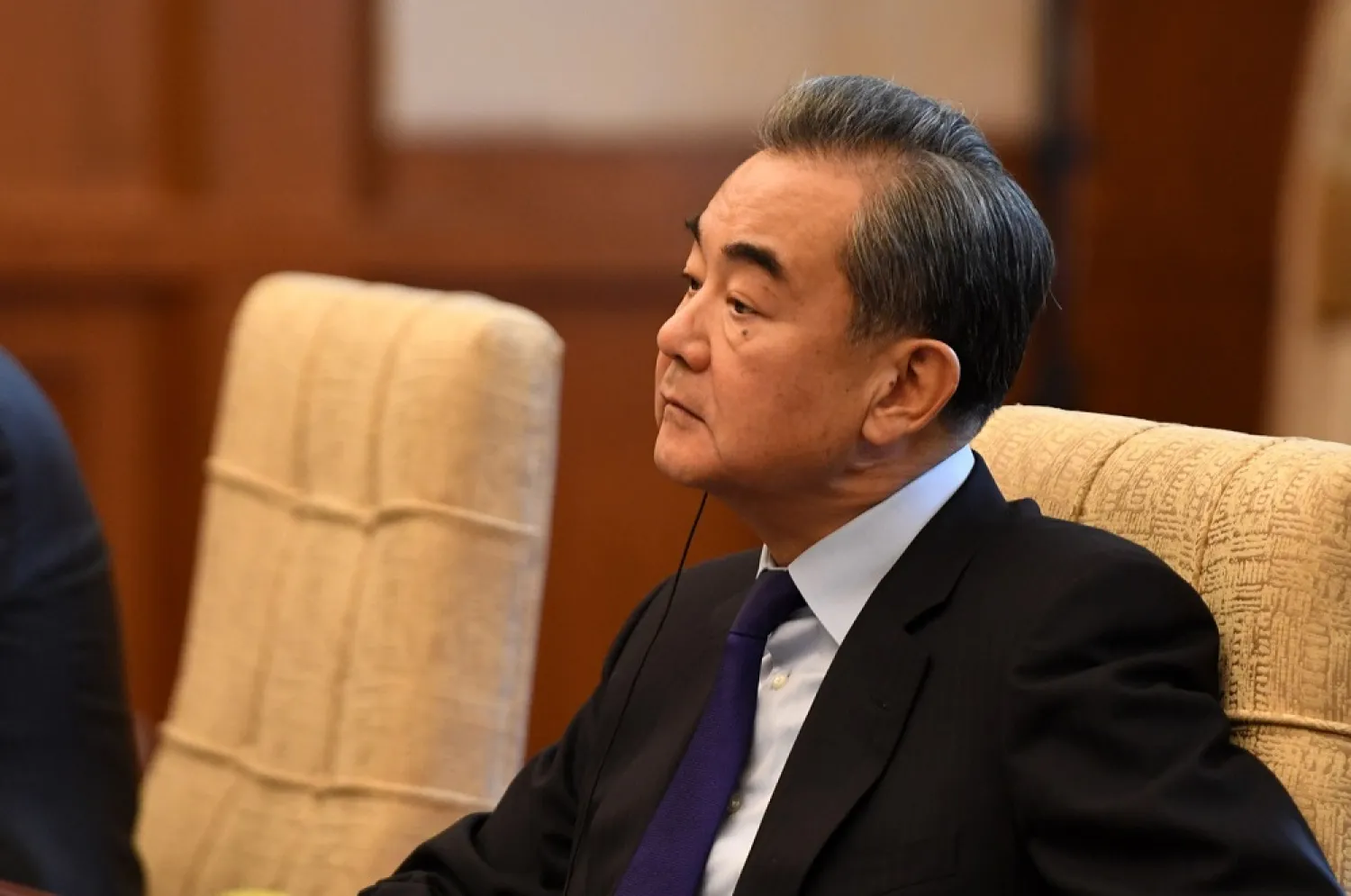
China's Foreign Minister Wang Yi listens to Iran's Foreign Minister Mohammad Javad Zarif during a meeting at the Diaoyutai state guest house in Beijing, China December 31, 2019. (Reuters)
TT

Iran, China Sign 25-Year Cooperation Accord

China's Foreign Minister Wang Yi listens to Iran's Foreign Minister Mohammad Javad Zarif during a meeting at the Diaoyutai state guest house in Beijing, China December 31, 2019. (Reuters)

The Chinese and Iranian foreign ministers on Saturday signed a 25-year cooperation agreement between the two allies in a ceremony carried live on state television.

“Our relations with Iran will not be affected by the current situation, but will be permanent and strategic,” Chinese Foreign Minister Wang Yi was earlier quoted by Iranian news agencies as saying.

“Iran decides independently on its relations with other countries and is not like some countries that change their position with one phone call.”

Wang met President Hassan Rouhani ahead of the signing of the agreement, which is expected to include Chinese investments in key sectors such as energy and infrastructure.

The accord is an example of “successful diplomacy,” Rouhani’s adviser Hesameddin Ashena was cited by Iranian media as saying. “A country’s strength is in its ability to join coalitions, not to remain isolated.”

Saeed Khatibzadeh, an Iranian foreign ministry spokesman, said the document was a “roadmap” for trade, economic and transportation cooperation, with a “special focus on the private sectors of the two sides.”

China, one of Iran’s largest trading partners, agreed in 2016 to boost bilateral trade by more than 10 times to $600 billion over a decade.

Its commerce ministry said on Thursday that Beijing will try to safeguard the 2015 Iran nuclear deal and defend the legitimate interests of Sino-Iranian relations.

The United States and the other Western powers party to the deal are at odds with Tehran over which side should first return to the accord, which was abandoned by former US President Donald Trump in 2018.


Strait of Hormuz to Stay Closed Until Port Blockade Lifts, Iran Says

This handout photo released by US Central Command via their X account (@CENTCOM) on April 18, 2026 shows AH-64 Apaches flying above the Strait of Hormuz during a patrol on April 17, 2026. (US Central Command (CENTCOM) / AFP)
TT

Strait of Hormuz to Stay Closed Until Port Blockade Lifts, Iran Says

This handout photo released by US Central Command via their X account (@CENTCOM) on April 18, 2026 shows AH-64 Apaches flying above the Strait of Hormuz during a patrol on April 17, 2026. (US Central Command (CENTCOM) / AFP)

The crucial Strait of Hormuz will not reopen until the United States lifts its naval blockade on Iranian ports, Tehran said Saturday, as a top official warned that a final peace deal remained "far" off.

Mohammad Bagher Ghalibaf, speaker of the Iranian parliament, said in a televised address that there has been "progress" in talks with Washington "but there are many gaps and some fundamental points remain."

"We are still far from the final discussion," said Ghalibaf, one of Tehran's negotiators in the talks aimed at ending the war launched by Israel and the United States against Iran.

A two-week ceasefire is set to end on Wednesday unless it is renewed.

US President Donald Trump said meanwhile that "very good conversations" were going on with Iran but warned Tehran against trying to "blackmail" the United States.

On Friday, Tehran had declared the Strait of Hormuz, which usually carries a fifth of the world's oil and liquefied natural gas, open after a ceasefire was agreed in Israel's war with Iran's ally Hezbollah in Lebanon.

This prompted elation in global markets and sent oil prices plunging, but with Trump insisting the blockade of Iranian ports would continue until a deal is struck to end the wider war, Tehran said it was shuttering the strait once more.

"If America does not lift the blockade, traffic in the Strait of Hormuz will definitely be limited," Ghalibaf said.

Iran's supreme leader Mojtaba Khamenei, who has yet to be seen since taking power, said meanwhile in a written message that Iran's navy "stands ready" to defeat the United States.

Trump, speaking to reporters at a White House event, accused Iran of getting "a little cute" with its recent moves and warned Tehran not to try to "blackmail" Washington with its flip-flopping on the Strait of Hormuz.

"We have very good conversations going on," the president said, adding that the United States was "taking a tough stand."

- 'Targeted' -

Iran's Revolutionary Guards warned that any attempt to pass through the strait without permission "will be considered cooperation with the enemy, and the offending vessel will be targeted."

A handful of oil and gas tankers crossed the strait early on Saturday during the brief reopening, tracking data showed, but others retreated and tracking platforms showed hardly any vessels crossing the waterway by the late afternoon.

A UK maritime security agency said the Revolutionary Guards fired at one tanker, while security intelligence firm Vanguard Tech reported the force had threatened to "destroy" an empty cruise ship that was fleeing the Gulf.

In a third incident, the UK agency said it received a report of a vessel "being hit by an unknown projectile which caused damage" to shipping containers but no fire.

The Indian foreign ministry said it had summoned the Iranian ambassador in New Delhi to lodge a protest over a "shooting incident" involving two Indian-flagged ships in the strait.

- French UN peacekeeper killed -

On the diplomatic front, Egypt, which has been involved in mediation efforts along with Pakistan, appeared optimistic on Saturday with Foreign Minister Badr Abdelatty saying Cairo and Islamabad hoped to secure a final agreement "in the coming days."

Two major sticking points in the talks have been Iran's stockpile of near-weapons-grade enriched uranium and the future of the Strait of Hormuz.

Trump declared Friday that Iran had agreed to hand over its 440 or so kilograms of enriched uranium. "We're going to get it by going in with Iran, with lots of excavators," he said.

Iran's foreign ministry has said the stockpile, thought to be buried deep under rubble from US bombing in last June's 12-day war, was "not going to be transferred anywhere" and surrendering it "to the US has never been raised in negotiations."

The Middle East war began on February 28 with a massive wave of US-Israeli surprise attacks on Iran, despite Washington and Tehran being engaged in negotiations at the time.

The conflict rapidly spread across the region, with Iran targeting neighboring Gulf countries and Hezbollah dragging Lebanon into the conflict by launching rockets at Israel.

A French soldier was killed and three others wounded in an ambush on Saturday on UN peacekeepers in Lebanon that French President Emmanuel Macron blamed on Hezbollah, an accusation the group denied.

UN Secretary-General Antonio Guterres condemned the attack in a statement and said an initial assessment by the United Nations Interim Force in Lebanon (UNIFIL) found it was carried out by Hezbollah.



North Korea Fires Multiple Ballistic Missiles into Sea

People watch a television screen showing a news broadcast with file footage of a North Korean missile test, at a train station in Seoul on April 19, 2026. (AFP)
TT

North Korea Fires Multiple Ballistic Missiles into Sea

People watch a television screen showing a news broadcast with file footage of a North Korean missile test, at a train station in Seoul on April 19, 2026. (AFP)

North Korea test-fired multiple short-range ballistic missiles on Sunday, South Korea's military said, the latest in a recent flurry of launches by the nuclear-armed state.

The Sunday launches add to a series of weapons tests Pyongyang has carried out in recent weeks, including ballistic missiles, anti-warship cruise missiles and cluster munitions.

"Our military detected several short-range ballistic missiles fired into the East Sea from the Sinpo area of North Korea at around 6:10 am (GMT 21:10)," South Korea's Joint Chiefs of Staff said, referring to a body of water also known as the Sea of Japan.

"The missiles flew approximately 140 kilometers (86.9 miles), and South Korean and US intelligence authorities are conducting a detailed analysis of their exact specifications," it added.

Seoul is maintaining a "firm combined defense posture" with the United States -- a security ally that stations about 28,000 troops in the South to help it defend against military threats from the North -- and will "respond overwhelmingly to any provocation", it said.

South Korea's presidential office said it held an emergency security meeting over the launches.

Analysts said the tests signaled Pyongyang's latest rejection of attempts by Seoul to repair strained ties.

Among them was an expression of regret from Seoul over civilian drone incursions into the North in January, a gesture initially described as "very fortunate and wise behavior" by Kim Yo Jong, the powerful sister of the North Korean leader.

But this month, a senior North Korean official described the South as "the enemy state most hostile" to Pyongyang, reviving a label previously used by leader Kim Jong Un.

North Korea is subject to multiple United Nations sanctions banning its nuclear weapons development and use of ballistic missile technology, restrictions it has repeatedly flouted.

- Two more destroyers -

Earlier in April, North Korean leader Kim Jong Un oversaw tests of strategic cruise missiles launched from a naval warship, with official photos showing him watching the firings flanked by military officials.

Those tests were carried out from the Choe Hyon, one of two 5,000-ton destroyers in the North's arsenal, both launched last year as Kim Jong Un seeks to ramp up the country's naval capabilities.

The North is also building two more 5,000-ton class destroyers to add to its fleet.

A South Korean lawmaker said this month that North Korea appeared to be speeding up construction of a destroyer at the western port city of Nampo.

Citing satellite imagery from a US-based intelligence firm, Yoo Yong-won of the opposition People Power Party said North Korea was "accelerating the naval forces' modernization on the back of military assistance from Russia".

North Korea has sent ground troops and artillery shells to support Russia's invasion of Ukraine, and observers say Pyongyang is receiving military technology assistance from Moscow in return.


Trump Says Iran Cannot 'Blackmail Us' with Strait of Hormuz

US President Donald Trump ( AFP)
TT

Trump Says Iran Cannot 'Blackmail Us' with Strait of Hormuz

US President Donald Trump ( AFP)

US President Donald Trump on Saturday warned Iran not to "blackmail" Washington with its flip-flopping on the fate of the Strait of Hormuz, after Tehran declared the strategic waterway once again closed.

"We're talking to them. They wanted to close up the strait again -- you know, as they've been doing for years -- and they can't blackmail us," Trump said at a White House event.

Trump said there would be "some information" about Iran later in the day, adding: "We're taking a tough stand."

Iran's military on Saturday declared the strait, through which about one-fifth of the world's crude and liquefied natural gas normally passes, was once again closed, a day after saying it was open.

Tehran said it was responding to a continued US blockade of Iranian ports, calling it a violation of their ceasefire, while Supreme Leader Mojtaba Khamenei said Iran's navy was ready to inflict "new bitter defeats" on its enemies.

Shipping sources said at least two vessels reported coming under fire while trying to transit the waterway. In Mumbai, an Indian government source said India summoned Iran's ambassador after an Indian-flagged vessel carrying crude oil was attacked while trying to cross the Strait.

Tehran’s renewed tough messaging injected fresh uncertainty around the Iran conflict, raising the risk that oil and gas shipments through the strait could remain disrupted just as Washington weighs whether to extend the fragile ceasefire.

Maritime security and shipping sources said some merchant vessels received radio messages from Iran’s navy saying no ships were allowed through the waterway, reversing signs earlier on Saturday that traffic might resume.

At least two vessels reported being hit by gunfire as they attempted to cross the strait, the sources said.