

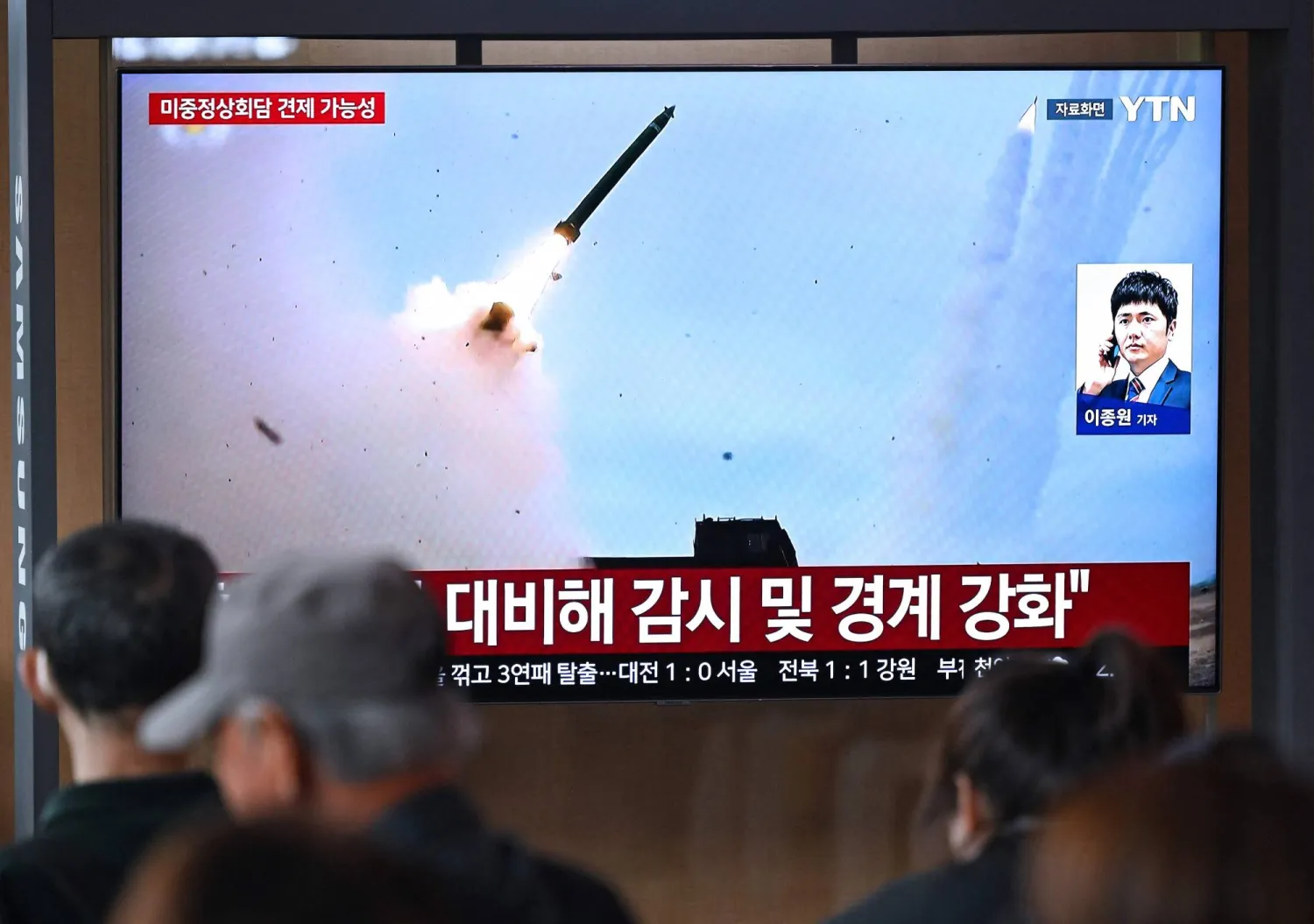

North Korea Fires Multiple Ballistic Missiles into Sea

People watch a television screen showing a news broadcast with file footage of a North Korean missile test, at a train station in Seoul on April 19, 2026. (AFP)
TT

North Korea Fires Multiple Ballistic Missiles into Sea

People watch a television screen showing a news broadcast with file footage of a North Korean missile test, at a train station in Seoul on April 19, 2026. (AFP)

North Korea test-fired multiple short-range ballistic missiles on Sunday, South Korea's military said, the latest in a recent flurry of launches by the nuclear-armed state.

The Sunday launches add to a series of weapons tests Pyongyang has carried out in recent weeks, including ballistic missiles, anti-warship cruise missiles and cluster munitions.

"Our military detected several short-range ballistic missiles fired into the East Sea from the Sinpo area of North Korea at around 6:10 am (GMT 21:10)," South Korea's Joint Chiefs of Staff said, referring to a body of water also known as the Sea of Japan.

"The missiles flew approximately 140 kilometers (86.9 miles), and South Korean and US intelligence authorities are conducting a detailed analysis of their exact specifications," it added.

Seoul is maintaining a "firm combined defense posture" with the United States -- a security ally that stations about 28,000 troops in the South to help it defend against military threats from the North -- and will "respond overwhelmingly to any provocation", it said.

South Korea's presidential office said it held an emergency security meeting over the launches.

Analysts said the tests signaled Pyongyang's latest rejection of attempts by Seoul to repair strained ties.

Among them was an expression of regret from Seoul over civilian drone incursions into the North in January, a gesture initially described as "very fortunate and wise behavior" by Kim Yo Jong, the powerful sister of the North Korean leader.

But this month, a senior North Korean official described the South as "the enemy state most hostile" to Pyongyang, reviving a label previously used by leader Kim Jong Un.

North Korea is subject to multiple United Nations sanctions banning its nuclear weapons development and use of ballistic missile technology, restrictions it has repeatedly flouted.

- Two more destroyers -

Earlier in April, North Korean leader Kim Jong Un oversaw tests of strategic cruise missiles launched from a naval warship, with official photos showing him watching the firings flanked by military officials.

Those tests were carried out from the Choe Hyon, one of two 5,000-ton destroyers in the North's arsenal, both launched last year as Kim Jong Un seeks to ramp up the country's naval capabilities.

The North is also building two more 5,000-ton class destroyers to add to its fleet.

A South Korean lawmaker said this month that North Korea appeared to be speeding up construction of a destroyer at the western port city of Nampo.

Citing satellite imagery from a US-based intelligence firm, Yoo Yong-won of the opposition People Power Party said North Korea was "accelerating the naval forces' modernization on the back of military assistance from Russia".

North Korea has sent ground troops and artillery shells to support Russia's invasion of Ukraine, and observers say Pyongyang is receiving military technology assistance from Moscow in return.



US Vice President Vance Postpones Trip to Switzerland for Iran Talks

Vice President JD Vance speaks to reporters in the James S. Brady Press Briefing Room at the White House, Thursday, June 18, 2026, in Washington. (AP Photo/Manuel Balce Ceneta)
TT

US Vice President Vance Postpones Trip to Switzerland for Iran Talks

Vice President JD Vance speaks to reporters in the James S. Brady Press Briefing Room at the White House, Thursday, June 18, 2026, in Washington. (AP Photo/Manuel Balce Ceneta)

US Vice President JD Vance will not travel to Switzerland as scheduled for talks on Friday following up on the deal to end the war with Iran, according to the White House.

The signing of the accord this week was intended to end the conflict in Iran, reopen the Strait of Hormuz and begin a 60-day period for talks on wider issues, including Tehran's nuclear program, said AFP.

At the same time, the deal was to end the fighting in Lebanon, but new clashes have flared between Israeli forces and Iran-backed Hezbollah militants.

It has also appeared increasingly unlikely that a signing ceremony between the United States and Iran, originally slated for Switzerland on Friday, will take place as planned.

"The logistics of these negotiations have never been simple or predictable. As of now the Vice President is not departing tonight," a White House spokesperson said of Vance late Thursday.

"We look forward to beginning technical talks as soon as possible."

In Iran, the Tasnim agency said "nothing has been confirmed" about the Iranian delegation's trip to Switzerland.

The agreement has been signed separately by US President Donald Trump and his Iranian counterpart Masoud Pezeshkian.

Iran's supreme leader Mojtaba Khamenei said Thursday that he had approved the agreement, despite reservations, even as the United States lifted a blockade of Iranian ports.

Mojtaba Khamenei, who took over after his father and longstanding ruler Ali Khamenei was killed in an airstrike on the first day of the war on February 28, said in a written statement that he held a "different view" on the deal, without elaborating.

"But I issued my permission due to the commitment" made by officials including Pezeshkian to "protect the rights of the Iranian nation".

"Face-to-face negotiations" with the United States will be held in the future, but that does not "mean accepting the enemy's point of view", he added.

On Friday, Iran's chief negotiator Mohammad Bagher Ghalibaf warned that Tehran would give a "decisive" response if the agreement was breached.

- 'Maybe they start fighting again' -

American forces on Thursday lifted their naval blockade of Iranian ports that had prevented ships from sailing to or from the Iranian republic, the US military said, noting that American warships "will remain in the general area".

Activity was still muted in the Strait of Hormuz, the strategic bottleneck for energy shipments that Iran blockaded during the conflict.

Three Saudi oil tankers left the Gulf through the strait on Thursday, maritime trackers said, as did a French vessel loaded with liquefied natural gas.

Iranian state TV, citing a statement from the country's Supreme National Security Council, said that ships "seeking passage through the Strait of Hormuz must submit their request" to a new government body tasked with overseeing the waterway.

In keeping with the terms of the deal, it added, "no fees whatsoever will be collected from applicants for a period of sixty days".

The deal should bring an end to the current US-Israeli conflict with Iran, which saw five weeks of all-out war until a ceasefire was struck in early April.

But fighting has continued in Lebanon, with Tehran-backed Hezbollah saying on Friday that its fighters destroyed three Israeli tanks in the country's south and that clashes were "ongoing".

Israel has yet to confirm if its tanks were hit.

Three people were also killed in Lebanon by Israeli drone strikes, the country's official National News Agency reported on Thursday.

Hezbollah drew Lebanon into the Middle East war in March by attacking Israel to avenge the killing of Iran's supreme leader at the start of the US-Israeli campaign.

Some in Tehran were downbeat at the prospects for peace.

"I have no hope that this is a lasting agreement. Maybe after the 60 days they start fighting again," said Mina, 54, a psychologist from Tehran.

Her sentiment was shared by French President Emmanuel Macron, who presided over the signing at the Palace of Versailles in what he described as a "spontaneous" move by Trump.

Macron said he did not believe that the war was "totally finished".

- 'What does that get us?' -

Under the text, Washington commits to immediately waive oil sanctions crippling Iran's economy.

And once a final agreement is reached on Iran's nuclear program, the United States will facilitate the release of a $300 billion reconstruction fund supported by regional nations, the deal says.

Trump's decision to end the war, in which 13 US service members were killed and a vast proportion of US ammunition stockpiles was used, has unsettled some of his allies at home.

US Senator Bill Cassidy from Trump's Republican Party described it as the "worst foreign policy blunder in decades".

But Trump argued that using military force to wring more concessions out of Tehran would have been counterproductive.

"The only way I can get tougher is if I go in there for another two or three weeks and continue to bomb the hell out of 'em. Right? But what does that get us? The Strait of Hormuz will not be open," he told Axios.

"We wouldn't have oil for months," he said. "This is the kind of thing that could cause a worldwide depression."


US Strike on Alleged Drug Boat Kills 3 in Eastern Pacific Ocean

A US strike targeted a boat suspected of being used for drug smuggling in the Eastern Pacific (Reuters file photo)
TT

US Strike on Alleged Drug Boat Kills 3 in Eastern Pacific Ocean

A US strike targeted a boat suspected of being used for drug smuggling in the Eastern Pacific (Reuters file photo)

The US military attacked a boat accused of smuggling drugs in the eastern Pacific Ocean on Thursday, killing three people, as the Trump administration wages a monthslong campaign against alleged traffickers in Latin America.

The latest attack brings the number of people who have been killed in boat strikes by the US military to at least 211 since the Trump administration began targeting those it calls “narcoterrorists” in early September.

As with most of the military’s statements on strikes in the eastern Pacific Ocean and Caribbean Sea, US Southern Command said it targeted the alleged drug traffickers along known smuggling routes.

The military did not provide evidence that the vessel was ferrying drugs. A video posted on X showed a boat speeding through the water before being struck and bursting into flames.

President Donald Trump has said the US is in “armed conflict” with cartels in Latin America and has justified the attacks as a necessary escalation to stem the flow of drugs into the United States and fatal overdoses claiming American lives. But his administration has offered little evidence to support its claims of killing “narcoterrorists.”

Critics have questioned the overall legality of the boat strikes as well as their effectiveness, in part because the fentanyl behind many fatal overdoses is typically trafficked to the US over land from Mexico, where it is produced with chemicals imported from China and India.

Senators on Thursday demanded that the Pentagon release “unedited video” of the strikes, The Associated Press reported. They have drawn intense scrutiny from some Democratic lawmakers and military legal scholars. The US military’s first strike in early September drew particular concern from some lawmakers and those who study military law.

Two men on the boat initially survived the attack that killed nine others, and they were clinging to the wreckage when the vessel was struck again, killing them. The White House confirmed the follow-up strike, insisting it was done “in self-defense” to ensure the boat was destroyed and in accordance with the laws of armed conflict.

But some legal scholars said a second strike killing survivors would have been illegal under any circumstance, armed conflict or not.

The Pentagon’s watchdog said in May that it plans to look into whether the US military followed an established targeting framework when carrying out the strikes. However, the evaluation is focused specifically on what’s known as the six-phase Joint Targeting Cycle and not on the legality of the strikes, the inspector general’s office said.


Iran's Khamenei Says He Approved MoU with US, Despite Reservations, after Assurances on Iran's Rights

Iranians walk past a billboard depicting Iran's late supreme leader Ruhollah Khomeini (L), his successor, the late Ali Khamenei (C), and the new supreme leader Mojtaba Khamenei outside the former US embassy in Tehran on June 15, 2026. (Photo by ATTA KENARE / AFP) /
TT

Iran's Khamenei Says He Approved MoU with US, Despite Reservations, after Assurances on Iran's Rights

Iranians walk past a billboard depicting Iran's late supreme leader Ruhollah Khomeini (L), his successor, the late Ali Khamenei (C), and the new supreme leader Mojtaba Khamenei outside the former US embassy in Tehran on June 15, 2026. (Photo by ATTA KENARE / AFP) /

Iran's ‌Supreme Leader Mojtaba Khamenei said on Thursday he had authorized a memorandum of understanding signed by the Iranian and US presidents, despite holding a different view, after ‌receiving assurances ‌from President ‌Masoud Pezeshkian ⁠and other senior officials ⁠that Iran's rights and the interests of the "Resistance Front" would be safeguarded, Reuters reported.

In a written message ⁠to the Iranian ‌nation, ‌Khamenei said Pezeshkian, in his ‌capacity as head ‌of the Supreme National Security Council, had accepted responsibility for ensuring the agreement ‌protected Iran's interests and pledged not ⁠to ⁠yield if Washington made what he described as excessive demands.

Khamenei added that future face-to-face negotiations with the United States would not mean accepting "the enemy's position".