


Dozens Killed in One of Deadliest Days Since Myanmar Coup

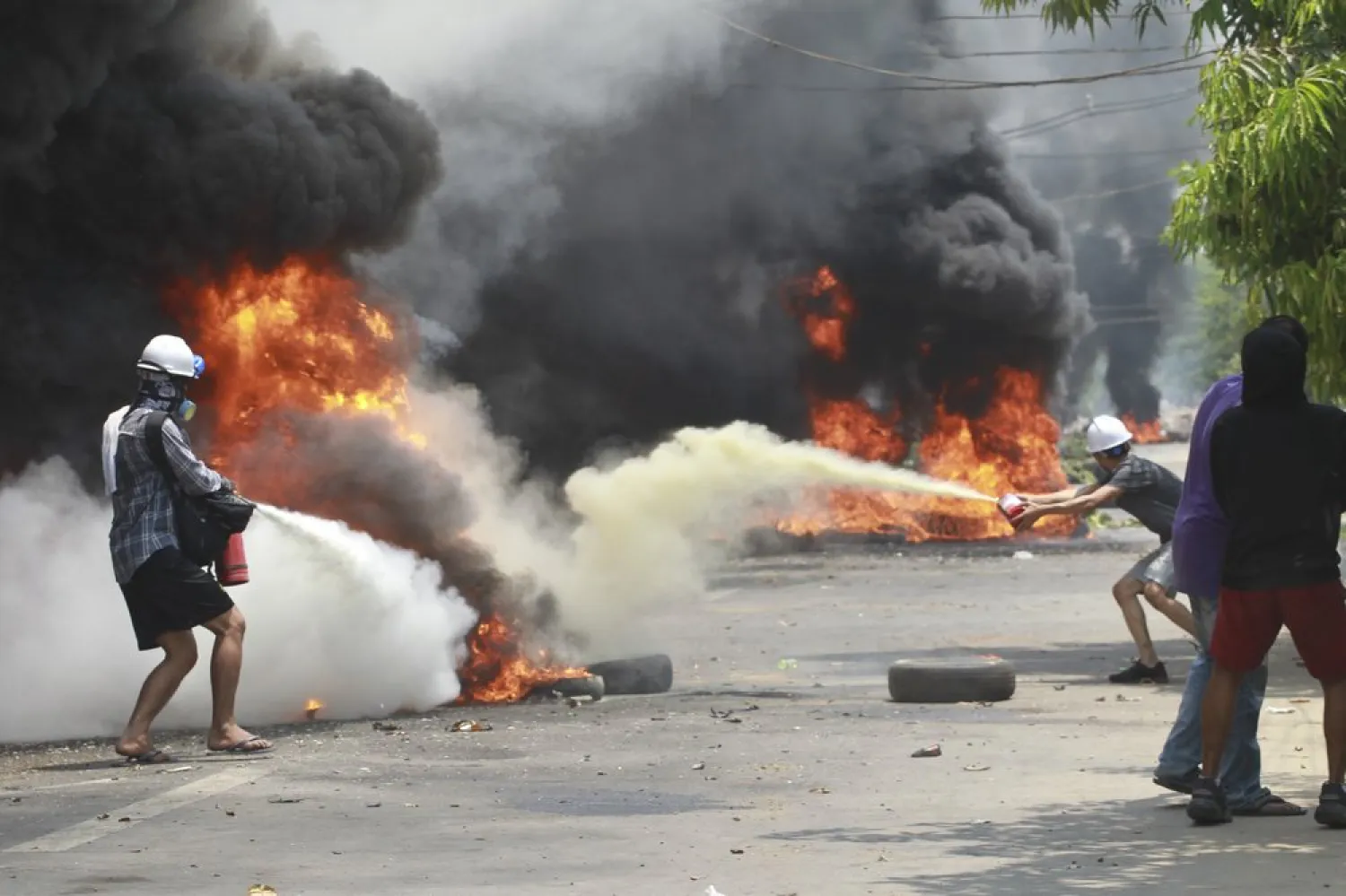
Anti-coup protesters extinguish fires during a protest in Thaketa township Yangon, Myanmar, Saturday, March 27, 2021. (AP)
TT

Dozens Killed in One of Deadliest Days Since Myanmar Coup

Anti-coup protesters extinguish fires during a protest in Thaketa township Yangon, Myanmar, Saturday, March 27, 2021. (AP)

As Myanmar’s military celebrated the annual Armed Forces Day holiday with a parade Saturday in the country's capital, soldiers and police elsewhere reportedly killed dozens of people as they suppressed protests against last month's coup.

A count issued by an independent researcher in Yangon who has been compiling near-real time death tolls put the total killed by late Saturday afternoon at 74, spread over more than two dozen cities and towns. That would make it equal to the deadliest day since the coup.

Figures collected by the researcher, who asked not to be named for his security, have generally tallied with the counts issued at the end of each day by the Assistance Association of Political Prisoners, which documents deaths and arrests and is widely seen as a definitive source. The Associated Press is unable to independently confirm the death tolls.

The killings quickly drew international condemnation, with multiple diplomatic missions to Myanmar releasing statements that mentioned the killing of civilians Saturday, including children.

“This 76th Myanmar armed forces day will stay engraved as a day of terror and dishonor,” the European Union’s delegation to Myanmar said on Twitter. “The killing of unarmed civilians, including children, are indefensible acts.”

The death toll in Myanmar has been steadily rising as authorities grow more forceful with their suppression of opposition to the Feb. 1 coup that ousted the elected government of Aung San Suu Kyi. The coup reversed years of progress toward democracy after five decades of military rule.

Up through Friday, the Association of Political Prisoners had verified 328 people killed in the post-coup crackdown. The highest daily death toll had been at least 74 people on March 14, but on that occasion all but a handful of deaths were in Yangon, the country’s biggest city.

Junta chief Senior Gen. Min Aung Hlaing did not directly refer to the protest movement when he gave his nationally televised Armed Forces Day speech before thousands of soldiers in Naypyitaw. He referred only to “terrorism which can be harmful to state tranquility and social security,” and called it unacceptable.

This year’s event was seen as a flashpoint for violence, with demonstrators threatening to double down on their public opposition to the coup with more and bigger demonstrations. The protesters refer to the holiday by its original name, Resistance Day, which marks the beginning of a revolt against Japanese occupation in World War II.

State television MRTV on Friday night showed an announcement urging young people — who have been at the forefront of the protests and prominent among the casualties — to learn a lesson from those killed during demonstrations about the danger of being shot in the head or back.

The warning was widely taken as a threat because a great number of the fatalities among protesters have come from being shot in the head, suggesting they have been targeted for death. The announcement suggested that some young people were taking part in protesting as if it was a game, and urged their parents and friends to talk them out of participating.

In recent days the junta has portrayed the demonstrators as the ones perpetrating violence for their sporadic use of Molotov cocktails. In contrast, security forces have used live ammunition for weeks against overwhelmingly unarmed and peaceful crowds.

The military government does not issue regular casualty counts, and when it has released figures, the totals have been a fraction of what independent parties such as the UN have reported. It has said its use of force has been justified to stop what it has called rioting.

In his speech Saturday, Min Aung Hlaing used the occasion to try to justify the overthrow of Suu Kyi’s government, accusing it of failing to investigate irregularities in last November’s general election, and repeating that his government would hold “a free and fair election” and hand over power afterward.

The military has claimed there were irregularities in the voting rolls for the last election, which Suu Kyi’s National League for Democracy party won in a landslide.

The junta detained Suu Kyi on the day it took power, and continues to hold her on minor criminal charges while investigating allegations of corruption against her that her supporters dismiss as politically motivated.

Phil Robertson, deputy Asia director for New York-based Human Rights Watch, said Saturday's events showed that the military, known in Myanmar as the Tatmadaw, should be prosecuted in international courts of law.

“This is a day of suffering and mourning for the Burmese people, who have paid for the Tatmadaw’s arrogance and greed with their lives, time and time again,” he said.



Iran ‘Drafting Framework to Advance’ Future US Talks, Says FM

Iranian Foreign Minister Abbas Araghchi speaks during the Conference on Disarmament at the European headquarters of the United Nations in Geneva, Switzerland, 17 February 2026. (EPA)
TT

Iran ‘Drafting Framework to Advance’ Future US Talks, Says FM

Iranian Foreign Minister Abbas Araghchi speaks during the Conference on Disarmament at the European headquarters of the United Nations in Geneva, Switzerland, 17 February 2026. (EPA)

Iran's top diplomat Abbas Araghchi said on Wednesday that Tehran was "drafting" a framework for future talks with the United States, as the US energy secretary said Washington would stop Iran's nuclear ambitions "one way or another".

Diplomatic efforts are underway to avert the possibility of US military intervention in Iran, with Washington conducting a military build-up in the region.

Iran and the US held a second round of Oman-mediated negotiations on Tuesday in Geneva, after talks last year collapsed following Israel's attack on Iran in June, which started a 12-day war.

Araghchi said on Tuesday that Tehran had agreed with Washington on "guiding principles", but US Vice President JD Vance said Tehran had not yet acknowledged all of Washington's "red lines".

On Wednesday, Araghchi held a phone call with Rafael Grossi, the head of the UN nuclear watchdog, the International Atomic Energy Agency.

In the call, Araghchi "stressed Iran's focus on drafting an initial and coherent framework to advance future talks", according to a statement from the Iranian foreign ministry.

Also on Wednesday, US Energy Secretary Chris Wright warned that Washington would deter Tehran from acquiring nuclear weapons "one way or the other".

"They've been very clear about what they would do with nuclear weapons. It's entirely unacceptable," Wright told reporters in Paris on the sidelines of meetings of the International Energy Agency.

Earlier on Wednesday, Reza Najafi, Iran's permanent representative to the IAEA in Vienna, held a joint meeting with Grossi and the ambassadors of China and Russia "to exchange views" on the upcoming session of the agency's board of governors meetings and "developments related to Iran's nuclear program", Iran's mission in Vienna said on X.

Tehran has suspended some cooperation with the IAEA and restricted the watchdog's inspectors from accessing sites bombed by Israel and the United States, accusing the UN body of bias and of failing to condemn the strikes.

- Displays of military might -

The Omani-mediated talks were aimed at averting the possibility of US military action, while Tehran is demanding the lifting of US sanctions that are crippling its economy.

Iran has insisted that the discussions be limited to the nuclear issue, though Washington has previously pushed for Tehran's ballistic missiles program and support for armed groups in the region to be on the table.

US President Donald Trump has repeatedly threatened to intervene militarily against Iran, first over a deadly crackdown on protesters last month and then more recently over its nuclear program.

On Wednesday, Israeli President Isaac Herzog sent a message to Iranians, saying "I want to send the people of Iran best wishes for the month of Ramadan, and I truly hope and pray that this reign of terror will end and that we will see a different era in the Middle East," according to a statement from his office.

Washington has ordered two aircraft carriers to the region, with the first, the USS Abraham Lincoln with nearly 80 aircraft, positioned about 700 kilometers (435 miles) from the Iranian coast as of Sunday, satellite images showed.

Iran has also sought to display its own military might, with its Islamic Revolutionary Guard Corps beginning a series of war games on Monday in the Strait of Hormuz.

Iranian politicians have repeatedly threatened to block the strait, a major global conduit for oil and gas.

On Tuesday, state TV reported that Tehran would close parts of the waterway for safety measures during the drills.

Iran's supreme leader warned on Tuesday that the country had the ability to sink a US warship deployed to the region.


US Judge Blocks Deportation of Columbia University Palestinian Activist

Mohsen Mahdawi at a press conference in Vermont last year - Photo by Alex Driehaus/AP
TT

US Judge Blocks Deportation of Columbia University Palestinian Activist

Mohsen Mahdawi at a press conference in Vermont last year - Photo by Alex Driehaus/AP

A US immigration judge has blocked the deportation of a Palestinian graduate student who helped organize protests at Columbia University against Israel's war in Gaza, according to US media reports.

Mohsen Mahdawi was arrested by immigration agents last year as he was attending an interview to become a US citizen.

Mahdawi had been involved in a wave of demonstrations that gripped several major US university campuses since Israel began a massive military campaign in the Gaza Strip.

A Palestinian born in the occupied West Bank, Mahdawi has been a legal US permanent resident since 2015 and graduated from the prestigious New York university in May. He has been free from federal custody since April.

In an order made public on Tuesday, Judge Nina Froes said that President Donald Trump's administration did not provide sufficient evidence that Mahdawi could be legally removed from the United States, multiple media outlets reported.

Froes reportedly questioned the authenticity of a copy of a document purportedly signed by Secretary of State Marco Rubio that said Mahdawi's activism "could undermine the Middle East peace process by reinforcing antisemitic sentiment," according to the New York Times.

Rubio has argued that federal law grants him the authority to summarily revoke visas and deport migrants who pose threats to US foreign policy.

The Trump administration can still appeal the decision, which marked a setback in the Republican president's efforts to crack down on pro-Palestinian campus activists.

The administration has also attempted to deport Mahmoud Khalil, another student activist who co-founded a Palestinian student group at Columbia, alongside Mahdawi.

"I am grateful to the court for honoring the rule of law and holding the line against the government's attempts to trample on due process," Mahdawi said in a statement released by his attorneys and published Tuesday by several media outlets.

"This decision is an important step towards upholding what fear tried to destroy: the right to speak for peace and justice."


Fire Breaks out Near Iran's Capital Tehran, State Media Says

Smoke rises from a fire caused by an explosion in Tehran (File photo - Reuters)
TT

Fire Breaks out Near Iran's Capital Tehran, State Media Says

Smoke rises from a fire caused by an explosion in Tehran (File photo - Reuters)

A fire broke out in Iran's Parand near the capital city Tehran, state media reported on Wednesday, publishing videos of smoke rising over the area which is close to several military and strategic sites in the country's Tehran province, Reuters reported.

"The black smoke seen near the city of Parand is the result of a fire in the reeds around the Parand river bank... fire fighters are on site and the fire extinguishing operation is underway", state media cited the Parand fire department as saying.