


Saudi Arabia Sets Stage for New Way for Tackling Carbon Emissions

Saudi Arabia Sets Stage for New Way for Tackling Carbon Emissions
TT

Saudi Arabia Sets Stage for New Way for Tackling Carbon Emissions

Saudi Arabia Sets Stage for New Way for Tackling Carbon Emissions

Saudi Arabia, during its G20 presidency, succeeded in launching a global platform for the circular carbon economy.

The circular carbon economy (CCE) is a system where carbon emissions are reduced, reused, recycled and removed (4R). Such a closed-loop system which was inspired by how nature works will support Saudi Arabia’s march towards achieving its own national transformation plan, dubbed “Kingdom Vision 2030.”

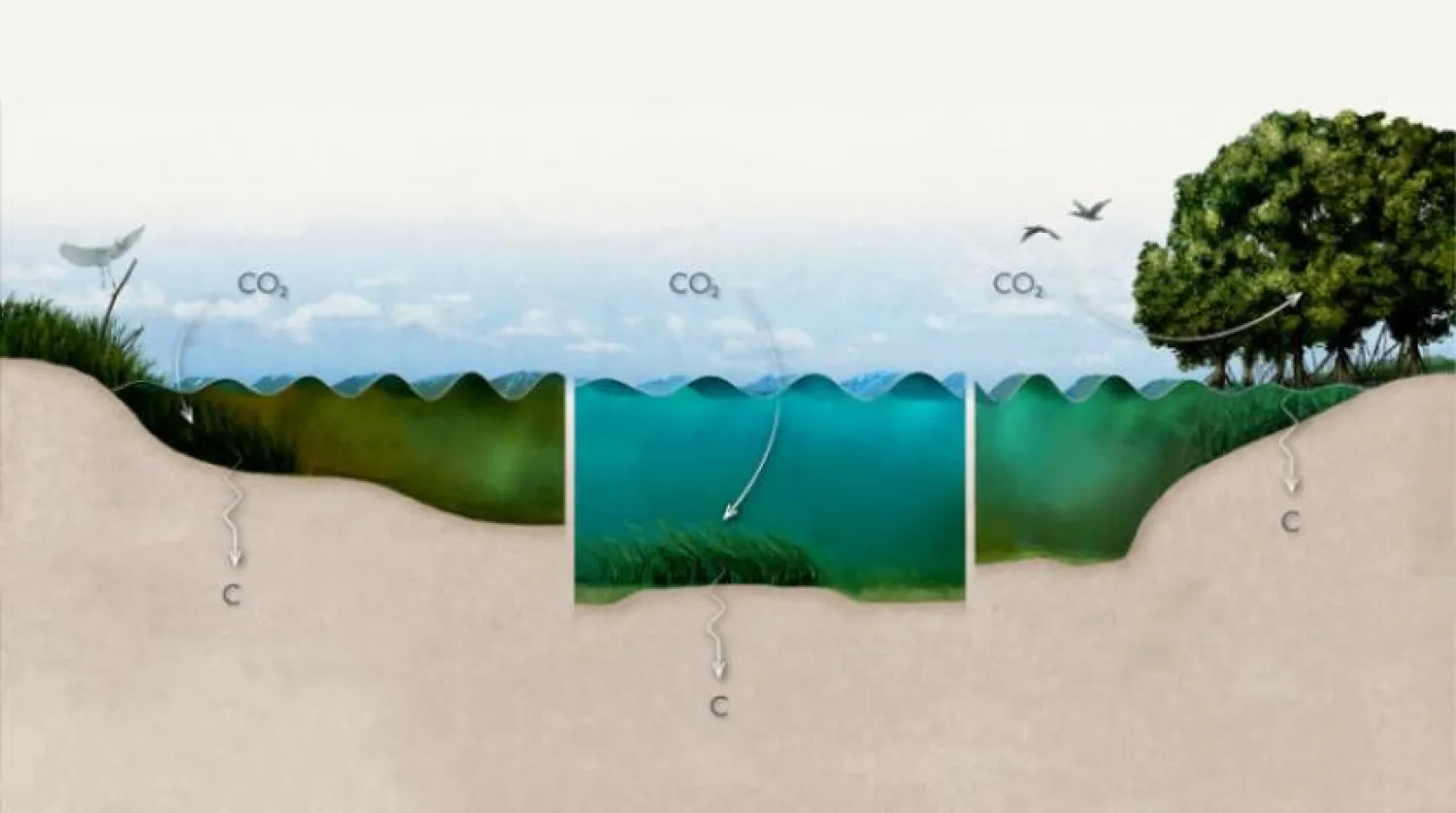
From developing cleaner-burning fuels to optimizing the performance of renewable energy technologies and from maximizing the oceans’ storage of blue carbon to minimizing the energy input needed to drive industrial processes, researchers at the King Abdullah University of Science and Technology (KAUST) aim to change the carbon narrative to reduce, reuse, recycle and remove.

In December 2020, KAUST launched a CCE initiative that focuses on increasing energy efficiency, capturing and storing carbon, transforming carbon into something useful and integrating renewable resources.

KAUST researchers have compiled a preliminary database for CO2 emissions from more than 1,200 industries involved in electricity generation, desalination, oil refineries, the cement industry, petrochemicals and iron and steel production. Future work aims to pinpoint potential CO2 storage sites within subsurface geological formations.

“Before life emerged on Earth, its atmosphere was formed of 98 per[1]cent carbon dioxide (CO2) with sur[1]face temperatures exceeding 240 degrees Celsius. Life modified Earth, particularly photosynthesis from cyanobacteria, releasing oxy[1]gen while reducing atmospheric carbon dioxide by transforming it into living carbon and stored organic matter,” explained KAUST marine ecologist Carlos Duarte.

“KAUST is a reference university for circular-carbon[1]economy-related research,” reaffirmed chemical engineer, Jorge Gascon.

“We cover the whole circularity concept, with very important contributions toward the 4 Rs,” he asserted.

More so, Iain McCulloch and his research group at KAUST are finding ways to reduce CO2 emissions by improving the ability to harness the sun’s energy.

A team led by McCulloch from the KAUST Solar Center, in partnership with researchers from the US and the UK, has developed hydrogen evolution photocatalysts (HEPs) made from two different semiconducting materials. They incorporated these materials into organic nanoparticles that can be tuned to absorb more of the visible light spectrum.



President of Yemeni Presidential Leadership Council Nullifies Joint Defense Agreement with UAE

Dr. Rashad Al-Alimi during his interview with Asharq Al-Awsat (Yemeni Presidency)
TT

President of Yemeni Presidential Leadership Council Nullifies Joint Defense Agreement with UAE

Dr. Rashad Al-Alimi during his interview with Asharq Al-Awsat (Yemeni Presidency)

President of the Presidential Leadership Council of the Republic of Yemen Dr. Rashad Mohammed Al-Alimi issued a presidential decree on Tuesday nullifying the joint defense agreement with the United Arab Emirates, based on the Constitution of the Republic of Yemen, the Gulf Cooperation Council Initiative and its implementation mechanism, the decision on the transfer of power, the formation of the Presidential Leadership Council, and the powers granted to it under the constitution, according to the Yemen News Agency (Saba).

Article Two of the decree mandates that all UAE forces and personnel withdraw from Yemeni territory within 24 hours, according to SPA.

Article Three instructs the Homeland Shield forces to assume control of all military camps in Hadramout and Al-Mahara governorates.


Yemeni Government Commends Saudi Historic Stance and Its Leadership of the Coalition to Restore Legitimacy

File photo of the Saudi flag/AAWSAT
TT

Yemeni Government Commends Saudi Historic Stance and Its Leadership of the Coalition to Restore Legitimacy

File photo of the Saudi flag/AAWSAT

The Yemeni government commended the Kingdom of Saudi Arabia's historic and steadfast stances, highlighting its crucial role in ensuring Yemen's security and stability.

The government acknowledged Saudi Arabia's leadership of the Coalition to Restore Legitimacy and its ongoing commitment to protecting civilians, de-escalating tensions, and preventing the eastern governorates from being drawn into conflicts that serve hostile agendas, SPA reported.

In an official statement, the government called on the Southern Transitional Council to withdraw immediately and unconditionally from the governorates of Hadramout and Al-Mahara. It urged the council to hand over all locations and camps to the Homeland Shield Forces and local authorities in these governorates, to adhere to the terms of reference of the transitional phase, and to cease all military or escalatory actions that threaten local security and undermine de-escalation efforts.

The statement, which was reported by the Yemen News Agency (Saba), expressed the government's full support for the decisions made by President of the Presidential Leadership Council of the Republic of Yemen Dr. Rashad Mohammed Al-Alimi, who is also Supreme Commander of the Armed Forces.

This includes declaring a state of emergency across Yemen and taking necessary sovereign measures to protect local security, preserve the unity and sovereignty of the state, and maintain its legal status in light of the dangerous developments in Yemen's eastern governorates.

The government stated: "The declaration of a state of emergency is grounded in the constitution and the references of the transitional phase, based on the recommendations of the National Defense Council.

It is a legitimate constitutional measure necessitated by our national duty to confront armed rebellion, protect civil peace, and prevent a descent into chaos that could undermine state institutions."


Custodian of the Two Holy Mosques Receives Written Message from Russian President

Russian Ambassador to the Kingdom Sergey Kozlov and Saudi Vice Minister of Foreign Affairs Waleed Elkhereiji meet in Riyadh on Tuesday. (SPA)
TT

Custodian of the Two Holy Mosques Receives Written Message from Russian President

Russian Ambassador to the Kingdom Sergey Kozlov and Saudi Vice Minister of Foreign Affairs Waleed Elkhereiji meet in Riyadh on Tuesday. (SPA)

Custodian of the Two Holy Mosques King Salman bin Abdulaziz Al Saud received on Tuesday a written message from Russian President Vladimir Putin on bilateral ties between their countries.

Russian Ambassador to the Kingdom Sergey Kozlov delivered the message to Vice Minister of Foreign Affairs Waleed Elkhereiji at the ministry’s headquarters in Riyadh.

The officials reviewed the strong relations between Saudi Arabia and Russia and discussed the latest regional and international developments, as well as efforts exerted to address them.