


Egypt Unveils 3,000-Year-Old 'Lost' City near Luxor

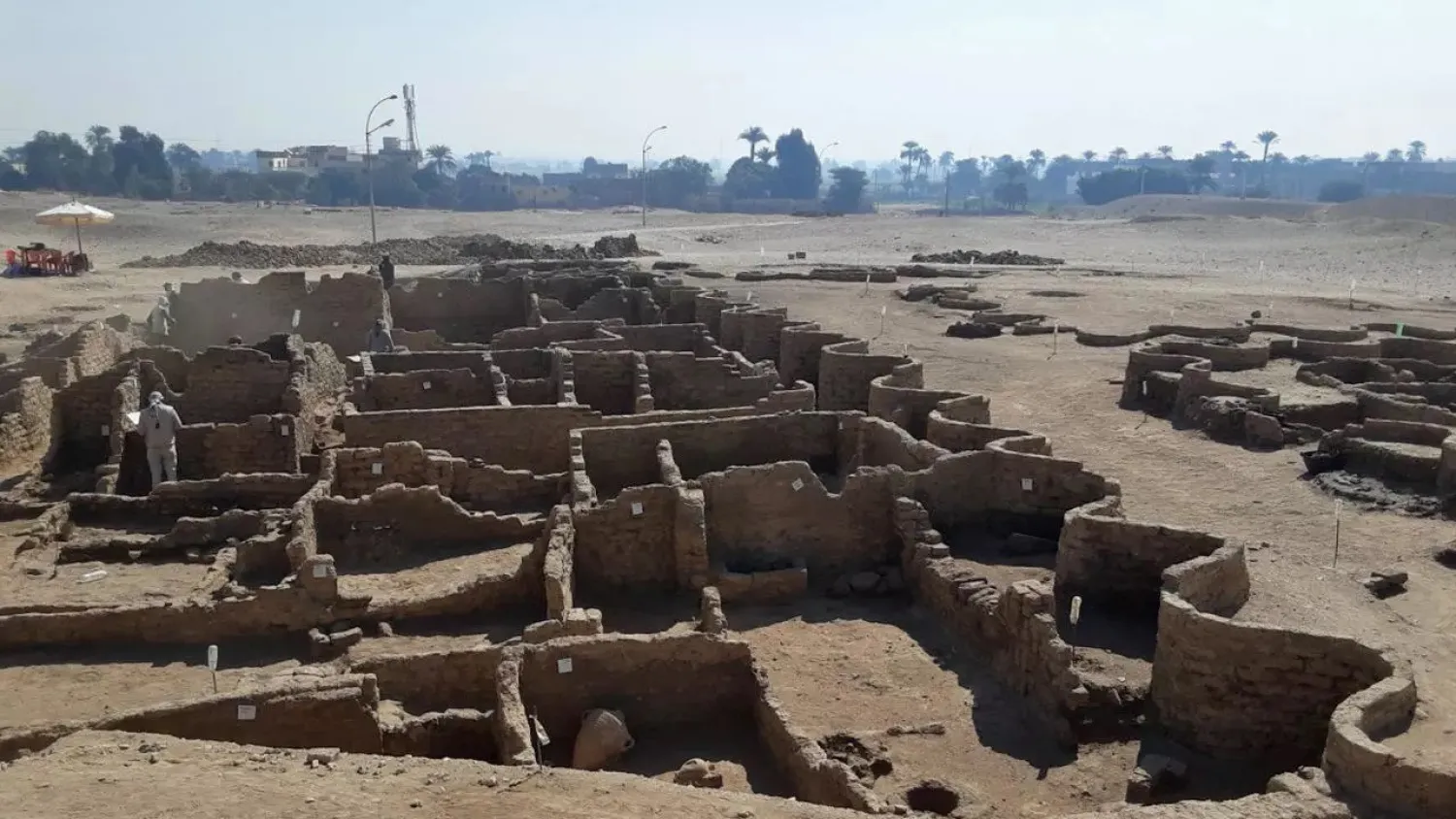
The team began excavations in September between the temples of Ramses III and Amenhotep III near Luxor, some 500 kilometers (300 miles) south of Cairo. (Egyptian Ministry of Antiquities/AFP)
TT

Egypt Unveils 3,000-Year-Old 'Lost' City near Luxor

The team began excavations in September between the temples of Ramses III and Amenhotep III near Luxor, some 500 kilometers (300 miles) south of Cairo. (Egyptian Ministry of Antiquities/AFP)

Archaeologists Saturday showed off their finds at what they say is the "largest" ancient city ever found in Egypt, dating to a golden age of the pharaohs 3,000 years ago.

At the site near Luxor, home of the legendary Valley of the Kings, workers carefully carried ancient pots and showed human and animal remains dug up from the earth as members of the media toured around curved brick walls and rudimentary streets.

"This is a large city that was lost. It was connected with the god Aton and Amenhotep III," famed Egyptologist Zahi Hawass enthusiastically told reporters Saturday.

"We found three major districts: one for administration, one for workers to sleep in and another for industry," he said.

Spaces include workshops for drying meat, making clothes and sandals, and crafting amulets and small statues.

Mostafa Waziri, head of the country's Supreme Council of Antiquities said the site was not limited to buildings.

"We can see... economic activity, workshops and ovens," he said.

Hawass had announced earlier this week the discovery of a "lost golden city", and the archaeological team said the find was "the largest" ancient city ever uncovered in Egypt.

"We found one portion of the city only," Hawass told AFP Saturday. "The city extends to the west and the north."

The team began excavations in September between the temples of Ramses III and Amenhotep III near Luxor, some 500 kilometers (300 miles) south of Cairo.

Amenhotep III inherited an empire that stretched from the Euphrates River in modern Iraq and Syria to Sudan and died around 1354 BC, ancient historians say.

He ruled for nearly four decades, a reign known for its opulence and the grandeur of its monuments, including the Colossi of Memnon -- two massive stone statues near Luxor that represent him and his wife.

Betsy Bryan, professor of Egyptian art and archaeology at Johns Hopkins University, had said in a statement this week that the find was the "second most important archaeological discovery since the tomb of Tutankhamun" nearly a century ago.

"The archaeological layers have laid untouched for thousands of years, left by the ancient residents as if it were yesterday," the team's statement said.

Archaeologists have unearthed items of jewelry, colored pottery vessels, scarab beetle amulets and mud bricks bearing seals of Amenhotep III.

Hawass said "a large fish covered in gold" may have been venerated.

Jose Galan, head of a separate Spanish archaeological mission near the Valley of the Kings, told AFP Saturday that the site was "a fantastic discovery".

"We are used to discoveries related to temples and tombs so we know about religious life and funerary habits. But we don't know much about settlements," he said.

The team have said they were optimistic that further important finds would be revealed, noting the discovery of groups of tombs reached through "stairs carved into the rock", a similar construction to those found in the Valley of the Kings.

Last week, the mummified remains of 18 ancient kings and four queens were transported across Cairo from the Egyptian Museum in iconic Tahrir Square to the new National Museum of Egyptian Civilization, in a procession dubbed the "Pharaohs' Golden Parade" watched by millions.



Thieves Drill into a German Bank Vault and Steal Tens of Millions of Euros Worth of Property

 Police officers stand in front of the savings bank branch in the Buer district in Gelsenkirchen, Germany, Tuesday, Dec. 30, 2025 following a break-in into the bank's vault. (Christoph Reichwein/dpa via AP)
Police officers stand in front of the savings bank branch in the Buer district in Gelsenkirchen, Germany, Tuesday, Dec. 30, 2025 following a break-in into the bank's vault. (Christoph Reichwein/dpa via AP)
TT

Thieves Drill into a German Bank Vault and Steal Tens of Millions of Euros Worth of Property

 Police officers stand in front of the savings bank branch in the Buer district in Gelsenkirchen, Germany, Tuesday, Dec. 30, 2025 following a break-in into the bank's vault. (Christoph Reichwein/dpa via AP)
Police officers stand in front of the savings bank branch in the Buer district in Gelsenkirchen, Germany, Tuesday, Dec. 30, 2025 following a break-in into the bank's vault. (Christoph Reichwein/dpa via AP)

Thieves stole tens of millions of euros worth of property from safety deposit boxes inside a German bank vault that they drilled into Monday during the holiday lull, police said.

Some 2,700 bank customers were affected by the theft in Gelsenkirchen, police and the Sparkasse bank said.

Thomas Nowaczyk, a police spokesperson, said investigators believe the theft was worth between 10 and 90 million euros ($11.7 to 105.7 million).

German news agency dpa reported that the theft could be one of Germany's largest heists.

The bank remained closed Tuesday, when some 200 people showed up demanding to get inside, dpa reported.

A fire alarm summoned police officers and firefighters to the bank branch shortly before 4 a.m. Monday. They found a hole in the wall and the vault ransacked. Police believe a large drill was used to break through the vault's basement wall.

Witnesses told investigators they saw several men carrying large bags in a nearby parking garage over the weekend. Video footage from the garage shows masked people inside a stolen vehicle early Monday, police said.

Gelsenkirchen is about 192 kilometers (119 miles) northwest of Frankfurt.


The Year's First Meteor Shower and Supermoon Clash in January Skies

People look up to the sky from an observatory near the village of Avren, Bulgaria, Aug. 12, 2009. (AP Photo/Petar Petrov, File)
TT

The Year's First Meteor Shower and Supermoon Clash in January Skies

People look up to the sky from an observatory near the village of Avren, Bulgaria, Aug. 12, 2009. (AP Photo/Petar Petrov, File)

The year's first supermoon and meteor shower will sync up in January skies, but the light from one may dim the other.

The Quadrantid meteor shower peaks Friday night into Saturday morning, according to the American Meteor Society. In dark skies during the peak, skygazers typically see around 25 meteors per hour, but this time they'll likely glimpse less than 10 per hour due to light from Saturday's supermoon, The AP news reported.

“The biggest enemy of enjoying a meteor shower is the full moon,” said Mike Shanahan, planetarium director at Liberty Science Center in New Jersey.

Meteor showers happen when speedy space rocks collide with Earth’s atmosphere, burning up and leaving fiery tails in their wake — the end of a “shooting star.” A handful of meteors are visible on any given night, but predictable showers appear annually when Earth passes through dense streams of cosmic debris.

Supermoons occur when a full moon is closer to Earth in its orbit. That makes it appear up to 14% bigger and 30% brighter than the faintest moon of the year, according to NASA. That difference can be tough to notice with the naked eye.

Supermoons, like all full moons, are visible in clear skies everywhere that it's night. The Quadrantids, on the other hand, can be seen mainly from the Northern Hemisphere. Both can be glimpsed without any special equipment.

To spot the Quadrantids, venture out in the early evening away from city lights and watch for fireballs before the moon crashes the party, said Jacque Benitez with the Morrison Planetarium at the California Academy of Sciences. Skygazers can also try looking during early dawn hours on Sunday.

Wait for your eyes to get used to the darkness, and don’t look at your phone. The space rocks will look like fast-moving white dots and appear over the whole sky.

Meteor showers are named for the constellation where the fireballs appear to come from. The Quadrantids — space debris from the asteroid 2003 EH1 — are named for a constellation that's no longer recognized.

The next major meteor shower, called the Lyrids, is slotted for April.

Supermoons happen a few times a year and come in groups, taking advantage of the sweet spot in the moon’s elliptical orbit. Saturday night’s event ends a four-month streak that started in October. There won't be another supermoon until the end of 2026.


New Maritime Theater in Jazan to Host the City's Festival Opening

The site also includes various amenities, such as shopping zones, kiosks for dining, an art gallery - SPA
TT

New Maritime Theater in Jazan to Host the City's Festival Opening

The site also includes various amenities, such as shopping zones, kiosks for dining, an art gallery - SPA

The Jazan city theater on the southern corniche will host the opening ceremony of the Jazan Festival 2026 on Friday. This event will take place at a 35-square-kilometer site that features the Kingdom's largest maritime theater, SPA reported.

The theater accommodates more than 10,000 spectators and features five VIP areas. To ensure a smooth experience, the venue offers parking for over 9,000 vehicles, providing easy access during peak times.

Built specifically for the festival, the stage meets stringent safety and technical standards, providing a high-quality audiovisual experience against the stunning backdrop of the Red Sea.

The site also includes various amenities, such as shopping zones, kiosks for dining, an art gallery, a play area for children, a bird garden, and a regional museum, showcasing the region's history and culture.

This temporary maritime theater aims to provide a cohesive experience, integrating entertainment, culture, shopping, and services in one location, further establishing Jazan as a year-round destination for tourism and entertainment.