


Haaland Transfer Saga Is a Grotesque Circus We May Never See Again

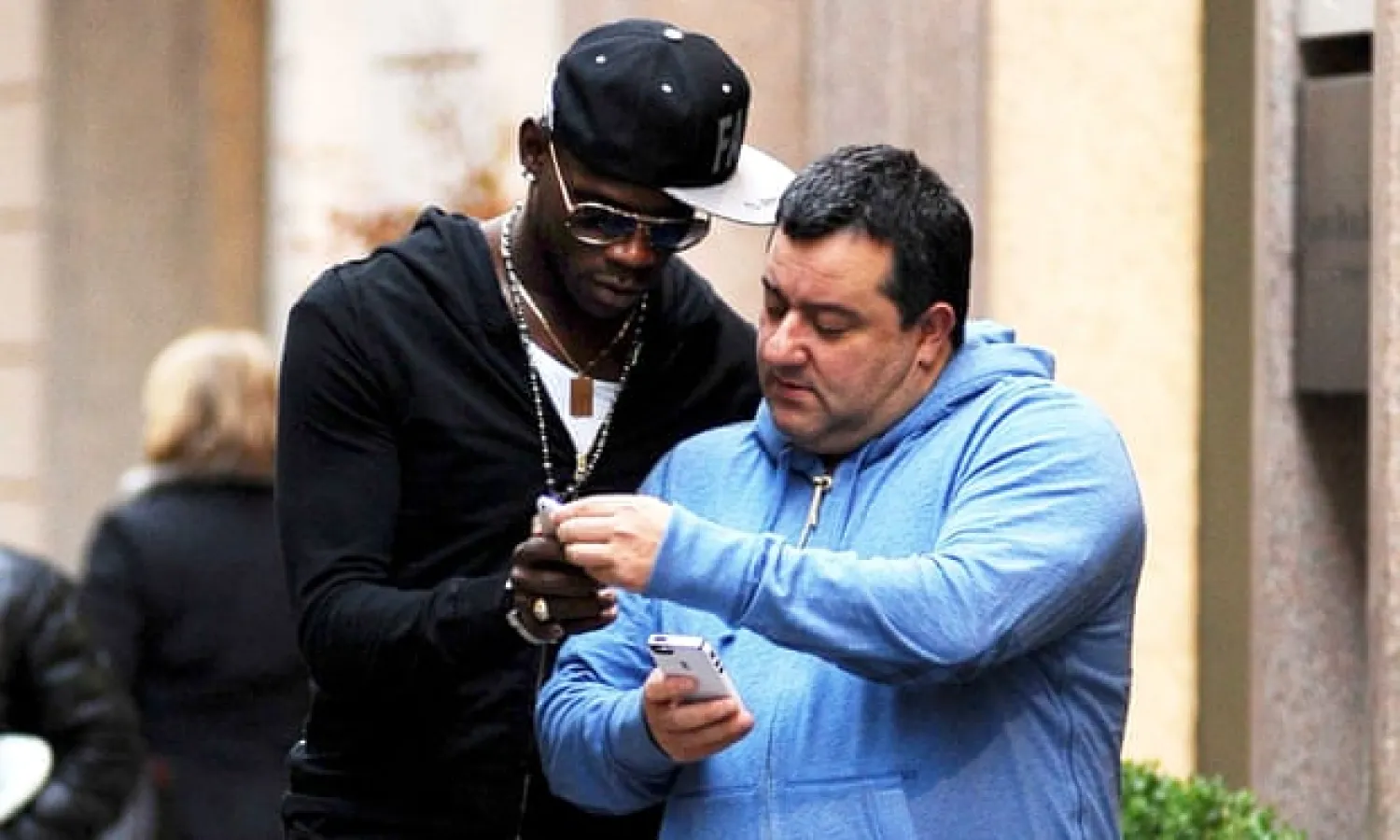
Mino Raiola (right), pictured with Mario Balotelli in Milan in 2013, is the most powerful agent in the modern game and is currently brokering a deal for Erling Haaland. Photograph: Olycom SPA/Shutterstock
TT

Haaland Transfer Saga Is a Grotesque Circus We May Never See Again

Mino Raiola (right), pictured with Mario Balotelli in Milan in 2013, is the most powerful agent in the modern game and is currently brokering a deal for Erling Haaland. Photograph: Olycom SPA/Shutterstock

At this time of year it was a common thing for elegant young men of the 19th century to set off on a Grand Tour of Europe. Shuttered inside his velveteen stagecoach, the brave traveler would wind from royal court to ancient city, taking in the rites of passage: harpsichord studies in Bologna, a marzipan banquet in Nîmes, a wonderful six-month tuition in the fine art of Etruscan wrestling from a youth called Hercule on the Istanbul docks.

It was interesting to see Erling Haaland embarking on a kind of modern-day superstar athlete equivalent this week. According to reports first published in Spain, Haaland has been seen winding his way from Dortmund to Barcelona in the company of his father and – more importantly – his agent, the fascinating, reviled, devastatingly effective Mino Raiola.

Further stops are planned – it is said – in Madrid and Manchester. And so here we are, poring over pictures of sullen men in masks getting into airport cars, picking over the details of meetings and personnel, another high point for the modern phenomenon of the transfer as a grand public theatre in its own right.

All that seems certain right now is Haaland really will leave Borussia Dortmund this summer. Two things have wound the clock forward on this.

First the convulsions, cooling and imminent downshift in the European transfer market. Transfers themselves are said to be in crisis. In 2019 the big five leagues spent a record €5.5bn on player deals. This dropped by 40% in the first year of Covid. How, you wonder, will anyone survive on such thin gruel, so few spare millions? If you’re holding the most valuable bauble in the room, this is the moment to cash it in.

Second, there is of course Haaland’s own astonishing progress, the sense of a man making the pitch look too small, the game too simple. He is that rare thing, a footballer who is thrillingly simple in what he does. He runs, he shoots, he travels in straight lines. He does all these things to a more intense human degree. He will hunt you down. He will find you. He will trample across your traumatized form on the shortest route to goal.

This kind of talent carries its own burden. Haaland is too big, too heavily stacked with potential energy to be allowed to remain in one place. Money, and the demands of money, will not let him rest. When Raiola said this week “With Haaland, everybody was wrong”, he sounded almost resigned, forced by powers outside his grasp to set in motion this obscenely overvalued public trade.

And there is something grotesque in the numbers involved here, evidence of football’s utterly skewed sense of value and scale, of where its wealth should be spread. At this point it would be all too easy to rail against the influence of agents, a source of constant financial leakage, and also of unrest, churn and supplication to the market above all else.

Raiola in particular does himself no favors, a super agent who embodies the small-round-sunglasses-plus-elegantly-straining-gut aesthetic, and who looks in most pictures like a friendly and successful local butcher who secretly wants to kill you. But he is a genuinely fascinating figure, and one of the few people close to the edge of this volcano who does at least seem to be looking at it with open eyes.

Even his early deals in the post-Bosman frontier times stand out now.

Dennis Bergkamp and Wim Jonk to Internazionale? What strange witchcraft was this? Raiola sold Robinho, sold Henrikh Mkhitaryan, sold Zlatan repeatedly, sold Paul Pogba to Manchester United. If the British Museum ever does get tired of polishing the Elgin marbles it could probably finance an entire second imperial pillage by getting Raiola to sell them back to the Greek government at a special Mino premium.

And now this: Haaland to somewhere else for £150m in a time of economic collapse. It is right to feel appalled, alienated and generally overpowered by the sums of money here. Most mega‑money transfers are a nonsense in any case. Look down the list and of the top eight deals of all time only Cristiano Ronaldo to Real Madrid actually looks a solid return – a function of Ronaldo’s miraculous talent rather than any kind of logic.

The unpalatable heart of this deal is that it is happening right now, at a time when there is contraction everywhere else, when community clubs are menaced by collapse and when the everyday people who fund this show, noses pressed against the glass, are suffering.

This is not magical money. Raiola’s cut, Haaland’s fee: this is your TV subscription, your match ticket, your club merchandise, your advertising value. This is what feeds this overheated soufflé, just as the whoops of shared national pride at each fresh TV deal are the sound of someone selling your own game back to you. Will this process meet any genuine resistance?

Those in power but excluded from the transfer circus seem most likely to do anything about it. There is some talk of new “solidarity rules” that would ban Champions League clubs from selling to one another – a strange idea until you twig its intended effect, the capping of massive-money deals fed by wealthy owners that have terrified some of the more established clubs.

It is across this fraught, changeable landscape that Erling and Mino are now striding out to strike what could be the last truly wild deal of the boom times. Manchester City probably have the will if they could find the finances, despite the current messaging: Haaland would transform the team into something irresistible. The two Spanish clubs have the cultural history and their own ways of rustling up finance. Raiola has the will and the levers to make it work.

But the vast, alienating sums, the loss of human scale, the continued tolerance of all this – well, that’s entirely our own.

The Guardian Sport


Shakhtar Boss Pays Ukrainian Racer $200,000 After Games Disqualification

Ukrainian President Volodymyr Zelenskiy holds helmet as he meets with a Ukrainian skeleton racer Vladyslav Heraskevych , who was disqualified from the Olympic skeleton competition over his "helmet of remembrance" depicting athletes killed since Russia's invasion and his father and coach, Mykhailo Heraskevych, amid Russia's attack on Ukraine, in Munich, Germany February 13, 2026. (Ukrainian Presidential Press Service/Handout via Reuters)
TT

Shakhtar Boss Pays Ukrainian Racer $200,000 After Games Disqualification

Ukrainian President Volodymyr Zelenskiy holds helmet as he meets with a Ukrainian skeleton racer Vladyslav Heraskevych , who was disqualified from the Olympic skeleton competition over his "helmet of remembrance" depicting athletes killed since Russia's invasion and his father and coach, Mykhailo Heraskevych, amid Russia's attack on Ukraine, in Munich, Germany February 13, 2026. (Ukrainian Presidential Press Service/Handout via Reuters)

The owner of ‌Ukrainian football club Shakhtar Donetsk has donated more than $200,000 to skeleton racer Vladyslav Heraskevych after the athlete was disqualified from the Milano Cortina Winter Games before competing over the use of a helmet depicting Ukrainian athletes killed in the war with Russia, the club said on Tuesday.

The 27-year-old Heraskevych was disqualified last week when the International Bobsleigh and Skeleton Federation jury ruled that imagery on the helmet — depicting athletes killed since Russia invaded Ukraine in 2022 — breached rules on athletes' expression at ‌the Games.

He ‌then lost an appeal at the Court ‌of ⁠Arbitration for Sport hours ⁠before the final two runs of his competition, having missed the first two runs due to his disqualification.

Heraskevych had been allowed to train with the helmet that displayed the faces of 24 dead Ukrainian athletes for several days in Cortina d'Ampezzo where the sliding center is, but the International Olympic Committee then ⁠warned him a day before his competition ‌started that he could not wear ‌it there.

“Vlad Heraskevych was denied the opportunity to compete for victory ‌at the Olympic Games, yet he returns to Ukraine a ‌true winner," Shakhtar President Rinat Akhmetov said in a club statement.

"The respect and pride he has earned among Ukrainians through his actions are the highest reward. At the same time, I want him to ‌have enough energy and resources to continue his sporting career, as well as to fight ⁠for truth, freedom ⁠and the remembrance of those who gave their lives for Ukraine," he said.

The amount is equal to the prize money Ukraine pays athletes who win a gold medal at the Games.

The case dominated headlines early on at the Olympics, with IOC President Kirsty Coventry meeting Heraskevych on Thursday morning at the sliding venue in a failed last-minute attempt to broker a compromise.

The IOC suggested he wear a black armband and display the helmet before and after the race, but said using it in competition breached rules on keeping politics off fields of play. Heraskevych also earned praise from Ukraine President Volodymyr Zelenskiy.


Speed Skating-Italy Clinch Shock Men’s Team Pursuit Gold, Canada Successfully Defend Women’s Title

 Team Italy with Davide Ghiotto, Andrea Giovannini, Michele Malfatti, celebrate winning the gold medal on the podium of the men's team pursuit speed skating race at the 2026 Winter Olympics, in Milan, Italy, Tuesday, Feb. 17, 2026. (AP)
Team Italy with Davide Ghiotto, Andrea Giovannini, Michele Malfatti, celebrate winning the gold medal on the podium of the men's team pursuit speed skating race at the 2026 Winter Olympics, in Milan, Italy, Tuesday, Feb. 17, 2026. (AP)
TT

Speed Skating-Italy Clinch Shock Men’s Team Pursuit Gold, Canada Successfully Defend Women’s Title

 Team Italy with Davide Ghiotto, Andrea Giovannini, Michele Malfatti, celebrate winning the gold medal on the podium of the men's team pursuit speed skating race at the 2026 Winter Olympics, in Milan, Italy, Tuesday, Feb. 17, 2026. (AP)
Team Italy with Davide Ghiotto, Andrea Giovannini, Michele Malfatti, celebrate winning the gold medal on the podium of the men's team pursuit speed skating race at the 2026 Winter Olympics, in Milan, Italy, Tuesday, Feb. 17, 2026. (AP)

An inspired Italy delighted the home crowd with a stunning victory in the Olympic men's team pursuit final as

Canada's Ivanie Blondin, Valerie Maltais and Isabelle Weidemann delivered another seamless performance to beat the Netherlands in the women's event and retain their title ‌on Tuesday.

Italy's ‌men upset the US who ‌arrived ⁠at the Games ⁠as world champions and gold medal favorites.

Spurred on by double Olympic champion Francesca Lollobrigida, the Italian team of Davide Ghiotto, Andrea Giovannini and Michele Malfatti electrified a frenzied arena as they stormed ⁠to a time of three ‌minutes 39.20 seconds - ‌a commanding 4.51 seconds clear of the ‌Americans with China taking bronze.

The roar inside ‌the venue as Italy powered home was thunderous as the crowd rose to their feet, cheering the host nation to one ‌of their most special golds of a highly successful Games.

Canada's women ⁠crossed ⁠the line 0.96 seconds ahead of the Netherlands, stopping the clock at two minutes 55.81 seconds, and

Japan rounded out the women's podium by beating the US in the Final B.

It was only Canada's third gold medal of the Games, following Mikael Kingsbury's win in men's dual moguls and Megan Oldham's victory in women's freeski big air.


Lindsey Vonn Back in US Following Crash in Olympic Downhill 

Milano Cortina 2026 Olympics - Alpine Skiing - Women's Downhill 3rd Official Training - Tofane Alpine Skiing Centre, Belluno, Italy - February 07, 2026. Lindsey Vonn of United States in action during training. (Reuters)
TT

Lindsey Vonn Back in US Following Crash in Olympic Downhill 

Milano Cortina 2026 Olympics - Alpine Skiing - Women's Downhill 3rd Official Training - Tofane Alpine Skiing Centre, Belluno, Italy - February 07, 2026. Lindsey Vonn of United States in action during training. (Reuters)

Lindsey Vonn is back home in the US following a week of treatment at a hospital in Italy after breaking her left leg in the Olympic downhill at the Milan Cortina Games.

“Haven’t stood on my feet in over a week... been in a hospital bed immobile since my race. And although I’m not yet able to stand, being back on home soil feels amazing,” Vonn posted on X with an American flag emoji. “Huge thank you to everyone in Italy for taking good care of me.”

The 41-year-old Vonn suffered a complex tibia fracture that has already been operated on multiple times following her Feb. 8 crash. She has said she'll need more surgery in the US.

Nine days before her fall in Cortina d'Ampezzo, Italy, Vonn ruptured the ACL in her left knee in another crash in Switzerland.

Even before then, all eyes had been on her as the feel-good story heading into the Olympics for her comeback after nearly six years of retirement.
