Palestinian Officials Pressure Abbas to Postpone Electionshttps://english.aawsat.com/home/article/2935331/palestinian-officials-pressure-abbas-postpone-elections
Palestinian Officials Pressure Abbas to Postpone Elections
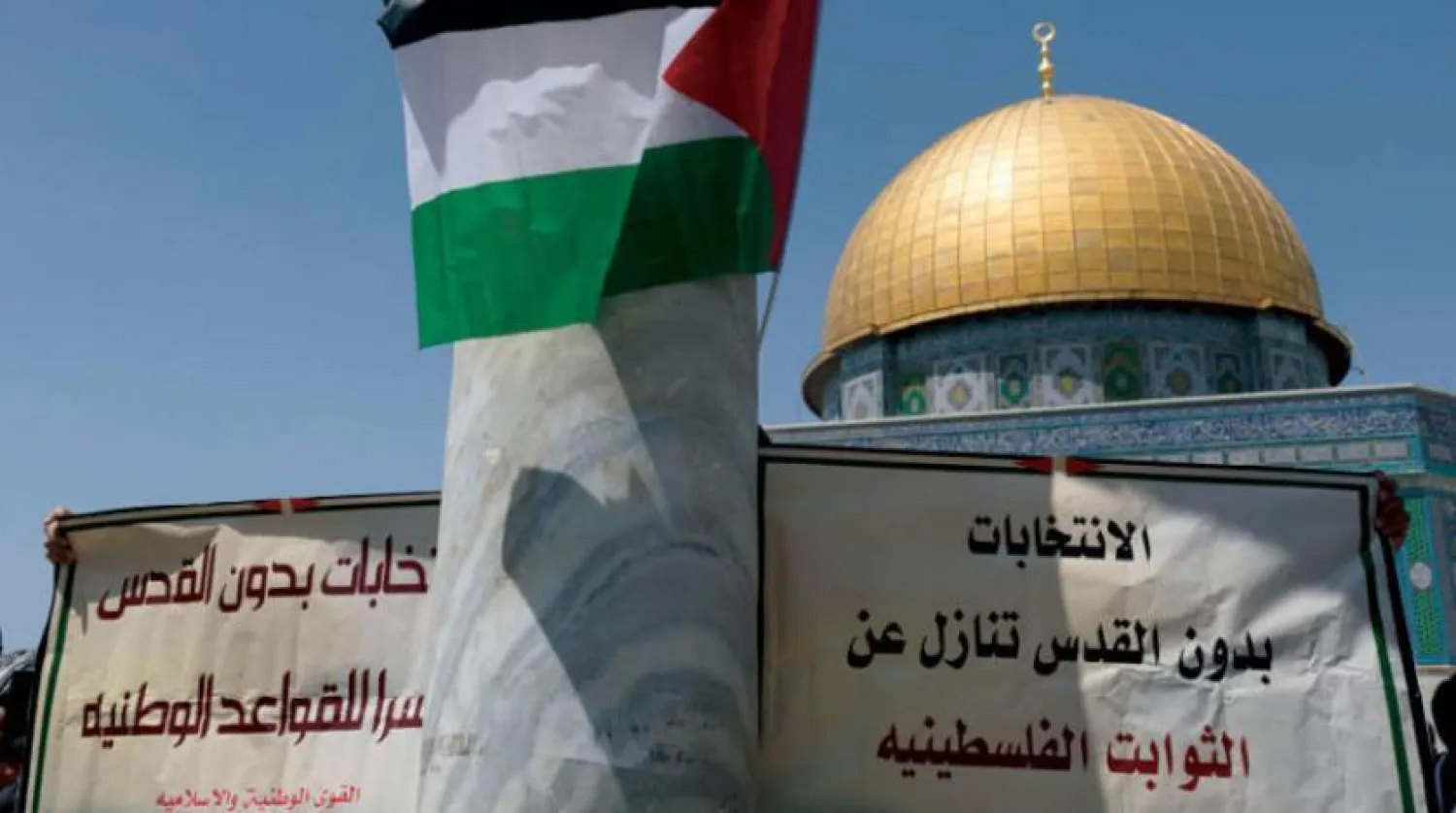
A banner at Al-Aqsa Mosque calls for holding elections in East Jerusalem. (Wafa)
More and more Palestinian officials have stated that President Mahmoud Abbas may postpone the upcoming parliamentary elections, a move increasingly opposed by the Hamas movement and other electoral lists.
Nabil Shaath, an advisor Abbas, was among the latest officials to warn that elections are “very likely” to be delayed if Israel continues to bar voting in East Jerusalem.
A senior Palestinian Authority (PA) official told Kan 11 News on Wednesday that he believes there is a high probability that the elections, which are scheduled for May 22, will be delayed.
“Currently, there is a 90 percent chance that the election will be postponed,” the source said.
According to the report, Abbas has not yet decided on whether to postpone the polls, even after a series of discussions on the issue that took place this week in Ramallah.
Kan 11 News reported that the pressure on Abbas has increased in recent days.
Among other things, Fatah officials fear that the internal divisions within the party ahead of the polls may allow Hamas to gain a foothold that would adversely affect relations between the PA and Israel and the administration in Washington.
Civil Affairs Minister Hussein al-Sheikh, Head of the General Intelligence Service Major General Majed Faraj, as well as other Fatah officials and heads of the security services are among the officials pressuring Abbas, the report noted.
Palestinians in the West Bank, Gaza Strip and East Jerusalem are due to vote on May 22 ahead of a planned presidential election in July.
The Palestinian leadership is supposed to hold an expanded meeting in the next few days, headed by Abbas, to review options related to holding the polls.
So far, Palestinian officials have stated that they are committed to the elections provided that they take place throughout occupied Palestinian territory, including Jerusalem.
“No elections without Jerusalem,” stressed Palestinian Liberation Organization (PLO) Executive Committee member Wasel Abu Youssef.
The leadership is currently waiting for the results of international efforts to pressure Israel in this regard, he told Voice of Palestine radio on Thursday.
Lebanese army members stand on a military vehicle during a Lebanese army media tour, to review the army's operations in the southern Litani sector, in Alma Al-Shaab, near the border with Israel, southern Lebanon, November 28, 2025. (Reuters)
The Lebanese army has uncovered a tunnel built by Hezbollah in the southern town of Touline after carrying out an excavation at the request of the ceasefire oversight committee known as the Mechanism, Lebanese media reported. The site had previously been struck by an Israeli attack, according to the reports.
This was not the first time the Lebanese army has inspected sites at the request of the Mechanism or following Israeli threats, as part of coordination between the military, the committee overseeing the cessation of hostilities and the United Nations Interim Force in Lebanon (UNIFIL).
A similar inspection took place last week when the army conducted a thorough search of a building in the southern town of Yanouh after Israel threatened to strike the house.
No weapons were found. After the Lebanese army deployed, the Israeli military announced it had temporarily suspended the strike it had threatened on what it described as Hezbollah military infrastructure in the town.
The developments came as Israeli strikes on southern Lebanon continued, with an air raid on Wednesday hitting the town of Kfar Kila. No casualties were reported, said the state-run National News Agency.
Meanwhile, Deputy Prime Minister Tarek Mitri described the Mechanism as a “platform for discussion and a framework for oversight and verification of compliance with agreements”, stressing that Lebanon has adhered to its commitments since the first day of the 2024 ceasefire, while Israeli violations have continued.
On Hezbollah’s weapons, Mitri said during the opening session of the eighth conference of the Carnegie Middle East Center in Beirut that Lebanese army commander General Rodolphe Haykal had proposed a five-phase plan starting with strengthening the army’s capabilities.
He stressed that extending state authority in the area surrounding the Litani River was making gradual progress, with the army nearing completion of its mission south of the Litani in preparation for moving to later phases.
On reconstruction, Mitri added that the international community was making the extension of state authority a key condition for support. He hoped that Arab states would play a supportive role through their international relations.
The developments come ahead of a new meeting of the Mechanism tasked with monitoring the ceasefire, scheduled for Dec. 19.
It will be the second meeting attended by the head of the Lebanese delegation, Ambassador Simon Karam, after his participation alongside an Israeli civilian in the previous session earlier this month, marking the first direct talks between the two countries.
President Joseph Aoun met Karam on Wednesday and provided him with guidance ahead of the meeting.
The ceasefire monitoring committee includes Lebanon, Israel, France, the United States and the United Nations.
The ceasefire agreement stipulates a halt to hostilities, the withdrawal of Hezbollah north of the Litani River, leading to its disarmament across Lebanon, and the withdrawal of Israeli forces from positions they occupied during the latest war.
Israel, however, maintains a presence at five “strategic” sites inside Lebanese territory, while Hezbollah refuses to disarm.
Bahbah to Asharq Al-Awsat: Second Phase of Gaza Ceasefire Begins Next Monthhttps://english.aawsat.com/arab-world/5220588-bahbah-asharq-al-awsat-second-phase-gaza-ceasefire-begins-next-month
Palestinians walk along a street surrounded by buildings destroyed during Israeli air and ground operations in Gaza City, Wednesday, Dec. 17, 2025. (AP)
Bahbah to Asharq Al-Awsat: Second Phase of Gaza Ceasefire Begins Next Month
Palestinians walk along a street surrounded by buildings destroyed during Israeli air and ground operations in Gaza City, Wednesday, Dec. 17, 2025. (AP)
The second phase of the Gaza ceasefire agreement is expected to begin in January, likely in the first or second week, according to Bishara Bahbah, head of the Arab Americans for Peace Committee and a mediator closely aligned with the US administration on the Gaza file.
Bahbah told Asharq Al-Awsat on Wednesday that preparations for managing Gaza are already complete, with the names of the prospective committee finalized and Palestinian Health Minister Majed Abu Ramadan emerging as the most likely candidate to lead the body.
Bahbah, who remains close to White House deliberations on Gaza, said Washington supports the presence of Turkish forces as part of an international stabilization force, viewing them as the most capable of maintaining stability in the enclave.
He said the anticipated meeting between US President Donald Trump and Israeli Prime Minister Benjamin Netanyahu later this month will be decisive for the second phase, noting that the United States will press for its launch next month and for a decision on Türkiye’s participation in the stabilization force.
Defining the mission
Bahbah disclosed details of a meeting held on Tuesday in the Qatari capital Doha on the formation of an international stabilization force for Gaza.
He said one of the main objectives was for Washington to clearly identify which countries are prepared to participate and to determine the nature of each country’s contribution, whether through troops, training, or technical and logistical support.
He said the second objective of the meeting was to clarify how the forces would coordinate with one another and establish a command structure, noting that one proposal under discussion is for a US general to lead the international force.
Discussions also covered deployment locations and whether the force would be stationed outside the so-called yellow line separating Israeli-controlled areas from Hamas-held zones, within that line, or inside densely populated areas, as well as which parties would provide funding, he added.
Rejection of Israel’s approach
On deployment plans, Bahbah said discussions are ongoing but that the model sought by Israel was rejected by an overwhelming majority of participating countries, indicating broad agreement on monitoring rather than combat roles.
On the nature of the mission, he stated that most participating states are unwilling to play any role related to disarmament, instead seeking to act as a buffer between Israeli forces and populated areas in order to protect civilians.
The ultimate objective of the force’s presence is Israel’s gradual withdrawal from the Gaza Strip, he stressed.
“These forces will not act on Israel’s behalf, particularly on disarmament,” Bahbah said, adding that Hamas leaders had expressed to him a willingness to negotiate on the issue.
“Using force will not work,” he warned, noting that Israel had failed to disarm Hamas by force over the past two years and that no international party would succeed in doing so militarily.
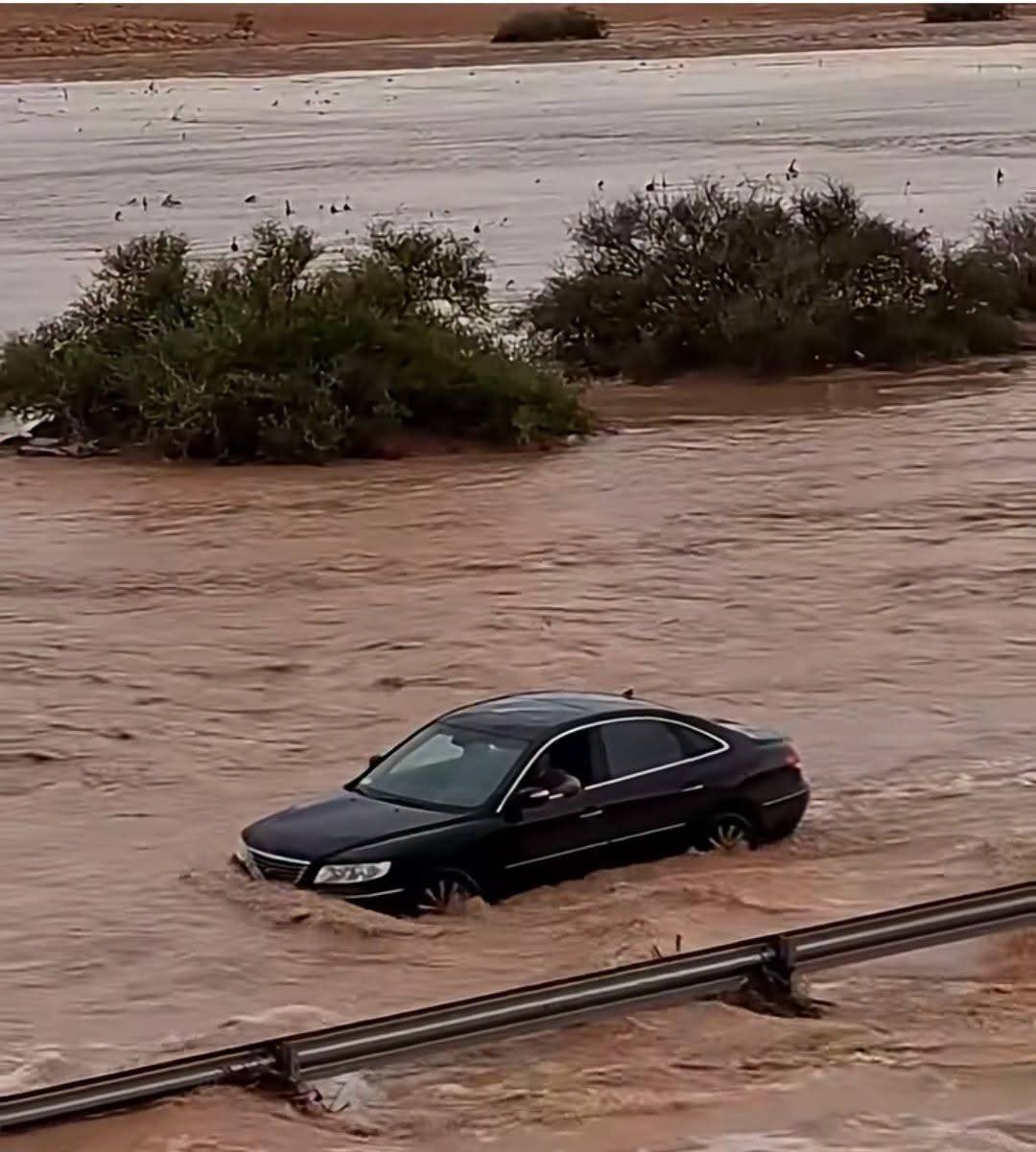
A car is seen partially submerged next to a small boat in a flooded area after heavy rains in a makeshift camp for displaced Palestinians in Zawaida, central Gaza Strip, Wednesday, Dec. 17, 2025. (AP)
Türkiye’s participation pivotal
On Türkiye’s role, Bahbah described Ankara’s participation as pivotal, saying Türkiye is the closest country to Hamas and the most capable of engaging with the group over its weapons, something other states struggle to do.
He said the presence of Turkish forces in Gaza would be essential and would lead to greater stability, adding that Washington supports their involvement.
Bahbah said Trump is expected to pressure Netanyahu during their upcoming meeting in the United States later this month to accept Turkish participation.
He added that Israel is likely to seek conditions, possibly pushing for a compromise in which Türkiye’s role would be technical rather than armed, but stressed that pressure from the US administration would be decisive.
Second phase commitments
On the so-called Peace Council, Bahbah noted that Trump has spoken of many world leaders wanting to join it, stressing that membership would not be free and would entail commitments, including funding, providing security forces, or other obligations.
Asked about potential members, he said names he has seen for the executive council include US envoys Steve Witkoff and Trump’s son-in-law Jared Kushner, former British prime minister Tony Blair, former US ambassador Richard Grenell, and former Bulgarian diplomat Nickolay Mladenov.
On Gaza’s administration, Bahbah revealed that a list of 42 candidates for a technocratic committee has been approved by Hamas, Fatah, and Egypt, adding that Health Minister Abu Ramadan is likely to chair the committee.
Despite talk of obstacles to moving to the second phase, Bahbah said he expects it to be launched in the first or second week of January, specifically after the Trump-Netanyahu summit resolves outstanding issues.
He denied knowledge of any arrangements for Egyptian President Abdel Fattah al-Sisi to attend the summit.
Trump will not allow the agreement to fail, he remarked, describing this as “100 percent certain” and adding that Hamas remains committed to the ceasefire despite continued Israeli violations.
Bahbah said the movement understands that Israel is seeking any pretext to resume what he described as acts of annihilation in Gaza and is therefore showing greater restraint to deny it that opportunity.
Report: RSF Destroying Evidence of Atrocities in Sudanhttps://english.aawsat.com/arab-world/5220576-report-rsf-destroying-evidence-atrocities-sudan
The Sudanese flag flutters in Omdurman, part of greater Khartoum on December 13, 2025. (AFP)
TT
TT
Report: RSF Destroying Evidence of Atrocities in Sudan
The Sudanese flag flutters in Omdurman, part of greater Khartoum on December 13, 2025. (AFP)
Sudan's paramilitary Rapid Support Forces destroyed and concealed evidence of mass killings they committed after overrunning the Darfur city of el-Fasher, a new report has found.
Yale University's Humanitarian Research Lab (HRL), which has used satellite imagery to monitor atrocities since the RSF's war with the army began, said on Tuesday the group "destroyed and concealed evidence of its widespread mass killings" in the North Darfur state capital.
The RSF's violent takeover of the army's last holdout position in the Darfur region in October led to international outrage over reports of summary executions, systematic rape and mass detention.
The HRL said that in the aftermath of the takeover, it had identified 150 clusters of objects consistent with human remains.
Dozens were consistent with reports of execution-style killings, and dozens more with reports of the RSF killing civilians as they fled.
Within a month, nearly 60 of those clusters were no longer visible, while eight earth disturbances appeared near the sites of mass killing, the HRL said.
It said the disturbances were not consistent with civilian burial practices.
"Largescale and systematic mass killing and body disposal has occurred," the report determined, estimating the death toll in the city to be in the tens of thousands.
Aid groups and the United Nations have repeatedly demanded safe access to el-Fasher, where communications remain cut and an estimated tens of thousands of survivors are trapped, many detained by the RSF.
The UN has called the Sudan conflict a "a war of atrocities".
There is no confirmed death toll from the Sudan war which began in April 2023, with estimates at more than 150,000.
The fighting has also displaced millions of people, and created the world's largest hunger and displacement crises.
Efforts to end the war have repeatedly faltered.
لم تشترك بعد
انشئ حساباً خاصاً بك لتحصل على أخبار مخصصة لك ولتتمتع بخاصية حفظ المقالات وتتلقى نشراتنا البريدية المتنوعة