

Somalia's government is seeking to slow the withdrawal of African peacekeepers and warning of a potential security vacuum, documents seen by Reuters show, with neighboring countries fretting that resurgent al Shabaab militants could seize power.
The African Union Transition Mission in Somalia (ATMIS), a peacekeeping force, is committed to withdrawing by Dec. 31, when a smaller new force is expected to replace it.
However, in a letter last month to the acting chair of the African Union Peace and Security Council the government asked to delay until September the withdrawal of half the 4,000 troops due to leave by the end of June. The letter has not been reported before.
The government had previously recommended, in a joint assessment with the AU in March, reviewed by Reuters, that the overall withdrawal timeline be adjusted "based on the actual readiness and capabilities" of Somali forces.
The joint assessment, which was mandated by the UN Security Council, warned that a "hasty drawdown of ATMIS personnel will contribute to a security vacuum".
"I've never been more concerned about the direction of my home country," said Mursal Khalif, an independent member of the defense committee in parliament.
The European Union and United States, the top funders of the AU force in Somalia, have sought to reduce the peacekeeping operation due to concerns about long-term financing and sustainability, four diplomatic sources and a senior Ugandan official said.
Negotiations about a new force have proven complicated, with the AU initially pushing for a more robust mandate than Somalia wanted, three of the diplomatic sources said. A heated political dispute could lead Ethiopia to pull out some of the most battle-hardened troops.
Somalia's presidency and prime minister's office did not respond to requests for comment.
Mohamed El-Amine Souef, AU special representative to Somalia and head of ATMIS, said there was no definitive timeline for concluding negotiations but that all parties were committed to an agreement that helps achieve sustainable peace and security.
"The AU and Somalia's government have emphasized the importance of a conditions-based drawdown to prevent any security vacuum," he told Reuters.
The Peace and Security Council is due to meet on Somalia later on Thursday to discuss the drawdown and follow up mission.
As the drawdown proceeds, with 5,000 of around 18,500 troops leaving last year, the government has projected confidence. It has said the new force should not exceed 10,000 and should be limited to tasks like securing major population centers.
The call for a smaller force likely reflects views of nationalists who oppose a heavy foreign presence in Somalia, said Rashid Abdi, an analyst with Sahan Research, a Nairobi-based think-tank focused on the Horn of Africa.
WORRIED NEIGHBORS
Uganda and Kenya, which contributed troops to the departing mission, are also worried.
Henry Okello Oryem, Uganda's state minister of foreign affairs, said that despite intensive training efforts, Somali troops could not sustain a long-term military confrontation.
"We do not want to get into a situation where we are fleeing, the kind of thing that we saw in Afghanistan," he told Reuters.
Oryem said Kenya accepted the drawdown requested by the US and EU but that the concerns of countries with forces in Somalia should be heard.
Kenyan President William Ruto told reporters in Washington last month that a withdrawal that did not account for conditions on the ground would mean "the terrorists will take over Somalia."
In response to questions, an EU spokesperson said it was focused on building domestic security capacities and supported in principle a Somali government proposal for a new mission that would have a reduced size and scope.
A US State Department spokesperson said the force should be large enough to prevent a security vacuum. Washington has supported all requests submitted by the AU to the UN Security Council to modify the drawdown timeline, the spokesperson said.
In response to a question about Ethiopian forces, the spokesperson said it was critical to avoid security gaps or unnecessary expenses "incurred by swapping out existing troop contributors."
SETBACKS
Two years ago, an army offensive in central Somalia initially seized large swathes of territory from al Shabaab.
In August, President Hassan Sheikh Mohamed declared his intention to "eliminate" the powerful al Qaeda offshoot within five months.
But just a few days later, al Shabaab counter-attacked, retaking the town of Cowsweyne. They killed scores of soldiers and beheaded several civilians accused of supporting the army, according to a soldier, an allied militiaman and a local resident.
"This broke the hearts of Somalis but gave courage to al Shabaab," Ahmed Abdulle, the militiaman, from a clan in central Somalia, said in an interview in April.
The Somali government has never publicly provided a death toll for the Cowsweyne battle and didn't respond to a request for a toll for this story.
"There were enough troops in Cowsweyne, over a battalion, but they were not organized well," said a soldier named Issa, who fought in the battle there last August.
Issa said car bombs had blasted through the gates of Cowsweyne army camp on the day of the attack, citing a shortage of defensive outposts to protect bases from such attacks.
Ten soldiers, militiamen from local clans and residents in areas targeted by the military campaign reported no army operations in the past two months following additional battlefield setbacks.
Reuters could not independently establish the extent of the territorial losses to al Shabaab. Somalia's National Security Adviser said on X this week that the army had held most of its gains.
The peacekeepers' withdrawal could make it more difficult to hold territory. While analysts estimate Somalia's army at around 32,000 soldiers, the government acknowledged, in the assessment with the AU, a shortage of some 11,000 trained personnel due to "high operational tempo" and "attrition".
The government has said its soldiers are capable of confronting al Shabaab with limited external support.
Somalia has defied gloomy predictions before and has expanded its security forces in recent years.
Residents of the seaside capital Mogadishu – whose ubiquitous blast walls testify to the threat of Shabaab suicide bombers and mortars - say security has improved. Once-quiet streets bustle with traffic, and upscale restaurants and supermarkets are opening.
An assessment published in April by the Combating Terrorism Center at the United States Military Academy said an Afghanistan-like collapse was unlikely, helped by ongoing external support.
The United States, for instance, has about 450 troops in Somalia to train and advise local forces, and conducts regular drone attacks against suspected militants.
But the assessment's author, Paul D. Williams, a professor of international affairs at George Washington University, said the militants' estimated 7,000-12,000 fighters would nevertheless be "slightly militarily stronger" than Somali forces because of superior cohesion and force employment.
INTERNATIONAL SUPPORT
Somalia's security has been underwritten by foreign resources since Ethiopia invaded in 2006, toppling an administration but galvanizing an insurgency that has since killed tens of thousands of people.
The US has spent more than $2.5 billion on counterterrorism assistance since 2007, according to a study last year by Brown University. That number does not include undisclosed military and intelligence spending on activities like drone strikes and deployments of American ground troops.
The EU says it has provided about $2.8 billion to ATMIS and its predecessor since 2007. But resources are under strain. The EU, which pays for most of ATMIS's roughly $100 million annual budget, is shifting toward bilateral support with an eye toward reducing its overall contributions in the medium-term, four diplomatic sources said.
Two diplomats interviewed by Reuters, who spoke on condition of anonymity to describe private negotiations, said the US and EU want to scale back peacekeeping operations because of competing spending priorities including Ukraine and Gaza and a sense Somalia should take responsibility for its own security.
Some European countries would like to see the new mission financed through assessed contributions of United Nations member states, which would increase the financial burden on the United States and China, the four diplomatic sources said.
The State Department spokesperson said the US did not believe such a system can be implemented by next year but said there was strong international consensus to support the follow-on mission. The EU didn't address questions about the financing of the replacement mission
Financing for the new mission can only be formally addressed once Somalia and the AU agree on a proposed size and mandate.


Somalia Asks Peacekeepers to Slow Withdrawal, Fears Extremists Insurgence
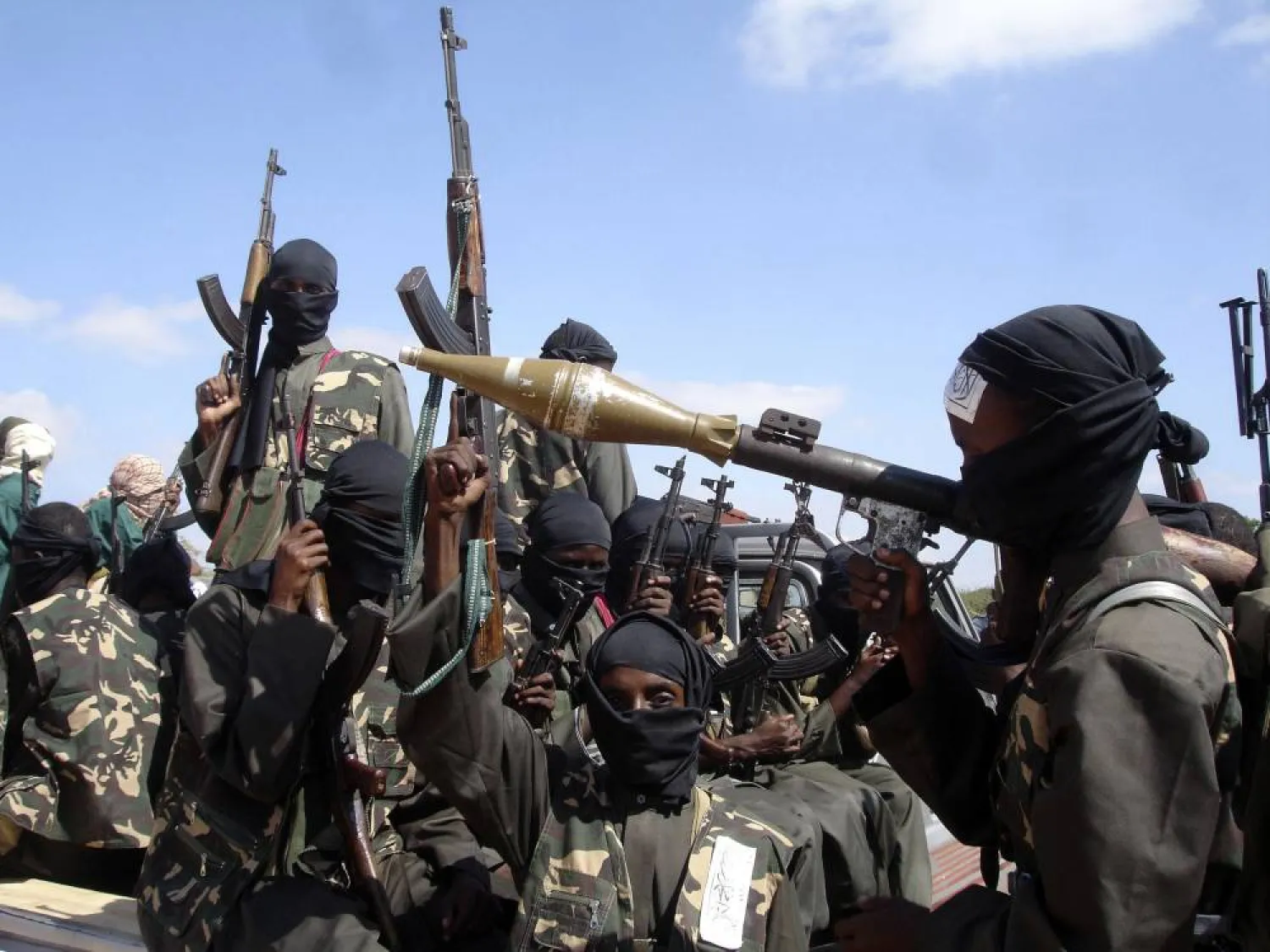
Armed al-Shabab fighters ride on pickup trucks as they prepare to travel into the city, just outside the capital Mogadishu, in Somalia on Dec. 8, 2008. (AP Photo/Farah Abdi Warsameh, File)

Somalia Asks Peacekeepers to Slow Withdrawal, Fears Extremists Insurgence
Armed al-Shabab fighters ride on pickup trucks as they prepare to travel into the city, just outside the capital Mogadishu, in Somalia on Dec. 8, 2008. (AP Photo/Farah Abdi Warsameh, File)


لم تشترك بعد
انشئ حساباً خاصاً بك لتحصل على أخبار مخصصة لك ولتتمتع بخاصية حفظ المقالات وتتلقى نشراتنا البريدية المتنوعة
