Iran Boosts OPEC Oil Output in April

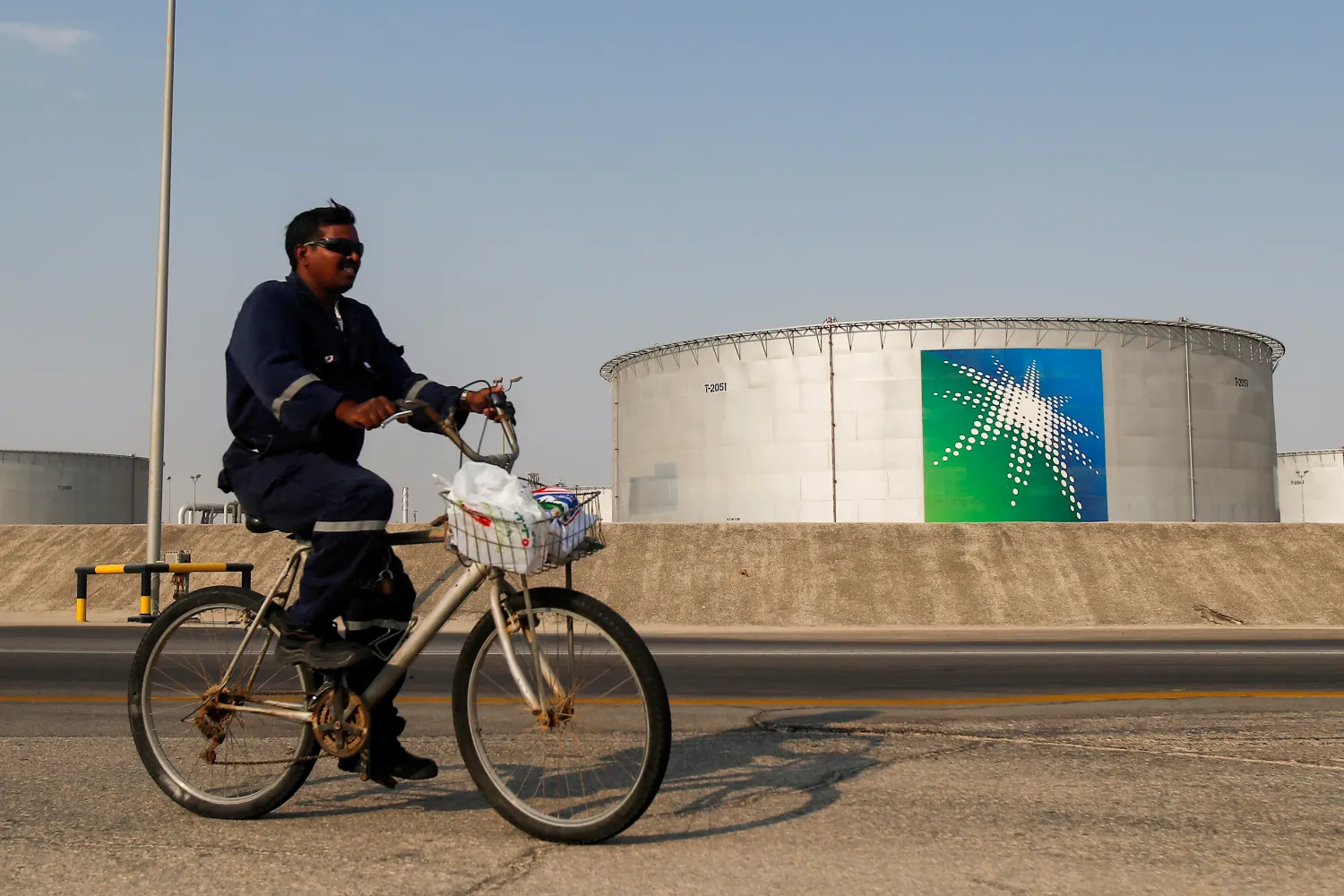
FILE PHOTO: An employee rides a bicycle next to oil tanks at Saudi Aramco oil facility in Abqaiq, Saudi Arabia October 12, 2019. REUTERS/Maxim Shemetov
TT

Iran Boosts OPEC Oil Output in April

FILE PHOTO: An employee rides a bicycle next to oil tanks at Saudi Aramco oil facility in Abqaiq, Saudi Arabia October 12, 2019. REUTERS/Maxim Shemetov

OPEC oil output has risen in April as higher supply from Iran countered involuntary cuts and agreed reductions by other members under a pact with allies, a Reuters survey found, adding to signs of a 2021 recovery in Tehran’s exports.

The 13-member Organization of the Petroleum Exporting Countries pumped 25.17 million barrels per day (bpd) in April, the survey found, up 100,000 bpd from March. Output has risen every month since June 2020 with the exception of February.

Iran’s exports are rising as talks take place to revive a 2015 nuclear deal which could eventually allow more oil to the market.

US President Joe Biden’s administration took office in January pledging to rejoin the accord.

So far, OPEC and its allies, known as OPEC+, are not concerned by Iran and plan their own output boost from May.

“The elevated levels that we are seeing from Iran are generally continuing,” Daniel Gerber, chief executive of Petro-Logistics, a consultant that tracks oil shipments, told Reuters this month.

Hoping for a demand recovery, OPEC+ this week confirmed a plan to ease from May more of the record cuts made in 2020.

From May Saudi Arabia will also begin to unwind an extra voluntary cut it made in February, March and April.

The extra Saudi cut means OPEC still pumped much less than called for under the OPEC+ deal in April. Compliance with pledged cuts was 123%, the survey found, versus 124% in March.

Iran, plus fellow OPEC members Libya and Venezuela, are exempt from making cuts, so changes in their output do not affect the compliance rate.


Saudi Arabia Officially Opens Property Ownership to Foreigners

A view of Riyadh, Saudi Arabia. (Reuters)
TT

Saudi Arabia Officially Opens Property Ownership to Foreigners

A view of Riyadh, Saudi Arabia. (Reuters)

Saudi Arabia opened a new chapter in its development drive on Thursday as a long-anticipated law allowing non-Saudis to own real estate came into force.

The step marks a pivotal shift in the Kingdom’s property framework, anchoring a revamped set of real estate laws designed to reposition the Saudi market from a largely domestic arena into a global investment destination.

The overhaul aims to draw foreign capital, individuals, and companies from across continents, capitalizing on the Kingdom’s political stability and steady economic expansion as one of the Middle East’s largest economies.

The updated system, approved by the Cabinet on July 8, 2025, caps a series of structural reforms under Vision 2030 and reflects the broader economic transformation reshaping the country. It seeks to deliver a secure and equitable investment environment aligned with international best practice.

Its objectives extend beyond financial considerations to include broader development goals, such as stimulating growth in the real estate sector by increasing project diversity and quality, and creating high-quality job opportunities for Saudi nationals in development and property-related services.

By enabling non-Saudis to own property, the Kingdom is laying the foundation for more dynamic and diverse communities, directly enhancing urban quality of life and fostering a competitive environment that raises standards for residential and commercial real estate projects alike. The move underscores stability and growth as defining features of the next phase.

Under the law, a “non-Saudi” is defined as a person who does not hold Saudi nationality, or owns a foreign company, a foreign non-profit entity, or any other non-Saudi legal person designated by a decision from the Cabinet.

'Saudi Real Estate' platform

As part of efforts to ensure transparency and protect rights, the General Authority for Real Estate announced that the “Saudi Real Estate” digital portal will serve as the official platform for managing ownership applications. User journeys have been designed to accommodate different categories:

Residents within the Kingdom can apply directly through the portal using their residency number, with requirements verified automatically and the process completed entirely online.

Non-residents outside the Kingdom must obtain the required digital identity from Saudi missions and embassies abroad before completing their application through the platform.

Foreign companies and entities without an existing presence in Saudi Arabia must first register with the Ministry of Investment through the “Invest Saudi Arabia” platform to obtain a unified number, then proceed to the “Saudi Real Estate” portal to complete the ownership process.

Geographic scope

The new system grants broad flexibility for ownership across the Kingdom, with particular focus on Riyadh and Jeddah as global economic and commercial hubs.

For Makkah and Madinah, a special regulatory framework has been established based on a “Geographic Zones Document,” details of which are set to be announced in the first quarter of 2026. The framework restricts ownership in the two holy cities to Muslims, whether inside or outside the Kingdom, and to Saudi companies wholly owned by Saudis, balancing investment openness with the cities’ religious status.

Under the law, a legally resident non-Saudi may own one residential property outside the designated geographic zones. Makkah and Madinah are excluded, with ownership there limited to Muslims.

Non-listed companies established under Saudi company law, in which one or more shareholders are non-Saudi or legal persons, are permitted to own property or acquire related rights within the designated zones, including Makkah and Madinah, for the purpose of conducting business activities and housing employees.

Listed companies, investment funds, and special purpose entities licensed under Saudi regulations may also own property and acquire related rights, including in Makkah and Madinah, in accordance with capital market laws, their executive regulations, and rules set by the Capital Market Authority in coordination with the Real Estate Authority and other relevant bodies.

Sustainable economic impact

The law translates Saudi Vision 2030 targets into action by attracting foreign direct investment and localizing real estate expertise through the entry of international developers and specialized companies.

The resulting activity is expected to stimulate related sectors, such as housing, trade, industry, and tourism, boosting the real estate sector’s contribution to non-oil gross domestic product on a sustainable basis.

Linking the ownership portal to the real estate title registration system provides the highest levels of legal certainty, strengthening foreign investor confidence in Saudi regulations and reinforcing the Kingdom's commitment to building a diversified, transparent, and innovation-driven economy.


Mawani Signs Agreement to Construct Offshore Structures at Ras Al-Khair Port

Mawani Signs Agreement to Construct Offshore Structures at Ras Al-Khair Port
TT

Mawani Signs Agreement to Construct Offshore Structures at Ras Al-Khair Port

Mawani Signs Agreement to Construct Offshore Structures at Ras Al-Khair Port

The Saudi Ports Authority (Mawani) has signed a contract with Singatac Arabia to establish a fabrication center for offshore structures and platforms at Ras Al-Khair Port.

The contract supports the oil and gas industry and includes warehouses for prefabricated parts, specialized welding equipment, systems, and cranes to serve offshore platform and marine structure projects with an investment of SAR139 million across 100,000 square meters, according to SPA.

The project aims to create over 500 direct and indirect jobs, strengthen Ras Al-Khair Port’s operational capabilities and value-added services, expand port capacity, and increase the contribution of exports to the national economy.

Ras Al-Khair Port is distinguished by its strategic location and its ability to efficiently handle a wide range of goods. It features 14 berths with a total capacity of 35 million tons and spans an area of 23 kilometers.


Asian Shares Rise, Tracking Wall Street Gains as Trump Backs Down on Greenland

Traders work in front of screens at Hana Bank in Seoul (EPA)
TT

Asian Shares Rise, Tracking Wall Street Gains as Trump Backs Down on Greenland

Traders work in front of screens at Hana Bank in Seoul (EPA)

Asian shares mostly advanced on Thursday, tracking Wall Street, after US President Donald Trump walked back from imposing tariffs on eight European countries over Greenland and ruled out using military force to take control of the territory.

The future for the S&P 500 gained less than 0.1% and that for the Dow Jones Industrial Average was virtually flat on Thursday, The Associated Press reported.

Tokyo’s Nikkei 225 climbed 1.7% to 53,688.89, with technology stocks leading gains. SoftBank Group jumped 11.6% and equipment maker Disco Corp. soared 17.1%. Advantest, which makes testing equipment for computer chips, surged 5%.

South Korea’s Kospi closed 0.9% higher at 4,952.44 after crossing the 5,000 mark for the first time, as traders cheered. Technology-related stocks drove the rally. Shares of chipmaker SK Hynix picked up 2%, while Samsung Electronics rose 1.9%.

Hong Kong’s Hang Seng edged less than 0.1% higher to 26,600.68. The Shanghai Composite index edged 0.1% higher to 4,122.58.

In Australia, the S&P/ASX 200 gained nearly 0.8% to 8,848.70.

Taiwan’s Taiex rose 1.6%, while India’s Sensex added 0.2%.

US markets logged their biggest losses since October on Tuesday as investors reacted to Trump’s threat over the weekend to slap tariffs of 10% on Denmark, Norway, Sweden, Germany, France, the United Kingdom, the Netherlands and Finland for opposing US control of Greenland, sparking concerns over worsening relationships between the US and its European allies.

But Trump, attending the World Economic Forum in Davos, Switzerland, backed down on Wednesday and said he would not use force to acquire Greenland. The US president also said in a post on his social media site that he had agreed with the head of NATO on a “framework of a future deal” on Greenland and on Arctic security.

The easing tensions drove Wall Street optimism. On Wednesday, the S&P 500 climbed 1.2% to 6,875. The Dow Jones Industrial Average gained 1.2% to 49,077.23, while the Nasdaq composite also rose 1.2%, to 23,224.82.

Halliburton, the oil field services company, jumped 4.1% following stronger-than-expected profits for the latest quarter. United Airlines rose 2.2% also after better-than-expected quarterly profits. Netflix fell 2.2% even as it reported a stronger profit than expected, as investors focused on factors including a slowing growth of subscribers.

The price of gold fell 0.2% to $4,828.70 per ounce, reflecting investors’ reduced worries, after passing the $4,800 mark ahead of Trump’s reversal of stance on Greenland as many flocked to safe-haven assets.

In the bond market, US Treasury yields also eased following lessened fear among investors as well as a calming of Japan’s bond market turmoil. The yield on the 10-year Treasury eased to 4.25% from 4.30% late Tuesday.

Japan’s long-term bond yields surged to records earlier this week after Prime Minister Sanae Takaichi’s decision to call a snap election in February. That sparked concerns over her pledges to cut taxes and increase spending, which could hinder efforts to rein in government debt.

The US dollar rose to 158.75 Japanese yen from 158.27 yen, prompting analysts to speculate that authorities might intervene if the yen falls any further.

The euro rose to $1.1692 from $1.1687.

US benchmark crude oil shed 16 cents to $60.46 per barrel. Brent crude, the international standard, fell 24 cents to $65.00 per barrel.