

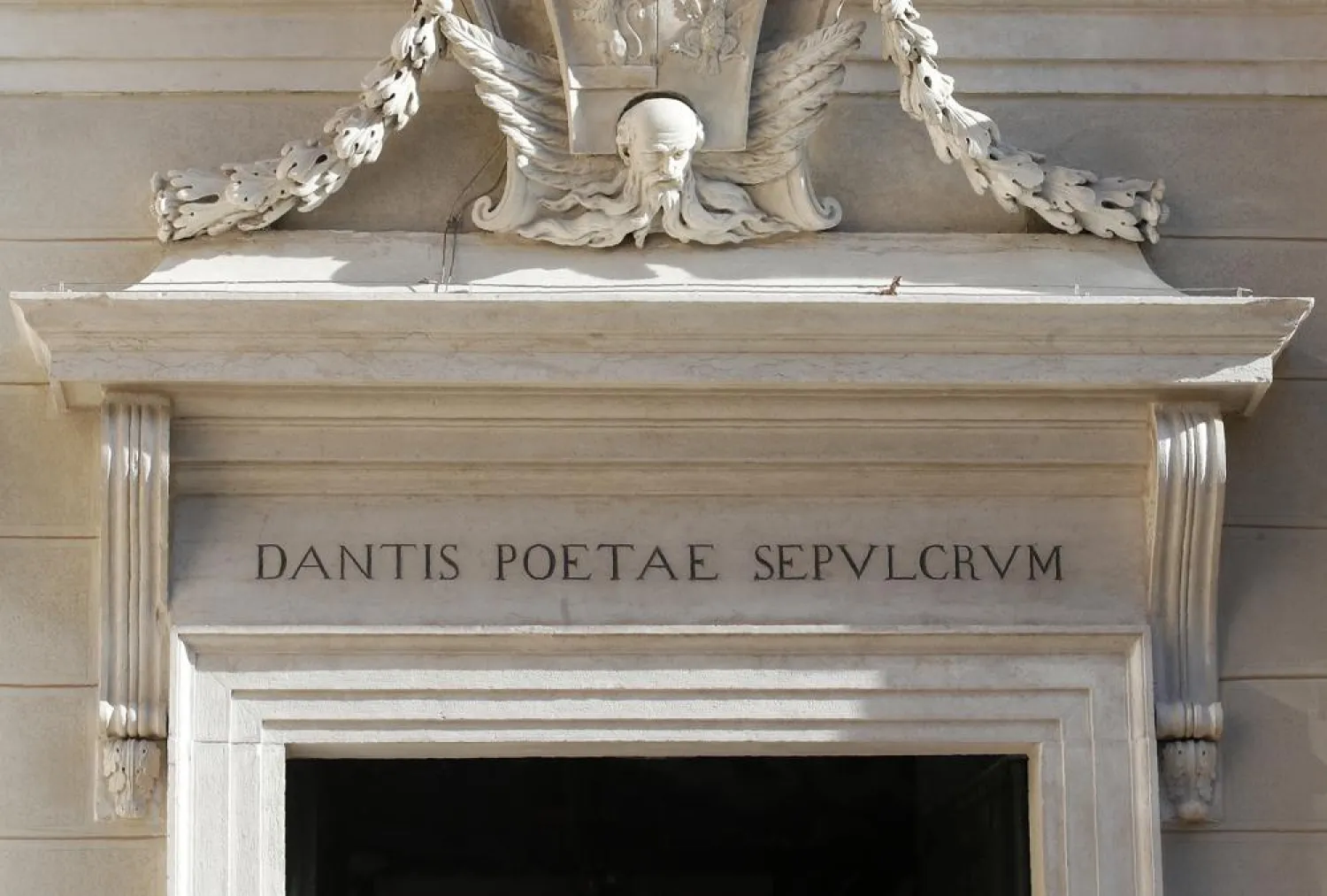

Daily Readings at Tomb Honor Dante 700 Years after his Death

The entrance of poet Dante Alighieri's tomb, in Ravenna, Italy, Saturday, May 8, 2021. (AP)
TT

Daily Readings at Tomb Honor Dante 700 Years after his Death

The entrance of poet Dante Alighieri's tomb, in Ravenna, Italy, Saturday, May 8, 2021. (AP)

As she has each evening for the last eight months, Giuliana Turati opened her well-worn copy of Dante’s “Divine Comedy” as the last of 13 peels of a church bell reverberated around the tomb of the great Italian poet.

Italy is honoring Dante Alighieri — who died in exile from Florence on Sept. 13, 1321 — in myriad ways on the 700th anniversary of his death. Those include new musical scores and gala concerts, exhibits and dramatic readings against stunning backgrounds in every corner of the country. Pope Francis has written an Apostolic letter, the latest by a pope examining Dante’s relationship with the Roman Catholic Church.

But nowhere is the tribute more intimate than before his tomb, which was restored for the anniversary, as dusk falls each day in the city of Ravenna, a former Byzantine capital.

Turati, a life-long Ravenna resident, comes to listen as volunteer Dante-lovers read a single canton, following along in the copy of the “Divine Comedy” inscribed with the year she studied the poet's masterwork in school: 1967.

“There is always something new,’’ Turati said. “Even if you have read and reread it, Dante always has something new to tell us.”

The daily reading, part of a yearlong celebration of Dante that started in September, is intended to connect ordinary people -- residents and tourists, scholars and the uninitiated -- with the “Divine Comedy” as an appreciation by the city he adopted while in exile.

Copies of the “Divine Comedy” in 60 languages are housed nearby, and organizers envision they also will be read by foreign tourists as soon as post-pandemic travel resumes.

“Reading Dante is perhaps the truest and most profound homage that we can offer,” said Francesca Masi, secretary general for Ravenna’s Dante 700 organizing committee. “It requires everyone to make an effort to go toward Dante, while too often we ask Dante to come toward us, perhaps stretching a little without understanding him, ideologizing him. Instead, this solemn way of reading, without comment, is respectful.”

Dante spent years composing “Divine Comedy” during his banishment from his native Florence, the home of the vernacular he elevated to a literary language through his poetry.

While Dante was embraced as a symbol of Italy’s unification in 1861, Florence and Ravenna continue to battle for Dante's legacy. Disputes over who has the right to claim his remains still erupt in newspapers seven centuries after his death.

Florence, so it seems, would have given up its claim by sentencing Dante to exile, his return punishable by death.

The sentence is written in a 14th-century court ledger on display through Aug. 8 as part of an exhibition on Dante’s relationship with Florence at the Bargello National Museum. The museum is housed in a medieval palace that Dante would have known and visited as the seat of the highest judicial magistrate, and where he was sentenced in absentia in the same vaulted room that now displays a famous bronze of David by Renaissance sculptor Donatello.

The museum also holds a fresco of Dante, painted by his contemporary Giotto after the poet’s death, and also of Lucifer, depicted with Dante's own imagery — three heads and the wings of a bat.

“It is very important, because it means that the iconography introduced by Dante was immediately received in Florence in the figurative arts,’’ Bargello National Museum Director Paola D’Agostino.

Another exhibit in the San Domenico Museum, near Ravenna in Forli, brings together 300 works from all over the world to tell the story of Dante through the ages, from pieces that influenced him to ones he influenced, museum director Gianfranco Brunelli said.

The exhibit, put on in conjunction with Florence’s Uffizi and running through July 4, includes art contemporary to Dante, elaborate manuscripts of his work, portraits of the poet and pieces inspired by his epic, monumental poem by artists such as Picasso, Giotto, Tintoretto and Michelangelo.

Brunelli said it's no surprise that Dante has continued to fascinate people through the centuries.

“Dante’s themes are those of heaven and earth. He speaks of salvation and pardon, of things very fundamental to human life,” Brunelli said. “For this reason, art couldn’t do other than return an infinite number of times to Dante and his themes.”

After being sentenced to exile in 1302, Dante spent much of the rest of his life in Verona and then Ravenna, where he arrived in 1318 or 1319. He died of malaria after a diplomatic mission to the Republic of Venice, 100 kilometers (60 miles) to the north.



Coffee Regions Hit by Extra Days of Extreme Heat, Say Scientists 

17 April 2012, North Rhine-Westphalia, Vluyn: A general view of Arabica Coffee beans. (dpa)
TT

Coffee Regions Hit by Extra Days of Extreme Heat, Say Scientists 

17 April 2012, North Rhine-Westphalia, Vluyn: A general view of Arabica Coffee beans. (dpa)

The world's main coffee-growing regions are roasting under additional days of climate change-driven heat every year, threatening harvests and contributing to higher prices, researchers said Wednesday.

An analysis found that there were 47 extra days of harmful heat per year on average in 25 countries representing nearly all global coffee production between 2021 and 2025, according to independent research group Climate Central.

Brazil, Vietnam, Colombia, Ethiopia and Indonesia -- which supply 75 percent of the world's coffee -- experienced on average 57 additional days of temperatures exceeding the threshold of 30C.

"Climate change is coming for our coffee. Nearly every major coffee-producing country is now experiencing more days of extreme heat that can harm coffee plants, reduce yields, and affect quality," said Kristina Dahl, Climate Central's vice president for science.

"In time, these impacts may ripple outward from farms to consumers, right into the quality and cost of your daily brew," Dahl said in a statement.

US tariffs on imports from Brazil, which supplies a third of coffee consumed in the United States, contributed to higher prices this past year, Climate Central said.

But extreme weather in the world's coffee-growing regions is "at least partly to blame" for the recent surge in prices, it added.

Coffee cultivation needs optimal temperatures and rainfall to thrive.

Temperatures above 30C are "extremely harmful" to arabica coffee plants and "suboptimal" for the robusta variety, Climate Central said. Those two plant species produce the majority of the global coffee supply.

For its analysis, Climate Central estimated how many days each year would have stayed below 30C in a world without carbon pollution but instead exceeded that level in reality -- revealing the number of hot days added by climate change.

The last three years have been the hottest on record, according to climate monitors.


Dog Gives Olympics Organizers Paws for Thought

A dog wanders on the ski trail during the women's team cross country free sprint qualification event of the Milano Cortina 2026 Winter Olympic Games at Tesero Cross-Country Skiing Stadium in Lago di Tesero (Val di Fiemme), on February 18, 2026. (Photo by Anne-Christine POUJOULAT / AFP)
TT

Dog Gives Olympics Organizers Paws for Thought

A dog wanders on the ski trail during the women's team cross country free sprint qualification event of the Milano Cortina 2026 Winter Olympic Games at Tesero Cross-Country Skiing Stadium in Lago di Tesero (Val di Fiemme), on February 18, 2026. (Photo by Anne-Christine POUJOULAT / AFP)

A dog decided he would bid for an unlikely Olympic medal on Wednesday as he joined the women's cross country team free sprint in the Milan-Cortina Games.

The dog ran onto the piste in Tesero in northern Italy and gamely, even without skis, ran behind two of the competitors, Greece's Konstantina Charalampidou and Tena Hadzic of Croatia.

He crossed the finishing line, his moment of glory curtailed as he was collared by the organizers and led away -- his owner no doubt will have a bone to pick with him when they are reunited.


Olives, Opera and a Climate-Neutral Goal: How a Mural in Greece Won ‘Best in the World’ 

A building with the mural entitled “Kalamata” depicting opera legend Maria Callas by artist Kleomenis Kostopoulos is seen in Kalamata town, about 240 kilometers (150 miles) southwest of Athens, Monday, Feb. 9, 2026. (AP) 
TT

Olives, Opera and a Climate-Neutral Goal: How a Mural in Greece Won ‘Best in the World’ 

A building with the mural entitled “Kalamata” depicting opera legend Maria Callas by artist Kleomenis Kostopoulos is seen in Kalamata town, about 240 kilometers (150 miles) southwest of Athens, Monday, Feb. 9, 2026. (AP) 

Long known for its olives and seaside charm, the southern Greek city of Kalamata has found itself in the spotlight thanks to a towering mural that reimagines legendary soprano Maria Callas as an allegory for the city itself.

The massive artwork on the side of a prominent building in the city center has been named 2025’s “Best Mural of the World” by Street Art Cities, a global platform celebrating street art.

Residents of Kalamata, approximately 240 kilometers (150 miles) southwest of Athens, cultivate the world-renowned olives, figs and grapes that feature prominently on the mural.

That was precisely the point.

Vassilis Papaefstathiou, deputy mayor of strategic planning and climate neutrality, explained Kalamata is one of the few Greek cities with the ambitious goal of becoming climate-neutral by 2030. He and other city leaders wanted a way to make abstract concepts, including sustainable development, agri-food initiatives, and local economic growth, more tangible for the city’s nearly 73,000 residents.

That’s how the idea of a massive mural in a public space was born.

“We wanted it to reflect a very clear and distinct message of what sustainable development means for a regional city such as Kalamata,” Papaefstathiou said. “We wanted to create an image that combines the humble products of the land, such as olives and olive oil — which, let’s be honest, are famous all over the world and have put Kalamata on the map — with the high-level art.”

“By bringing together what is very elevated with ... the humbleness of the land, our aim was to empower the people and, in doing so, strengthen their identity. We want them to be proud to be Kalamatians.”

Southern Greece has faced heatwaves, droughts and wildfires in recent years, all of which affect the olive groves on which the region’s economy is hugely dependent.

The image chosen to represent the city was Maria Callas, widely hailed as one of the greatest opera singers of the 20th century and revered in Greece as a national cultural symbol. She may have been born in New York to Greek immigrant parents, but her father came from a village south of Kalamata. For locals, she is one of their own.

This connection is also reflected in practice: the alumni association at Kalamata’s music school is named for Callas, and the cultural center houses an exhibition dedicated to her, which includes letters from her personal archive.

Artist Kleomenis Kostopoulos, 52, said the mural “is not actually called ‘Maria Callas,’ but ‘Kalamata’ and my attempt was to paint Kalamata (the city) allegorically.”

Rather than portraying a stylized image of the diva, Kostopoulos said he aimed for a more grounded and human depiction. He incorporated elements that connect the people to their land: tree branches — which he considers the above-ground extension of roots — birds native to the area, and the well-known agricultural products.

“The dress I create on Maria Callas in ‘Kalamata’ is essentially all of this, all of this bloom, all of this fruition,” he said. “The blessed land that Kalamata itself has ... is where all of these elements of nature come from.”

Creating the mural was no small feat. Kostopoulos said it took around two weeks of actual work spread over a month due to bad weather. He primarily used brushes but also incorporated spray paint and a cherry-picker to reach all edges of the massive wall.

Papaefstathiou, the deputy mayor, said the mural has become a focal point.

“We believe this mural has helped us significantly in many ways, including in strengthening the city’s promotion as a tourist destination,” he said.

Beyond tourism, the mural has sparked conversations about art in public spaces. More building owners in Kalamata have already expressed interest in hosting murals.

“All of us — residents, and I personally — feel immense pride,” said tourism educator Dimitra Kourmouli.

Kostopoulos said he hopes the award will have a wider impact on the art community and make public art more visible in Greece.

“We see that such modern interventions in public space bring tremendous cultural, social, educational and economic benefits to a place,” he said. “These are good springboards to start nice conversations that I hope someday will happen in our country, as well.”