
Gaza Bookshop Owner's Dreams Buried Under the Rubble

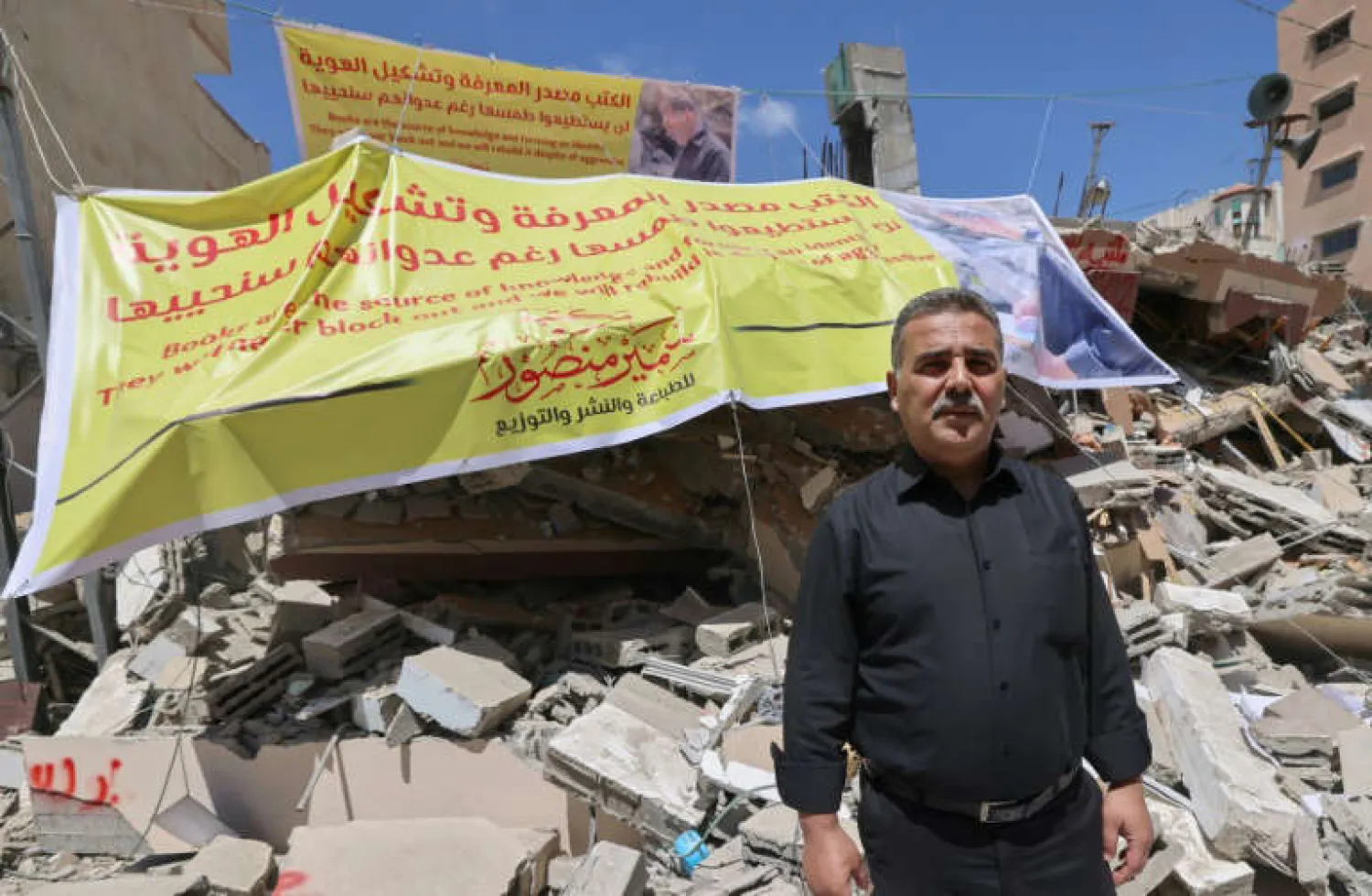
Samir al-Mansour stands in front of the rubble of his bookshop in Gaza City. 'Forty years of my life were obliterated in less than a second,' he said - AFP
TT

Gaza Bookshop Owner's Dreams Buried Under the Rubble

Samir al-Mansour stands in front of the rubble of his bookshop in Gaza City. 'Forty years of my life were obliterated in less than a second,' he said - AFP

For decades, it was the place to go for books in the blockaded Gaza Strip, from school texts to the Quran to Arabic translations of European literary classics.

But last Tuesday, owner Samir al-Mansour watched in disbelief as the bookshop and publishing house he had poured his life into went up in smoke.

"Forty years of my life were obliterated in less than a second," said the man in his 50s, a cigarette between his fingers, staring at a mound of concrete, paper and squashed plastic chairs.

"There are 100,000 books under this rubble," he said.

At around 5:00 am on Tuesday, Mansour was at home watching television when the channel reported the Israeli air force was about to hit the building housing his bookshop.

Mansour rushed over, but came to a dead stop some 200 metres (220 yards) away from the building, just in time to see a missile obliterate his life's work.

The latest deadly clashes lasted 11 days and saw Israel launch air strikes in response to a rocket barrage by Hamas, which rules Gaza, and other Islamist groups.

"I have nothing to do with an armed group, a political faction," Mansour told AFP.

"It's an attack on culture."

- 'Never happened before' -

Mansour started working in his father's bookshop in the 1980s, when he was just 14 years old, then took over in 2000 and soon branched out into publishing.

As rescue workers continue to look for bodies and survivors in the rubble after the military conflict, Mansour was mourning all that he has lost.

Buried in the rubble were copies of Islamic religious texts, children's picture books and a copy of Fyodor Dostoevsky's "The Brothers Karamazov".

Israeli strikes on Gaza since May 10 have killed 248 Palestinians, including 66 children, and have wounded over 1,900 people, the Gaza health ministry says.

Rockets and other fire from Gaza have claimed 12 lives in Israel, including one child and an Arab-Israeli teenager, an Israeli soldier, one Indian, and two Thai nationals, medics say. Some 357 people in Israel have been wounded.

There is controversy about how many of those killed in Gaza were combatants, and how many were civilians.

Prime Minister Benjamin Netanyahu said Israel's bombing campaign had killed "more than 200 terrorists" in Gaza.

Mansour said he had lived through two Palestinian uprisings and three Gaza wars.

"But this had never happened, my bookshop was never destroyed," he said.

His son-in-law Montasser Saleh had arrived in Gaza from Norway to visit the family just before the conflict started, and was with him when his life was turned upside down.

"We were at home, watching television," Saleh said.

- 'More than a bookshop' -

He recounted how on the TV channel Al Jazeera "they said there had been a warning shot on the building containing the bookshop".

He too said they immediately rushed over to the building.

"Samir wanted to go and grab some papers, his computer, but he was too scared to go in and be hit by a missile, so we stayed outside," he said.

Mosaab Abu Toha, a poet and the founder of the Edward Said library started after the Gaza war in 2014, said the Gaza Strip had lost "one of its main cultural resources".

"Mansour was more than a bookshop," he said. "It was a publishing house publishing Gaza writers.

"The books were printed in Egypt -- some to come back to Gaza, but others to stay there and be circulated around the Arab world.

"It was a way to lift the siege on Gaza through literature," he said of the blockade on the Palestinian territory in place since 2007.

For Gaza readers, the publishing house had printed around 1,000 copies of the works of local authors such as Ghareeb Askalani or Yusri al-Ghoul.

Mansour is not the only book or stationery shop destroyed in the latest Israeli bombing campaign.

Nearby Iqraa was also levelled, and the Al-Nahda stationery and bookshop was reduced to a pile of pulverised cinderblocks.

In front of what remains of Al-Nahda, a poster assured loyal customers it would re-open soon.

"Ideas do not die," it read.


Culture Ministry Continues Preparations in Historic Jeddah to Welcome Visitors during Ramadan 

Historic Jeddah has emerged as a leading cultural tourism destination during Ramadan. (SPA)
TT

Culture Ministry Continues Preparations in Historic Jeddah to Welcome Visitors during Ramadan 

Historic Jeddah has emerged as a leading cultural tourism destination during Ramadan. (SPA)

The Saudi Ministry of Culture is continuing its efforts to revitalize Historic Jeddah in preparation for welcoming visitors during the holy month of Ramadan, offering cultural programs, events, and heritage experiences that reflect the authenticity of the past.

The district has emerged as a leading cultural tourism destination at this time of year as part of the “The Heart of Ramadan” campaign launched by the Saudi Tourism Authority.

Visitors are provided the opportunity to explore the district’s attractions, including archaeological sites located within the geographical boundaries of the UNESCO World Heritage-listed area, which represent a central component of the Kingdom’s urban and cultural heritage.

The area also features museums that serve as gateways to understanding the city’s rich heritage and cultural development, in addition to traditional markets that narrate historical stories through locally made products and Ramadan specialties that reflect authentic traditions.

These initiatives are part of the ministry’s ongoing efforts to revitalize Historic Jeddah in line with the objectives of Saudi Vision 2030 and aiming to transform it into a vibrant hub for arts, culture, and the creative economy, while preserving its tangible and intangible heritage.


Thousands of Animals, Rare Specimens Stolen from Sudan Museum

Skulls of several mammals before the destruction (Asharq Al-Awsat)
TT

Thousands of Animals, Rare Specimens Stolen from Sudan Museum

Skulls of several mammals before the destruction (Asharq Al-Awsat)

“Everything is over.” With that short and painful phrase, a Sudanese government official summed up the loss of nearly a century and a half of history after war destroyed the headquarters of the Sudan Natural History Museum in central Khartoum, stripping the country of thousands of taxidermied and live endangered animals, as well as rare reference specimens.

In the first days after fighting erupted in April 2023, activists on social media called for food and water to be provided to save the live animals. When that proved impossible, cages were opened, and the animals fled, even though some of the reptiles were venomous snakes.

The museum, officially affiliated with the University of Khartoum, lies about one kilometer from the Sudanese army’s general command headquarters in central Khartoum.

Its close proximity led to severe damage from clashes and shelling between the Sudanese army and the Rapid Support Forces, which later took control of the surrounding area for more than a year.

Dr. Othman Ali Haj Al-Amin, Dean of the Faculty of Science at the University of Khartoum, said: “We lost thousands of taxidermied animals, birds, and reptiles that are more than 150 years old.”

“It is most likely that the live animals were stolen or looted and did not die,” he added. “We did not find remains or skeletons of those animals inside the museum.”

Al-Amin broke down in tears as he described to Asharq Al-Awsat the scale of devastation inflicted on one of the world’s oldest natural history museums.

“We lost about 2,000 taxidermied animal specimens, in addition to more than 600 endangered reference specimens that were on display, and nearly all geological records, including animal, plant, and rock fossils,” he said.

“The greatest loss was around 100 species representing all families of animals, birds, and reptiles that had been cared for and preserved for decades.”

Among them were fossil bird specimens collected between 1885 and 1945 that cannot be replaced, as well as a Kordofan giraffe, an endangered subspecies.

The war also claimed “the oldest crocodile, which had lived in the museum for many years and had been cared for since it was an egg,” along with numerous reptiles, including venomous snakes, scorpions, and a Nile monitor lizard.

A taxidermied lioness was recovered and transferred to the university’s veterinary faculty.

Asharq Al-Awsat learned that the International Committee of the Red Cross attempted in those early days to evacuate civilians, including university students who were trapped inside the museum for weeks, as well as to move live and taxidermied animals. The effort failed due to intense fighting in the heart of Khartoum.

According to the Sudanese official, the preserved specimens were collected in the mid-19th century by British army officers.

During World War II, they were transferred from the Sudan National Museum to the Natural History Museum next to the University of Khartoum, which has managed them since its establishment in 1929.

Al-Amin said the museum housed specimens illustrating biodiversity from across Sudan, including South Sudan before its secession, as well as samples gifted to Sudan by international museums.

The Sudan Natural History Museum included multiple sections, among them halls displaying rare bird species, another devoted to animal skulls preserved for decades, a section for medicinal and aromatic plants, geological rock samples collected from ancient eras and environments, and enclosures for live animals.

The dean said restoring the museum to its original state would require many years of work and significant funding. He voiced pessimism about recovering the rare animals, historical specimens, and old records lost during the war.

Many live animals were likely deliberately killed or died of hunger and thirst, he said, while taxidermied animals and rare rock and herb specimens — painstakingly collected, sorted, and classified over many years by researchers — were looted.

The Natural History Museum was a scientific and cultural institution dedicated to the study of biodiversity and natural specimens, and one of the oldest museums in Sudan.


Once a National Obsession, Traditional Korean Wrestling Fights for Survival 

An elderly spectator watches a ssireum match during a Lunar New Year Ssireum championship at the Taean Complex Indoor Gymnasium in Taean, South Korea, February 14, 2026. (Reuters)
TT

Once a National Obsession, Traditional Korean Wrestling Fights for Survival 

An elderly spectator watches a ssireum match during a Lunar New Year Ssireum championship at the Taean Complex Indoor Gymnasium in Taean, South Korea, February 14, 2026. (Reuters)

As South Korea's global cultural influence expands in areas such as music, film and television, one form of entertainment struggling to attract attention even at home is Korea's traditional style of wrestling, known as ssireum.

Ssireum - pronounced like "see room" - had its heyday in the 1980s and early 1990s, when there were as many as eight professional teams and the top wrestlers became household names. Since then, it has been squeezed by tighter budgets and a public quick to move on to new trends.

Twenty-year-old Lee Eun-soo, who began training at the age ‌of nine, is ‌taking part in this year's Lunar New Year ‌tournament, ⁠the showcase event ⁠for the more than 1,500-year-old sport.

Lee lamented that at his former high school, the ssireum team currently has no members and there is talk of disbanding it.

"I once tried to imagine my life if I hadn’t done ssireum," Lee said. "I don’t think I could live without it."

A ssireum match involves two wrestlers facing off in an ⁠eight-meter (26.25 ft) sandpit ring, gripping each other by a ‌cloth belt called a "satba" and using ‌strength, balance, timing and stamina to force the opponent to the ground.

Ssireum ‌was inscribed on UNESCO's Representative List of the Intangible Cultural Heritage ‌of Humanity in 2018, but that international recognition has not translated into commercial success. Its relative obscurity contrasts with the high profile of Japan's sumo, another centuries-old form of wrestling.

Unlike sumo, which is supported by ‌a centralized professional ranking system and six major annual tournaments - or Olympic wrestling, with its global reach - ⁠ssireum remains ⁠largely domestic.

"Sport is something people won't come to watch if they don’t know the wrestlers or even the sport itself," said Lee Tae-hyun, a former ssireum wrestler and Professor of Martial Arts at Yong In University, who has promoted the sport overseas and believes it has commercial potential with the right backing.

Lee Hye-soo, 25, a spectator at the Lunar New Year tournament, said many Koreans are now unfamiliar with ssireum.

"My grandfather liked watching ssireum, so I watched it with him a lot when I was young," she said.

"I like it now too, but I think it would be even better if it became more famous."