


Egypt Bets on Ancient Finds to Pull Tourism out of Pandemic

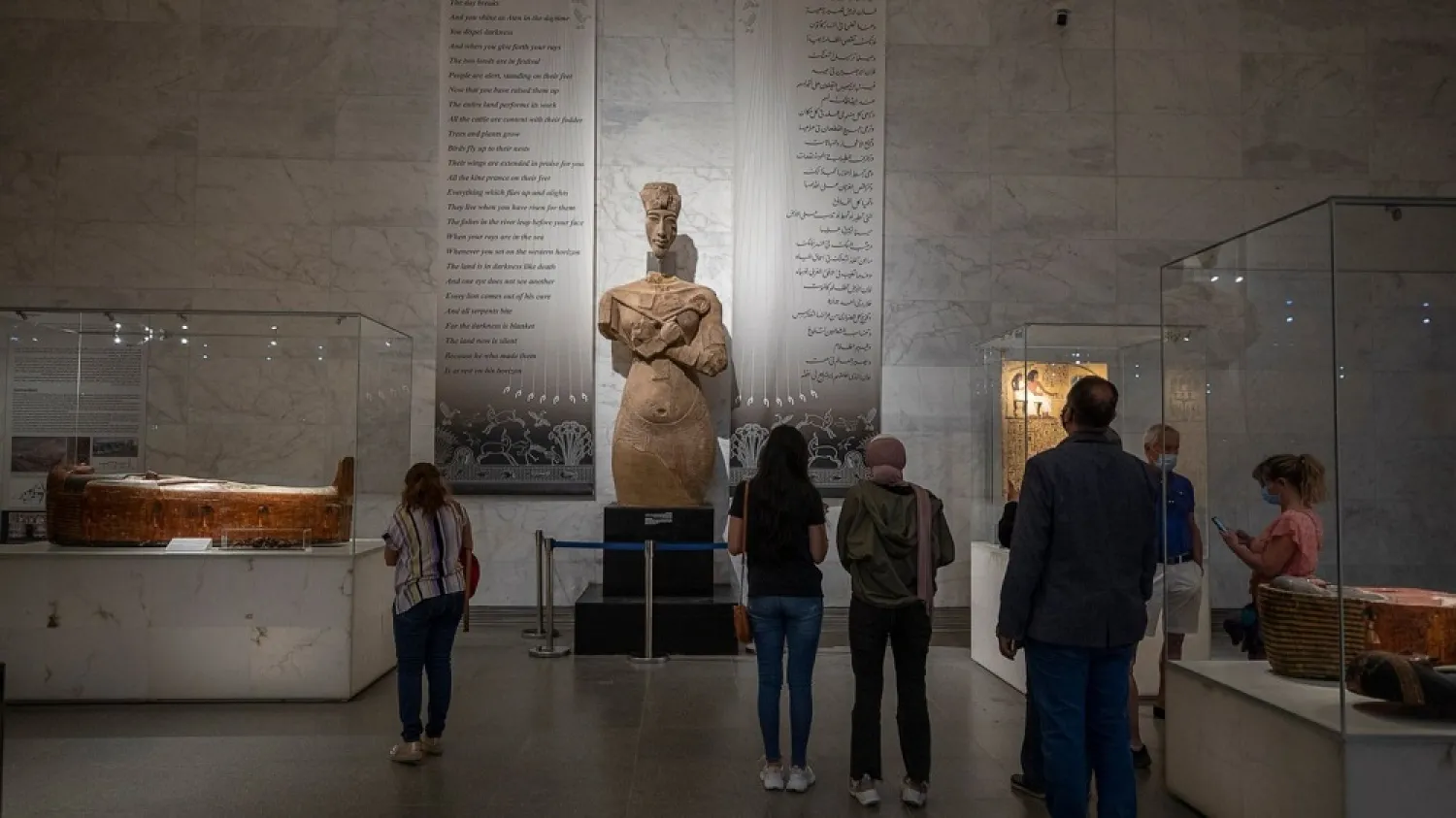
In this April 24, 2021 file photo, people visit the new National Museum of Egyptian Civilization in Old Cairo. (AP)
TT

Egypt Bets on Ancient Finds to Pull Tourism out of Pandemic

In this April 24, 2021 file photo, people visit the new National Museum of Egyptian Civilization in Old Cairo. (AP)

Workers dig and ferry wheelbarrows laden with sand to open a new shaft at a bustling archaeological site outside of Cairo, while a handful of Egyptian archaeologists supervise from garden chairs. The dig is at the foot of the Step Pyramid of Djoser, arguably the world’s oldest pyramid, and is one of many recent excavations that are yielding troves of ancient artifacts from the country’s largest archaeological site.

As some European countries re-open to international tourists, Egypt has already been trying for months to attract them to its archaeological sites and museums. Officials are betting that the new ancient discoveries will set it apart on the mid- and post-pandemic tourism market. They need visitors to come back in force to inject cash into the tourism industry, a pillar of the economy.

But like countries elsewhere, Egypt continues to battle the coronavirus. In early May, the government announced that 1 million people had been vaccinated, though that number is believed to be higher now.

In the meantime, authorities have kept the publicity machine running, focused on the new discoveries.

In November, archaeologists announced the discovery of at least 100 ancient coffins dating back to the Pharaonic Late Period and Greco-Ptolemaic era, along with 40 gilded statues found 2,500 years after they were first buried. That came a month after the discovery of 57 other coffins at the same site, the necropolis of Saqqara that includes the step pyramid.

“Saqqara is a treasure,” said Tourism and Antiquities Minister Khaled el-Anany while announcing the November discovery, estimating that only 1% of what the site contains has been unearthed so far.

“Our problem now is that we don’t know how we can possibly wow the world after this,” he said.

If they don’t, it certainly won’t be for lack of trying.

In April, Zahi Hawass, Egypt’s best-known archaeologist, announced the discovery of a 3,000-year-old lost city in southern Luxor, complete with mud brick houses, artifacts and tools from pharaonic times. It dates back to Amenhotep III of the 18th dynasty, whose reign (1390–1353 B.C.) is considered a golden era for ancient Egypt.

That discovery was followed by a made-for-TV parade celebrating the transport of 22 of the country’s prized royal mummies from central Cairo to their new resting place in a massive facility farther south in the capital, the National Museum of Egyptian Civilization.

The Red Sea resort of Sharm el-Sheikh is now home to an archaeological museum, as is Cairo’s International Airport, both opened in recent months. And officials have also said they still plan to open the massive new Grand Egyptian Museum next to the Giza Pyramids by January, after years of delays. Entrance fees for archeological sites have been lowered, as has the cost of tourist visas.

At the newly opened National Museum of Egyptian Civilization, Mahmoud el-Rays, a tour guide, was leading a small group of European tourists at the hall housing the royal mummies.

“2019 was a fantastic year,” he said. “But corona reversed everything. It is a massive blow.”

Tourism traffic strengthened in the first months of 2021, el-Anany, the minister, told The Associated Press in a recent interview, though he did not give specific figures. He was optimistic that more would continue to come year-round.

“Egypt is a perfect destination for post-COVID in that our tourism is really an open-air tourism,” he said.

It has recorded a total of 14,950 deaths from the virus and is still seeing more than a thousand new cases daily. Like other countries, the real numbers are believed to be much higher.

Egypt also had a trying experience early on in the pandemic, when it saw a coronavirus outbreak on one of its Nile River cruise boats. It first closed its borders completely until the summer of 2020, but later welcomed tourists back, first to Red-Sea resort towns and now to the heart of the country — Cairo and the Nile River Valley that hosts most of its famous archaeological sites. Visitors still require a negative COVID-19 test result to enter the country.

In a further cause for optimism, Russia said in April that it plans to resume direct flights to Egypt’s Red Sea resort towns. Moscow stopped the flights after a Russian airliner crashed over the Sinai Peninsula in October 2015, killing all on board.

Amanda, a 36-year-old engineer from Austria, returned to Egypt in May. It was her second visit in four years. She visited the Egyptian Museum, the National Museum of Egyptian Civilization and Islamic Cairo, in the capital’s historic center.

She had planned to come last year, but the pandemic interfered.

“Once they opened, I came,” she said. “It was my dream to see the Pyramids again.”

El-Rays, the tour guide, says that while he’s seeing tourists starting to come in larger numbers, he knows a full recovery will not happen overnight.

“It will take some time to return to before corona,” he said.


Riyadh Airports Company Wins Four Global Awards at 2026 Stevie Awards

Riyadh Airports Company Wins Four Global Awards at 2026 Stevie Awards
TT

Riyadh Airports Company Wins Four Global Awards at 2026 Stevie Awards

Riyadh Airports Company Wins Four Global Awards at 2026 Stevie Awards

Riyadh Airports Company, which manages and operates King Khalid International Airport in Riyadh, achieved a new global accomplishment by winning four awards at the 2026 Stevie Awards, considered among the most prominent international awards honoring innovation and excellence across various business fields.

The awards annually attract thousands of entries from leading institutions and companies worldwide and are subject to precise evaluation standards by specialized international judging committees, reinforcing their position as one of the leading global awards in institutional excellence, SPA reported.

The company received awards across multiple categories, winning the gold award for Innovation in the Use of Social Media, in addition to two silver awards for Most Innovative Social Media Campaign and Most Innovative Use of Influencer Collaboration, alongside a bronze award for Innovation in Social Media Marketing.

This recognition reflects the level of progress achieved by Riyadh Airports Company in adopting the latest and best practices and developing distinguished initiatives based on innovation and integration in implementing communication and marketing campaigns, enhancing its institutional presence and reinforcing its position at both regional and international levels.


Oil Prices Drop awaiting Mideast Peace Progress

In an aerial view, a Valero refinery is seen on May 05, 2026 in Corpus Christi, Texas. Corpus Christi is facing a looming water crisis driven by rising temperatures, prolonged drought conditions, and increasing demand from local oil refineries.   Brandon Bell/Getty Images/AFP
In an aerial view, a Valero refinery is seen on May 05, 2026 in Corpus Christi, Texas. Corpus Christi is facing a looming water crisis driven by rising temperatures, prolonged drought conditions, and increasing demand from local oil refineries. Brandon Bell/Getty Images/AFP
TT

Oil Prices Drop awaiting Mideast Peace Progress

In an aerial view, a Valero refinery is seen on May 05, 2026 in Corpus Christi, Texas. Corpus Christi is facing a looming water crisis driven by rising temperatures, prolonged drought conditions, and increasing demand from local oil refineries.   Brandon Bell/Getty Images/AFP
In an aerial view, a Valero refinery is seen on May 05, 2026 in Corpus Christi, Texas. Corpus Christi is facing a looming water crisis driven by rising temperatures, prolonged drought conditions, and increasing demand from local oil refineries. Brandon Bell/Getty Images/AFP

Oil prices fell and global stock markets traded mixed Thursday awaiting an update on a US plan to end the Middle East war and reopen the Strait of Hormuz.

Having plunged more than 10 percent at one point Wednesday on peace hopes, crude futures fell far less sharply Thursday, with losses of around two percent.

European stock markets declined after big gains the previous session, while leading Asian markets climbed.

Tokyo soared 5.6 percent, which largely reflected resumption of trading in Japan after the country's public holidays this week.

"The wild streak of enthusiasm which hit markets amid hopes for a major de-escalation in the Iran conflict is tempering," noted Susannah Streeter, chief investment strategist at Wealth Club.

"There's a realisation that there are more hurdles to climb for a longer-term resolution to be agreed, even though Iran is reported to be studying a US peace proposal aimed at formally ending the conflict."

US President Donald Trump said an agreement could be near after positive talks, with Iran adding that it would pass on its latest position to mediator Pakistan.

The war, launched by the United States and Israel in late February, has seen Iran respond with attacks across the Middle East and impose a chokehold on the Strait of Hormuz, the gateway to the Gulf oil and gas industries and a strategic trade route.

In foreign exchange Thursday, the dollar lost some of its safe haven support.

Investors in Tokyo were closely watching the yen after speculation of intervention by the Japanese government to prop up the beleaguered currency.

Norway's central bank on Thursday hiked its guiding rate by a quarter point to 4.25 percent, citing a risk that the war in the Middle East could worsen already elevated inflation.

"Inflation is too high and has run above target for several years," Norges Bank governor Ida Wolden Bache said in a statement.

Away from the war, there has been a fresh wave of cash pumped into the technology sector as traders snap up all things artificial intelligence, helped by standout earnings from Apple, Google parent Alphabet, Microsoft and Samsung during the ongoing first-quarter reporting season.

Emirates Group on Thursday announced a three-percent rise in annual profits to $5.7 billion despite severe disruption to flights owing to the war.


Shell's Profit Beats Expectations at $6.9 Billion

(FILES) The Shell logo is pictured above a Shell petrol station in London on January 30, 2026. (Photo by HENRY NICHOLLS / AFP)
TT

Shell's Profit Beats Expectations at $6.9 Billion

(FILES) The Shell logo is pictured above a Shell petrol station in London on January 30, 2026. (Photo by HENRY NICHOLLS / AFP)

Shell's first-quarter profit beat estimates and hit its highest in two years at $6.9 billion on Thursday, boosted by gains linked to the Middle East war, leading the company to raise the dividend by 5%.

At the same time, it slowed its quarterly share buyback program to $3 billion from $3.5 billion to help divert cash to its balance sheet as a short-term liquidity squeeze after war-related energy supply disruption increased its debt.

"It really reflects that confidence we have in the long term cash ⁠flows of the ⁠company," Shell's Chief Financial Officer Sinead Gorman said on a call with reporters of the dividend hike. She added she still felt Shell shares were undervalued.

Turning to the buybacks, she said she had reduced them to allocate cash to the balance sheet.

Shell's shares were down 2.2% in early trading, broadly in line with other oil majors' shares as ⁠benchmark global oil prices have retreated from peaks well above $100 a barrel, Reuters reported.

First-quarter adjusted earnings, Shell's definition of net profit, rose to $6.92 billion, beating an analyst consensus of $6.36 billion in a company-provided poll and up from $5.58 billion a year earlier.

Profits at its chemicals and products unit, which includes refining and its oil trading desk, were $1.93 billion, beating expectations of $1.24 billion and up from $0.45 billion last year.

This echoes big oil trading profits at its European peers BP and TotalEnergies that also take speculative bets on moving prices in contrast with their more cautious US rivals.

Shell's oil and gas output fell 4% compared with the previous quarter, mainly due ⁠to outages in ⁠Qatar where part of its Pearl gas-to-liquids plant was damaged in the Middle Eastern conflict that began at the end of February. Full repairs might take about a year, Shell has said.

Shell's gearing, or debt to equity ratio including leases, rose to 23.2% from 20.7% at end-2025. Shell had flagged higher debt due to managing war-related price and supply disruptions and volatility.

Gorman told reporters she was very happy with Shell's balance sheet.

Its cash flow from operating activities at $6.1 billion was hit by large swings in inventory values, pushing working capital - a liquidity measure of current assets minus liabilities - to minus $11.2 billion.

Shell expects working capital movements to reverse over time provided oil and gas prices ease.
