


UN: Global Displacement from War, Crises Doubles in a Decade

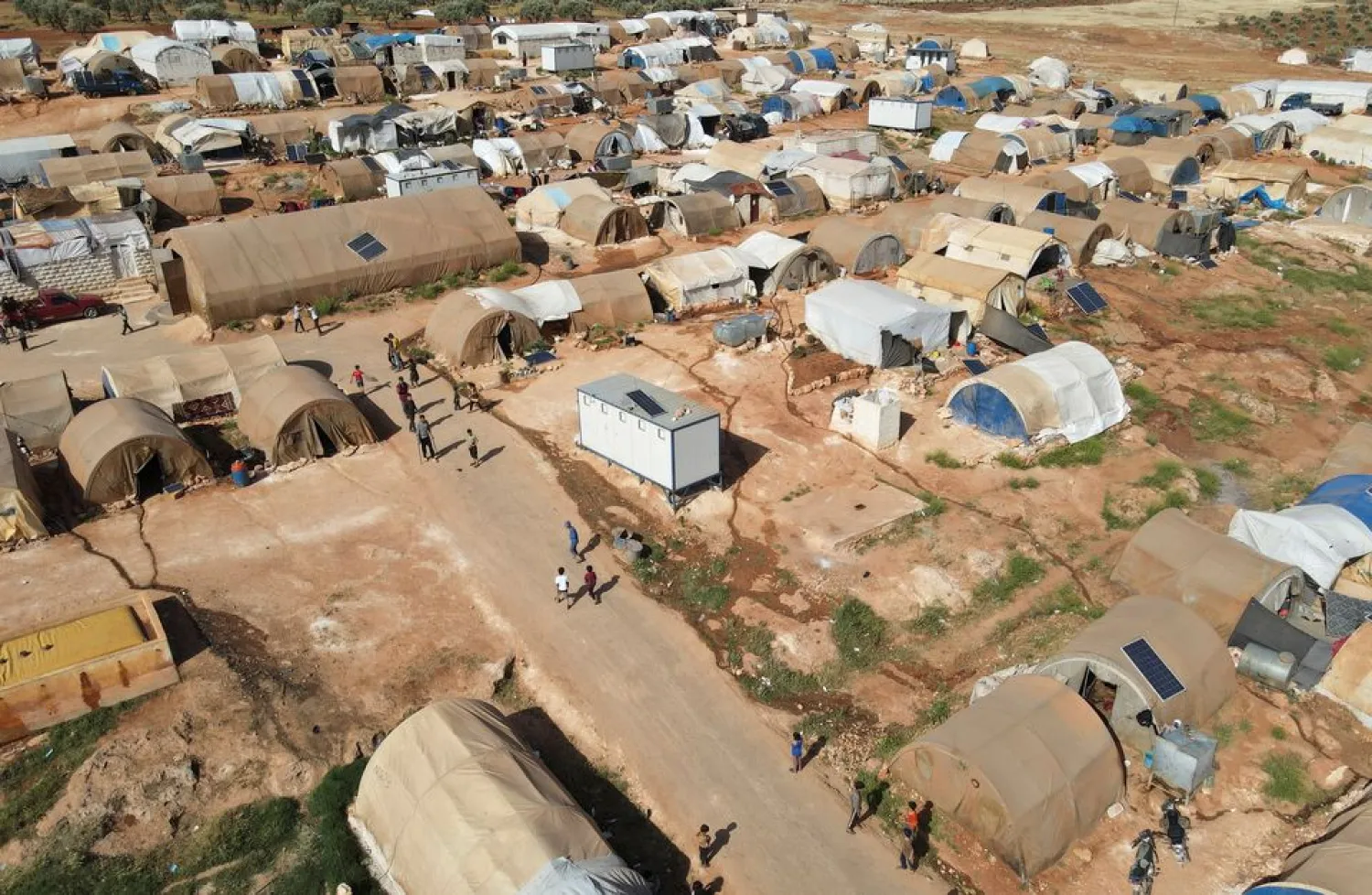
A general view shows a camp for internally displaced Syrians in northern Idlib, Syria May 5, 2021. Picture taken with a drone. REUTERS/Khalil Ashawi
TT

UN: Global Displacement from War, Crises Doubles in a Decade

A general view shows a camp for internally displaced Syrians in northern Idlib, Syria May 5, 2021. Picture taken with a drone. REUTERS/Khalil Ashawi

Despite the coronavirus pandemic, the number of people fleeing war and persecution continued rising last year, with global displacement climbing to over 82 million -- double the figure a decade ago, the UN said Friday.

A fresh report from the UN refugee agency showed global displacement figures swelled by around three million in 2020 after an already record-breaking year in 2019, leaving a full one percent of humanity uprooted and displaced.

The report highlighted how drawn-out crises like those in Syria, Afghanistan, Somalia and Yemen were continuing to force people to flee, while eruptions of violence in places like Ethiopia and Mozambique were causing surging displacement.

The fact that the numbers rose for the ninth straight year was all the more devastating because Covid-19 restrictions had been expected to limit displacement.

During the pandemic, "everything else has stopped, including the economies, but wars and conflict and violence and discrimination and persecution, all the factors that pushed these people to flee, have continued," UNHCR chief Filippo Grandi told AFP.

The UN agency found that by the end of 2020, a record 82.4 million people were living as refugees or asylum seekers, or in so-called internal displacement within their own countries, up from some 40 million in 2011.

A full 42 percent of the world's displaced are girls and boys under the age of 18.

"The tragedy of so many children being born into exile should be reason enough to make far greater efforts to prevent and end conflict and violence," Grandi said.

Some 26.4 million people were living as refugees at the end of 2020, including 5.7 million Palestinians.

Some 3.9 million Venezuelans were also displaced beyond their borders without being considered refugees, while 4.1 million people were registered worldwide as asylum seekers.

But while both refugee and asylum seeker numbers remained relatively flat from 2019, the number of people displaced within their own countries surged by more than two million to 48 million, the report said.

This was perhaps not surprising, given that the factors that generally force people to flee did not disappear during the pandemic, but the possibility to cross borders largely did.

In 2020, at least 164 countries closed their borders because of Covid-19, and more than half of them made no exceptions for asylum seekers and refugees fleeing for their lives.

"In a situation of increased conflict and violence, in a situation in which borders have been difficult to cross because of Covid, inevitably the figure... that has gone up is that of internally displaced people (IDPs)," Grandi told reporters.

Last year, more than 11 million people were newly displaced -- slightly more than in 2019 -- with most in just a handful of conflict-wracked countries and regions, the report showed.

They include Syria, which after more than a decade of war counts 13.5 million people displaced either inside or outside the country -- more than half of its population and a sixth of the global displacement total.

More than two-thirds of the world's refugees meanwhile come from just five countries: Syria, Venezuela, Afghanistan, South Sudan and Myanmar.

A number of new crises have also sparked significant displacement, the report said, pointing to Ethiopia's violence-hit Tigray region, which saw an exodus into Sudan of over 54,000 people in the final months of 2020 alone.

Hundreds of thousands of people also escaped deadly militant violence in northern Mozambique, while hundreds of thousands more were freshly displaced in Africa's restive Sahel region.

The vast majority of the world's refugees are hosted in countries neighboring crisis areas, mainly in poorer parts of the world.

Turkey remained the host of the world's largest refugee population totaling some 3.7 million, followed by Colombia with 1.7 million, Pakistan and Uganda with 1.4 million each and Germany with 1.2 million.

While needs are continuously rising, solutions for the displaced seemed to dwindle last year.

Over the course of 2020, only around 3.2 million IDPs and just 251,000 refugees returned to their homes, marking drops of 40 and 21 percent respectively from 2019.

And only 34,400 vulnerable refugees were resettled in third countries last year -- the lowest level in 20 years, the report said.

"Solutions require global leaders and those with influence to put aside their differences, end an egoistic approach to politics, and instead focus on preventing and solving conflict and ensuring respect for human rights," Grandi said.



Russia Says French Troops in Ukraine a ‘Direct Participation’ in War

Russian Foreign Minister Sergei Lavrov attends a joint press conference with the Secretary General of the Collective Security Treaty Organization (CSTO) Taalatbek Masadykov following the Joint Meeting of the CSTO Council of Foreign Ministers, Council of Ministers of Defense and Committee of Secretaries of Security Councils during the International Collective Security Forum in Moscow, Russia 10 November 2026. (EPA)
TT

Russia Says French Troops in Ukraine a ‘Direct Participation’ in War

Russian Foreign Minister Sergei Lavrov attends a joint press conference with the Secretary General of the Collective Security Treaty Organization (CSTO) Taalatbek Masadykov following the Joint Meeting of the CSTO Council of Foreign Ministers, Council of Ministers of Defense and Committee of Secretaries of Security Councils during the International Collective Security Forum in Moscow, Russia 10 November 2026. (EPA)

Russia said Tuesday it was aware of French troops having been sent to Ukraine, calling it "direct participation" in the war and saying a message had been issued to Paris.

"Not only French ones, we know this. We have conveyed our concern... this is no longer support for Ukraine, but direct participation in the war," Foreign Minister Sergei Lavrov told reporters.

His remarks come a day after a source told AFP and other media that French soldiers had been operating in Ukraine for several months to train Ukrainian personnel and help maintain equipment.

France on Tuesday rejected Lavrov's claim that the deployment amounted to "direct participation" in the Ukraine war as "absurd".

There is a "very limited" deployment of French troops in Ukraine for training and equipment maintenance, deputy defense minister Alice Rufo told parliament.

"There is the absence of any intention to fight, contrary to what the Russian foreign minister said this morning, which is absurd."

A source told AFP earlier the mission of a small contingent of French troops excludes any combat role.

They spoke on condition of anonymity after Radio France Internationale (RFI) first revealed the presence of French troops in the war-torn country earlier Monday.

"The rotation of French trainers supporting Ukraine in France, Poland, or occasionally in Ukraine is a reality," the source told AFP.

"But this is not a military operation. There is absolutely no intention of engaging in coercive actions."


US Attacks Iran’s Qeshm Island in Strait of Hormuz

An aerial view of the Iranian shores and the island of Qeshm in the Strait of Hormuz, December 10, 2023. (Reuters)
TT

US Attacks Iran’s Qeshm Island in Strait of Hormuz

An aerial view of the Iranian shores and the island of Qeshm in the Strait of Hormuz, December 10, 2023. (Reuters)

The United States on Tuesday carried out several attacks on Iran's southern Island of Qeshm, located in the Strait of Hormuz, a local Iranian official said.

"The American attack on locations on Qeshm island caused no damage to residential, commercial, or infrastructural areas," said Ahmad Nafisi, deputy provincial governor of the southern province of Hormozgan, quoted by the official IRNA news agency.

"The situation on Qeshm island is under control, and all relief, service, and executive agencies are on full alert," he added.

"The sounds of five to six explosions were heard on Qeshm on Tuesday evening," IRNA said.

Earlier in the day Iran's Revolutionary Guards said they had launched a drone attack targeting a radar system in Bahrain operated by the United States.

Since the outbreak of the Middle East war in late February, Tehran has attempted to restrict traffic through the strategic waterway, insisting vessels use only routes authorized by the country.

It has regularly targeted ships that transit without its authorization.

The United States has in response imposed a naval blockade on Iranian ports and helped tankers travel the strait, which normally carries about one-fifth of global oil supplies.

In recent weeks, Tehran has made multiple announcements saying ships have caught fire in the strait, often claiming they struck mines.

On Tuesday, the Iranian armed forces said three oil tankers struck naval mines while attempting to transit Hormuz.

The US military recently said it had cleared all mines from the main routes through the waterway.

US Central Command, which oversees US military operations in the region, said last month that it had helped Gulf countries export 1.5 billion barrels of oil via Hormuz since the summer.


4 Detained in North Macedonia for Alleged Iran-Backed Assassination Plot in Greece

Domestic security agency director Bojan Hristovski speaks to media after announcing the detention of four people implicated in an alleged Iran-backed assassination plot in neighboring Greece, in Skopje, North Macedonia, Tuesday, Nov. 17, 2026. (AP)
TT

4 Detained in North Macedonia for Alleged Iran-Backed Assassination Plot in Greece

Domestic security agency director Bojan Hristovski speaks to media after announcing the detention of four people implicated in an alleged Iran-backed assassination plot in neighboring Greece, in Skopje, North Macedonia, Tuesday, Nov. 17, 2026. (AP)

Authorities in North Macedonia have detained four people for questioning over an alleged Iran-linked assassination plot in neighboring Greece, officials said Tuesday.

Bojan Hristovski, director of North Macedonia's domestic security agency, said Tuesday that the suspects are all Macedonian citizens, adding that a fifth person had also been questioned and a sixth remained wanted by the authorities.

Hristovski named one of the Iranian recruiters as Naji Sharifi Zindashti, who is wanted in the United States for allegedly operating a criminal network that targets Iranian dissidents and activists abroad.

He did not give details of the alleged target in Greece, and Greek authorities did not immediately comment on the announcement.

“This concerns the dismantling of an Iranian proxy network involved in planning a terrorist attack,” Hristovski said.

“The network operating in Macedonia consisted of individuals embedded in criminal organizations within the country,” he said. “Acting on direct instructions from an Iranian national, they undertook preparatory and logistical activities for a terrorist act — an assassination targeting a previously identified individual located in Greece.”

Iran's mission to the United Nations did not immediately respond to a request for comment.