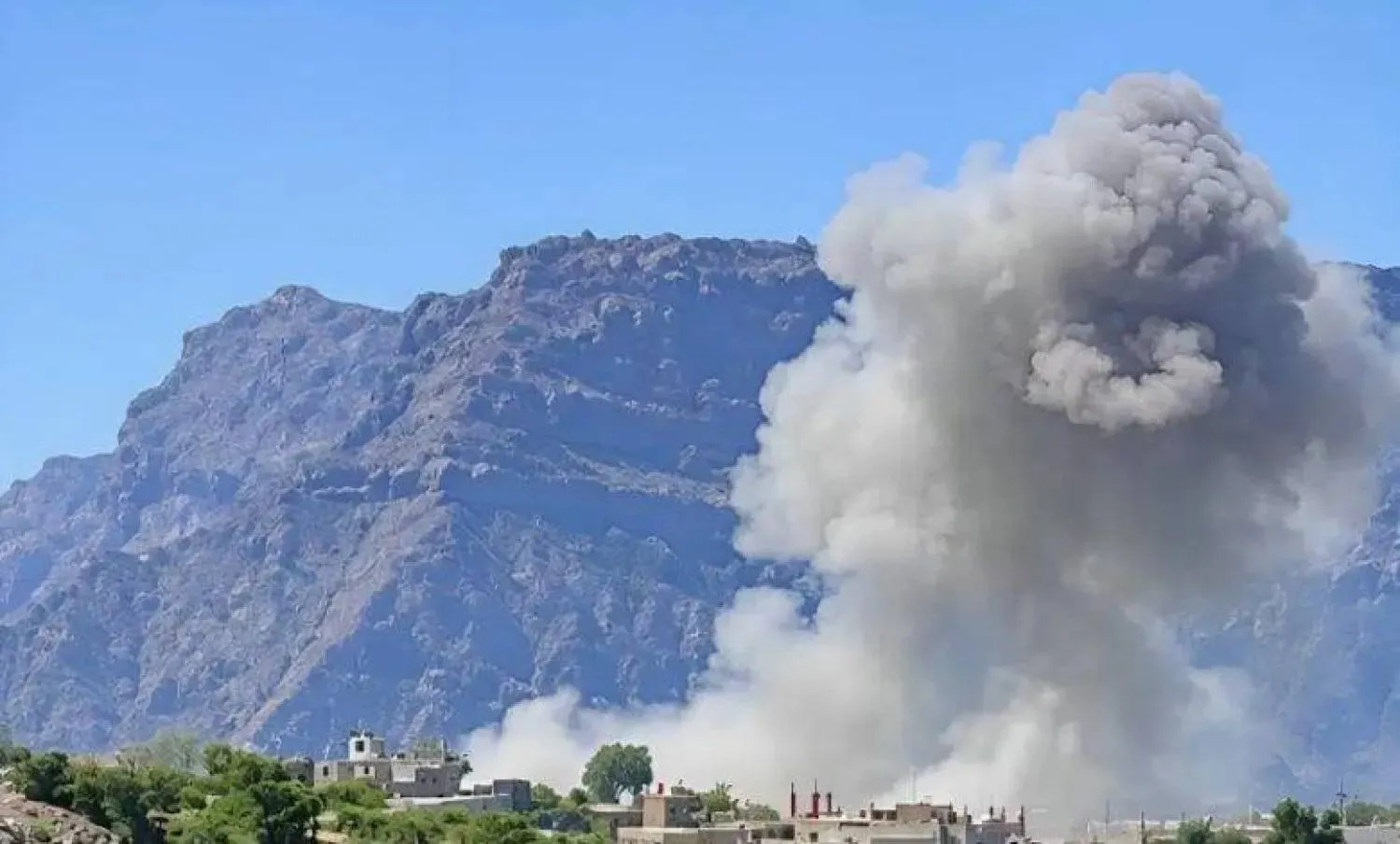
Yemen Intensifies Houthi Offensive as Parliament Approves Terrorism Law

Smoke rises after an airstrike on a Houthi position in Taiz. (Military media)
TT

Yemen Intensifies Houthi Offensive as Parliament Approves Terrorism Law

Smoke rises after an airstrike on a Houthi position in Taiz. (Military media)

Yemen is stepping up its military and legal campaign against the terrorist Houthi militia, with fighting raging across Taiz, Marib and Al-Jawf and airstrikes intensifying against the group's positions and military capabilities. Parliament also approved a law designating it a terrorist organization and criminalizing its activities, funding and arms supplies.

In the latest fighting, government forces backed by Popular Resistance fighters repelled a Houthi attack on their positions in Al-Shaqab, in southeast Taiz, where clashes and attacks by both sides have continued for weeks.

Government operations continued in northern Marib and southeastern Al-Jawf, backed by warplanes, drones and artillery under Operation Dawn of Yemen, with the military reporting hundreds of strikes on Houthi positions, fortifications, command centers and military equipment.

The Yemeni armed forces said they carried out 661 strikes in recent hours, including 15 airstrikes, 526 field artillery strikes, 53 drone strikes and 67 rocket launcher strikes, hitting Houthi troop concentrations, fortifications, weapons positions and military vehicle movements.

Colonel Majed al-Nuzaili, the armed forces' spokesperson, said the strikes killed or wounded 173 Houthi field commanders and fighters, destroyed or disabled 71 military vehicles and pieces of equipment, and destroyed forward command-and-control centers, observation posts and fortifications.

He said government troops were engaged in direct combat from northern Marib to southeastern Al-Jawf, targeting Houthi firing positions and combat formations deployed to the front lines.

Airstrikes also hit Houthi concentrations and fortifications in the Al-Alam sector of eastern Al-Jawf, as well as military equipment southeast of Al-Hazm.

In Taiz, government forces and Popular Resistance fighters continued to repel Houthi attacks across the province, including a fresh assault on Al-Shaqab.

The military said operations would continue on all fronts, with precautions taken to protect civilians and civilian infrastructure.

Yemen's Chief of the General Staff and Commander of Joint Operations, Lieutenant General Sagheer bin Aziz, briefed parliament on the fighting across multiple fronts, saying the Houthis had suffered heavy losses in personnel and equipment.

Bin Aziz said breaking the siege of Taiz must top the national military campaign's priorities, calling it essential to restoring state institutions, ending the coup, easing residents' suffering and restoring their rights to life, freedom and movement.

Parliament approves terrorism law

Alongside the military campaign, Yemen's parliament unanimously approved a law designating the Houthis a terrorist organization and criminalizing their activities and financing after two days of debate.

The legislation will be submitted to Rashad al-Alimi, chairman of the Presidential Leadership Council.

The vote followed a review by a special parliamentary committee chaired by Deputy Speaker Mohsen Basura, with parliamentary bloc leaders, the constitutional committee and government representatives taking part. Lawmakers then debated and voted on the bill article by article.

The law comprises 55 articles across nine chapters, classifying the Houthis and all their political, military and civilian formations as a terrorist organization. It sets out offenses, penalties and legal measures to prosecute those implicated in the group's violations and cut off its funding and arms supplies.

It bans the promotion of hereditary and sectarian supremacy and criminalizes the seizure of state powers, sieges and starvation of cities, attacks on civilians, public facilities, private property and roads, and the planting of landmines.

It also criminalizes attacks on international shipping and essential infrastructure, including water, electricity, healthcare and transportation services.

The law imposes penalties for recruiting, training and arming individuals, including the death penalty in specified cases, and establishes procedures to trace, seize, freeze and confiscate funds, assets and property linked to the Houthis and affiliated entities.


Ibb Records Highest Number of Cancer Cases in Yemen

A cancer treatment center in Ibb receives five to 10 new cases daily. (Local media)
TT

Ibb Records Highest Number of Cancer Cases in Yemen

A cancer treatment center in Ibb receives five to 10 new cases daily. (Local media)

Health fears are mounting in Yemen’s Houthi-controlled Ibb governorate, 192 kilometers south of Sanaa, as cancer cases are rising at an alarming rate, with five to 10 new cases recorded daily.

Residents are demanding an investigation into the surge amid growing concerns that it may be linked to crops irrigated with untreated sewage.

According to the National Cancer Control Foundation, based in the Houthi-controlled capital Sanaa, its Al-Amal Oncology Center in Ibb receives between five and 10 new confirmed cancer cases a day, raising alarm over the health situation.

The concerns come amid worsening environmental conditions across Yemen since the outbreak of the conflict. Weak government oversight and soaring energy and fuel costs have driven farmers on the outskirts of major cities, including Ibb, to irrigate crops with untreated sewage.

While no official scientific findings have established the direct causes of the surge, residents suspect a link to vegetables irrigated with sewage over the years.

Since the Houthis coup, the indiscriminate use of banned pesticides and chemical fertilizers has spread, turning the country's food supply into a source of serious health concerns.

Houthis accused of neglect

Residents estimate that around 60% of Yemeni cancer patients traveling to Egypt for treatment come from Ibb governorate.

They accuse the Houthis of turning a blind eye to agricultural practices that contaminate their food and failing to take decisive action to stop them.

Residents told Asharq Al-Awsat that the authorities had done little beyond directing a local university to hold a discussion on the issue, without taking practical steps to address the use of contaminated water for irrigation.

Meanwhile, cancer patients face worsening conditions at Al-Amal Oncology Center, where growing numbers arriving from across the governorate are straining already limited resources.

Medical sources told Asharq Al-Awsat that the center was under mounting pressure from rising patient numbers, while patients and their families struggled with treatment costs and difficulties obtaining essential medicines and medical services.

The sources said Ibb had recorded 9,000 cancer cases, the most across the country.

Despite its limited resources, the center's medical staff strive to provide free diagnostic and treatment services, including medical consultations, laboratory tests, chemotherapy, inpatient care and medication, as well as psychological support for patients.

Residents demand action

Medical sources warn that the center’s ability to sustain these services is increasingly at risk as patient needs outpace available support.

Residents are demanding urgent investigations into the rise in cancer cases, testing of water sources used to irrigate crops and tighter oversight of farms and markets. They are also calling for greater support for Al-Amal Oncology Center to strengthen its capacity to provide free treatment.

The plight of cancer patients in Yemen has deepened amid the collapse of the public healthcare system and the suspension of international support for dozens of medical facilities.

This has left charitable and community-run facilities, such as Al-Amal Oncology Center, as the only line of defense for thousands of impoverished patients unable to afford treatment abroad or costly chemotherapy drugs, amid unpaid salaries and deteriorating living conditions.


Yemen Intensifies Houthi Offensive as Parliament Approves Terrorism Law

Smoke rises after an airstrike on a Houthi position in Taiz. (Military media)
TT

Yemen Intensifies Houthi Offensive as Parliament Approves Terrorism Law

Smoke rises after an airstrike on a Houthi position in Taiz. (Military media)

Yemen is stepping up its military and legal campaign against the terrorist Houthi militia, with fighting raging across Taiz, Marib and Al-Jawf and airstrikes intensifying against the group's positions and military capabilities. Parliament also approved a law designating it a terrorist organization and criminalizing its activities, funding and arms supplies.

In the latest fighting, government forces backed by Popular Resistance fighters repelled a Houthi attack on their positions in Al-Shaqab, in southeast Taiz, where clashes and attacks by both sides have continued for weeks.

Government operations continued in northern Marib and southeastern Al-Jawf, backed by warplanes, drones and artillery under Operation Dawn of Yemen, with the military reporting hundreds of strikes on Houthi positions, fortifications, command centers and military equipment.

The Yemeni armed forces said they carried out 661 strikes in recent hours, including 15 airstrikes, 526 field artillery strikes, 53 drone strikes and 67 rocket launcher strikes, hitting Houthi troop concentrations, fortifications, weapons positions and military vehicle movements.

Colonel Majed al-Nuzaili, the armed forces' spokesperson, said the strikes killed or wounded 173 Houthi field commanders and fighters, destroyed or disabled 71 military vehicles and pieces of equipment, and destroyed forward command-and-control centers, observation posts and fortifications.

He said government troops were engaged in direct combat from northern Marib to southeastern Al-Jawf, targeting Houthi firing positions and combat formations deployed to the front lines.

Airstrikes also hit Houthi concentrations and fortifications in the Al-Alam sector of eastern Al-Jawf, as well as military equipment southeast of Al-Hazm.

In Taiz, government forces and Popular Resistance fighters continued to repel Houthi attacks across the province, including a fresh assault on Al-Shaqab.

The military said operations would continue on all fronts, with precautions taken to protect civilians and civilian infrastructure.

Yemen's Chief of the General Staff and Commander of Joint Operations, Lieutenant General Sagheer bin Aziz, briefed parliament on the fighting across multiple fronts, saying the Houthis had suffered heavy losses in personnel and equipment.

Bin Aziz said breaking the siege of Taiz must top the national military campaign's priorities, calling it essential to restoring state institutions, ending the coup, easing residents' suffering and restoring their rights to life, freedom and movement.

Parliament approves terrorism law

Alongside the military campaign, Yemen's parliament unanimously approved a law designating the Houthis a terrorist organization and criminalizing their activities and financing after two days of debate.

The legislation will be submitted to Rashad al-Alimi, chairman of the Presidential Leadership Council.

The vote followed a review by a special parliamentary committee chaired by Deputy Speaker Mohsen Basura, with parliamentary bloc leaders, the constitutional committee and government representatives taking part. Lawmakers then debated and voted on the bill article by article.

The law comprises 55 articles across nine chapters, classifying the Houthis and all their political, military and civilian formations as a terrorist organization. It sets out offenses, penalties and legal measures to prosecute those implicated in the group's violations and cut off its funding and arms supplies.

It bans the promotion of hereditary and sectarian supremacy and criminalizes the seizure of state powers, sieges and starvation of cities, attacks on civilians, public facilities, private property and roads, and the planting of landmines.

It also criminalizes attacks on international shipping and essential infrastructure, including water, electricity, healthcare and transportation services.

The law imposes penalties for recruiting, training and arming individuals, including the death penalty in specified cases, and establishes procedures to trace, seize, freeze and confiscate funds, assets and property linked to the Houthis and affiliated entities.


UN Agency Warns of Gaza Hypothermia Deaths without More Supplies

 Palestinians gather around a fire to keep warm among tents on a cold day in Gaza City, November 17, 2026. (Reuters)
Palestinians gather around a fire to keep warm among tents on a cold day in Gaza City, November 17, 2026. (Reuters)
TT

UN Agency Warns of Gaza Hypothermia Deaths without More Supplies

 Palestinians gather around a fire to keep warm among tents on a cold day in Gaza City, November 17, 2026. (Reuters)
Palestinians gather around a fire to keep warm among tents on a cold day in Gaza City, November 17, 2026. (Reuters)

The UN migration agency warned on Tuesday of further deaths from hypothermia in Gaza and called for more funding and shelter supplies ahead of winter after a baby died from cold.

Heavy rain has already flooded tens of thousands of tents housing displaced Palestinians crammed into encampments after the war between Israel and Hamas ‌reduced much of ‌the Gaza Strip to rubble. Last week, ‌a ⁠9-month-old baby living ⁠in a tent died from suspected hypothermia, UN agencies and Gaza authorities said, and respiratory illnesses are rising.

"Without proper shelter, without critical relief items, then hypothermia deaths will occur," Karl Baker, head of the International Organization for Migration's Gaza program, said on Tuesday, adding that children were particularly vulnerable, since they lose ⁠body heat more quickly. "It's unacceptable to have hypothermia ‌in the modern world."

IOM has ‌a $173 million funding shortfall for its winter shelter programs, he said.

Most ‌of Gaza's population of 2.1 million people is displaced and ‌is being squeezed into a smaller part of the territory, with UN maps showing more than half of Gaza's total area under Israeli restrictions.

Baker said at a UN press briefing in Geneva ‌that some 100,000 tents were currently waiting to enter Gaza – more than in previous years – with ⁠flows hindered ⁠by crossing closures and by lengthy Israeli security checks.

He also called for robust structures such as caravans and prefabricated housing to be funded and allowed in. The UN children's agency has complained that Israel has blocked equipment ahead of winter.

Israel's military agency that coordinates aid, COGAT, says it has a proactive "winterization plan" and that supplies and medicines continue to enter Gaza.

Baker described meeting a drenched family sheltering beneath sagging, worn-out tarpaulins.

"Gaza is turning into one large IDP camp (internally displaced persons). It ranks as one of the worst I've walked through," he said.