Egypt, Iraq Agree to Cooperate to Fight Cybercrimes

The Egyptian PM and Iraqi telecom minister in Cairo on Thursday. (Egyptian government)
TT

Egypt, Iraq Agree to Cooperate to Fight Cybercrimes

The Egyptian PM and Iraqi telecom minister in Cairo on Thursday. (Egyptian government)

Egypt and Iraq signed on Thursday a memorandum of understanding on cooperation in the field of communications and information technology and fighting cybercrimes.

The agreement was signed in the presence of Egyptian Prime Minister Mostafa Madbouly and the Iraqi and Egyptian ministers of telecommunications, Arkan Shahab Ahmed and Amr Talaat.

Meeting with Shahab Ahmed on Thursday, Madbouly underscored President Abdel Fattah al-Sisi's directives to the Egyptian government to exert all possible efforts to boost cooperation with Baghdad.

Shahab Ahmed praised the level and progress of the telecommunications and information technology sector in Egypt, indicating that the cooperation with Egypt in this field will bring optimal benefit to the Iraqi telecommunications sector.

He said that Iraqi Prime Minister Mustafa al-Kadhimi had underlined instructions to his government to establish strong partnership with Egypt to benefit from its expertise in the latest IT trends and advances.

Shahab Ahmed had arrived in the Egyptian capital, Cairo, at the head of a delegation on an official visit.

For his part, Talaat said the areas of cooperation between both countries include exchanging experiences to build a digital society and an involved digital government.

The two parties agreed to “utilize the available capabilities in the field of telecommunications to support and develop cooperation.”

They also hope the agreement will contribute to the growth of digital infrastructure, through the exchange of experiences and knowledge in order to enhance Internet access for individuals and public and private institutions at reasonable prices.”

Egypt and Iraq said the agreement would support fixed and mobile networks in terms of coverage and the ability to improve efficiency. It helps both parties attract investments and increase the contribution of the telecommunications sector to the economy.


Waiting for DeepSeek: New Model to Test China's AI Ambitions

(FILES) Floor signage for the offices of DeepSeek (C) is seen in Beijing on January 28, 2025. (Photo by PETER CATTERALL / AFP)
TT

Waiting for DeepSeek: New Model to Test China's AI Ambitions

(FILES) Floor signage for the offices of DeepSeek (C) is seen in Beijing on January 28, 2025. (Photo by PETER CATTERALL / AFP)

For weeks now, the global tech industry has been waiting for a major artificial intelligence launch from DeepSeek, seen as a benchmark for China's progress in the fast-moving field.

More than a year has passed since the startup put Chinese AI on the map in early 2025 with a low-cost chatbot that performed at a similar level to US rivals.

But despite reports and rumors about its imminent release, DeepSeek's next-generation "V4" model is nowhere in sight.

Speculation is also swirling over the geopolitical implications of which computer chips were chosen to train and power the new system: world-leading US designs or made-in-China alternatives that the country is racing to develop.

"It's important to know because at one level, it is a signal of China's AI self-sufficiency trajectory," Wei Sun, principal AI analyst at Counterpoint Research, told AFP.

Tech news outlet The Information reported last week that V4 can be run on the latest chips made by China's Huawei.

Such a shift would mark a milestone for China in its bid to beat US restrictions on the export of top-of-the-range AI chips from Californian titan Nvidia to the country.

The report cited five people with direct knowledge of large orders for Huawei chips, made in preparation for the DeepSeek launch by tech giants including Alibaba, ByteDance and Tencent.

AFP contacted DeepSeek, Huawei, Alibaba, ByteDance and Tencent but none were able to comment.

DeepSeek started life in 2023 as a side project of a hedge fund that had access to a cache of powerful Nvidia processors.

It shot to attention in January 2025 with its R1 deep-reasoning chatbot, which sent US tech shares tumbling with President Donald Trump calling it a "wake-up call" for American firms.

R1 was based on DeepSeek's last major AI model, V3, which was released in December 2024.

The company's affordable, customizable AI tools have been widely adopted in China, and are also popular in emerging markets such as Southeast Asia and the Middle East.

Stephen Wu, founder of the Carthage Capital fund, told AFP that V4 -- said to be multimodal, meaning it can generate text, pictures and video -- could again shock US tech valuations.

"I expect the upcoming DeepSeek V4 release will not just be a software update; it will be a highly capable, open-source model that handles massive context windows at a fraction of the cost," he predicted.

But DeepSeek's reputation as a company at the frontier of AI technology is also at stake.

Its models previously relied on Nvidia chips, so a move to collaborate with domestic chipmakers would require "substantial re-engineering", Wei said.

"That transition can slow development cycles and introduce performance trade-offs, especially for V4, a model expected to be state-of-the-art."

The US cites national security concerns as the reason for its export ban on Nvidia's most powerful AI processors to China.

"The ongoing wait for DeepSeek V4 points to friction in scaling advanced models without unrestricted access to top-tier Nvidia hardware," Wu said.

But some reports allege that DeepSeek skirted the ban to train V4 using thousands of Nvidia's top-end Blackwell chips, dismantled in third countries and smuggled to China.

Training AI models requires huge amounts of computing power -- much more than for processing generative AI queries, which is known as inference.

AFP has contacted DeepSeek for comment. Nvidia did not respond to a comment request but told The Information it had not seen evidence of this and "such smuggling seems farfetched".

Another Chinese AI startup, Zhipu, in January unveiled an image generator that it said had been entirely trained on Huawei chips.

And Alibaba said this week it would open a new data center for AI training and inference in southern China, powered by 10,000 of its own chips and operated by China Telecom.

As for DeepSeek, "if they have successfully trained V4 entirely on Huawei silicon, it signals a material shift in the geopolitical tech landscape", Wu said.



Samsung Electronics Expects Record Quarterly Profit on AI Boom

People visit a Samsung Electronics store gallery in Seoul, South Korea, 07 April 2026. (EPA)
TT

Samsung Electronics Expects Record Quarterly Profit on AI Boom

People visit a Samsung Electronics store gallery in Seoul, South Korea, 07 April 2026. (EPA)

Tech giant Samsung Electronics estimated on Tuesday that its first quarter profit had soared 755 percent annually to a record high of 57.2 trillion won ($37.9 billion), driven by strong sales of chips crucial for artificial intelligence.

The South Korean government has pledged to become one of the world's top three AI powers, alongside the United States and China.

Samsung has emerged as a key player -- along with fellow South Korean firm SK hynix -- in the supply of high-performing chips in demand from companies racing to keep up with the fast-evolving AI industry.

The company also said in a regulatory filing that its sales were expected to reach 133 trillion won ($88 billion) in the three months to the end of March, a 68 percent increase compared to the same period last year.

The strong outlook comes despite the risk posed to the global semiconductor supply chain if the war in the Middle East drags on.

A South Korean ruling party lawmaker told reporters last month that officials from Samsung and other companies had raised concern about potential disruption to chip production if some key supply chain materials, such as helium, cannot be sourced from the Middle East.

"Samsung Electronics achieved its highest-ever results, driven by rising revenue and profits in its memory-focused Device Solutions (DS) division," a Samsung spokesperson said.

He said the firm's competitiveness in home appliances and smartphones has helped to boost earnings.

The operating profit -- more than an eight-fold increase from 6.69 trillion won a year earlier -- was 36.7 percent higher than the average estimate, South Korea's Yonhap news agency reported, citing its own data firm.

- Growing demand -

With growing demand for memory chips, Samsung is expected to see "even better figures" in the months ahead, analyst Ryu Hyung-keun of Daishin Securities told AFP.

"As we are seeing a surge in memory chip prices, its profit margins will improve further for the remainder of the year," he said.

But the company is facing risks, said Kim Dae-jong, a business professor at Sejong University.

"A labor union strike scheduled for next month and the war in Iran are weighing on the outlook," he told AFP.

"The Middle East is Samsung's key market for home appliances, and demand from the region is significant, making it a source of concern."

Meanwhile, LG Electronics, South Korea's second-largest appliance maker after Samsung, also projected record first-quarter revenue of 23.73 trillion won.

"Despite continued macroeconomic uncertainty, the company's core businesses, including home appliances, maintained growth based on strong product competitiveness and solid market positions," the company said in a statement.

- Pushing up prices -

Samsung has seen strong orders from major technology firms for high-bandwidth memory -- a type of chip that is used in data centers and AI "accelerators", which are useful in carrying out demanding tasks and computation.

That is also pushing up the cost of less flashy chips used in consumer electronics -- threatening higher prices for phones, laptops and other devices worldwide.

Riding the AI boom, Samsung's shares have risen more than 240 percent over the past year.

Samsung did not provide earnings breakdowns from its separate divisions, such as the chip and mobile divisions.

Taipei-based research firm TrendForce predicts that memory chip industry revenue will surge to a global peak of more than $840 billion in 2027.

Samsung has already earmarked billions of dollars to expand chip production facilities, pledging to continue spending in "transitioning to advanced manufacturing processes and upgrading existing production lines to meet rising demand".

Experts have said the move would help Samsung seize the moment in the intensifying race for chips critical to AI infrastructure.

Samsung is expected to disclose its final quarterly earnings report at the end of April.

The firm's shares were up 0.73 percent in the afternoon trade in Seoul.


Samsung Is Discontinuing Its Texting App, Tells Impacted Users to Switch to Google Messages

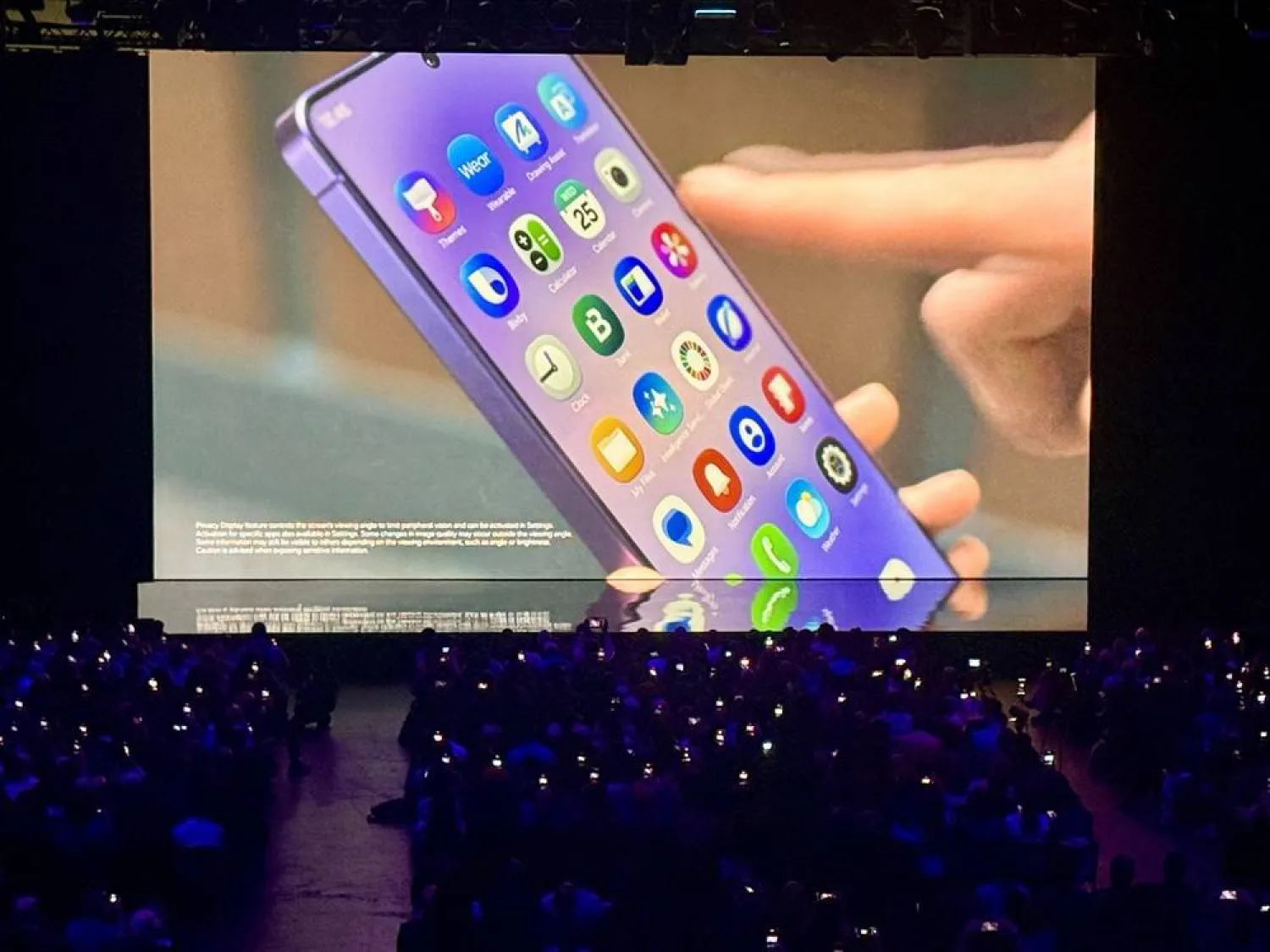
Samsung unveils its latest Galaxy smartphones during a showcase in San Francisco, Feb. 25, 2026. (AP)
TT

Samsung Is Discontinuing Its Texting App, Tells Impacted Users to Switch to Google Messages

Samsung unveils its latest Galaxy smartphones during a showcase in San Francisco, Feb. 25, 2026. (AP)

Samsung is saying goodbye its namesake texting app.

According to an end of service announcement published on the tech giant's US support website, Samsung Messages will be discontinued in July. Impacted owners of Samsung smartphones and other gadgets are being asked to switch to Google Messages in the meantime, “to maintain a consistent messaging experience on Android.”

All Samsung Galaxy phones run on Google's Android operating system. To switch to Google Messages, Samsung's website gives users instructions to download the app from the Play Store, if not already on their phone, and set it as the default. Some people may also receive an in-app notification to guide them through the process.

Samsung says switching to Google Messages will give users access to updates like the latest artificial intelligence features from Google's Gemini — which includes an experimental feature called “Remix” to generate images during conversations and AI-powered reply suggestions — and the ability to share higher quality photos between Android and Apple iOS devices through RCS-enabled messages.

Users of older Android operating systems (dating back to Android 11 or older) will not be impacted by the end of Samsung Messages, the company noted. To check what Android OS you have on a Samsung device, open the settings app, click on “software information” and scroll to “Android version.”

Meanwhile, owners of Samsung's latest Galaxy 26 lineup and other newer phones cannot download the Samsung Messages app from the Galaxy Store today.

All devices will no longer be able to download Samsung Messages after it's officially discontinued in July, the company noted. Samsung said users can check their app for the exact date for when service will go offline.

Beyond the US, Samsung did not immediately respond to a request for further information about whether its guidance for Samsung Messages was the same globally.