

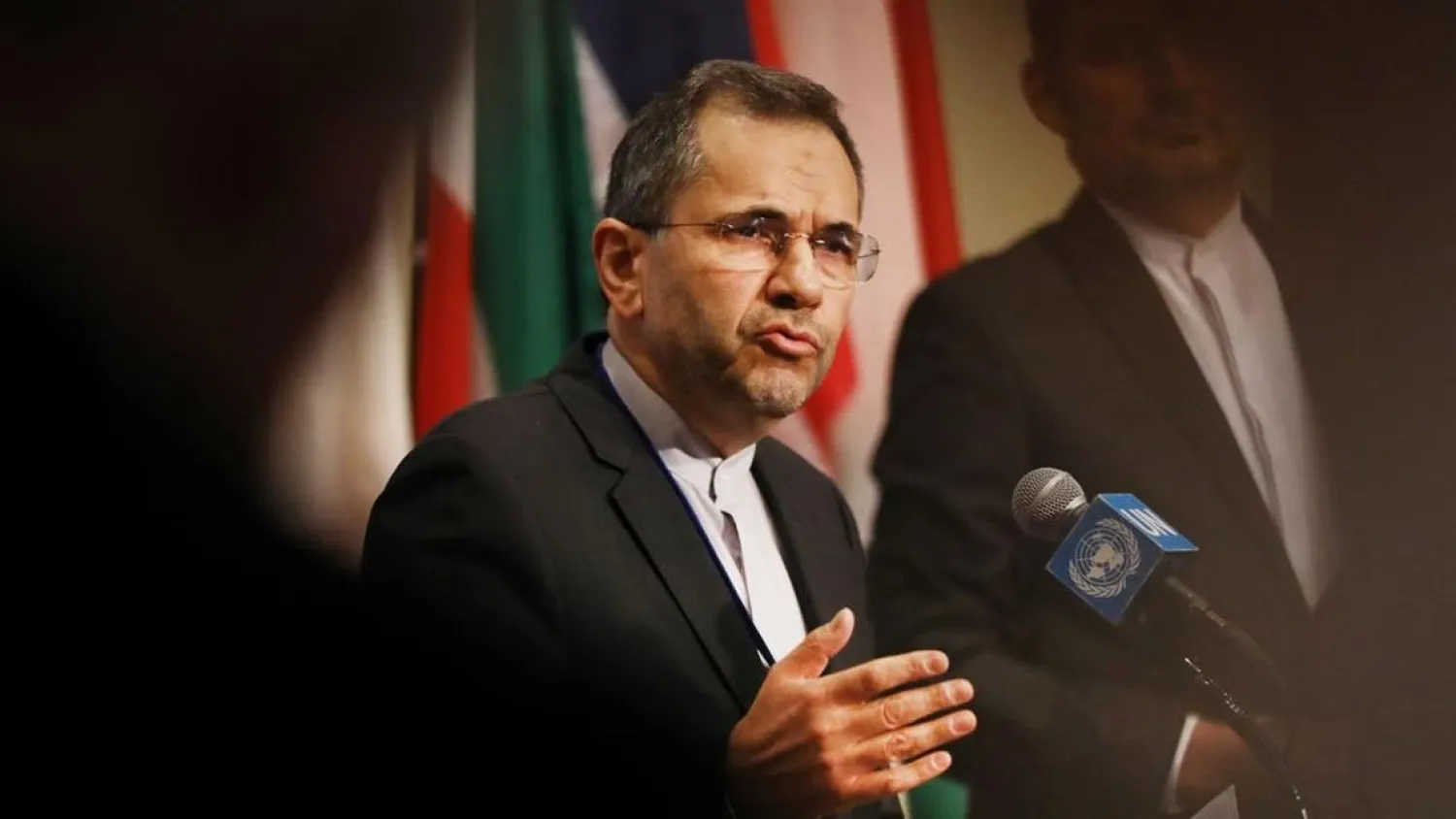

Iran Denies Links to Attacks on US Forces in Iraq, Syria

Iran’s Ambassador to the United Nations Majid Takht Ravanchi speaks to the media. (File Photo/AFP)
TT

Iran Denies Links to Attacks on US Forces in Iraq, Syria

Iran’s Ambassador to the United Nations Majid Takht Ravanchi speaks to the media. (File Photo/AFP)

Iran denied on Saturday US accusations that Tehran supported attacks on US forces in Iraq and Syria, and condemned US airstrikes on Iranian-backed militants there, state media reported.

On Tuesday, the United States told the UN Security Council that it targeted Iran-backed militia in Syria and Iraq with airstrikes to deter the militants and Tehran from conducting or supporting further attacks on US personnel or facilities.

But Iran’s UN envoy, Majid Takht Ravanchi, said: “Any claim to attribute to Iran... any attack carried out against American personnel or facilities in Iraq is factually wrong and void of the minimum requirements of authenticity and reliability,” according to the official news agency IRNA.

Under Article 51 of the United Nations Charter, the 15-member Security Council must immediately be informed of any action that states take in self-defense against armed attack.

Washington told the United Nations that the airstrikes hit facilities used by militia blamed for an escalating series of drone and rocket attacks against US forces in Iraq.

According to Reuters, Ravanchi said: “The US argument that such attacks were conducted to deter ...Iran and the so-called Iran-backed militia groups from conducting or supporting further attacks..., has no factual or legal ground, as it is founded on mere fabrication as well as arbitrary interpretation of Article 51.”

“The attacks by the United States are conducted in flagrant violation of international law,” Ravanchi said in a letter, quoted by IRNA.



Iran Hangs Man Convicted for Part in January Protests

Iranian women walk past a mural of late Iranian Supreme Leader Ali Khamenei on a street in Tehran, Iran, 15 July 2026. (EPA)
TT

Iran Hangs Man Convicted for Part in January Protests

Iranian women walk past a mural of late Iranian Supreme Leader Ali Khamenei on a street in Tehran, Iran, 15 July 2026. (EPA)

Iran hanged a man on Wednesday, the judiciary announced, after finding him guilty of taking part in anti-government protests that rocked the country over the winter.

"Mohammad Amini Dehaghani, a collaborator with the enemy, was hanged this morning after confirmation of the verdict by the supreme court," the judiciary's press agency reported.

He was found guilty of "moharebeh" (war against God in Persian) and "corruption on earth".

The condemned had "thrown a Molotov cocktail on January 9 outside the governor's office in Dehaghan, set it alight and destroyed public property as well as the town's police station," state media added.

At the end of December, protests against the cost of living in Iran spread rapidly across the country and expanded to include political demands.

The protests were met by a crackdown that rights groups say killed thousands.

Iranian authorities have portrayed the protests as riots backed by the United States and Israel, and said the violence killed around 3,000 people.

Rights groups abroad put the toll higher and accused the security forces of firing at demonstrators.

The number of executions has surged since the start of the Middle East war, begun by the United States and Israel against Iran on February 28.

According to Amnesty International, Iran conducts the second most executions of any country, after China.


Briton Jailed in Iran Given Additional Two-Year Sentence, Family Says

15 February 2025, United Kingdom, London: Craig Foreman (L) and Lindsay Foreman pose for a family photo. (Family Handout/dpa)
TT

Briton Jailed in Iran Given Additional Two-Year Sentence, Family Says

15 February 2025, United Kingdom, London: Craig Foreman (L) and Lindsay Foreman pose for a family photo. (Family Handout/dpa)

The family ‌of British couple Craig and Lindsay Foreman, who are serving a 10-year prison sentence in Iran on espionage charges that they deny, said on Wednesday that a judge had extended Craig Foreman's sentence by two years for speaking to the media.

The couple were arrested in 2025 while travelling through Iran by motorcycle as ‌part of ‌a round-the-world journey. Britain ‌has described ⁠their original sentences ⁠as "totally unjustifiable".

Joe Bennett, Lindsay Foreman's son and the family's spokesperson, said they had received reports that Craig Foreman had been taken before a judge and informed that his sentence had been extended because ⁠he had spoken to the ‌media.

"We understand ‌he was told he was being taken to ‌see his lawyer, but was instead brought ‌before a judge and informed of the additional sentence," Bennett said in a statement.

He said Craig Foreman had been denied access to ‌a lawyer and a translator and was given no opportunity to ⁠defend ⁠himself.

A spokesperson for Britain's foreign ministry said in an emailed statement that they were "urgently following up with the Iranian authorities about the reported increased sentence".

Last month, two independent UN experts said the Foremans appeared to have been wrongfully detained and sentenced following proceedings that failed to meet basic fair trial guarantees, while expressing concern over a hunger strike the couple began in May.


Confirmed Ebola Cases Top 2,000 in Congo, Including 754 Deaths

A doctor provides care to a patient with Ebola virus disease at the Rwampara Ebola Treatment Centre (ETC) in Bunia, Ituri, in the east of the Democratic Republic of Congo on July 13, 2026. (Photo by BENEDICTION MURHABAZI / AFP)
TT

Confirmed Ebola Cases Top 2,000 in Congo, Including 754 Deaths

A doctor provides care to a patient with Ebola virus disease at the Rwampara Ebola Treatment Centre (ETC) in Bunia, Ituri, in the east of the Democratic Republic of Congo on July 13, 2026. (Photo by BENEDICTION MURHABAZI / AFP)

Confirmed cases of Ebola in Congo have reached 2,011, including 754 deaths, according to government data released overnight in what authorities say is the fastest-growing outbreak on record even as some health workers have gone on strike over payment issues.

A total of 753 people remain in isolation or in hospitals, while 366 have so far recovered, according to data from Congo’s Ministry of Health.

Contact tracing remains a challenge, with coverage of those exposed still at 67%.

The Central African nation has been battling the Ebola outbreak caused by the rare Bundibugyo virus since May 15.

Two months since the onset, the outbreak continues to spread faster than health officials can track despite an expanding response. At least 80% of new cases are emerging from unknown chains of transmission, the World Health Organization said Tuesday.

A key challenge is that health authorities have yet to identify the outbreak’s patient zero, while displacements from armed conflict as well as mining-related movements have made it difficult to trace thousands who have come in contact with infected individuals.

Many of the newly reported deaths are people who died in their communities without ever reaching a health facility and without receiving care, Dr. Chikwe Ihekweazu, the WHO health emergencies chief, said Tuesday after returning from Bunia in Ituri, the worst-hit province in the outbreak.

Health workers are also going on strike in different parts of Ituri. Some have told The Associated Press they have not received any payment since they started work at the onset of the outbreak.

Response efforts have also been challenged by the lack of approved vaccines or treatments for the Bundibugyo virus, unlike the more common Zaire virus for which there is a vaccine and which was responsible for most of Congo’s past 16 outbreaks of the disease.

Enrollment for a highly anticipated study of two possible Ebola treatments recently kicked off in Ituri.