


US State Department Stresses Importance of Saudi Arabia in Resolving Regional Crises, Boosting Stability

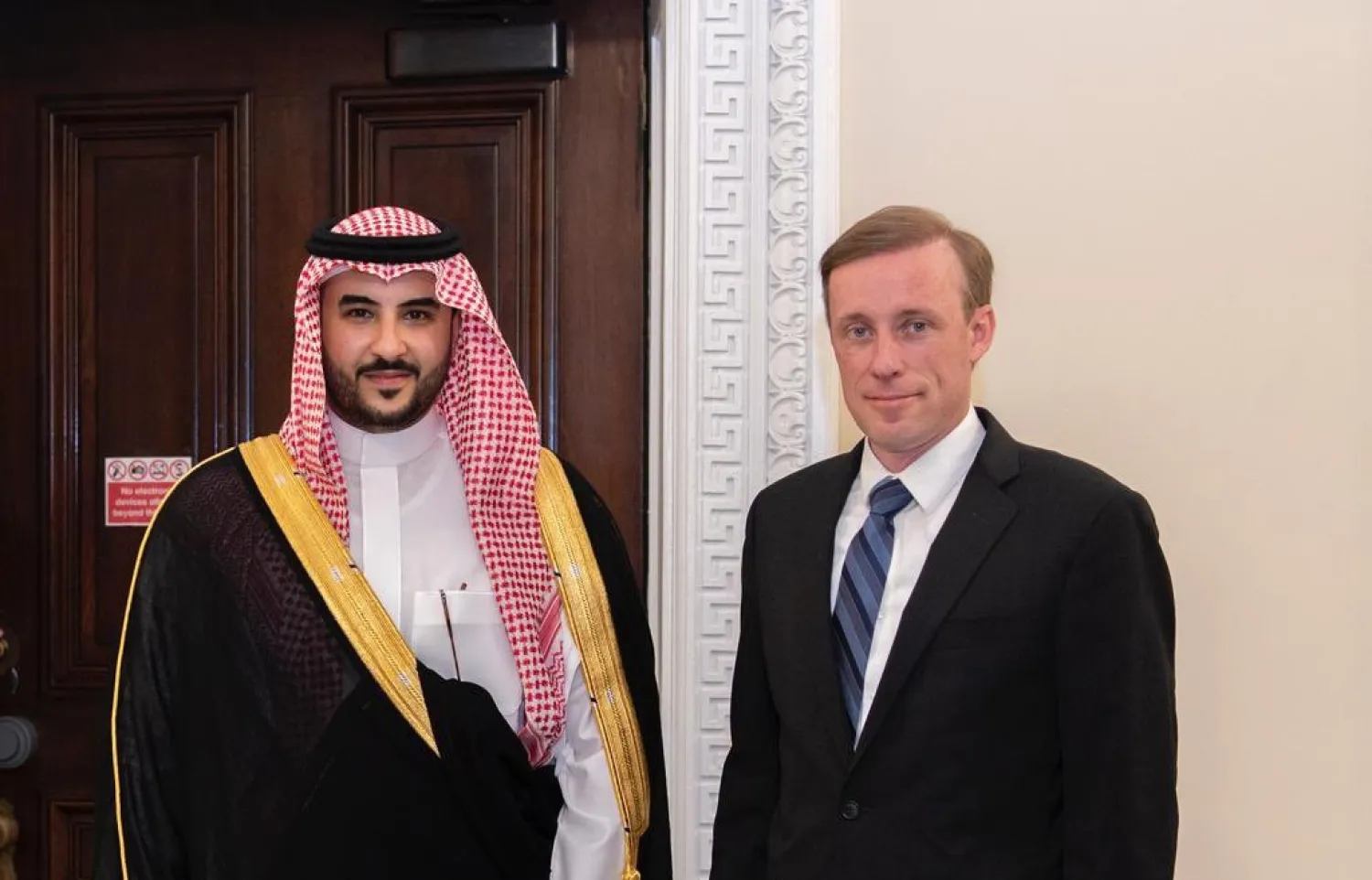
Prince Khalid meets with National Security Advisor Jake Sullivan. (Twitter)
TT

US State Department Stresses Importance of Saudi Arabia in Resolving Regional Crises, Boosting Stability

Prince Khalid meets with National Security Advisor Jake Sullivan. (Twitter)

The US State Department stressed the importance of Saudi Arabia’s role in resolving regional crises, saying it is among the most important actors in bolstering regional security and stability.

It noted cooperation between Riyadh and Washington in resolving problems in the Horn of Africa, the war in Yemen and helping the Lebanese people.

It also underscored support to Riyadh in defending itself and reaching a ceasefire in Yemen.

The statement was released after Saudi Deputy Defense Minister Prince Khalid bin Salman held talks with US Secretary of State Antony Blinken and other senior Department officials in Washington on Wednesday.

State Department officials reiterated support to Saudi Arabia in defending itself against cross-border attacks.

These statements were stressed by the senior officials, including Defense Secretary Lloyd Austin, who met Prince Khalid on Tuesday.

Prince Khalid was on a visit to the US that included meetings with National Security Advisor Jake Sullivan at the White House.

In a series of tweets, Prince Khalid said: “We discussed the longstanding and historic partnership between our two countries, our military and defense cooperation, and our mutual efforts to preserve regional stability.”

In a statement, State Department spokesman Ned Price said Prince Khalid discussed with Under Secretary of State for Political Affairs Victoria Nuland and Counselor of the US Department of State Derek Chollet efforts to achieve a comprehensive ceasefire in Yemen and transition to a political process.

They also underscored the need for economic reform and humanitarian relief to the Lebanese people, among other bilateral issues.

CNN reported that the American administration accorded Prince Khalid with the “red carpet treatment”, paving the way for “warm” relations between the two sides and consolidating Saudi-American discussions, whose significance were highlighted by the royal’s visit to Washington.

“As the administration struggles on a number of fronts -- with a likely resurgence of Taliban violence in Afghanistan, the ongoing war in Yemen, faltering Iran talks and gas prices at seven-year highs as Americans hit the road to celebrate summer and post-quarantine freedom -- Saudi Arabia's role in all these areas becomes too important to ignore,” said CNN.

Price said Prince Khalid held a series of meetings with special envoy for the Horn of Africa, Ambassador Feltman and Special Envoy for Yemen Tim Lenderking.

“In terms of the former, Feltman and Prince Khalid discussed the situation in Ethiopia, in areas where the United States and Saudi Arabia could potentially cooperate to address the crisis and to mitigate instability in the broader region. They also agreed to continue a dialogue on mechanisms to promote peace, security and prosperity in the Red Sea,” added Price.

On Yemen, spokesman said Prince Khalid and Lenderking discussed steps “to mitigate the ongoing humanitarian crisis in Yemen and steps necessary to end the conflict there, including steps that would ease restrictions at Hodeidah port and Sanaa Airport. Lenderking stressed the need for continued Saudi engagement on Yemen, allowing space for nationwide comprehensive ceasefire followed by a transition to a Yemeni political process that would lead to a permanent solution to this conflict.”

“Lenderking recognized Saudi Arabia for its efforts to improve implementation of the Riyadh Agreement, and he agreed that both the Republic of Yemen Government and the Southern Transition Council must continue to negotiate so that the Yemeni Government can return to Aden to provide the essential services the Yemeni people need and deserve.”

On Lebanon, Price spoke of efforts led by Saudi Arabia and in partnership with the US and France to help the Lebanese people.

French Ambassador Anne Grillo to Beirut and US Ambassador to Beirut Dorothy Shea “conducted important trilateral consultations with Saudi Arabia to discuss the situation in Lebanon and ways in which together we can support the Lebanese people and, very importantly, help to stabilize the Lebanese economy that has placed such a tremendous burden on the Lebanese people,” he added.



Saudi Arabia, Iraq Underscore their Continued Security Coordination

Saudi Defense Minister Prince Khalid bin Salman and Iraqi Armed Forces Commander General Abdul Amir al-Shammari meet in Riyadh on Thursday. (Saudi Defense Ministry)
TT

Saudi Arabia, Iraq Underscore their Continued Security Coordination

Saudi Defense Minister Prince Khalid bin Salman and Iraqi Armed Forces Commander General Abdul Amir al-Shammari meet in Riyadh on Thursday. (Saudi Defense Ministry)

Saudi Defense Minister Prince Khalid bin Salman held talks in Riyadh on Thursday with Iraqi Armed Forces Commander General Abdul Amir al-Shammari.

They discussed bilateral relations between their countries in the military and defense fields. They also tackled regional developments.

“We underscored the importance of continuing coordination and cooperation between our countries to serve common interests and achieve regional security and stability,” Prince Khalid said in a post on the X platform.

“Iraq will remain a dear neighbor,” he added, saying: “We share fraternal bonds with its government and people.”

Saudi Arabia will always stand by Iraq to support its security, stability, development and prosperity, he declared.

Al-Shammari had arrived in the Kingdom earlier on Thursday to discuss security files and issues of common interest.


Egypt, UAE Urge US and Iran to Restore Calm

Egyptian Foreign Minister Dr. Badr Abdelatty and UAE Deputy Prime Minister and Minister of Foreign Affairs Sheikh Abdullah bin Zayed Al Nahyan during a previous meeting in Abu Dhabi. (Egyptian Foreign Ministry)
TT

Egypt, UAE Urge US and Iran to Restore Calm

Egyptian Foreign Minister Dr. Badr Abdelatty and UAE Deputy Prime Minister and Minister of Foreign Affairs Sheikh Abdullah bin Zayed Al Nahyan during a previous meeting in Abu Dhabi. (Egyptian Foreign Ministry)

Egypt and the United Arab Emirates have called for a return to compliance with the Memorandum of Understanding between the United States and Iran, in order to pave the way for resuming political and diplomatic tracks and to prevent the expansion of the conflict.

This came during a phone call on Thursday between Egyptian Foreign Minister Dr. Badr Abdelatty and UAE Deputy Prime Minister and Minister of Foreign Affairs Sheikh Abdullah bin Zayed Al Nahyan, according to a statement by the Egyptian Ministry of Foreign Affairs.

The statement said that the call "comes within the framework of ongoing consultation and coordination between the two brotherly countries regarding bilateral relations and regional developments."

The ministers exchanged views on the latest developments in the region, and stressed "the importance of intensifying efforts aimed at de-escalation and containing tensions."

They underscored "the importance of respecting the rules of international law and safeguarding the security, safety, and freedom of international navigation."

The call also addressed developments in the Gaza Strip and the West Bank amid ongoing escalatory measures and Israeli violations. The FMs affirmed "the importance of completing the implementation of all obligations of the first phase of US President Donald Trump’s peace plan in Gaza, in accordance with the announced roadmap, to contribute to stabilizing the situation and preparing conditions for transitioning to the next phases of the plan."

According to the Egyptian Foreign Ministry statement, they stressed the need for halting Israeli escalatory measures and practices in the West Bank.

They rejected "any actions that would undermine the chances of achieving peace and the two-state solution, emphasizing the importance of preserving the territorial unity of the Palestinian territories in Gaza and the West Bank."

They covered developments in Sudan, where the ministers exchanged views on the latest updates of the crisis and the regional and international efforts being made to handle it. They stressed "the importance of continued coordination and consultation to contribute to supporting the security and stability of Sudan and alleviating the humanitarian suffering of the Sudanese people."

The ministers agreed to continue close coordination and consultation during the coming period on various issues of common interest, contributing to the support of regional security and stability.

On the level of bilateral relations, the FMs praised the depth and distinctiveness of the brotherly and strategic relations binding their two countries, and the continuous development they are witnessing across various fields.

They underlined "a shared keenness to continue strengthening the frameworks of bilateral cooperation and building upon the existing momentum in relations to achieve the interests of both countries and their brotherly peoples."


Saudi Arabia: Royal Orders Reconstitute Cabinet Under Crown Prince Mohammed bin Salman

Joint photo of King Salman bin Abdulaziz Al-Saud and Saudi Crown Prince Mohammed bin Salman bin Abdulaziz Al-Saud - File Photo
TT

Saudi Arabia: Royal Orders Reconstitute Cabinet Under Crown Prince Mohammed bin Salman

Joint photo of King Salman bin Abdulaziz Al-Saud and Saudi Crown Prince Mohammed bin Salman bin Abdulaziz Al-Saud - File Photo

Custodian of the Two Holy Mosques King Salman bin Abdulaziz Al Saud issued three royal orders on Thursday, including the reconstitution of the Cabinet under the chairmanship of Crown Prince and Prime Minister Mohammed bin Salman bin Abdulaziz Al Saud, with its current members.

The orders follow two previous royal orders concerning the formation of the Cabinet, as well as related royal orders, and Article 9 of the Council of Ministers Law, which stipulates that the term of the Cabinet shall not exceed four years, during which it shall be reconstituted by royal order.

The new royal orders included relieving Bandar Alkhorayef of his position as Chairman of the Board of Directors of the Local Content and Government Procurement Authority and appointing Prince Abdulaziz bin Salman bin Abdulaziz as Chairman of the Board.

They also included relieving Mohammed ElKuwaiz of his position as Chairman of the Capital Market Authority and appointing Mazen Al-Sudairi as his successor, with the rank of minister.