


UN Security Council Backs AU Bid to Broker Ethiopia Dam Deal

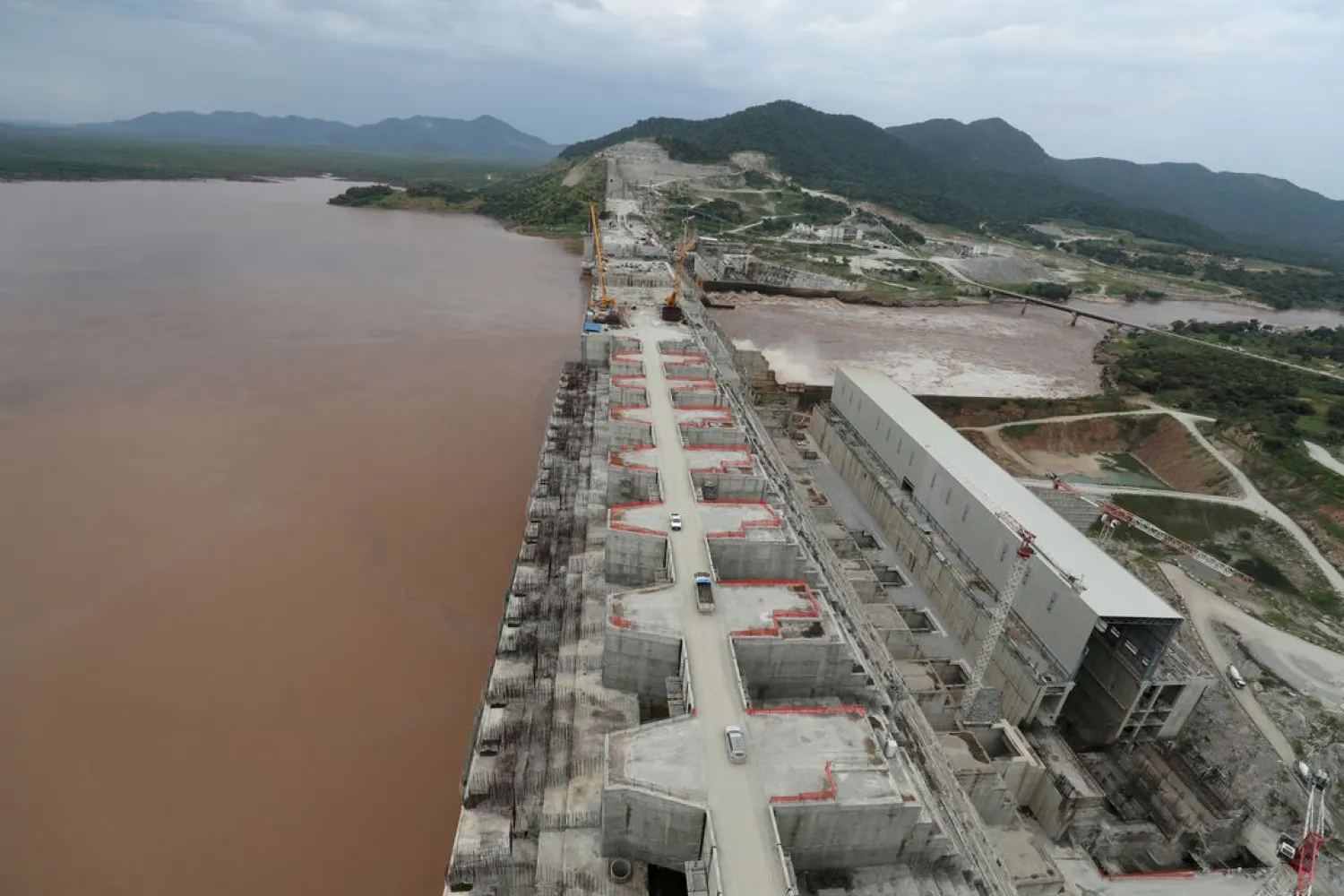
Ethiopia's Grand Renaissance Dam is seen as it undergoes construction work on the river Nile in Guba Woreda, Benishangul Gumuz Region, Ethiopia September 26, 2019. (Reuters)
TT

UN Security Council Backs AU Bid to Broker Ethiopia Dam Deal

Ethiopia's Grand Renaissance Dam is seen as it undergoes construction work on the river Nile in Guba Woreda, Benishangul Gumuz Region, Ethiopia September 26, 2019. (Reuters)

UN Security Council members on Thursday backed African Union mediation efforts between Ethiopia, Egypt and Sudan in a dispute over the operation of a giant hydropower dam on the Blue Nile in Ethiopia, urging the parties to resume talks.

Egypt and Sudan both called on the UN Security Council to help resolve the dispute after Ethiopia earlier this week began filling the reservoir behind its Grand Ethiopian Renaissance Dam (GERD) for a second year. Ethiopia is opposed to any Security Council involvement.

"A balanced and equitable solution to the filling and operation of the GERD can be reached with political commitment from all parties," US Ambassador to the United Nations, Linda Thomas-Greenfield, told the council.

"This begins with the resumption of productive substantive negotiations. Those negotiations should be held under the leadership of the African Union, and should recommence with urgency," she said, adding that the African Union "is the most appropriate venue to address this dispute."

Many council diplomats were wary of involving the body in the dispute - beyond holding the meeting on Thursday - as they are concerned it could set a precedent that could allow other countries to seek Security Council help with water disputes.

Ethiopia says the dam is crucial to its economic development and to provide power. But Egypt views it as a grave threat to its Nile water supplies, on which it is almost entirely dependent. Sudan, also downstream, has expressed concern about the dam's safety and impact on its own dams and water stations.

Tunisia has proposed a draft Security Council resolution that would call for a binding agreement between Ethiopia, Sudan and Egypt on the operation of the giant dam within six months. It was not clear if or when it could be put to a vote.

Egypt's Foreign Minister Sameh Shoukry called on the Security Council to adopt the resolution.

"We do not expect the council to formulate solutions to the outstanding legal and technical issues, nor do we request that the council impose the terms of a settlement," he said. "This resolution is political in nature and its purpose ... is to re-launch negotiations."

Sudan's Foreign Minister Mariam Sadiq al-Mahdi also urged the council to act by calling for a resumption of negotiations and on Ethiopia to abstain from any unilateral measures.

Ethiopia's Minister of Water, Irrigation and Energy, Seleshi Bekele Awulachew, said an agreement on the operation of the $5 billion dam is "within reach" and he described it as regrettable that Egypt and Sudan pushed for the Security Council meeting.

"We urge our Egyptian and Sudanese brothers and sisters to understand that the resolution to the Nile issue will not come from the Security Council. It can only come from good faith negotiations," he told the council.

Russian UN Ambassador Vassily Nebenzia suggested the countries meet while in New York to try to resolve some issues.



Lifting of US Sanctions on Syria Could Spur Refugee Returns, Says UN Official

People sit after receiving bread from Ecir Kapici, Turkish humanitarian NGO at Al-Yarmouk Palestinian refugee camp, after Syria's Bashar Al-Assad was ousted, in Damascus, Syria, December 20 , 2024. (Reuters)
TT

Lifting of US Sanctions on Syria Could Spur Refugee Returns, Says UN Official

People sit after receiving bread from Ecir Kapici, Turkish humanitarian NGO at Al-Yarmouk Palestinian refugee camp, after Syria's Bashar Al-Assad was ousted, in Damascus, Syria, December 20 , 2024. (Reuters)

The head of the UN refugee agency in Lebanon said Thursday that the move by the United States to lift sweeping sanctions on Syria could encourage more refugees to return to their country.

The US Senate voted Wednesday to permanently remove the so-called Caesar Act sanctions after the administration of President Donald Trump previously temporarily lifted the penalties by executive order. The vote came as part of the passage of the country's annual defense spending bill. Trump is expected to sign off on the final repeal Thursday.

An estimated 400,000 Syrian refugees have returned from Lebanon since the ouster of former Syrian President Bashar Assad in December 2024 following a nearly 14-year civil war, UNHCR Lebanon Representative Karolina Lindholm Billing said, with around 1 million remaining in the country. Of those, about 636,000 are officially registered with the refugee agency.

The UN refugee agency reports that altogether more than 1 million refugees and nearly 2 million internally displaced Syrians have returned to their homes since Assad’s fall.

Refugees returning from neighboring countries are eligible for cash payments of $600 per family upon their return, but with many coming back to destroyed houses and no work opportunities, the cash does not go far. Without jobs and reconstruction, many may leave again.

The aid provided so far by international organizations to help Syrians begin to rebuild has been on a “relatively small scale compared to the immense needs,” Billing said, but the lifting of US sanctions could “make a big difference.”

The World Bank estimates it will cost $216 billion to rebuild the homes and infrastructure damaged and destroyed in Syria's civil war.

“So what is needed now is big money in terms of reconstruction and private sector investments in Syria that will create jobs,” which the lifting of sanctions could encourage, Billing said.

Lawmakers imposed the wide-reaching Caesar Act sanctions on Syria in 2019 to punish Assad for human rights abuses during the country’s civil war.

Despite the temporary lifting of the sanctions by executive order, there has been little movement on reconstruction. Advocates of a permanent repeal argued that international companies are unlikely to invest in projects needed for the country’s rebuilding as long as there is a threat of sanctions returning.

New refugees face difficulties While there has been a steady flow of returnees over the past year, other Syrians have fled the country since Assad was ousted by Islamist-led insurgents. Many of them are members of religious minorities fearful of being targeted by the new authorities — particularly members of the Alawite sect to which Assad belonged and Shiites fearful of being targeted in revenge attacks because of the support provided to Assad during the war by Iran and the Lebanese militant group Hezbollah.

Hundreds of Alawite civilians were killed in outbreaks of sectarian violence on Syria’s coast in March.

While the situation has calmed since then, Alawites continue to report sporadic sectarian attacks, including incidents of kidnapping and sexual assault of women.

About 112,000 Syrians have fled to Lebanon since Assad’s fall, Billing said. Coming at a time of shrinking international aid, the new refugees have received very little assistance and generally do not have legal status in the country.

“Their main need, one of the things they raise with us all the time, is documentation because they have no paper to prove that they are in Lebanon, which makes it difficult for them to move around,” Billing said.

While some have returned to Syria after the situation calmed in their areas, she said, “Many are very afraid of being returned to Syria because what they fled were very violent events.”


Israel Launches Intense Airstrikes in Lebanon as Deadline Looms to Disarm Hezbollah

TOPSHOT - Smoke rises from the site of a series of Israeli airstrikes that targeted the outskirts of the southern Lebanese village of al-Katrani on December 18, 2025.  (Photo by Rabih DAHER / AFP)
TOPSHOT - Smoke rises from the site of a series of Israeli airstrikes that targeted the outskirts of the southern Lebanese village of al-Katrani on December 18, 2025. (Photo by Rabih DAHER / AFP)
TT

Israel Launches Intense Airstrikes in Lebanon as Deadline Looms to Disarm Hezbollah

TOPSHOT - Smoke rises from the site of a series of Israeli airstrikes that targeted the outskirts of the southern Lebanese village of al-Katrani on December 18, 2025.  (Photo by Rabih DAHER / AFP)
TOPSHOT - Smoke rises from the site of a series of Israeli airstrikes that targeted the outskirts of the southern Lebanese village of al-Katrani on December 18, 2025. (Photo by Rabih DAHER / AFP)

Israel carried out a series of airstrikes on southern and northeastern Lebanon on Thursday as a deadline looms to disarm the militant Hezbollah group along the tense frontier.

The strikes came a day before a meeting of the committee monitoring the enforcement of a US-brokered ceasefire that halted the latest war between Israel and Hezbollah a year ago.

It will be the second meeting of the mechanism after Israel and Lebanon appointed civilian members to a previously military-only committee. The group also includes the US, France and the UN peacekeeping force deployed along the border.

In Paris, Lebanon’s army commander Gen. Rodolphe Haykal is scheduled to meet on Thursday with US, French and Saudi officials to discuss ways of assisting the army in its mission to boost its presence in the border area.

The Lebanese government has said that the army should have cleared all the border area south of the Litani river from Hezbollah’s armed presence by the end of the year.

The Israeli military said the strikes hit Hezbollah infrastructure sites and launching sites in a military compound used by the group to conduct training and courses for its fighters. The Israeli military added that it struck several Hezbollah military structures in which weapons were stored, and from which Hezbollah members operated recently.

Lebanon’s state-run National News Agency said the intense airstrikes stretched from areas in Mount Rihan in the south to the northeastern Hermel region that borders Syria.

Shortly afterward, a drone strike on a car near the southern town of Taybeh inflicted casualties, NNA said.

“This is an Israeli message to the Paris meeting aiming to support the Lebanese army,” Parliament Speaker Nabih Berri said about the strikes.

“The fire belt of Israeli airstrikes is to honor the mechanism’s meeting tomorrow,” Berri added during a parliament meeting in Beirut.

The latest Israel-Hezbollah war began Oct. 8, 2023, a day after Hamas attacked southern Israel, after Hezbollah fired rockets into Israel in solidarity with Hamas. Israel launched a widespread bombardment of Lebanon in September last year that severely weakened Hezbollah, followed by a ground invasion.

Israel has carried out almost daily airstrikes since then, mainly targeting Hezbollah members but also killing 127 civilians, according to the office of the UN High Commissioner for Human Rights.

Over the past weeks, the US has increased pressure on Lebanon to work harder on disarming Hezbollah.


UN: Over 1,000 Civilians Killed in Sudan's Darfur when Paramilitary Group Seized Camp

The Sudanese flag flutters in Omdurman, part of greater Khartoum on December 13, 2025. (AFP)
TT

UN: Over 1,000 Civilians Killed in Sudan's Darfur when Paramilitary Group Seized Camp

The Sudanese flag flutters in Omdurman, part of greater Khartoum on December 13, 2025. (AFP)

Over 1,000 civilians were killed when a Sudanese paramilitary group took over a displacement camp in Sudan's Darfur region in April, including about a third who were summarily executed, according to a report by the UN Human Rights Office on Thursday.

"Such deliberate killing of civilians or persons hors de combat may constitute the war crime of murder,” said the UN High Commissioner for Human Rights Volker Turk in a statement accompanying the 18-page report.

The Zamzam camp in Sudan's western region of Darfur housed around half a million people displaced by the civil war and was taken over by Rapid Support Forces between April 11-13.