India Internet Law Adds to Fears over Online Speech, Privacy

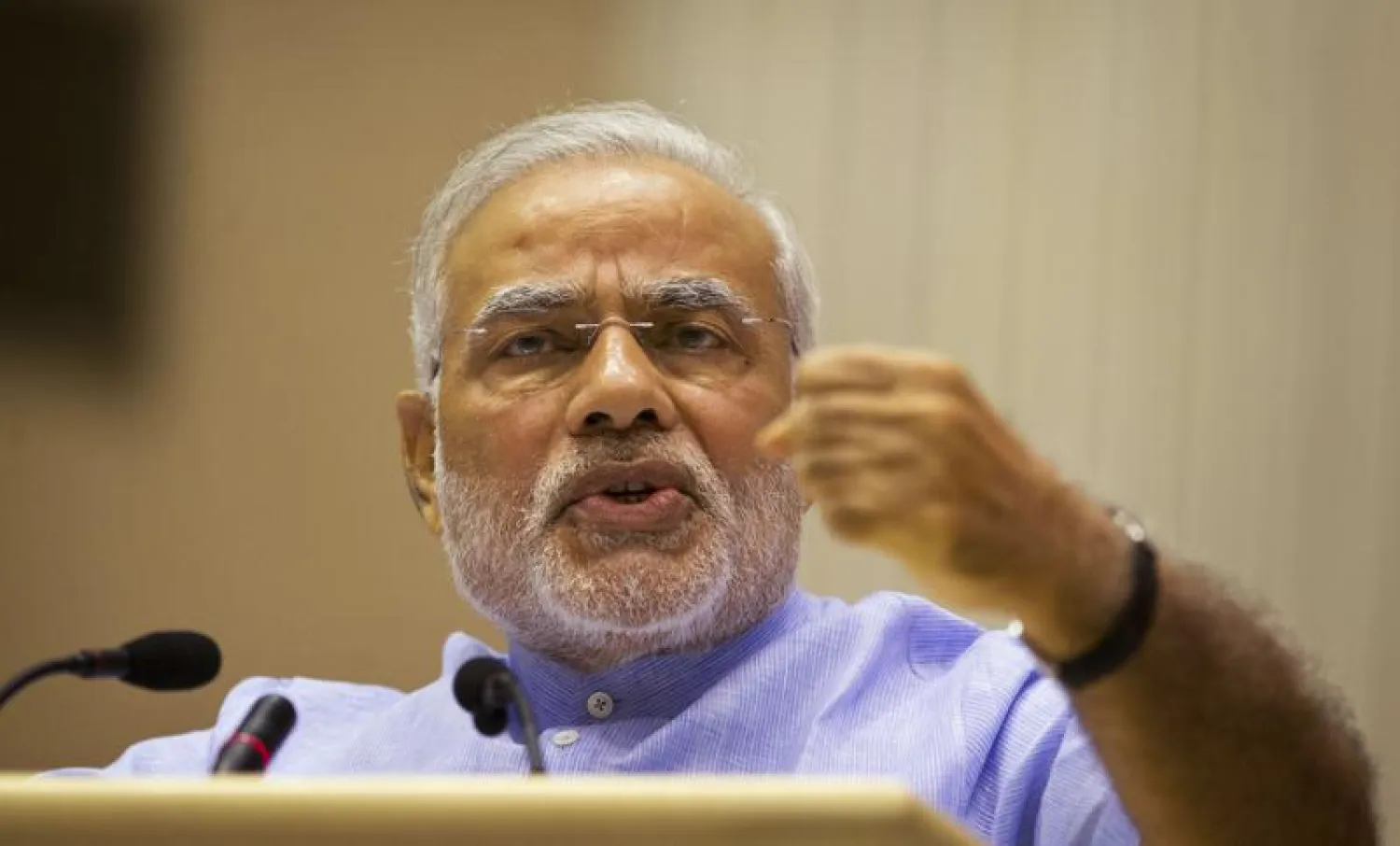
FILE - In this Aug. 28, 2014 file photo, Indian Prime Minister Narendra Modi speaks at the launch of a campaign aimed at opening millions of bank accounts for poor Indians in New Delhi, India. (AP Photo/Saurabh Das, File)
TT

India Internet Law Adds to Fears over Online Speech, Privacy

FILE - In this Aug. 28, 2014 file photo, Indian Prime Minister Narendra Modi speaks at the launch of a campaign aimed at opening millions of bank accounts for poor Indians in New Delhi, India. (AP Photo/Saurabh Das, File)

It began in February with a tweet by pop star Rihanna that sparked widespread condemnation of Indian Prime Minister Narendra Modi’s handling of massive farmer protests near the capital, souring an already troubled relationship between the government and Twitter.

Moving to contain the backlash, officials hit Twitter with multiple injunctions to block hundreds of tweets critical of the government. Twitter complied with some and resisted others.
Relations between Twitter and Modi's government have gone downhill ever since.

At the heart of the standoff is a sweeping internet law that puts digital platforms like Twitter and Facebook under direct government oversight. Officials say the rules are needed to quell misinformation and hate speech and to give users more power to flag objectionable content.

Critics of the law worry it may lead to outright censorship in a country where digital freedoms have been shrinking since Modi took office in 2014.

Police have raided Twitter's offices and have accused its India chief, Manish Maheshwari, of spreading “communal hatred” and “hurting the sentiments of Indians.” Last week, Maheshwari refused to submit to questioning unless police promised not to arrest him.

On Wednesday, the company released a transparency report showing India had submitted most government information requests -- legal demands for account information -- to Twitter. It accounted for a quarter of worldwide requests in July- December last year.

It was the first time since Twitter started publishing the report in 2012 that the US was displaced as the “top global requester,” it added.

“India’s plans for the internet appear to be like that of a closed ecosystem like China,” said Raheel Khursheed, co-founder of Laminar Global and Twitter India’s former head of Politics, Policy and Government. “Twitter’s case is the basis of a touchstone on how the future of the internet will be shaped in India.”

Tech companies are facing similar challenges in many countries. China has been aggressively tightening controls on access to its 1.4 billion-strong market, which is already largely sequestered by the Communist Party's Great Firewall and by US trade and technology sanctions.

India is another heavyweight, with 900 million users expected by 2025.

“Any internet company knows that India is probably the biggest market in terms of scale. Because of this, the option of leaving India is like the button they’d press if they had no options left,” said tech analyst Jayanth Kolla.

The new rules, in the works for years and announced in February, apply to social media companies, streaming platforms and digital news publishers. They make it easier for the government to order social media platforms with over 5 million users to take down content that is deemed unlawful. Individuals now can request that companies remove material. If a government ministry flags content as illegal or harmful it must be removed within 36 hours. Noncompliance could lead to criminal prosecutions.

Tech companies also must assign staff to answer complaints from users, respond to government requests and ensure overall compliance with the rules.

Twitter missed a three-month deadline in May, drawing a strong rebuke from the Delhi High Court. Last week, after months of haggling with the government, it appointed all three officers as required.

“Twitter continues to make every effort to comply with the new IT Rules 2021. We have kept the Government of India apprised of the progress at every step of the process,” the company said in a statement to the Associated Press.

Apar Gupta, executive director of the Internet Freedom Foundation, says he worries the rules will lead to numerous cases against internet platforms and deter people from using them freely, leading to self-censorship. Many other critics say Modi’s Hindu nationalist government is imposing what they call a climate of “digital authoritarianism."

“If it becomes easier for user content to be taken down, it will amount to the chilling of speech online,” Gupta said.

The government insists the rules will benefit and empower Indians.

“Social media users can criticize Narendra Modi, they can criticize government policy, and ask questions. I must put it on the record straight away . . . But a private company sitting in America should refrain from lecturing us on democracy" when it denies its users the right to redress, the ex-IT minister, Ravi Shankar Prasad, told the newspaper The Hindu last month.

Despite the antagonisms between Modi and Twitter, he has been an enthusiastic user of the platform in building popular support for his Bharatiya Janata Party. His government has also worked closely with the social media giant to allow Indians to use Twitter to seek help from government ministries, particularly during health emergencies. Bharatiya Janata Party's social media team has meanwhile been accused of initiating online attacks against critics of Modi.

Still, earlier internet restrictions had already prompted the Washington-based Freedom House to list India, the world's most populous democracy, as “partly free” instead of “free” in its annual analysis.
The law announced in February requires tech companies to aid police investigations and help identify people who post “mischievous information.” That means messages must be traceable, and experts say this it could mean end-to-end encryption would not be allowed in India.

Facebook’s WhatsApp, which has more than 500 million users in India, has sued the government, saying breaking encryption, which continues for now, would “severely undermine the privacy of billions of people who communicate digitally.”

Officials say they only want to trace messages that incite violence or threatening national security. WhatsApp says it can’t selectively do that.

“It is like you are renting out an apartment to someone but want to look into it whenever you want. Who would want to live in a house like that?” said Khursheed of Laminar Global.

The backlash over online freedom of expression, privacy and security concerns comes amid a global push for more data transparency and localization, said Kolla, the tech expert.

Germany requires social media companies to devote local staff and data storage to curbing hate speech. Countries like Vietnam and Pakistan are drafting legislation similar to India’s. In Turkey, social media companies complied with a broad mandate for removing content only after they were fined and faced threats to their ad revenues.

Instead of leaving, some companies are fighting the new rules in the courts, where at least 13 legal challenges have been filed by news publishers, media associations and individuals. But such cases can stretch for months or even years.

Mishi Choudhary, a technology lawyer and founder of India’s Software Freedom Law Center, says that under the rules, social media platforms might lose their safe harbor protection, which shields them from legal liability over user-generated content. Courts have to decide that on a case-by-case basis, she said. And their legal costs would inevitably soar.

“You know how it is in India. The process is the punishment,” Choudhary said. “And until we get to a place where the courts will actually come and tell us what the legal position is and determine those legal positions, it is open season for tech backlash.”


Russia Says French Troops in Ukraine a ‘Direct Participation’ in War

Russian Foreign Minister Sergei Lavrov attends a joint press conference with the Secretary General of the Collective Security Treaty Organization (CSTO) Taalatbek Masadykov following the Joint Meeting of the CSTO Council of Foreign Ministers, Council of Ministers of Defense and Committee of Secretaries of Security Councils during the International Collective Security Forum in Moscow, Russia 10 November 2026. (EPA)
TT

Russia Says French Troops in Ukraine a ‘Direct Participation’ in War

Russian Foreign Minister Sergei Lavrov attends a joint press conference with the Secretary General of the Collective Security Treaty Organization (CSTO) Taalatbek Masadykov following the Joint Meeting of the CSTO Council of Foreign Ministers, Council of Ministers of Defense and Committee of Secretaries of Security Councils during the International Collective Security Forum in Moscow, Russia 10 November 2026. (EPA)

Russia said Tuesday it was aware of French troops having been sent to Ukraine, calling it "direct participation" in the war and saying a message had been issued to Paris.

"Not only French ones, we know this. We have conveyed our concern... this is no longer support for Ukraine, but direct participation in the war," Foreign Minister Sergei Lavrov told reporters.

His remarks come a day after a source told AFP and other media that French soldiers had been operating in Ukraine for several months to train Ukrainian personnel and help maintain equipment.

France on Tuesday rejected Lavrov's claim that the deployment amounted to "direct participation" in the Ukraine war as "absurd".

There is a "very limited" deployment of French troops in Ukraine for training and equipment maintenance, deputy defense minister Alice Rufo told parliament.

"There is the absence of any intention to fight, contrary to what the Russian foreign minister said this morning, which is absurd."

A source told AFP earlier the mission of a small contingent of French troops excludes any combat role.

They spoke on condition of anonymity after Radio France Internationale (RFI) first revealed the presence of French troops in the war-torn country earlier Monday.

"The rotation of French trainers supporting Ukraine in France, Poland, or occasionally in Ukraine is a reality," the source told AFP.

"But this is not a military operation. There is absolutely no intention of engaging in coercive actions."


US Attacks Iran’s Qeshm Island in Strait of Hormuz

An aerial view of the Iranian shores and the island of Qeshm in the Strait of Hormuz, December 10, 2023. (Reuters)
TT

US Attacks Iran’s Qeshm Island in Strait of Hormuz

An aerial view of the Iranian shores and the island of Qeshm in the Strait of Hormuz, December 10, 2023. (Reuters)

The United States on Tuesday carried out several attacks on Iran's southern Island of Qeshm, located in the Strait of Hormuz, a local Iranian official said.

"The American attack on locations on Qeshm island caused no damage to residential, commercial, or infrastructural areas," said Ahmad Nafisi, deputy provincial governor of the southern province of Hormozgan, quoted by the official IRNA news agency.

"The situation on Qeshm island is under control, and all relief, service, and executive agencies are on full alert," he added.

"The sounds of five to six explosions were heard on Qeshm on Tuesday evening," IRNA said.

Earlier in the day Iran's Revolutionary Guards said they had launched a drone attack targeting a radar system in Bahrain operated by the United States.

Since the outbreak of the Middle East war in late February, Tehran has attempted to restrict traffic through the strategic waterway, insisting vessels use only routes authorized by the country.

It has regularly targeted ships that transit without its authorization.

The United States has in response imposed a naval blockade on Iranian ports and helped tankers travel the strait, which normally carries about one-fifth of global oil supplies.

In recent weeks, Tehran has made multiple announcements saying ships have caught fire in the strait, often claiming they struck mines.

On Tuesday, the Iranian armed forces said three oil tankers struck naval mines while attempting to transit Hormuz.

The US military recently said it had cleared all mines from the main routes through the waterway.

US Central Command, which oversees US military operations in the region, said last month that it had helped Gulf countries export 1.5 billion barrels of oil via Hormuz since the summer.


4 Detained in North Macedonia for Alleged Iran-Backed Assassination Plot in Greece

Domestic security agency director Bojan Hristovski speaks to media after announcing the detention of four people implicated in an alleged Iran-backed assassination plot in neighboring Greece, in Skopje, North Macedonia, Tuesday, Nov. 17, 2026. (AP)
TT

4 Detained in North Macedonia for Alleged Iran-Backed Assassination Plot in Greece

Domestic security agency director Bojan Hristovski speaks to media after announcing the detention of four people implicated in an alleged Iran-backed assassination plot in neighboring Greece, in Skopje, North Macedonia, Tuesday, Nov. 17, 2026. (AP)

Authorities in North Macedonia have detained four people for questioning over an alleged Iran-linked assassination plot in neighboring Greece, officials said Tuesday.

Bojan Hristovski, director of North Macedonia's domestic security agency, said Tuesday that the suspects are all Macedonian citizens, adding that a fifth person had also been questioned and a sixth remained wanted by the authorities.

Hristovski named one of the Iranian recruiters as Naji Sharifi Zindashti, who is wanted in the United States for allegedly operating a criminal network that targets Iranian dissidents and activists abroad.

He did not give details of the alleged target in Greece, and Greek authorities did not immediately comment on the announcement.

“This concerns the dismantling of an Iranian proxy network involved in planning a terrorist attack,” Hristovski said.

“The network operating in Macedonia consisted of individuals embedded in criminal organizations within the country,” he said. “Acting on direct instructions from an Iranian national, they undertook preparatory and logistical activities for a terrorist act — an assassination targeting a previously identified individual located in Greece.”

Iran's mission to the United Nations did not immediately respond to a request for comment.