Vaccine Deliveries Rising as Delta Virus Variant Slams Asia

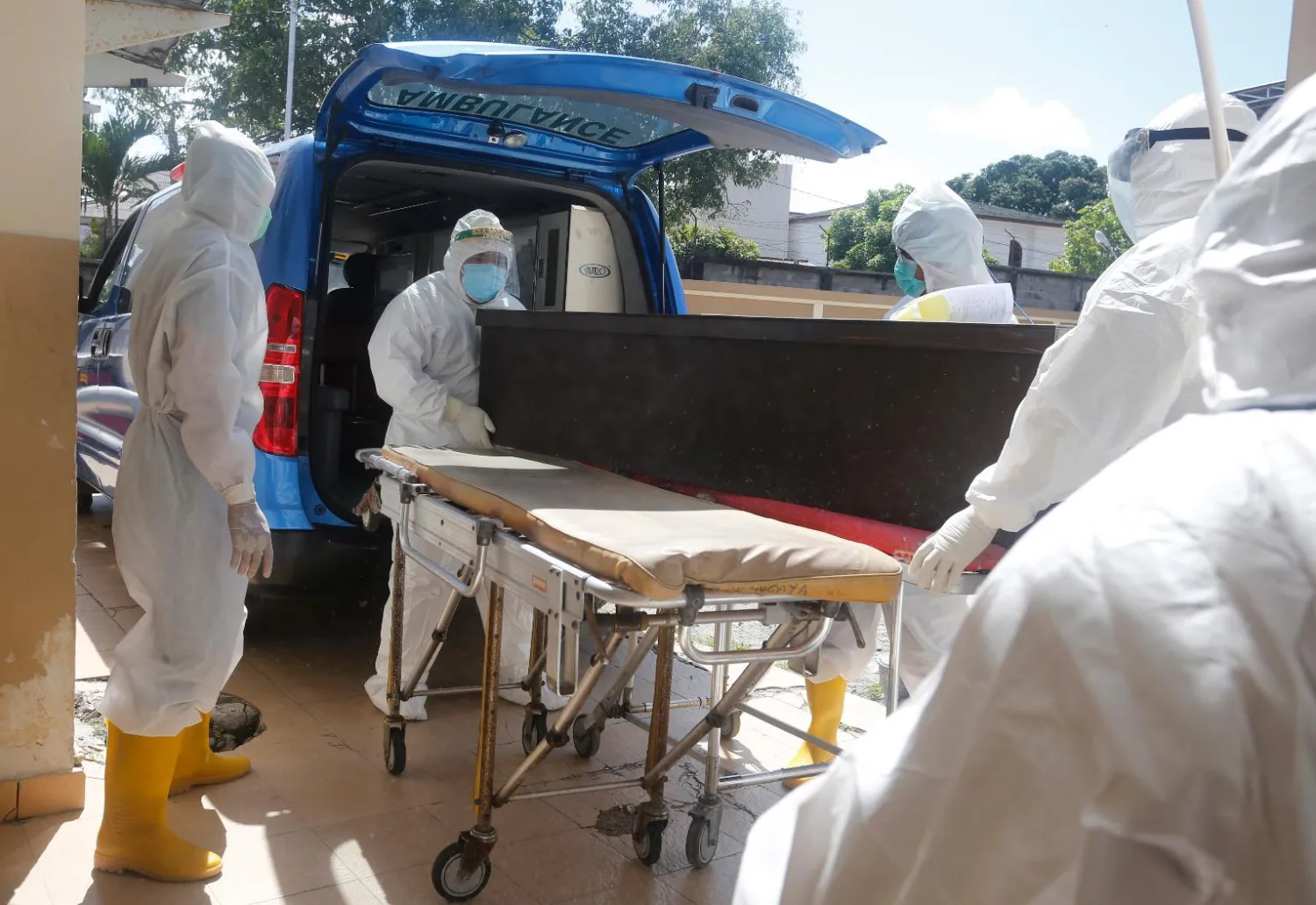
Health workers in protective suits carry a coffin containing the body of a COVID-19 victim into an ambulance for a burial in Denpasar, Bali, Indonesia on Thursday, July 15, 2021. The world's fourth most populous country has been hit hard by an explosion of COVID-19 cases that have strained hospitals on the main island of Java. (AP Photo/Firdia Lisnawati)
TT

Vaccine Deliveries Rising as Delta Virus Variant Slams Asia

Health workers in protective suits carry a coffin containing the body of a COVID-19 victim into an ambulance for a burial in Denpasar, Bali, Indonesia on Thursday, July 15, 2021. The world's fourth most populous country has been hit hard by an explosion of COVID-19 cases that have strained hospitals on the main island of Java. (AP Photo/Firdia Lisnawati)

As many Asian countries battle their worst surge of COVID-19 infections, the slow-flow of vaccine doses from around the world is finally picking up speed, giving hope that low inoculation rates can increase and help blunt the effect of the rapidly spreading delta variant.

With many vaccine pledges still unfulfilled and the rates of infection spiking across multiple countries, however, experts say more needs to be done to help nations struggling with the overflow of patients and shortages of oxygen and other critical supplies.

Some 1.5 million doses of the Moderna vaccine were set to arrive Thursday afternoon in Indonesia, which has become a dominant hot spot with a record high infections and deaths.

The US shipment comes in addition to 3 million other American doses that arrived Sunday, and 11.7 million doses of AstraZeneca that have come in batches since March through the UN-backed COVAX mechanism, the last earlier this week.

“It’s quite encouraging,” said Sowmya Kadandale, health chief in Indonesia of UNICEF, which is in charge of the distribution of vaccines provided through COVAX. “It seems now to be, and not just in Indonesia, a race between the vaccines and the variants, and I hope we win that race.”

Many, including the World Health Organization, have been critical of the vaccine inequalities in the world, pointing out that many wealthy nations have more than half of their populations at least partially vaccinated, while the vast majority of people in lower-income countries are still waiting on a first dose.

The International Red Cross warned this week of a “widening global vaccine divide” and said wealthy countries needed to increase the pace of following through on their pledges.

“It’s a shame it didn’t happen earlier and can’t happen faster,” Alexander Matheou, the Asia-Pacific director of the Red Cross, said of the recent uptick in deliveries. “There’s no such thing as too late — vaccinating people is always worth doing — but the later the vaccines come, the more people will die.”

Vietnam, Thailand and South Korea have all imposed new lockdown restrictions over the past week as they struggle to contain rapidly rising infections amid sluggish vaccination campaigns.

In South Korea — widely praised for its initial response to the pandemic that included extensive testing and contact tracing — a shortage in vaccines has left 70% of the population still waiting for their first shot. Thailand, which only started its mass vaccination in early June, is seeing skyrocketing cases and record deaths, and only about 15% of people have had at least one shot. In Vietnam, only about 4% have.

“Parts of the world ... are talking about reclaiming lost freedoms such as going back to work, opening the cinemas and restaurants,” Matheou told The Associated Press. “This part of the world is far away from that.”

Indonesia started aggressively vaccinating earlier than many in the region, negotiating bilaterally with China for the Sinovac jabs. Now about 14% of its population — the fourth largest in the world — has at least one dose of a vaccine, primarily Sinovac. Several countries also have their own production capabilities, including South Korea, Japan and Thailand, but still need more doses to fill the needs of the region’s huge population.

“Both Moderna and AstraZeneca have been really critical in ramping up these numbers and ensuring that the supplies are available,” said UNICEF's Kadandale, noting that Indonesia plans to have some additional 208.2 million people vaccinated by year’s end and is giving 1 million shots daily. “Every single dose does make a huge difference.”

Many other countries in the region have vaccination rates far below Indonesia’s for a variety of reasons, including production and distribution issues as well as an initial wait-and-see attitude from many early on when numbers were low and there was less of a sense of urgency.

Some were shocked into action after witnessing the devastation in India in April and May as the country’s health system collapsed under a severe spike in cases that caught the government unprepared and led to mass fatalities.

At the same time, India — a major regional producer of vaccines — stopped exporting doses so that it could focus on its own suffering population.

The US has sent tens of millions of vaccine doses to multiple countries in Asia recently, part of President Joe Biden’s pledge to provide 80 million doses, including Vietnam, Laos, South Korea and Bangladesh. The US plans to donate an additional 500 million vaccines globally in the next year, and 200 million by the end of 2021.

“Indonesia is a critical partner for US engagement in Southeast Asia and the vaccines come without strings attached,” said Scott Hartmann, a spokesman for the US Embassy in Jakarta. “We’re doing this with the object of saving lives and ending the global pandemic, and equitable global access to safe and effective vaccines is essential.”

Earlier in the week, German Foreign Minister Heiko Maas, whose country is one of the largest financial backers of COVAX, accused Russia and China of using their delivery of vaccines for policy leverage.

“We note, in particular with China, that the supply of vaccines was also used to make very clear political demands of various countries,” he said, without providing specific examples.

There are also growing questions about the effectiveness of China’s Sinovac vaccine against the delta variant of the virus.

Thai officials said that booster doses of AstraZeneca would be given to front-line medical personnel who earlier received two doses of Sinovac, after a nurse who received two doses of Sinovac died Saturday after contracting COVID-19.

Sinovac has been authorized by WHO for emergency use but Indonesia also said it was planning boosters for health workers, using some of the newly delivered Moderna doses, after reports that some of the health workers who had died since June had been fully vaccinated with the Chinese shot.

“We have still found people getting severe symptoms or dying even when they are vaccinated,” Pandu Riono, an epidemiologist with the University of Indonesia, said about the Sinovac shot. “It’s only proven that some vaccines are strong enough to face the delta variant — AstraZeneca, Moderna and Pfizer seem capable.”

While the majority of recent deliveries have been American, Japan was sending 1 million doses of AstraZeneca on Thursday each to Indonesia, Taiwan and Vietnam as part of bilateral deals, and Vietnam said it was receiving 1.5 million more AstraZeneca doses from Australia.

The Philippines is expecting a total of 16 million doses in July, including 3.2 million from the US later this week, 1.1 million from Japan, 132,000 of Sputnik V from Russia, as well as others through COVAX.

Japan is also is sending 11 million through COVAX this month to Bangladesh, Cambodia, Iran, Laos, Nepal, Sri Lanka, and others. Canada this week committed an additional 17.7 million surplus doses to the 100 million already pledged through COVAX, which is coordinated by Gavi, a vaccine alliance.

In addition to distributing some donated vaccines, financial contributions to COVAX also help fund the purchase of doses to distribute for free to 92 low or moderate income nations.

Earlier this month, it took blistering criticism from the African Union for how long it was taking for vaccines to reach the continent, which noted that just 1% of Africans are fully vaccinated.

Gavi said the vaccine shortfall so far this year is because the major COVAX supplier, the Serum Institute of India, diverted production for domestic use.

In its latest supply forecast, however, Gavi shows deliveries just beginning a sharp uptick, and still on track to meet the goal of about 1.5 billion doses by year’s end, representing 23% coverage in lower and middle income nations, and more than 5 billion doses by the end of 2022.

“It’s better to focus on vaccinating the world and to avoid hoarding doses,” said Matheou, of the Red Cross. “Sharing vaccines makes everyone safer.”


Russia Says French Troops in Ukraine a ‘Direct Participation’ in War

Russian Foreign Minister Sergei Lavrov attends a joint press conference with the Secretary General of the Collective Security Treaty Organization (CSTO) Taalatbek Masadykov following the Joint Meeting of the CSTO Council of Foreign Ministers, Council of Ministers of Defense and Committee of Secretaries of Security Councils during the International Collective Security Forum in Moscow, Russia 10 November 2026. (EPA)
TT

Russia Says French Troops in Ukraine a ‘Direct Participation’ in War

Russian Foreign Minister Sergei Lavrov attends a joint press conference with the Secretary General of the Collective Security Treaty Organization (CSTO) Taalatbek Masadykov following the Joint Meeting of the CSTO Council of Foreign Ministers, Council of Ministers of Defense and Committee of Secretaries of Security Councils during the International Collective Security Forum in Moscow, Russia 10 November 2026. (EPA)

Russia said Tuesday it was aware of French troops having been sent to Ukraine, calling it "direct participation" in the war and saying a message had been issued to Paris.

"Not only French ones, we know this. We have conveyed our concern... this is no longer support for Ukraine, but direct participation in the war," Foreign Minister Sergei Lavrov told reporters.

His remarks come a day after a source told AFP and other media that French soldiers had been operating in Ukraine for several months to train Ukrainian personnel and help maintain equipment.

France on Tuesday rejected Lavrov's claim that the deployment amounted to "direct participation" in the Ukraine war as "absurd".

There is a "very limited" deployment of French troops in Ukraine for training and equipment maintenance, deputy defense minister Alice Rufo told parliament.

"There is the absence of any intention to fight, contrary to what the Russian foreign minister said this morning, which is absurd."

A source told AFP earlier the mission of a small contingent of French troops excludes any combat role.

They spoke on condition of anonymity after Radio France Internationale (RFI) first revealed the presence of French troops in the war-torn country earlier Monday.

"The rotation of French trainers supporting Ukraine in France, Poland, or occasionally in Ukraine is a reality," the source told AFP.

"But this is not a military operation. There is absolutely no intention of engaging in coercive actions."


US Attacks Iran’s Qeshm Island in Strait of Hormuz

An aerial view of the Iranian shores and the island of Qeshm in the Strait of Hormuz, December 10, 2023. (Reuters)
TT

US Attacks Iran’s Qeshm Island in Strait of Hormuz

An aerial view of the Iranian shores and the island of Qeshm in the Strait of Hormuz, December 10, 2023. (Reuters)

The United States on Tuesday carried out several attacks on Iran's southern Island of Qeshm, located in the Strait of Hormuz, a local Iranian official said.

"The American attack on locations on Qeshm island caused no damage to residential, commercial, or infrastructural areas," said Ahmad Nafisi, deputy provincial governor of the southern province of Hormozgan, quoted by the official IRNA news agency.

"The situation on Qeshm island is under control, and all relief, service, and executive agencies are on full alert," he added.

"The sounds of five to six explosions were heard on Qeshm on Tuesday evening," IRNA said.

Earlier in the day Iran's Revolutionary Guards said they had launched a drone attack targeting a radar system in Bahrain operated by the United States.

Since the outbreak of the Middle East war in late February, Tehran has attempted to restrict traffic through the strategic waterway, insisting vessels use only routes authorized by the country.

It has regularly targeted ships that transit without its authorization.

The United States has in response imposed a naval blockade on Iranian ports and helped tankers travel the strait, which normally carries about one-fifth of global oil supplies.

In recent weeks, Tehran has made multiple announcements saying ships have caught fire in the strait, often claiming they struck mines.

On Tuesday, the Iranian armed forces said three oil tankers struck naval mines while attempting to transit Hormuz.

The US military recently said it had cleared all mines from the main routes through the waterway.

US Central Command, which oversees US military operations in the region, said last month that it had helped Gulf countries export 1.5 billion barrels of oil via Hormuz since the summer.


4 Detained in North Macedonia for Alleged Iran-Backed Assassination Plot in Greece

Domestic security agency director Bojan Hristovski speaks to media after announcing the detention of four people implicated in an alleged Iran-backed assassination plot in neighboring Greece, in Skopje, North Macedonia, Tuesday, Nov. 17, 2026. (AP)
TT

4 Detained in North Macedonia for Alleged Iran-Backed Assassination Plot in Greece

Domestic security agency director Bojan Hristovski speaks to media after announcing the detention of four people implicated in an alleged Iran-backed assassination plot in neighboring Greece, in Skopje, North Macedonia, Tuesday, Nov. 17, 2026. (AP)

Authorities in North Macedonia have detained four people for questioning over an alleged Iran-linked assassination plot in neighboring Greece, officials said Tuesday.

Bojan Hristovski, director of North Macedonia's domestic security agency, said Tuesday that the suspects are all Macedonian citizens, adding that a fifth person had also been questioned and a sixth remained wanted by the authorities.

Hristovski named one of the Iranian recruiters as Naji Sharifi Zindashti, who is wanted in the United States for allegedly operating a criminal network that targets Iranian dissidents and activists abroad.

He did not give details of the alleged target in Greece, and Greek authorities did not immediately comment on the announcement.

“This concerns the dismantling of an Iranian proxy network involved in planning a terrorist attack,” Hristovski said.

“The network operating in Macedonia consisted of individuals embedded in criminal organizations within the country,” he said. “Acting on direct instructions from an Iranian national, they undertook preparatory and logistical activities for a terrorist act — an assassination targeting a previously identified individual located in Greece.”

Iran's mission to the United Nations did not immediately respond to a request for comment.