


Tunisia Puts Military on Vaccination Duty as Cases Soar

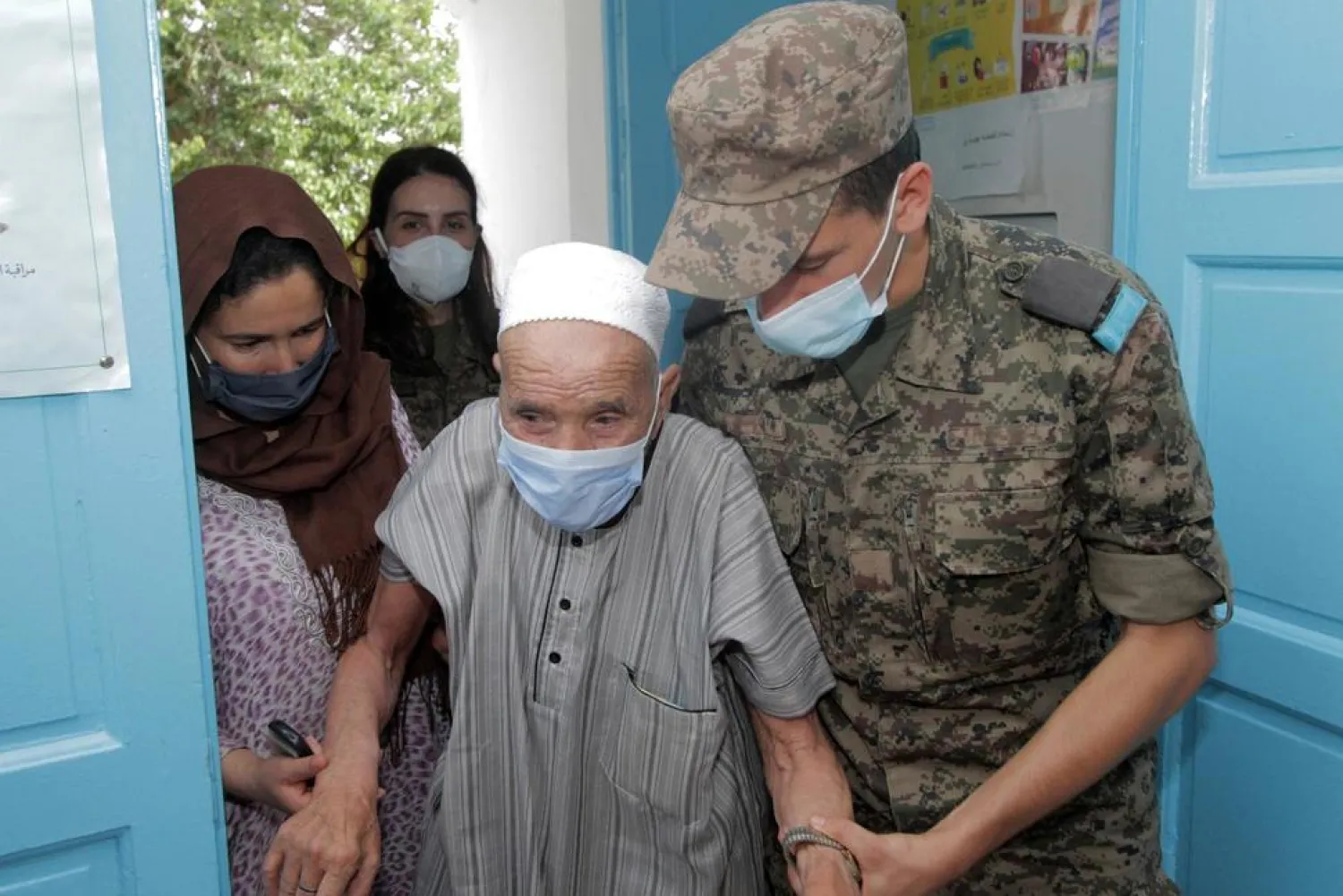
A soldier helps and elderly man to enter the vaccination center in Kesra,130 kilometers (80 miles) south of Tunis, Tuesday, July 13, 2021.(AP Photo/Saber Zidi) THE ASSOCIATED PRESS
TT

Tunisia Puts Military on Vaccination Duty as Cases Soar

A soldier helps and elderly man to enter the vaccination center in Kesra,130 kilometers (80 miles) south of Tunis, Tuesday, July 13, 2021.(AP Photo/Saber Zidi) THE ASSOCIATED PRESS

Soldiers hold rifles to guard the health center in the traditional Tunisian village of Kesra, while inside, military medics use other weapons to combat COVID-19: vaccines.

Tunisia is facing its worst coronavirus surge since the pandemic began, further stressing the North African country's already crowded hospitals and health system. That has forced some regions to go back into lockdown and prompted waves of donations of vaccines or medical aid from China, France, Turkey, Italy, the United Arab Emirates and Algeria.

Tunisia’s government decided to deploy the armed forces to vaccinate people in the regions with the worst infection rates and in areas with particularly low vaccination rates.

At the Kesra medical center this week, military doctor Riadh Allani said the turnout for shots “is satisfactory, but it is weak compared to the big cities where the news spreads quickly and people come.”

“Here, many citizens face difficulties to reach the vaccination center, so we are ready to extend our stay to give an opportunity for everyone to come,” Allani told The Associated Press. He said the medics would with local authorities to vaccinate people at home, if necessary.

Over the past month, confirmed cases in Tunisia have reached their highest daily numbers of the pandemic, but the nationwide vaccination rate remains low, according to data from John’s Hopkins University.

Tunisia has reported Africa’s highest per-capita pandemic death toll and is currently recording one of the world's highest daily per-capita infection rates, the data indicate.

Military health workers vaccinated thousands of people in Kesra and other sites in the Siliana region in central inland Tunisia, mainly individuals over age 60 with underlying health conditions. The campaign in Kesra used Sinovac vaccines from China.

The military said the medical deployment could be extended to other areas in the coming days. Tunisia's president said the military would send helicopters to mountainous areas to bring vaccines to remote villages.

Kesra resident Rafika Achour said she was summoned twice to get a vaccine, but had been skeptical about submitting to a shot.

“When I heard of the arrival of the army, I decided to come for the vaccine because ... for me, (the army) is more honest than others," Achour said at the vaccination site.

To encourage vaccination and build awareness, Tunisian President Kaies Saied got his first dose of the vaccine on Monday.

Meanwhile, aid is arriving from near and far.

The United Arab Emirates, Turkey and Algeria have sent hundreds of thousands of vaccine doses and medical supplies to Tunisia. A shipment of medical aid came in by sea from Italy on Friday. France this week promised another 800,000 COVID-19 vaccines, and China promised 400,000, according to Tunisia's TAP news agency.

As of Saturday, Tunisia had reported more than 17,000 deaths and more than 533,000 confirmed cases since the start of the pandemic, according to Johns Hopkins data.



Türkiye Holds Military Funeral for Libyan Officers Killed in Plane Crash

The Libyan national flag flies at half-mast in Tripoli on December 24, 2025, after the head of Libya's armed forces and his four aides died in a plane crash in Türkiye. (AFP)
TT

Türkiye Holds Military Funeral for Libyan Officers Killed in Plane Crash

The Libyan national flag flies at half-mast in Tripoli on December 24, 2025, after the head of Libya's armed forces and his four aides died in a plane crash in Türkiye. (AFP)

Türkiye held a military funeral ceremony Saturday morning for five Libyan officers, including western Libya’s military chief, who died in a plane crash earlier this week.

The private jet with Gen. Muhammad Ali Ahmad al-Haddad, four other military officers and three crew members crashed on Tuesday after taking off from Ankara, Türkiye’s capital, killing everyone on board. Libyan officials said the cause of the crash was a technical malfunction on the plane.

Al-Hadad was the top military commander in western Libya and played a crucial role in the ongoing, UN-brokered efforts to unify Libya’s military.

The high-level Libyan delegation was on its way back to Tripoli, Libya’s capital, after holding defense talks in Ankara aimed at boosting military cooperation between the two countries.

Saturday's ceremony was held at 8:00 a.m. local time at the Murted Airfield base, near Ankara, and attended by the Turkish military chief and the defense minister. The five caskets, each wrapped in a Libyan national flag, were then loaded onto a plane to be returned to their home country.

Türkiye’s military chief, Selcuk Bayraktaroglu, was also on the plane headed to Libya, state-run news agency TRT reported.

The bodies recovered from the crash site were kept at the Ankara Forensic Medicine Institute for identification. Justice Minister Yilmaz Tunc told reporters their DNA was compared to family members who joined a 22-person delegation that arrived from Libya after the crash.

Tunc also said Germany was asked to help examine the jet's black boxes as an impartial third party.


Syrian Foreign Ministry: Talks with SDF Have Not Yielded Tangible Results

SDF fighters are seen at a military parade in Qamishli. (Reuters file)
TT

Syrian Foreign Ministry: Talks with SDF Have Not Yielded Tangible Results

SDF fighters are seen at a military parade in Qamishli. (Reuters file)

A source from the Syrian Foreign Ministry said on Friday that the talks with the Kurdish Syrian Democratic Forces (SDF) over their integration into state institutions “have not yielded tangible results.”

Discussions about merging the northeastern institutions into the state remain “hypothetical statements without execution,” it told Syria’s state news agency SANA.

Repeated assertions over Syria’s unity are being contradicted by the reality on the ground in the northeast, where the Kurds hold sway and where administrative, security and military institutions continue to be run separately from the state, it added.

The situation “consolidates the division” instead of addressing it, it warned.

It noted that despite the SDF’s continued highlighting of its dialogue with the Syrian state, these discussions have not led to tangible results.

It seems that the SDF is using this approach to absorb the political pressure on it, said the source. The truth is that there is little actual will to move from discussion to application of the March 10 agreement.

This raises doubts over the SDF’s commitment to the deal, it stressed.

Talk about rapprochement between the state and SDF remains meaningless if the agreement is not implemented on the ground within a specific timeframe, the source remarked.

Furthermore, the continued deployment of armed formations on the ground that are not affiliated with the Syrian army are evidence that progress is not being made.

The persistence of the situation undermines Syria’s sovereignty and hampers efforts to restore stability, it warned.


Terrorist Attack on Mosque in Syria’s Homs Draws Wide Condemnation

 A view shows an interior of a damaged mosque after several people were killed in an explosion in Homs, Syria December 26, 2025. (Reuters)
A view shows an interior of a damaged mosque after several people were killed in an explosion in Homs, Syria December 26, 2025. (Reuters)
TT

Terrorist Attack on Mosque in Syria’s Homs Draws Wide Condemnation

 A view shows an interior of a damaged mosque after several people were killed in an explosion in Homs, Syria December 26, 2025. (Reuters)
A view shows an interior of a damaged mosque after several people were killed in an explosion in Homs, Syria December 26, 2025. (Reuters)

Condemnations poured in across the Arab world and international community of the terrorist attack that targeted a mosque in Syria’s Homs city on Friday.

An explosion killed at least eight worshippers with the extremist group Saraya Ansar al-Sunna claiming responsibility.

In a statement on Telegram, the group said its fighters “detonated a number of explosive devices” in the Imam Ali Bin Abi Talib Mosque in the central Syrian city.

Syria's interior ministry said in a statement that “a terrorist explosion” targeted the mosque and that authorities had “begun investigating and collecting evidence to pursue the perpetrators of this criminal act.”

The Saudi Ministry of Foreign Affairs condemned the attack, stressing the Kingdom’s “categorical rejection of terrorism and extremism in all their forms, including attacks on mosques and places of worship and the targeting of innocent civilians.”

It expressed the Kingdom’s “solidarity with Syria in this tragic incident and its support for the Syrian government’s efforts to uphold security and stability.”

Türkiye slammed the attack, saying it stands by Syria and its efforts to support stability, security and unity “despite all the provocations.”

The Iraqi Foreign Ministry strongly condemned the “heinous terrorist attack,” saying Baghdad rejects all forms of terrorism, violence and extremism regardless of their motives.

It slammed the attack against civilians and places of worship, saying they aim to create instability and sow strife in society.

The ministry underlined Iraq’s support for regional and international efforts aimed at eliminating terrorism and drying up its sources of funding.

The United Arab Emirates condemned the attack, saying it rejects all forms of violence and terrorism that aim to undermine security and stability.

Jordan’s Foreign Ministry slammed the attack, voicing its full support to Syria in its reconstruction process “based on principles that ensure its territorial unity, sovereignty, security and stability.”

In Beirut, President Joseph Aoun slammed the Homs attack, saying Lebanon stands by Syria in its war on terrorism. He offered his condolences to the Syrian people.

Qatar slammed the attack, saying it fully stands by the Syrian government and all the measures it takes to preserve security.

France said the blast was an “act of terrorism” designed to destabilize the country, while United Nations Secretary General Antonio Guterres condemned the “unacceptable” attack and said the perpetrators should be brought to justice.