

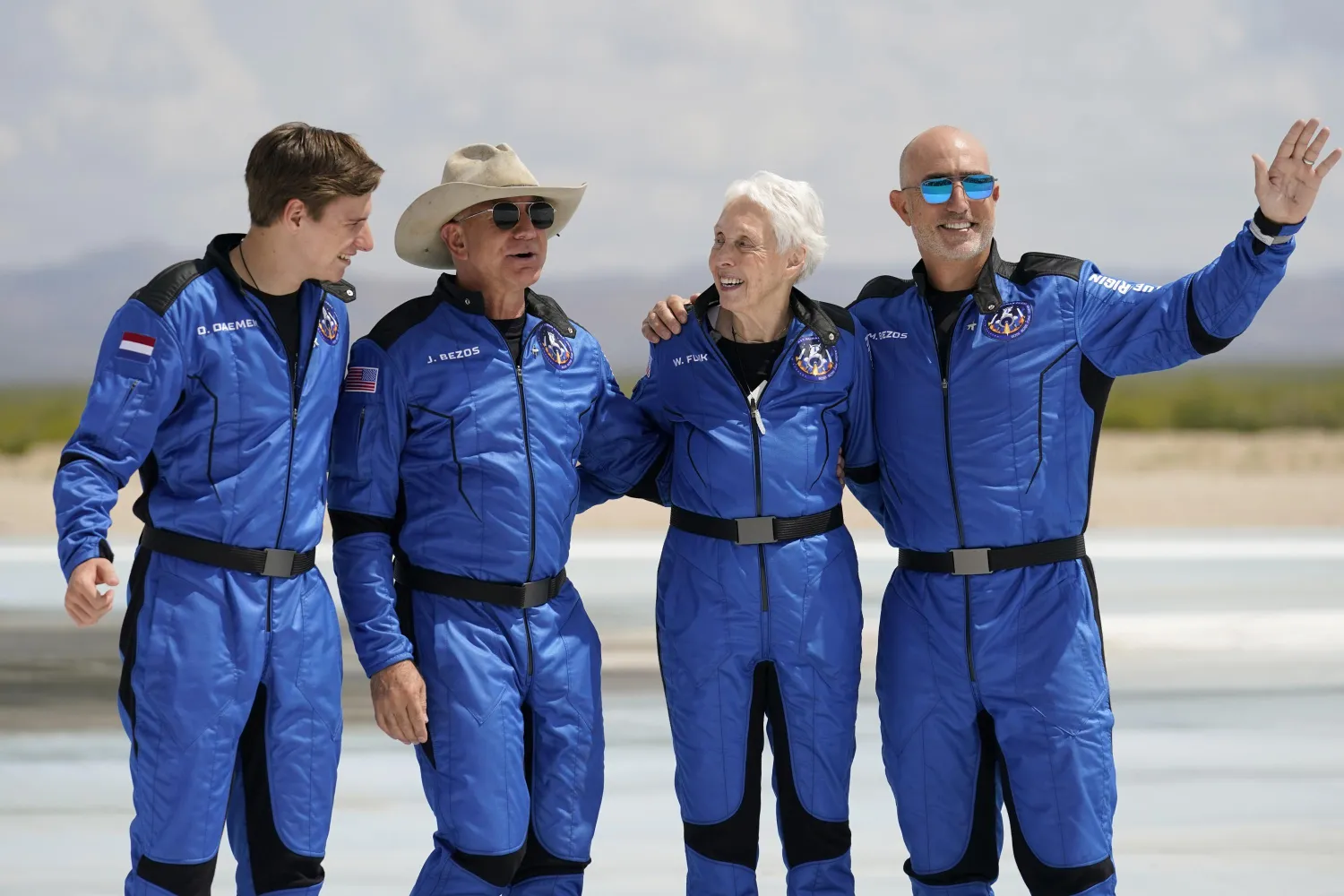

Jeff Bezos Blasts into Space on Own Rocket: 'Best Day Ever!'

Oliver Daemen, from left, Jeff Bezos, founder of Amazon and space tourism company Blue Origin, Wally Funk and Bezos' brother Mark pose for photos in front of the Blue Origin New Shepard rocket, derby, after their launch from the spaceport near Van Horn, Texas, Tuesday, July 20, 2021. (AP Photo/Tony Gutierrez)
TT

Jeff Bezos Blasts into Space on Own Rocket: 'Best Day Ever!'

Oliver Daemen, from left, Jeff Bezos, founder of Amazon and space tourism company Blue Origin, Wally Funk and Bezos' brother Mark pose for photos in front of the Blue Origin New Shepard rocket, derby, after their launch from the spaceport near Van Horn, Texas, Tuesday, July 20, 2021. (AP Photo/Tony Gutierrez)

Jeff Bezos blasted into space Tuesday on his rocket company’s first flight with people on board, becoming the second billionaire in just over a week to ride his own spacecraft.

The Amazon founder was accompanied by a hand-picked group: his brother, an 18-year-old from the Netherlands and an 82-year-old aviation pioneer from Texas — the youngest and oldest to ever fly in space.

“Best day ever!” Bezos said when the capsule touched down on the desert floor in remote West Texas after the 10-minute flight, said The Associated Press.

Named after America’s first astronaut, Blue Origin’s New Shepard rocket soared on the 52nd anniversary of the Apollo 11 moon landing, a date chosen by Bezos for its historical significance. He held fast to it, even as Virgin Galactic’s Richard Branson pushed up his own flight from New Mexico and beat him to space by nine days.

The two private companies chasing space tourism dollars, though, have drawn criticism for catering to the rich while so many are struggling amid the pandemic.

During Tuesday's flight, Blue Origin's capsule reached an altitude of about 66 miles (106 kilometers), more than 10 miles (16 kilometers) higher than Branson’s July 11 ride. The 60-foot (18-meter) booster accelerated to Mach 3 or three times the speed of sound to get the capsule high enough, before separating and landing upright.

Unlike Branson’s piloted rocket plane, Bezos’ capsule was completely automated and required no official staff on board for the up-and-down flight.

During their several minutes of weightlessness, video from inside the capsule showed the four floating, doing somersaults, tossing Skittles candies and throwing balls, with lots of cheering, whooping and exclamations of “Wow!” The Bezos brothers also joined their palms to display a “HI MOM” greeting written on their hands. The capsule landed under parachutes, with Bezos and his guests briefly experiencing nearly six times the force of gravity, or 6 G’s, on the way back.

Led by Bezos, they climbed out of the capsule after touchdown with wide grins, embracing parents, partners and children, then popped open bottles of sparkling wine, spraying one another.
“My expectations were high and they were dramatically exceeded,” Bezos said later.

Their flight lasted 10 minutes and 10 seconds — five minutes shy of Alan Shepard’s Freedom 7 flight in 1961. Shepard's daughters, Laura and Julie, were introduced at a press event a few hours later.

Sharing Bezos’ dream-come-true adventure was Wally Funk, from the Dallas area, one of 13 female pilots who went through the same tests as NASA’s all-male astronaut corps in the early 1960s but never made it into space.

"I’ve been waiting a long time to finally get it up there,” Funk said.

“I want to go again — fast," she added.

Joining them on the ultimate joyride was the company’s first paying customer, Oliver Daemen, a last-minute fill-in for the mystery winner of a $28 million charity auction who opted for a later flight. The Dutch teen’s father took part in the auction, and agreed on a lower undisclosed price last week when Blue Origin offered his son the vacated seat.

“It was so amazing," Daemen said. “Let’s hope that many, many more people can do this."

Four hours after their flight, Bezos drove his crew over to see the rocket that carried them safely to space.

Among the items brought on the flight: A pair of aviator Amelia Earhart’s goggles and a piece of fabric from the original Wright Flyer.

“I got goose bumps,” said Angel Herrera of El Paso, who watched the launch from inside Van Horn High School, about 25 miles (40 kilometers) away. “The hair on the back of my neck stood up, just witnessing history.”

No one is rushing to buy a ticket from this bleak and isolated town.

“This ride is only for the wealthy,” pizza shop owner Jesus Ramirez said after watching the launch, adding that he hoped the venture would attract businesses to the town and provide opportunities for local companies.

Blue Origin — founded by Bezos in 2000 in Kent, Washington, near Amazon’s Seattle headquarters — hasn't revealed its price for a ride to space but has lined up spots for other auction bidders. Ticket sales, including the auction, are approaching $100 million, Bezos said. Two more flights are planned by year’s end.

The recycled rocket and capsule used Tuesday flew on the last two space demos, according to company officials.

Virgin Galactic already has more than 600 reservations at $250,000 apiece. Founded by Branson in 2004, the company has sent crew into space four times and plans two more test flights from New Mexico before launching customers next year.

Blue Origin’s approach was slower and more deliberate. After 15 successful unoccupied test flights to space since 2015, Bezos finally declared it was time to put people on board. The Federal Aviation Administration agreed last week, approving the commercial space license.

Bezos, 57, who also owns The Washington Post, claimed the first seat. The next went to his 50-year-old brother, Mark Bezos, an investor and volunteer firefighter, then Funk and Daemen. They spent two days together in training.

University of Chicago space historian Jordan Bimm said the passenger makeup is truly remarkable. Imagine if the head of NASA decided he wanted to launch in 1961 instead of Shepard on the first US spaceflight, he said in an email.

“That would have been unthinkable!” Bimm said. “”It shows just how much the idea of who and what space is for has changed in the last 60 years.”

Bezos stepped down this month as Amazon’s CEO and last week donated $200 million to renovate the National Air and Space Museum.

Fewer than 600 people have reached the edge of space or beyond. Until Tuesday, the youngest was 25-year-old Soviet cosmonaut Gherman Titov and the oldest at 77 was Mercury-turned-shuttle astronaut John Glenn.

Both Bezos and Branson want to drastically increase those overall numbers, as does SpaceX’s Elon Musk, who’s skipping brief space hops and sending his private clients straight to orbit for tens of millions apiece, with the first flight coming up in September.

“We're going to build a road to space so our kids and their kids can build the future,” Bezos said. "We need to do that to solve the problems here on Earth.”

Despite appearances, Bezos and Branson insist they weren’t trying to outdo each other by strapping in themselves. Bezos noted this week that only one person can lay claim to being first in space: Soviet cosmonaut Yuri Gagarin, who rocketed into orbit on April 12, 1961.

Branson sent a congratulatory tweet: “Impressive! Very best to all the crew from me and all the team” at Virgin Galactic.

Blue Origin is working on a massive rocket, New Glenn, to put payloads and people into orbit from Cape Canaveral, Florida. The company also wants to put astronauts back on the moon with its proposed lunar lander Blue Moon; it’s challenging NASA’s sole contract award to SpaceX.

Included in the many people that Bezos thanked Tuesday was "every Amazon employee and every Amazon customer. Because you guys paid for all this.” Bezos has said he finances the rocket company by selling $1 billion in Amazon stock each year.



17th Century Wreck Reappears from Stockholm Deep

The remains of a 17th century shipwreck is pictured after resurfacing in Stockholm, Sweden, on February 17, 2026. (Photo by Jonathan NACKSTRAND / AFP)
TT

17th Century Wreck Reappears from Stockholm Deep

The remains of a 17th century shipwreck is pictured after resurfacing in Stockholm, Sweden, on February 17, 2026. (Photo by Jonathan NACKSTRAND / AFP)

A 17th century Swedish Navy shipwreck buried underwater in central Stockholm for 400 years has suddenly become visible due to unusually low Baltic Sea levels.

The wooden planks of the ship's well-preserved hull have since early February been peeking out above the surface of the water off the island of Kastellholmen, providing a clear picture of its skeleton.

"We have a shipwreck here, which was sunk on purpose by the Swedish Navy," Jim Hansson, a marine archeologist at Stockholm's Vrak - Museum of Wrecks, told AFP.

Hansson said experts believe that after serving in the navy, the ship was sunk around 1640 to use as a foundation for a new bridge to the island of Kastellholmen.

Archeologists have yet to identify the exact ship, as it is one of five similar wrecks lined up in the same area to form the bridge, all dating from the late 16th and early 17th centuries.

"This is a solution, instead of using new wood you can use the hull itself, which is oak" to build the bridge, Hansson said.

"We don't have shipworm here in the Baltic that eats the wood, so it lasts, as you see, for 400 years," he said, standing in front of the wreck.

Parts of the ship had already broken the surface in 2013, but never before has it been as visible as it is now, as the waters of the Baltic Sea reach their lowest level in about 100 years, according to the archaeologist.

"There has been a really long period of high pressure here around our area in the Nordics. So the water from the Baltic has been pushed out to the North Sea and the Atlantic," Hansson explained.

A research program dubbed "the Lost Navy" is underway to identify and precisely date the large number of Swedish naval shipwrecks lying on the bottom of the Baltic.


China Has Slashed Air Pollution, but the ‘War’ Isn’t Over 

This picture taken on February 11, 2026 shows pedestrians walking along an overpass as traffic snarls in Beijing. (AFP)
TT

China Has Slashed Air Pollution, but the ‘War’ Isn’t Over 

This picture taken on February 11, 2026 shows pedestrians walking along an overpass as traffic snarls in Beijing. (AFP)

Fifteen years ago, Beijing's Liangma riverbanks would have been smog-choked and deserted in winter, but these days they are dotted with families and exercising pensioners most mornings.

The turnaround is the result of a years-long campaign that threw China's state power behind policies like moving factories and electrifying vehicles, to improve some of the world's worst air quality.

Pollution levels in many Chinese cities still top the World Health Organization's (WHO) limits, but they have fallen dramatically since the "airpocalypse" days of the past.

"It used to be really bad," said Zhao, 83, soaking up the sun by the river with friends.

"Back then when there was smog, I wouldn't come out," she told AFP, declining to give her full name.

These days though, the air is "very fresh".

Since 2013, levels of PM2.5 -- small particulate that can enter the lungs and bloodstream -- have fallen 69.8 percent, Beijing municipality said in January.

Particulate pollution fell 41 percent nationwide in the decade from 2014, and average life expectancy has increased 1.8 years, according to the University of Chicago's Air Quality Life Index (AQLI).

China's rapid development and heavy coal use saw air quality decline dramatically by the 2000s, especially when cold winter weather trapped pollutants close to the ground.

There were early attempts to tackle the issue, including installing desulphurization technology at coal power plants, while factory shutdowns and traffic control improved the air quality for events like the 2008 Olympics.

But the impact was short-lived, and the problem worsened.

- Action plan -

Public awareness grew, heightened by factors like the US embassy in Beijing making monitoring data public.

By 2013, several international schools had installed giant inflatable domes around sport facilities to protect students.

That year, multiple episodes of prolonged haze shrouded Chinese cities, with one in October bringing northeastern Harbin to a standstill for days as PM2.5 levels hit 40 times the WHO's then-recommended standard.

The phrase "I'm holding your hand, but I can't see your face" took off online.

Later that year, an eight-year-old became the country's youngest lung cancer patient, with doctors directly blaming pollution.

As concerns mounted, China's ruling Communist Party released a ten-point action plan, declaring "a war against pollution".

It led to expanded monitoring, improved factory technology and the closure or relocation of coal plants and mines.

In big cities, vehicles were restricted and the groundwork was laid for widespread electrification.

For the first time, "quantitative air quality improvement goals for key regions within a clear time limit" were set, a 2016 study noted.

These targets were "the most important measure", said Bluetech Clean Air Alliance director Tonny Xie, whose non-profit worked with the government on the plan.

"At that time, there were a lot of debates about whether we can achieve it, because (they were) very ambitious," he told AFP.

The policy targeted several key regions, where PM2.5 levels fell rapidly between 2013 and 2017, and the approach was expanded nationwide afterwards.

"Everybody, I think, would agree that this is a miracle that was achieved in China," Xie said.

China's success is "entirely" responsible for a decline in global pollution since 2014, AQLI said last summer.

- 'Low-hanging fruits' gone -

Still, in much of China the air remains dangerous to breathe by WHO standards.

This winter, Chinese cities, including financial hub Shanghai, were regularly among the world's twenty most polluted on monitoring site IQAir.

Linda Li, a running coach who has lived in both Beijing and Shanghai, said air quality has improved, but she still loses up to seven running days to pollution in a good month.

A top environment official last year said China aimed to "basically eliminate severe air pollution by 2025", but the government did not respond when AFP asked if that goal had been met.

Official 2025 data found nationwide average PM2.5 concentrations decreased 4.4 percent on-year.

Eighty-eight percent of days featured "good" air quality.

However, China's current definition of "good" is PM2.5 levels of under 35 micrograms per cubic meter, significantly higher than the WHO's recommended five micrograms.

China wants to tighten the standard to 25 by 2035.

The last five years have also seen pollution reduction slow.

The "low-hanging fruits" are gone, said Chengcheng Qiu from the Center for Research on Energy and Clean Air (CREA).

Qiu's research suggests pollution is shifting west as heavy industry relocates to regions like Xinjiang, and that some cities in China have seen double-digit percentage increases in PM2.5 in the last five years.

"They can't just stop all industrial production. They need to find cleaner ways to produce the output," Qiu said.

There is hope for that, given China's status as a renewable energy powerhouse, with coal generation falling in 2025.

"Cleaner air ultimately rests on one clear direction," said Qiu.

"Move beyond fossil fuels and let clean energy power the next stage of development."


Sydney Man Jailed for Mailing Reptiles in Popcorn Bags 

Investigators recovered 101 Australian reptiles from parcels destined for Hong Kong, South Korea, Sri Lanka and Romania. (AFP file)
TT

Sydney Man Jailed for Mailing Reptiles in Popcorn Bags 

Investigators recovered 101 Australian reptiles from parcels destined for Hong Kong, South Korea, Sri Lanka and Romania. (AFP file)

A Sydney man who tried to post native lizards, dragons and other reptiles out of Australia in bags of popcorn and biscuit tins has been sentenced to eight years in jail, authorities said Tuesday.

The eight-year term handed down on Friday was a record for wildlife smuggling, federal environment officials said.

A district court in Sydney gave the man, 61-year-old Neil Simpson, a non-parole period of five years and four months.

Investigators recovered 101 Australian reptiles from seized parcels destined for Hong Kong, South Korea, Sri Lanka and Romania, the officials said in a statement.

The animals -- including shingleback lizards, western blue-tongue lizards, bearded dragons and southern pygmy spiny-tailed skinks -- were posted in 15 packages between 2018 and 2023.

"Lizards, skinks and dragons were secured in calico bags. These bags were concealed in bags of popcorn, biscuit tins and a women's handbag and placed inside cardboard boxes," the statement said.

The smuggler had attempted to get others to post the animals on his behalf but was identified by government investigators and the New South Wales police, it added.

Three other people were convicted for taking part in the crime.

The New South Wales government's environment department said that "the illegal wildlife trade is not a victimless crime", harming conservation and stripping the state "and Australia of its unique biodiversity".