
Tunisia President Sacks Defense Minister amid Political Turmoil

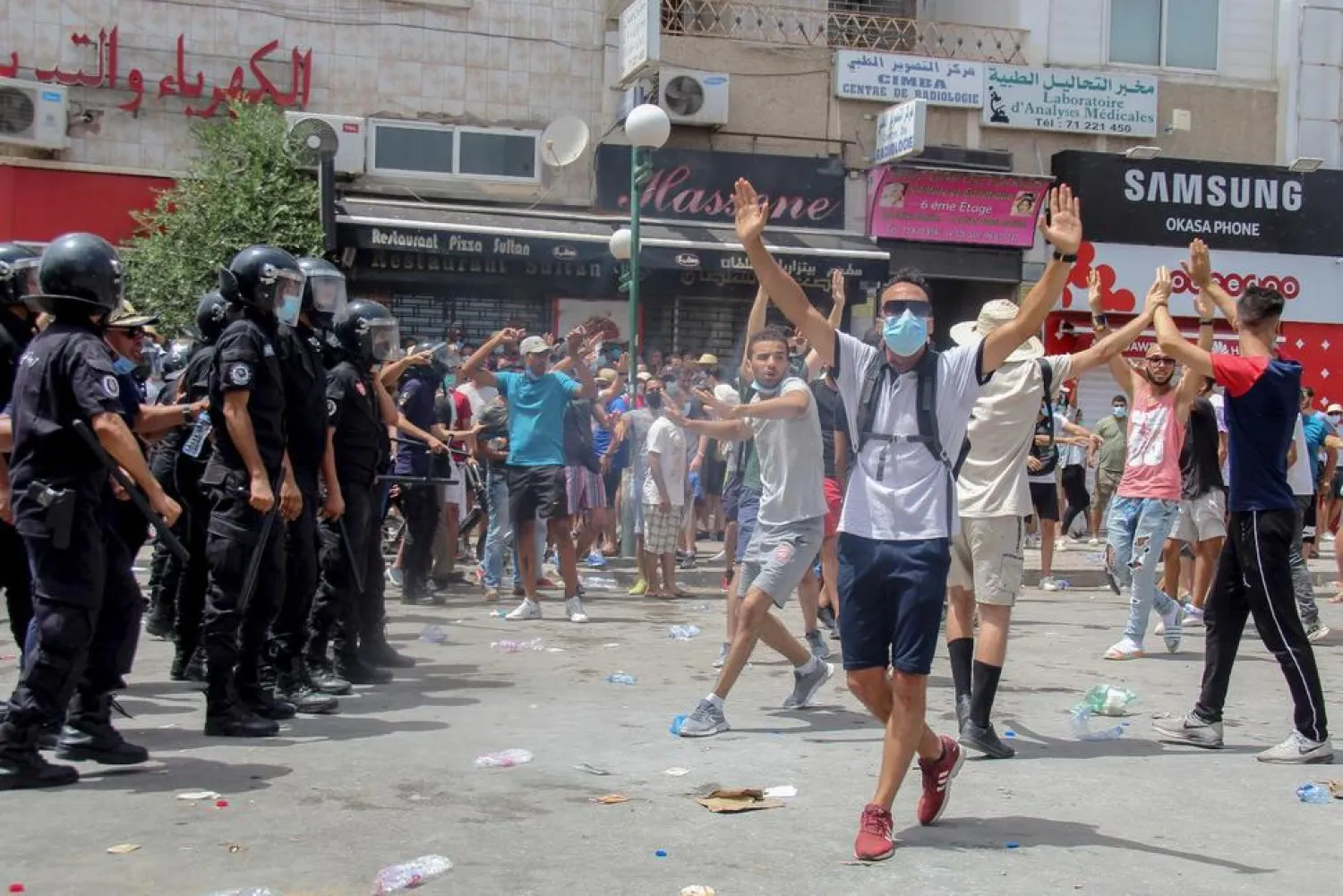
Protesters face Tunisian police officers during a demonstration in Tunis, Tunisia, Sunday, July 25, 2021. (AP)
TT

Tunisia President Sacks Defense Minister amid Political Turmoil

Protesters face Tunisian police officers during a demonstration in Tunis, Tunisia, Sunday, July 25, 2021. (AP)

Tunisian President Kais Saied sacked the defense minister Monday, a day after ousting the prime minister and suspending parliament, plunging the young democracy into constitutional crisis in the midst of a pandemic.

Street clashes erupted Monday outside the army-barricaded parliament, after Saied dismissed Prime Minister Hichem Mechichi and ordered parliament closed for 30 days, a move the biggest political party Ennahdha decried as a “coup”.

Saied declared on Sunday that he had “taken the necessary decisions to save Tunisia, the state and the Tunisian people,” following street protests in multiple cities against the government’s handling of the Covid pandemic.

The president, who under the constitution controls the armed forces, warned his opponents against taking up arms, threatening that if anyone “fires a single bullet, our forces will respond with a rain of bullets”.

On Monday afternoon, a statement from the presidency announced the dismissals of Defense Minister Ibrahim Bartaji and acting justice minister Hasna Ben Slimane, who is also the government spokeswoman.

‘Very dangerous’
Soldiers from early Monday blockaded the assembly in Tunis while Saied backers hurled stones, bottles and insults at supporters of the Islamist-inspired Ennahdha, whose leader, parliament Speaker Rached Ghannouchi, was barred entry to the complex.

Troops also surrounded the office of Mechichi, who was yet to officially react to the events rocking the North African country.

Later in the afternoon, the protests died down.

Saied’s dramatic move -- a decade on from Tunisia’s 2011 revolution -- comes even though the constitution enshrines a parliamentary democracy.

It “is a coup d’etat against the revolution and against the constitution,” said Ennahdha, the lead party in Tunisia’s fractious ruling coalition charged, warning its members “will defend the revolution”.

The crisis follows months of deadlock between the president, the premier and Ennahdha chief Ghannouchi, which has crippled the Covid response as deaths have surged to one of the world’s highest per capita rates.

Tunisia has recently been overwhelmed by Covid-19 cases which have raised the death toll to more than 18,000 in a nation of 12 million.

Police also shuttered the local bureau of Qatari-based Al Jazeera television, the network’s Tunis director Lotfi Hajji said, warning that “what is happening is very dangerous, it is proof that freedom of the press is threatened”.

‘Imminent danger’
The powerful Tunisian General Labor Union (UGTT) which played a key role in the 2011 uprising, said the president acted “in accordance” with the constitution to “prevent imminent danger and to restore the normal functioning” of the state.

Saied’s power-grab sparked jubilant rallies late Sunday by thousands of his supporters who flooded the streets of Tunis, waving the national flag and sounding their car horns as fireworks lit up the sky.

But the shock move was criticized abroad.

The United States is concerned about developments in Tunisia and urged calm in the country, White House spokeswoman Jen Psaki said on Monday, adding the United States is in touch at a senior level with Tunisian leaders to learn more.

Psaki said the White House has not made a determination on whether it was a coup.

Germany urged a rapid “return to constitutional order” while the foreign ministry in Turkey, where the government supports Ennahdha, called for “democratic legitimacy” to be restored.

France called for respect of the rule of law in Tunisia as quickly as possible and called on all political parties to refrain from violence.

Since Saied was elected in 2019, he has been locked in a showdown with Mechichi and Ghannouchi.

The rivalry has blocked ministerial appointments and diverted resources from tackling Tunisia’s many economic and social problems.

In the chaotic scenes outside parliament Monday, Ghannouchi admonished an army officer who was blocking access and who had declared the troops were “the protectors of the nation”.

Ghannouchi retorted that “the Tunisian people will never accept an authoritarian government, whatever your efforts”.

Saied said he would assume executive power “with the help” of a government whose new chief he would appoint himself.

The president also lifted parliamentary immunity for lawmakers.

Skepticism
In the 10 years since Tunisia’s popular revolution toppled long-time leader Zine El Abidine Ben Ali, Tunisia has had nine governments.

Some of them have lasted only a few months, hindering the reforms needed to revamp the country’s struggling economy and poor public services.

Sunday’s political drama began with mass protests against the government for its failures in tackling the pandemic.

“The people want the dissolution of parliament,” the crowd chanted outside parliament in Tunis. Protests were also reported in several other cities.

A senior Ennahdha official, speaking to AFP on condition of anonymity, alleged that the protests and subsequent celebrations, had all been choreographed by the president.

After Saied’s announcement, one jubilant supporter, Nahla, brandished a Tunisian flag and hailed the president’s “courageous decisions”.

“This is the president we love!” she said.

But one man, aged in his forties, watched on without enthusiasm and said: “These fools are celebrating the birth of a new dictator.”

One Dead as Israeli Forces Open Fire on West Bank Stone-Throwers

Israeli troops during a military operation in the Palestinian village of Qabatiya, near the West Bank city of Jenin, 27 December 2025. (EPA)
TT

One Dead as Israeli Forces Open Fire on West Bank Stone-Throwers

Israeli troops during a military operation in the Palestinian village of Qabatiya, near the West Bank city of Jenin, 27 December 2025. (EPA)

The Israeli military said its forces killed a Palestinian in the occupied West Bank in the early hours on Thursday as they opened fire on people who were throwing stones at soldiers.

Two other people were hit on a main ‌road near the ‌village of Luban ‌al-Sharqiya ⁠in Nablus, ‌the military statement added. It described the people as militants and said the stone-throwing was part of an ambush.

Palestinian authorities in the West Bank said ⁠a 26-year-old man they named as ‌Khattab Al Sarhan was ‍killed and ‍another person wounded.

Israeli forces had ‍closed the main entrance to the village of Luban al-Sharqiya, in Nablus, and blocked several secondary roads on Wednesday, the Palestinian Authority's official news agency WAFA reported.

More ⁠than a thousand Palestinians were killed in the West Bank between October 2023 and October 2025, mostly in operations by security forces and some by settler violence, the UN has said.

Over the same period, 57 Israelis were killed ‌in Palestinian attacks.


UN Chief Condemns Israeli Law Blocking Electricity, Water for UNRWA Facilities

A girl stands in the courtyard of a building of the United Nations Relief and Works Agency for Palestine Refugees (UNRWA) in the Askar camp for Palestinian refugees, east of Nablus in the Israeli-occupied West Bank, on December 31, 2025. (AFP)
TT

UN Chief Condemns Israeli Law Blocking Electricity, Water for UNRWA Facilities

A girl stands in the courtyard of a building of the United Nations Relief and Works Agency for Palestine Refugees (UNRWA) in the Askar camp for Palestinian refugees, east of Nablus in the Israeli-occupied West Bank, on December 31, 2025. (AFP)

United Nations Secretary-General Antonio Guterres condemned on Wednesday a move by Israel to ban electricity or water to facilities owned by the UN Palestinian refugee agency, a UN spokesperson said.

The spokesperson said the move would "further impede" the agency's ability to operate and carry out activities.

"The Convention on the Privileges and Immunities of the United Nations remains applicable to UNRWA (United Nations Relief and Works Agency for Palestine Refugees in the Near East), its property and assets, and to its officials and other personnel. Property used ‌by UNRWA ‌is inviolable," Stephane Dujarric, spokesman for the ‌secretary-general, ⁠said while ‌adding that UNRWA is an "integral" part of the world body.

UNRWA Commissioner General Phillipe Lazzarini also condemned the move, saying that it was part of an ongoing " systematic campaign to discredit UNRWA and thereby obstruct" the role it plays in providing assistance to Palestinian refugees.

In 2024, the Israeli parliament passed a law banning the agency from operating in ⁠the country and prohibiting officials from having contact with the agency.

As a ‌result, UNRWA operates in East Jerusalem, ‍which the UN considers territory occupied ‍by Israel. Israel considers all Jerusalem to be part ‍of the country.

The agency provides education, health and aid to millions of Palestinians in Gaza, the West Bank, Jordan, Lebanon and Syria. It has long had tense relations with Israel, but ties have deteriorated sharply since the start of the war in Gaza and Israel has called repeatedly for UNRWA to ⁠be disbanded, with its responsibilities transferred to other UN agencies.

The prohibition of basic utilities to the UN agency came as Israel also suspended of dozens of international non-governmental organizations working in Gaza due to a failure to meet new rules to vet those groups.

In a joint statement, Canada, Denmark, Finland, France, Iceland, Japan, Norway, Sweden, Switzerland and the United Kingdom said on Tuesday such a move would have a severe impact on the access of essential services, including healthcare. They said one in ‌three healthcare facilities in Gaza would close if international NGO operations stopped.


Israel Says It ‘Will Enforce’ Ban on 37 NGOs in Gaza

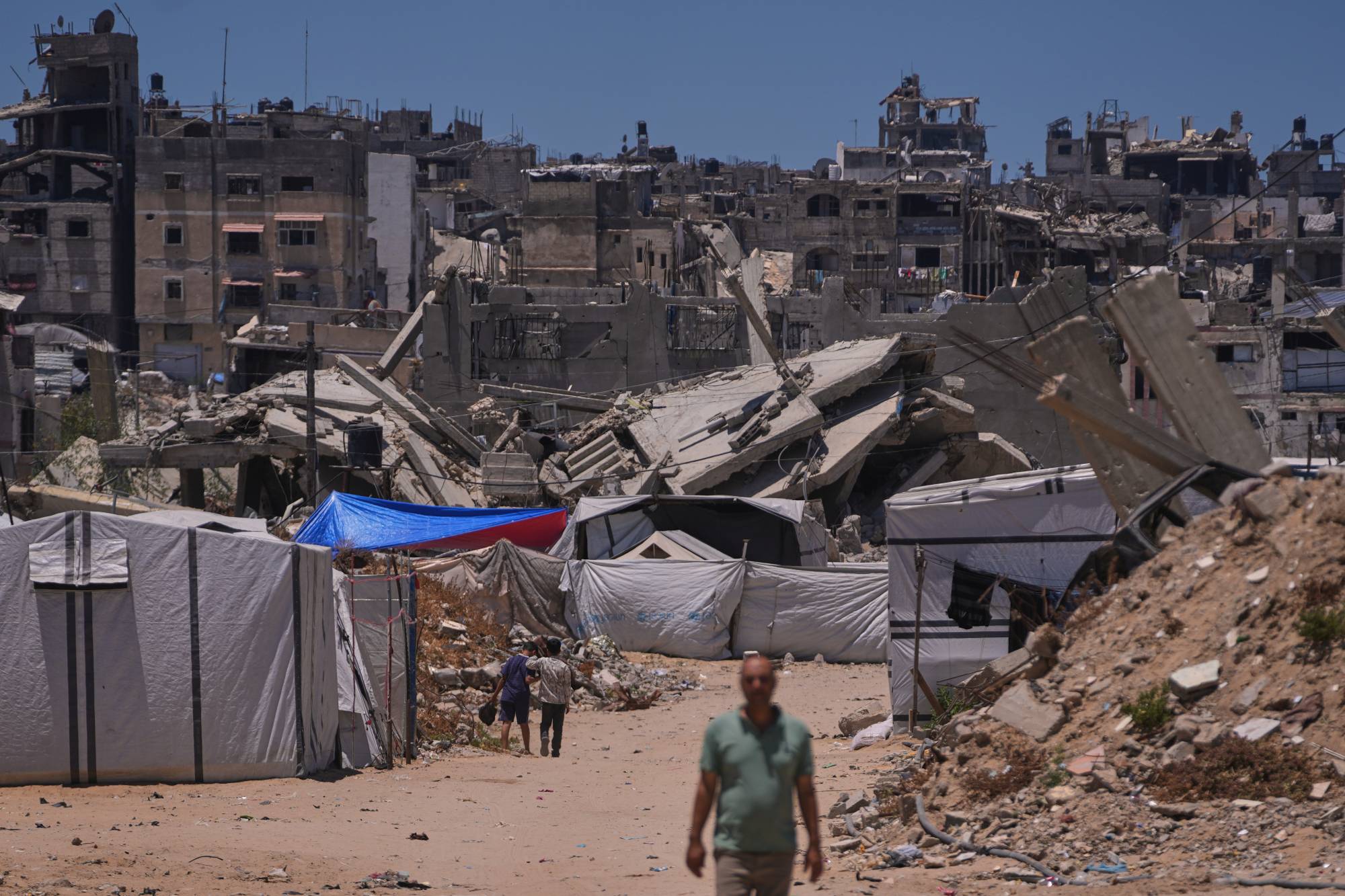
The sun sets behind the ruins of destroyed buildings in the Nuseirat refugee camp in the central Gaza Strip on December 31, 2025. (AFP)
TT

Israel Says It ‘Will Enforce’ Ban on 37 NGOs in Gaza

The sun sets behind the ruins of destroyed buildings in the Nuseirat refugee camp in the central Gaza Strip on December 31, 2025. (AFP)

Israel said on Thursday that 37 international NGOs operating in Gaza had not complied with a deadline to meet "security and transparency standards," in particular disclosing information on their Palestinian staff, and that it "will enforce" a ban on their activities. 

The groups will now be required to cease their operations by March 1, which the United Nations has warned will exacerbate the humanitarian crisis in the war-ravaged Palestinian territory. 

"Organizations that have failed to meet required security and transparency standards will have their licenses suspended," the Ministry of Diaspora Affairs and Combating Antisemitism said in a statement on Thursday. 

Several NGOS have said the requirements contravene international humanitarian law or endanger their independence, while Israel has faced international criticism in the run-up to the deadline. 

Israel says the new regulation aims to prevent bodies it accuses of supporting terrorism from operating in the Palestinian territories. 

"The primary failure identified was the refusal to provide complete and verifiable information regarding their employees, a critical requirement designed to prevent the infiltration of terrorist operatives into humanitarian structures," the ministry said. 

In March, Israel gave a ten-month deadline to NGOs to comply with the new rules, which demand the "full disclosure of personnel, funding sources, and operational structures." 

The deadline expired on Wednesday. 

The 37 NGOs "were formally notified that their licenses would be revoked as of January 1, 2026, and that they must complete the cessation of their activities by March 1, 2026," the ministry said Thursday. 

- 'Weaponization of bureaucracy' - 

Minister of Diaspora Affairs and Combating Antisemitism Amichai Chikli said: "The message is clear: humanitarian assistance is welcome - the exploitation of humanitarian frameworks for terrorism is not." 

Numerous prominent humanitarian organizations have been hit by the ban, including Doctors Without Borders (MSF), World Vision International and Oxfam, according to the list provided by the ministry. 

In the case of MSF, Israel accused it of having two employees who were members of Palestinian groups Islamic Jihad and Hamas. 

MSF said earlier this week that the request to share a list of its staff "may be in violation of Israel's obligations under international humanitarian law" and said it "would never knowingly employ people engaging in military activity". 

On Thursday, 18 Israel-based left-wing NGOs denounced the decision to ban their international peers, saying "the new registration framework violates core humanitarian principles of independence and neutrality." 

"This weaponization of bureaucracy institutionalizes barriers to aid and forces vital organizations to suspend operations," they said. 

On Wednesday, United Nations rights chief Volker Turk described Israel's decision as "outrageous", calling on states to urgently insist Israel shift course. 

"Such arbitrary suspensions make an already intolerable situation even worse for the people of Gaza," he said. 

UN Palestinian refugee agency chief Philippe Lazzarini said the move sets a "dangerous precedent". 

"Failing to push back against attempts to control the work of aid organizations will further undermine the basic humanitarian principles of neutrality, independence, impartiality and humanity underpinning aid work across the world," he said on X. 

- 'Catastrophic' - 

On Tuesday, the foreign ministers of 10 countries, including France and the United Kingdom, urged Israel to "guarantee access" to aid in the Gaza Strip, where they said the humanitarian situation remains "catastrophic". 

A fragile ceasefire has been in place in Gaza since October, following a deadly war waged by Israel in response to Hamas's unprecedented attack on Israeli territory on October 7, 2023. 

Conditions for the civilian population in the Gaza Strip remain dire, with nearly 80 percent of buildings destroyed or damaged by the war, according to UN data. 

About 1.5 million of Gaza's more than two million residents have lost their homes, said Amjad Al-Shawa, director of the Palestinian NGO Network in Gaza.