First Hunting Dog in Europe Lived 1.8 Million Years Ago, New Study Findshttps://english.aawsat.com/home/article/3112526/first-hunting-dog-europe-lived-18-million-years-ago-new-study-finds
First Hunting Dog in Europe Lived 1.8 Million Years Ago, New Study Finds
This Tuesday, Feb. 11, 2020, file photo, shows Daniel, a golden retriever, during the sporting group competition at the 144th Westminster Kennel Club dog show in New York. (AP Photo/John Minchillo, File)
First Hunting Dog in Europe Lived 1.8 Million Years Ago, New Study Finds
This Tuesday, Feb. 11, 2020, file photo, shows Daniel, a golden retriever, during the sporting group competition at the 144th Westminster Kennel Club dog show in New York. (AP Photo/John Minchillo, File)
Is this Europe's first hunting dog? Jawbone of a huge canine dating back 1.8 million years is discovered alongside human remains in Georgia.
The jawbone of a huge canine from 1.8 million years ago has been found alongside human remains in Georgia — and may be Europe's first hunting dog, a study claimed.
Experts led from the University of Florence analyzed remains freshly collected from the Dmanisi archaeological site, which previously yielded several hominine skulls.
They concluded that the remains belong to the species Canis (Xenocyon) lycaonoides — the 'Eurasian hunting dog' — which originated in East Asia, The Daily Mail reported.
The Dmanisi dog, the team said, could be the ancestor of African hunting dogs — and likely lived alongside early humans in Georgia before dispersing more widely. The study of the large dog's remains was undertaken by vertebrate paleontologist Saverio Bartolini-Lucenti of the University of Florence, Italy, and his colleagues. According to their analysis, the bones date back to between 1.77–1.76 million years ago — making it the earliest known case of a hunting dog in Europe.
According to the researchers, it actually predates the widespread movement of hunting dogs from their origin in Asia west into Europe and Africa during the middle of the Pleistocene Epoch. Based on the lack of wear on the Dmanisi dog's teeth, the researchers have concluded that it was a young adult, if large, weighing in at around 30kg (66 lbs).
Analysis of the dog's dental features also showed similarities with other wild dog-like species — 'canids' — from the same time period. They have narrower and shorter third premolars than omnivores and an enlarged and sharp tooth in the middle of the jaw which would have served to help shred food.
These features have allowed experts to identify these canids as being highly carnivorous, eating a diet that was at least 70 percent meat.
When the World Saw van Gogh as ‘a Madman,’ she Saw his Geniushttps://english.aawsat.com/varieties/5325024-when-world-saw-van-gogh-%E2%80%98-madman%E2%80%99-she-saw-his-genius
“Four Sunflowers Gone to Seed” Credit...Ilvy Njiokiktjien for The New York Times
TT
TT
When the World Saw van Gogh as ‘a Madman,’ she Saw his Genius
“Four Sunflowers Gone to Seed” Credit...Ilvy Njiokiktjien for The New York Times
By Nina Siegal
It was April 1912, and Helene Kröller-Müller was on a shopping spree. She wasn’t interested in the latest shoes or fashions. She was on the hunt for Vincent van Gogh’s portrait of Madame Augustine Roulin.
She managed to find “La Berceuse,” as the painting is known, at a Paris gallery, and bought it on the spot. The next day, she went from gallery to gallery, looking for more van Gogh paintings, and took home a great haul: 15 in a single trip.
Kröller-Müller, a German heiress, had made it her life’s goal to establish a great public collection of modern art. She became one of the first major collectors to recognize van Gogh’s genius.
Now, more than a century after that Paris shopping spree, the entire collection of van Gogh paintings she assembled is on view together at the museum she built in the middle of a Dutch forest — for the first time since 1984.
It is the second-largest trove of van Gogh’s works anywhere, after the Van Gogh Museum in Amsterdam, and it was assembled by a woman who took great risks in buying his art at a time when few others dared.
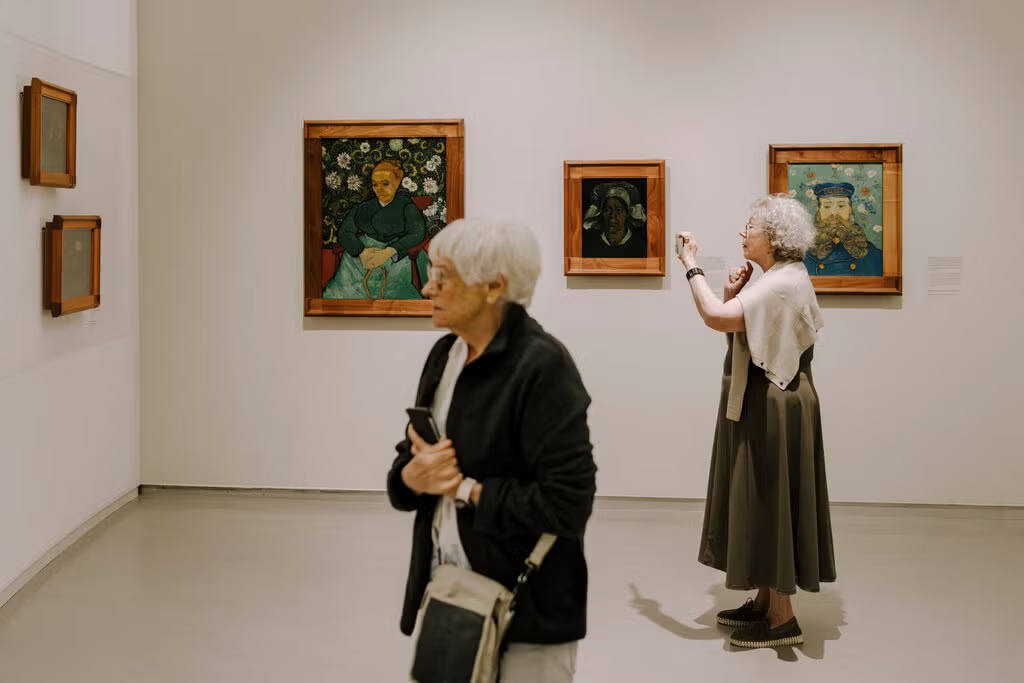
The exhibition “Van Gogh: All Our Paintings” includes works like “La Berceuse,” hanging on the left side of the rear wall. Credit...Ilvy Njiokiktjien for The New York Times
The exhibition at the Kröller-Müller Museum in Otterlo, the Netherlands, called “Van Gogh: All Our Paintings” and running through Jan. 3, presents the whole collection as Kröller-Müller conceived it: an expression of the artist’s development, range and spiritual aspirations.
“This is a rare moment that all the paintings are in the house,” said Benno Tempel, the museum’s director. “It hasn’t happened for such a long time.”
The show is organized around three themes — faith, hope and love — reflecting the spiritual dimension that Kröller-Müller saw in van Gogh’s work. It includes many of his popular works, scattered throughout these broad categories, such as “Café Terrace at Night,” “Portrait of Joseph Roulin” and “The Sower.”
Kröller-Müller, the daughter of a German industrialist, had an early interest in art but had to end her formal education at age 16. At 18, she married one of her father’s employees, who would later take over the family business. Her husband, Anton Müller, encouraged her intellectual pursuits, including her interest in art, a socially acceptable hobby for wealthy women of the era.
“If you were married at the time, you gave all your money and assets to your husband," said the exhibition’s curator, Renske Cohen Tervaert. “So it was quite open-minded of him, in a way, to allow her to follow her dream in this way.”
But Kröller-Müller didn’t collect as a hobbyist. She embraced art with a kind of religious fervor.
She bought her first van Gogh painting in 1908 for 110 guilders — about the price of an exquisite dress, said Eva Rovers, her biographer. Four months later, she bought his “Four Sunflowers Gone to Seed” for 4,000 guilders.
Prices were rising in large part because she was buying so much.
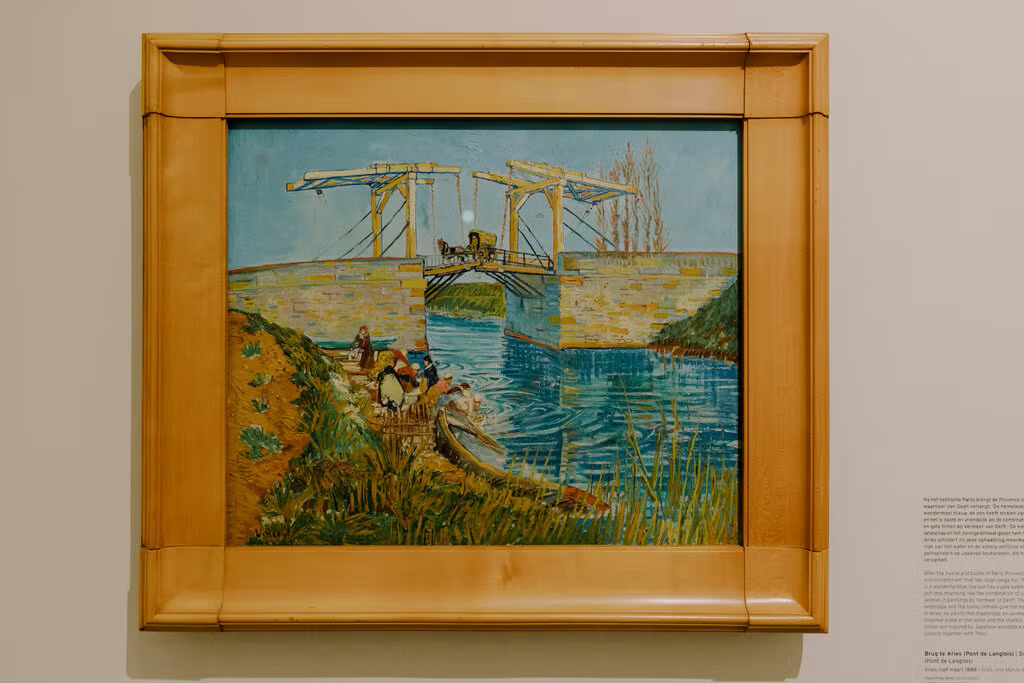
“Bridge at Arles” Credit...Ilvy Njiokiktjien for The New York Times
Kröller-Müller’s collecting philosophy was largely shaped by the art historian Henk Bremmer, with whom she took an art appreciation class, Tervaert said. She added that for Bremmer, the key component of good art was that it made the viewer feel an emotion or experience something spiritual.
Kröller-Müller went looking for art that stirred her spirit and found van Gogh.
Rovers said that van Gogh was not well regarded in the early 20th century. “If the general public knew him at all, they really considered him a madman who could not paint,” she said.
But because van Gogh had been a preacher before becoming an artist, Kröller-Müller regarded him as a man who had found a connection to faith through his art.
“She understood his wish to transcend suffering, and his aim to use art to transcend suffering,” Rovers said.
While most collectors in the Netherlands were buying old masters and 19th-century Dutch painting, Kröller-Müller focused on Cubism, Pointillism and De Stijl artists, including Piet Mondrian, Fernand Léger and Pablo Picasso.
Van Gogh’s work dominated the collection for a simple reason, Rovers said: He “stood at the cradle of the beginning of avant-garde art.” Kröller-Müller built a collection, Rovers added, “that could show the broad variety of his work — landscapes, portraits, cityscapes.”
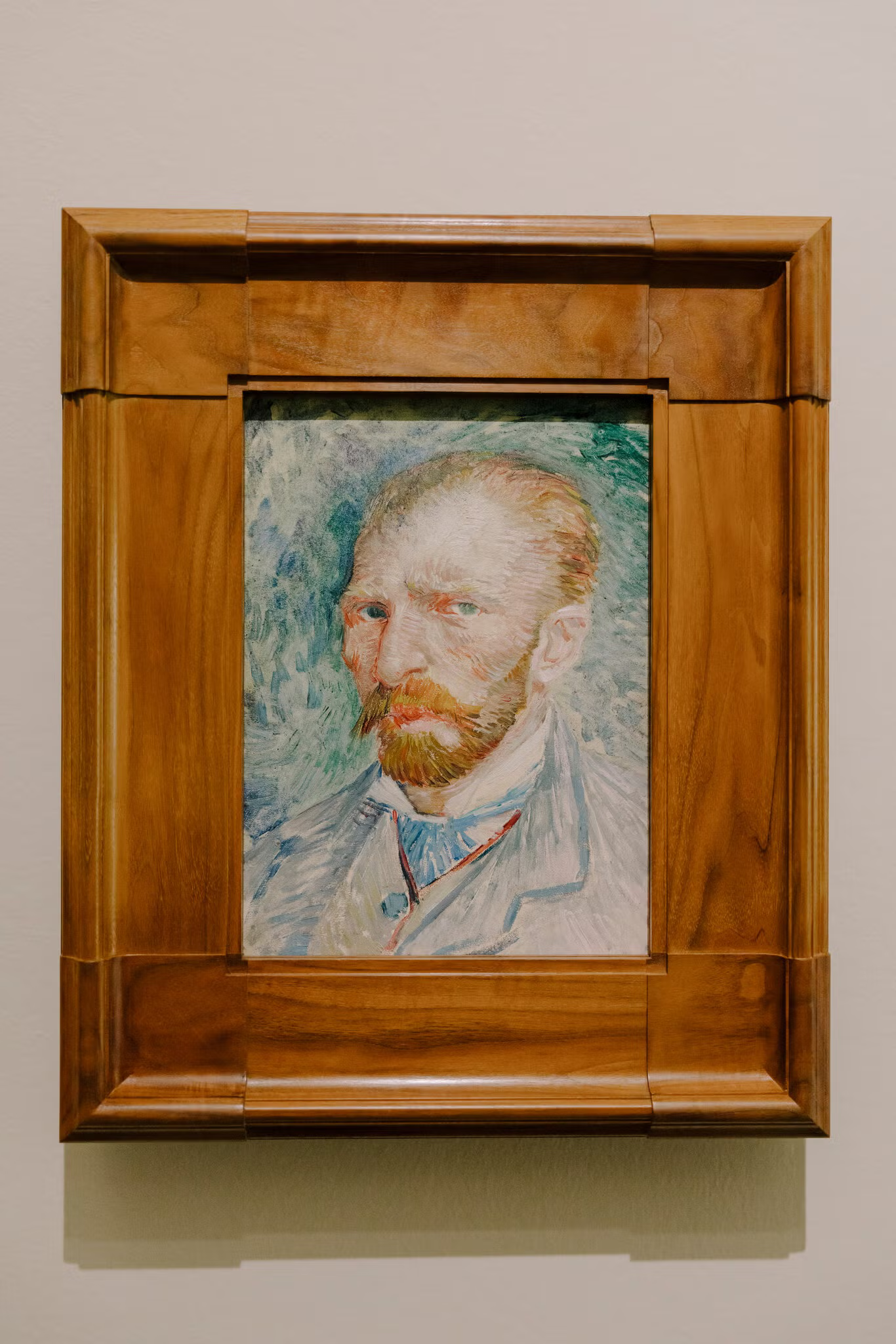
A van Gogh self-portrait from 1887. The show is organized around the themes of faith, hope and love. Credit...Ilvy Njiokiktjien for The New York Times
In the late 1930s, as Europe was approaching World War II, Kröller-Müller’s health was declining, along with her family fortune.
She decided to offer her art collection, worth about 4 million guilders at the time, along with family property in the Veluwe forest, to the Dutch state, as long as it would agree to build a museum to display it. She imagined the museum, with a 62-acre sculpture garden, as a retreat for spiritual and philosophical inquiry.
The result was a rare trove in a remote Dutch forest — now a national park — built around her collection.
The Van Gogh Museum in Amsterdam has more than 200 paintings, but its collection has a different history: It was established to show the collection of the van Gogh family, who owned the artist’s unsold works. The Kröller-Müller represents a collector’s eye.
“The Van Gogh Museum is just what was left over,” Tempel said. “This is a chosen collection.”
The New York Times
Not Your Everyday Coffee in a Serbia Cafe. Enjoy it in the Company of Alpacashttps://english.aawsat.com/varieties/5325011-not-your-everyday-coffee-serbia-cafe-enjoy-it-company-alpacas
Six alpacas roam among the tables in the Alpaca Cafe interacting with the guests in the village of Stajicevo, 50 kilometers north of Belgrade, Serbia, Wednesday, Sept. 30, 2026. (AP Photo/Darko Vojinovic)
Not Your Everyday Coffee in a Serbia Cafe. Enjoy it in the Company of Alpacas
Six alpacas roam among the tables in the Alpaca Cafe interacting with the guests in the village of Stajicevo, 50 kilometers north of Belgrade, Serbia, Wednesday, Sept. 30, 2026. (AP Photo/Darko Vojinovic)
A cafe in northern Serbia has unusual hosts: six alpacas.
The South American animals, of various sizes and colors, roam among the tables at the Tiganjica Ethno-Village resort near Stajicevo, north of Belgrade, happy to interact with the guests.
The Alpaca Cafe here opened only a week ago and is a rare sight in Europe. Tiganjica resort owner Zoran Ostojin said he got the idea in Slovakia.
“My wife and I were in an Alpaca cafe in Slovakia and we were fascinated,” Ostojin told The Associated Press. “We wanted people in our country to get to know alpacas and feel this animal and its energy.”
Calm and friendly, alpacas are known for their mild character and easy disposition. While related to llamas and camels, alpacas are smaller, loved for their soft fleece and gentle humming sounds they produce to communicate.
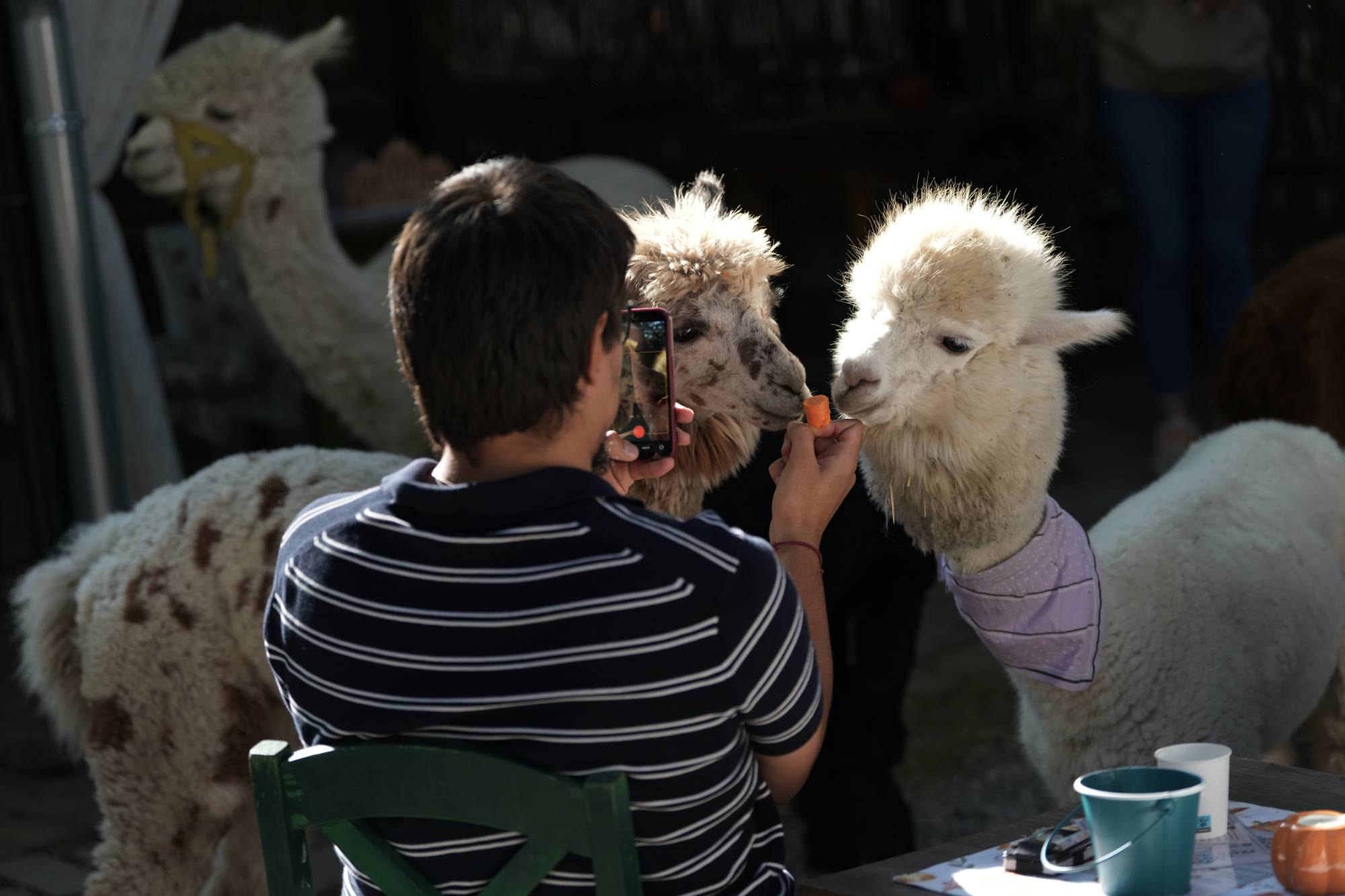
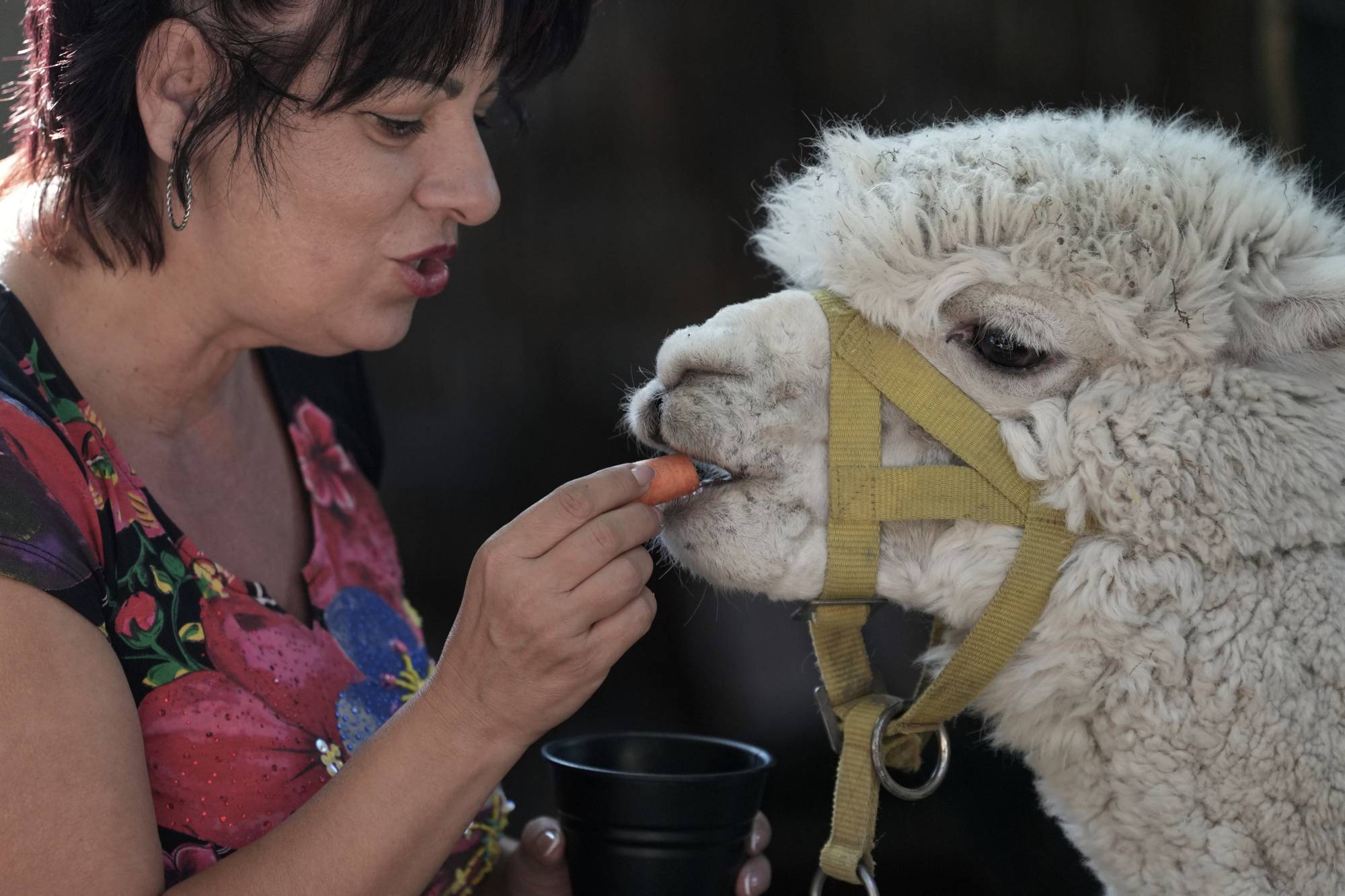
A man feeds alpacas in the Alpaca Cafe happy in the village of Stajicevo, 50 kilometers north of Belgrade, Serbia, Wednesday, Sept. 30, 2026. (AP Photo/Darko Vojinovic)
The alpacas in Tiganjica mingle with the visitors who often come in organized tours to see the animals and spend time in their company.
Written on a board are house rules. Visitors are asked not to approach the alpacas from behind or feed them any food they brought along. Guests are instead given small buckets with carrots, lettuce and apples.
Visits must be prearranged and the cost is around 10 euros ($11.35), which includes a drink and a bucket with alpaca food.
All six animals differ in character, according to the alpacas' carer Simona Frangi, who said a black alpaca called Ljubica is grumpy, while Snezana is the herd leader despite being the smallest of all.
A woman feeds an alpaca in the Alpaca Cafe happy in the village of Stajicevo, 50 kilometers north of Belgrade, Serbia, Wednesday, Sept. 30, 2026. (AP Photo/Darko Vojinovic)
“They are very sensitive to people's intentions,” Frangi explained. “They feel if someone wants to harm them, they move away. But if someone wants to offer something, they will come close.”
Ostojin runs a small zoo within his resort, which also includes a restaurant and a garden on the family estate. Ostojin said it all started because he and his brother were bringing over injured animals to care for since they were boys.
The first alpaca came as a present from the Belgrade Zoo eight years ago. Ostojin said he “very much liked the energy, the emotion that this animal sends out.”
“Almost like a healing ability,” he said.
Japan to Survey Animal Cafes for 1st Time over Welfare and Disease Concernshttps://english.aawsat.com/varieties/5324659-japan-survey-animal-cafes-1st-time-over-welfare-and-disease-concerns
Syaina Nozaki, manager of Owl Otter Cafe, holds food for Asian small-clawed otters at the cafe, which houses rescued animals, in Kamakura, Kanagawa Prefecture, Japan, September 24, 2026. REUTERS/Kim Kyung-Hoon
Japan to Survey Animal Cafes for 1st Time over Welfare and Disease Concerns
Syaina Nozaki, manager of Owl Otter Cafe, holds food for Asian small-clawed otters at the cafe, which houses rescued animals, in Kamakura, Kanagawa Prefecture, Japan, September 24, 2026. REUTERS/Kim Kyung-Hoon
Japan has started its first nationwide survey of animal cafes amid concerns over animal welfare, hygiene and public health, a government official said, bringing greater scrutiny to the popular but lightly regulated sector.
The desktop survey, which began this month, will examine the number of facilities, the types of animals they house and the conditions they are held in, and how visitors interact with the animals.
Exotic animal cafes, where visitors can interact with species ranging from otters to owls and marmots, have become popular attractions for both Japanese and foreign tourists. But researchers say some facilities keep threatened species, raising concerns about animal welfare and the trade in wildlife.
Japan lacks specific standards governing such cafes and handling of many exotic species, said Takuya Ishikawa, an official at the Environment Ministry.
"There has been strong public interest, including from animal welfare groups, which have regularly shared findings from their own research with the ministry," Reuters quoted Ishikawa as saying. "Experts on a government advisory panel have also frequently raised concerns about potential problems at such cafes."
Cafes with domesticated animals including cats and dogs will also be included in the survey.
The government also plans a public awareness campaign, acknowledging that it had not done enough to inform public about the risks of interacting with exotic animals.
The prospect of tighter oversight has been welcomed by some in the industry.
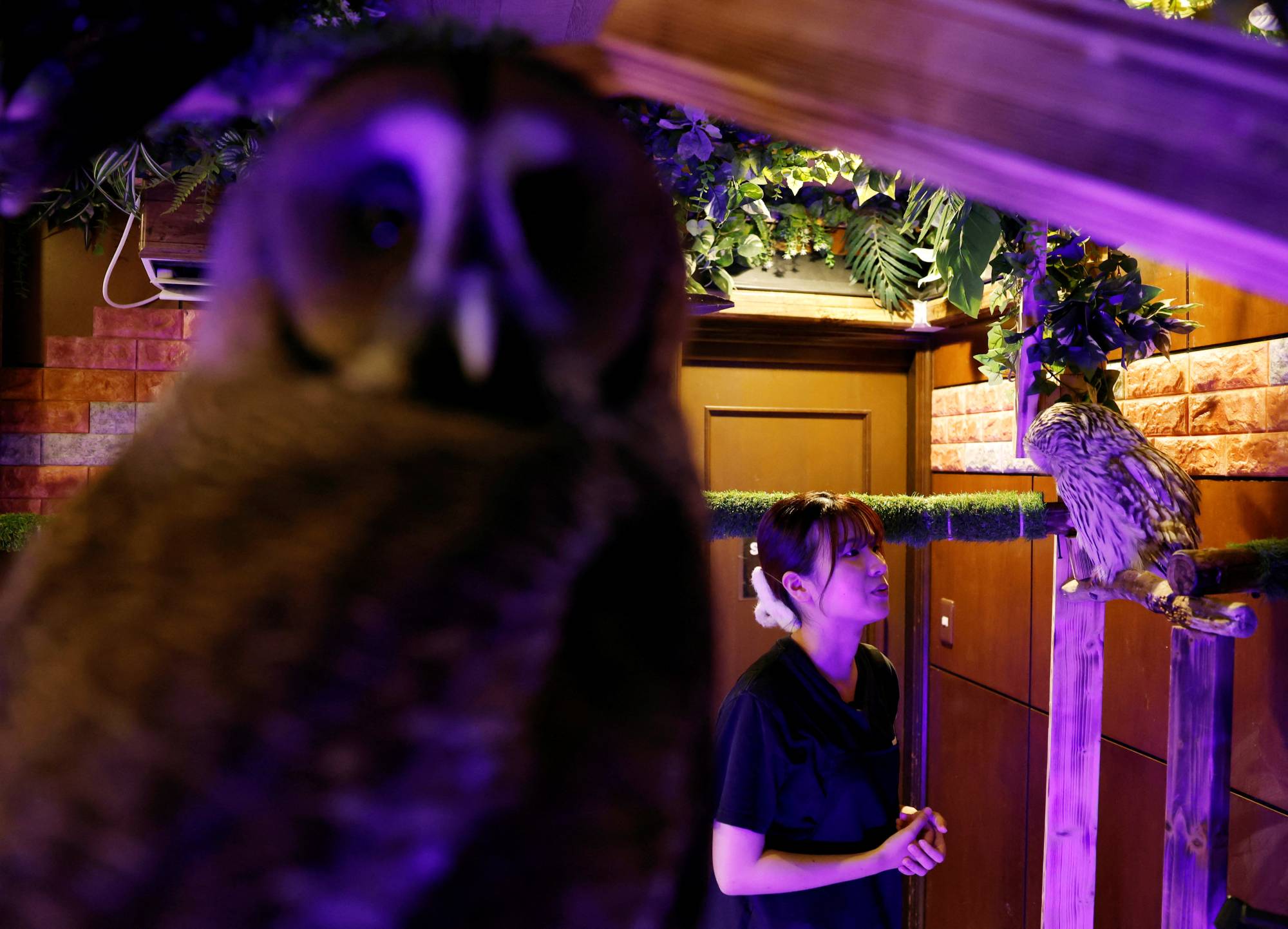
Syaina Nozaki, manager of Owl Otter Cafe, which houses rescued animals, checks on owls at the cafe in Kamakura, Kanagawa Prefecture, Japan, September 24, 2026. REUTERS/Kim Kyung-Hoon
"Japan is clearly lagging behind when it comes to (animal welfare) regulation," said Syaina Nozaki, manager of Owl Otter Cafe in Kamakura, near Tokyo, which houses rescued animals.
Nozaki said that she hoped that regulations will help distinguish facilities like hers from less responsible operators focused solely on profit.
Japan, which has a large domestic pet market, ranked as the world's second-biggest importer of both live reptiles and mammals by value in 2024, a report by the World Wildlife Fund this month said, highlighting risks including invasive species introduced through pet releases and the spread of zoonotic diseases.
Of about 80 registered wildlife animal cafes in Tokyo and Osaka, three-quarters were also registered to sell animals, according to a separate report by WWF and Hokkaido University.
Researchers visiting 25 cafes found more than 1,700 animals on display, 27% of them threatened species. More than 90% of the cafes displayed animals considered at high risk of causing injury through contact, while samples from four cafes tested positive for enterohemorrhagic E. coli (EHEC), which can cause bloody diarrhea.
لم تشترك بعد
انشئ حساباً خاصاً بك لتحصل على أخبار مخصصة لك ولتتمتع بخاصية حفظ المقالات وتتلقى نشراتنا البريدية المتنوعة