

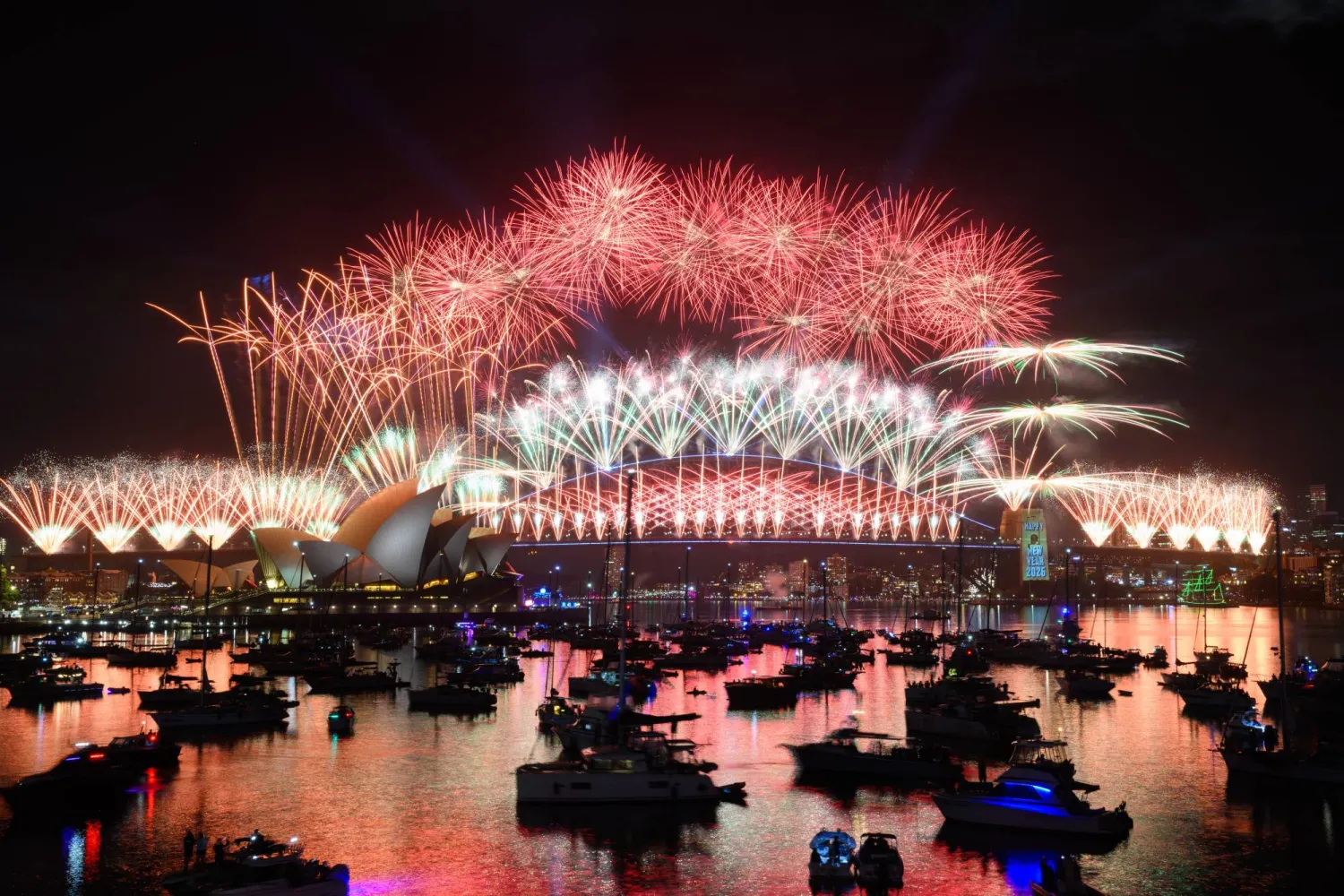

Cities Around the World Welcome 2026 with Fireworks and Heightened Security

Fireworks are seen over Sydney Harbour during the New Year's Eve midnight display, at Mrs Macquaries Point in Sydney, 01 January 2026. EPA/DAN HIMBRECHTS
TT

Cities Around the World Welcome 2026 with Fireworks and Heightened Security

Fireworks are seen over Sydney Harbour during the New Year's Eve midnight display, at Mrs Macquaries Point in Sydney, 01 January 2026. EPA/DAN HIMBRECHTS

From Sydney to Paris to New York City, crowds rang in the new year with exuberant celebrations filled with thunderous fireworks or light shows, while others took a more subdued approach.

As the clock struck midnight in Japan, temple bells rang and some climbed mountains to see the year’s first sunrise, while a light show with somersaulting jet skis twinkled in Dubai. The countdown to 2026 was projected onto the Arc de Triomphe in Paris, while in Moscow people celebrated in the snow, The Associated Press reported.

In New York City's Times Square, revelers braved frigid temperatures to celebrate with the famed New Year’s Eve ball drop.

In Rio de Janeiro, crowds packed more than 4 kilometers (2 1/2 miles) of the city’s Copacabana Beach for concerts and a 12-minute fireworks show, despite high tides and large waves that rocked barges carrying fireworks.

Other events were more subdued. Hong Kong held limited celebrations following a recent fire at an apartment complex that killed 161 people.

Australia saluted the new year with defiance less than a month after its worst mass shooting in almost 30 years.

Crowds bundled up against the chilly temperatures cheered and embraced as the New Year’s Eve ball covered in more than 5,000 crystals descended down a pole and confetti fell in Times Square.

Revelers wearing tall celebratory hats and light-up necklaces had waited for hours to see the 12,350-pound (5,602-kilograms) ball drop. The festivities also included Tones and I performing John Lennon's “Imagine” just before midnight.

The television hosts interviewed visitors who were attending from such places as Florida, Mexico and South Korea, and read people's wishes for the new year.

A sixth grader from Dallas, Texas, told one of the hosts that he wants to get good grades in 2026 and have a better year.

Police in the city had planned additional anti-terrorism measures at the ball drop, with “mobile screening teams.” It was not in response to a specific threat, according to NYPD Commissioner Jessica Tisch.

Moments after the ball dropped it rose again, sparkling in red, white and blue, to mark the country’s upcoming 250th birthday.

A few miles away in a decommissioned subway station, Zohran Mamdani was sworn in as mayor during a private event just after midnight Thursday.

A heavy police presence monitored crowds watching fireworks in Sydney.

Many officers openly carried rapid-fire rifles, a first for the event, after two gunmen targeted a Hannukah celebration at Bondi Beach on Dec. 14, killing 15.

An hour before midnight, victims were commemorated with a minute of silence, and the crowd was invited to show solidarity with Australia’s Jewish community.

New South Wales Premier Chris Minns had urged residents not to stay away from festivities, saying extremists would interpret smaller crowds as a victory: “We have to show defiance in the face of this terrible crime."

Indonesia scaled back festivities in solidarity with communities devastated by floods and landslides in parts of Sumatra a month ago that killed over 1,100. Fireworks on the tourist island of Bali were replaced with traditional dances.

Hong Kong rang in 2026 without fireworks over Victoria Harbor after the massive fire in November. Facades of landmarks were turned into countdown clocks and a light show at midnight.

And in Gaza, Palestinians said they hope the new year brings an end to the conflict between Israel and Hamas.

“The war humiliated us,” said Mirvat Abed Al-Aal, displaced from the southern city of Rafah.

Around Europe Pope Leo XIV closed out the year with a plea for the city of Rome to welcome foreigners and the fragile. Fireworks erupted over European landmarks, from the Colosseum in Rome to the London Eye.

In Paris, revelers converged around the glittering Champs-Élysées avenue. Taissiya Girda, a 27-year-old tourist from Kazakhstan, expressed hope for a calmer 2026.

“I would like to see happy people around me, no war anywhere,” she said.

“Russia, Ukraine, Palestine, Israel, I want everybody to be happy and in peace."

In Scotland, where New Year’s is known as Hogmanay, First Minister John Swinney urged Scots to follow the message of “Auld Lang Syne” by national poet Robert Burns and show small acts of kindness.

Greece and Cyprus turned down the volume, replacing traditional fireworks with low-noise pyrotechnics in capitals. Officials said the change was intended to make celebrations more welcoming for children and pets.




Macron’s ‘Top Gun’ Shades Charm Internet as Leaders Wrangle Over Greenland

 French President Emmanuel Macron, wearing sunglasses, speaks during a meeting on the institutional future of New Caledonia at the Elysee Palace in Paris, France, January 16, 2026. (Reuters)
French President Emmanuel Macron, wearing sunglasses, speaks during a meeting on the institutional future of New Caledonia at the Elysee Palace in Paris, France, January 16, 2026. (Reuters)
TT

Macron’s ‘Top Gun’ Shades Charm Internet as Leaders Wrangle Over Greenland

 French President Emmanuel Macron, wearing sunglasses, speaks during a meeting on the institutional future of New Caledonia at the Elysee Palace in Paris, France, January 16, 2026. (Reuters)
French President Emmanuel Macron, wearing sunglasses, speaks during a meeting on the institutional future of New Caledonia at the Elysee Palace in Paris, France, January 16, 2026. (Reuters)

French President Emmanuel Macron's aviator sunglasses have caught the eye, with social media users debating his choice of a "Top Gun" look as he criticized US President Donald Trump over Greenland during his speech in Davos.

As he spoke at the annual World Economic Forum in the Swiss mountain resort of Davos on Tuesday, the French president wore dark, reflective sunglasses.

Memes, comments and speculation over his appearance surged on social media, with some supporters praising him for his "Top Gun" look while opponents dismissed it as bombastic or speculated ‌about his ‌health.

Macron's office said the choice to ‌wear ⁠sunglasses during his ‌speech, which took place indoors, was to protect his eyes because of a burst blood vessel.

One meme, with the headline "Duel in Davos," was styled like a Top Gun parody, with Macron and Trump eyeballing each other, both wearing military-style flight suits, and Macron, looking very small next to Trump, sporting oversized aviator sunglasses.

References to the ⁠1986 movie starring Tom Cruise were ubiquitous.

"Trump: be careful ... Macron is here," one social ‌media user said on X, with a ‍picture of the French ‍president with the aviator glasses. "Could he not find some more sober ‍glasses?" another user asked.

Even Trump weighed in, mocking Macron for his glasses in his own Davos speech on Wednesday.

Meanwhile, some of Macron's colleagues had gotten in on the act, with European Affairs Minister Benjamin Haddad posting a version of the "Soyboy vs Yes Chad" meme with Chad donning aviators and draped in a French flag.

Italian ⁠group iVision Tech, which owns Henry Jullien, said the model worn by Macron was its Pacific S 01, with a price tag of 659 euros ($770) on its website. It said it sent Macron the sunglasses as a gift but that he had insisted on paying for them, and made sure they were made in France.

The Milan-listed stock was up almost 6% on Wednesday.

"The news this morning came as a surprise," the group's chief executive Stefano Fulchir said. "We were flooded with calls and requests on the ‌website ... The site crashed."


3 Authors Win $10,000 Prizes for Blending Science and Literature

This combination of images shows cover art for “Ancient Light” by Kimberly Blaeser, left, “Bog Queen” by Anna North, center, and “Forest Euphoria: The Abounding Queerness of Nature” by Patricia Ononiwu Kaishian. (University of Arizona Press/Bloomsbury Publishing/Spiegel & Grau via AP)
TT

3 Authors Win $10,000 Prizes for Blending Science and Literature

This combination of images shows cover art for “Ancient Light” by Kimberly Blaeser, left, “Bog Queen” by Anna North, center, and “Forest Euphoria: The Abounding Queerness of Nature” by Patricia Ononiwu Kaishian. (University of Arizona Press/Bloomsbury Publishing/Spiegel & Grau via AP)

Three authors who demonstrated how scientific research can be wedded to literary grace have been awarded $10,000 prizes.

On Wednesday, the National Book Foundation and the Alfred P. Sloan Foundation announced the winners of the fifth annual Science + Literature awards. The books include Kimberly Blaeser's poetry collection, “Ancient Light,” inspired in part by the environmental destruction of Indigenous communities; the novel “Bog Queen” by Anna North, the story of a forensic anthropologist and a 2000-year-old Celtic druid; and a work of nonfiction, Patricia Ononiwu Kaishian's “Forest Euphoria: The Abounding Queerness of Nature.”

“These gifted storytellers shine a scientific and poetic light on the beauties and terrors of nature and what they reveal to us about our deepest selves, our humanity, and our existence on this planet,” Doron Weber, vice president and program director at the Sloan Foundation, said in a statement, The AP news reported.

Ruth Dickey, executive director of the National Book Foundation, said in a statement that the new winners continue the awards' mission to highlight “diverse voices in science writing that ... enlighten, challenge, and engage readers everywhere.”

The Book Foundation presents the National Book Awards, one of the literary world's most prestigious events. The Sloan Foundation has a long history of supporting books that join science and the humanities, including Kai Bird's and Martin J. Sherwin’s Pulitzer Prize-winning “American Prometheus,” which director Christopher Nolan adapted into the Oscar-winning “Oppenheimer.”

“At a time when science is under attack, it has become more urgent to elevate books that bring together the art of literature with the wonders of science,” Daisy Hernández, this year's chair of the awards committee and a 2022 Science + Literature honoree, said in a statement.


Meteorologists Blame a Stretched Polar Vortex, Moisture, Lack of Sea Ice for Dangerous Winter Blast

Ice forms along the Lake Michigan shore as People walk their dogs on a beach, Tuesday, Jan. 20, 2026, in Chicago. (AP Photo/Kiichiro Sato)
TT

Meteorologists Blame a Stretched Polar Vortex, Moisture, Lack of Sea Ice for Dangerous Winter Blast

Ice forms along the Lake Michigan shore as People walk their dogs on a beach, Tuesday, Jan. 20, 2026, in Chicago. (AP Photo/Kiichiro Sato)

Warm Arctic waters and cold continental land are combining to stretch the dreaded polar vortex in a way that will send much of the United States a devastating dose of winter later this week with swaths of painful subzero temperatures, heavy snow and powerline-toppling ice.

Meteorologists said the eastern two-thirds of the nation is threatened with a winter storm that could rival the damage of a major hurricane and has some origins in an Arctic that is warming from climate change. They warn that the frigid weather is likely to stick around through the rest of January and into early February, meaning the snow and ice that accumulates will take a long time to melt.

Wednesday’s forecast has the storm stretching from New Mexico to New England, threatening at least 250 million people.

“I think people are underestimating just how bad it’s going to be,” said former National Oceanic and Atmospheric Administration chief scientist Ryan Maue, now a private meteorologist.

The polar vortex, a patch of bitter cold air that often stays penned up in northern Canada and Alaska, is being elongated by a wave in the upper atmosphere that goes back to a relatively ice-free part of the Arctic and snow-buried Siberia. As the bone-chilling temperatures sweep through the US, they'll meet with moisture from off California and the Gulf of Mexico to set up crippling ice and snow in many areas.

Origins of the system in a warming Arctic The origins of the system begin in the Arctic, where relatively warmer temperatures add energy to the polar vortex and help push its cold air south.

“The atmosphere is aligned perfectly that the pattern is locked into this warm Arctic, cold continent," Maue said. "And it’s not just here for us in North America, but the landmass of Eastern Europe to Siberia is also exceptionally cold. The whole hemisphere has gone into the deep freeze.”

As far back as October 2025, changes in the Arctic and low sea ice were setting up conditions for the kind of stretched polar vortex that brings severe winter weather to the US, said winter weather expert Judah Cohen, an MIT research scientist. Heavy Siberian snowfall added to the push-and-pull of weather that warps the shape of the normally mostly circular air pattern. Those conditions “kind of loaded the dice a bit'' for a stretching of the polar vortex, he said, The AP news reported.

Cohen co-authored a July 2025 study that found more stretched polar vortex events linked to severe winter weather bursts in the central and eastern US over the past decade. Cohen said part of the reason is that dramatically low sea ice in the Barents and Kara seas in the Arctic helps set up a pattern of waves that end up causing US cold bursts. A warmer Arctic is causing sea ice in that region to shrink faster than other places, studies have found.

Arctic sea ice is at a record low extent for this time of year, according to the National Snow and Ice Data Center.

Where the winter blast will strike The center of the stretched polar vortex will be somewhere above Duluth, Minnesota, by Friday morning, ushering in “long-lasting brutal cold,” Maue said. Temperatures in the North and Midwest will get about as cold as possible, even down to minus 25 or 30 degrees Fahrenheit (minus 32 to minus 34 degrees Celsius), Maue said. The average low temperature for the Lower 48 states will dance around 11 or 12 degrees (minus 12 to minus 11 degrees Celsius) on Saturday, Sunday and Monday, Maue said.

Two Great Lakes — Erie and Ontario — may freeze up, which would at least reduce the famed lake-effect snow a bit, Maue said.

National Weather Service meteorologist Zack Taylor of the national Weather Prediction Center said most areas east of the Rockies will be impacted by the bitter cold, snow or ice. Treacherous freezing rain could stretch from the southern plains through the mid-South and into the Carolinas, he said.

“We’re looking at the potential for impactful ice accumulation. So the kind of ice accumulation that could cause significant or widespread power outages or potentially significant tree damage,” he said.

And if you don't get ice, you could get “another significant swath of heavy snow,” Taylor said. He said it was too early to predict how many inches will fall, but “significant snowfall accumulations” could hit "the Ozarks region, Tennessee and Ohio valleys, the central Appalachians, and then into the mid-Atlantic, and perhaps into the portions of the northeast.”

Maue said in the mid-Atlantic around the nation's capital, there's a possibility that “you can get two blizzards on top of each other in the next 14 days.”
