


Lebanese Demand Justice on Anniversary of Port Blast

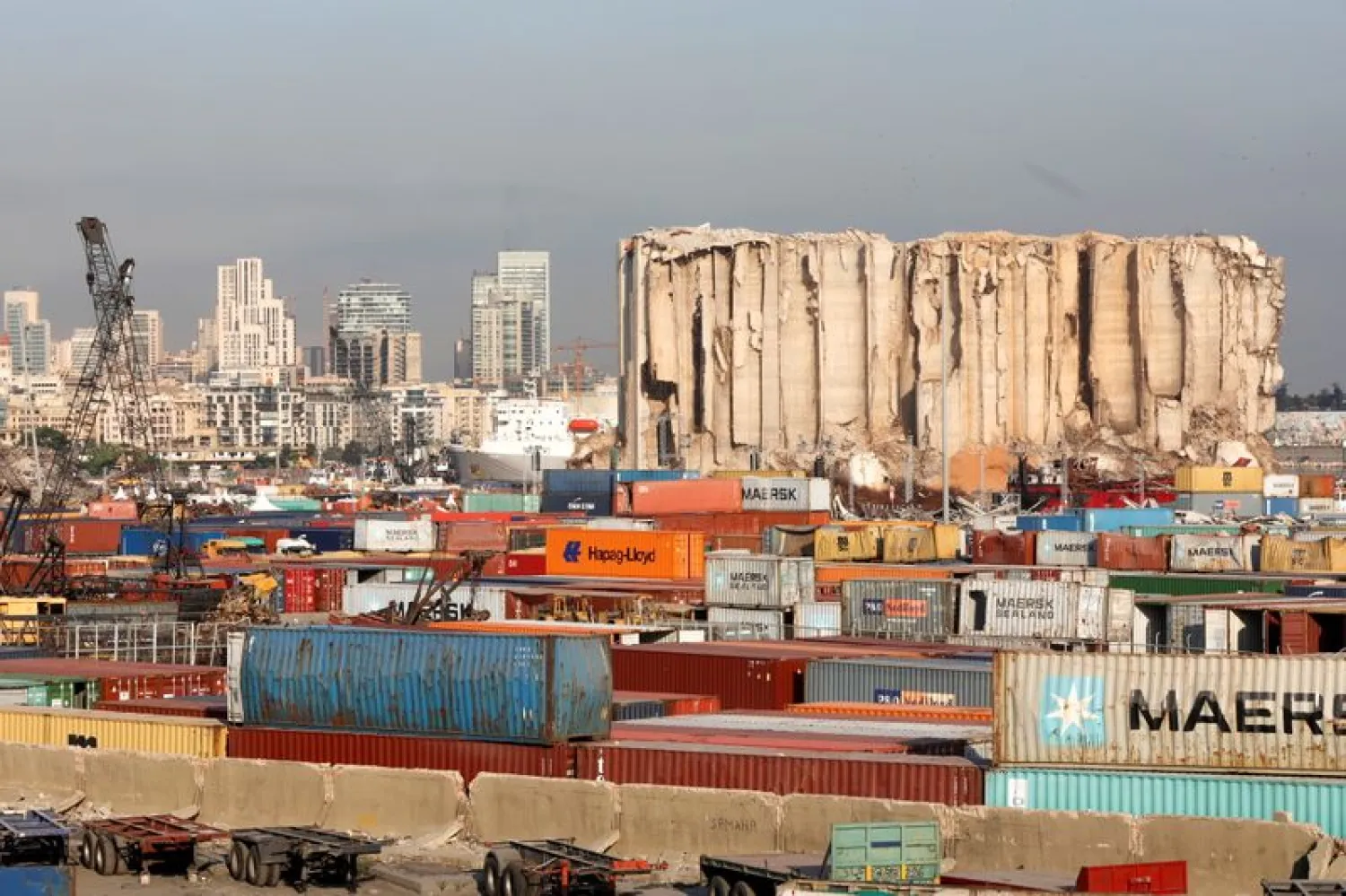
A view shows the grain silo that was damaged during last year's Beirut port blast, as Lebanon marks the one-year anniversary of Beirut port explosion, in Beirut, Lebanon August 4, 2021. (Reuters)
TT

Lebanese Demand Justice on Anniversary of Port Blast

A view shows the grain silo that was damaged during last year's Beirut port blast, as Lebanon marks the one-year anniversary of Beirut port explosion, in Beirut, Lebanon August 4, 2021. (Reuters)

Thousands of Lebanese gathered to mark the first anniversary of the catastrophic Beirut port blast on Wednesday, calling for justice as Maronite Patriarch Beshara al-Rai demanded to know why explosive chemicals had been stored in the capital.

As a memorial service got underway at the port, water cannon and tear gas were fired at protesters who threw stones towards security forces near parliament. Eight people were wounded, the Red Cross said.

One of the biggest non-nuclear explosions ever recorded, the blast killed more than 200 people, wounded thousands and was felt in Cyprus, more than 240 km (150 miles) away.

One year since the disaster, caused by a huge quantity of ammonium nitrate kept at the port for years, no senior official has been held to account, infuriating many Lebanese as their country suffers financial collapse.

An investigation is stalling, with requests denied for immunity to be lifted from senior politicians and former officials. All those sought for questioning by the Lebanese investigators have denied any wrongdoing.

“We will not forget and we will not forgive them ever. And if they can’t bring them to account, we will by our own hands,” said Hiyam al-Bikai, dressed in black and clutching a picture of her son, Ahmad, who was killed when masonry fell on his car.

The chemicals arrived on a Russian-leased cargo ship that made an unscheduled stop in Beirut in 2013. An FBI report seen by Reuters last week estimated around 552 tons of ammonium nitrate exploded, far less than the 2,754 tons that arrived.

“Justice isn’t just the demand of the families of the victims but of all Lebanese,” al-Rai said during the memorial service. All immunities should be lifted, he added.

“We want to know who brought in the explosives ..., who allowed for their unloading and storage, who removed quantities of it and where it was sent,” he said.

French President Emmanuel Macron said Lebanese leaders owed the people the truth and heaped new criticism on the governing elite for failing to deal with the economic crisis.

The damage is still visible across much of Beirut. The port resembles a bomb site, its huge grain silo still unrepaired.

A huge banner on a building overlooking the port said: “Hostages of a Murderous State.”

Relatives of the dead clutched photos of their loved ones.

Army helicopters flew overhead giving off red and green smoke - the national colors - as Quranic verses were recited at the start of the service and the victims’ names were read.

‘Historic and moral failure’
A Human Rights Watch report released this week concluded that evidence suggested some Lebanese officials knew about and tacitly accepted the lethal risks posed by ammonium nitrate.

Reuters reported last August that Prime Minister Hassan Diab and President Michel Aoun were both warned in July last year that the chemicals posed a security risk and could destroy the capital if they exploded.

Aoun has said he is ready to testify if needed, and that he supports an impartial investigation.

Diab, who quit after the blast, has said his conscience is clear.

Leading prayers at a hospital that was badly damaged in the blast, Greek Orthodox Archbishop Elias Audi said nobody was above the law, and “whoever obstructs justice is a criminal, even if they are highly placed”.

At the time of the explosion, Lebanese were already facing deepening hardship due to the financial crisis caused by decades of state corruption and waste.

The meltdown worsened throughout the last year with the governing elite failing to establish a new cabinet to start tackling the crisis even as poverty has soared and medicines and fuel have run out.

A donors’ conference hosted by France raised $370 million. France has led Western pressure on Lebanese leaders to enact reforms, but to no avail. “Lebanese leaders seem to bet on a stalling strategy, which I regret and I think is a historic and moral failure,” Macron said.

Pope Francis wished Macron success and said donors should help Lebanon “on a path of resurrection”. He said he had a great desire to visit Lebanon, where many had lost “even the illusion of living”.

The state has taken no steps towards reforms that might ease the economic crisis, with the sectarian elite locked in a power struggle over cabinet posts.

As the crowds built in Beirut, two people were injured in scuffles between supporters of rival parties in the nearby Gemmayzeh area, a security source said. Gun shots were fired into the air.



Egypt’s Prime Minister and FM Head to Washington for Trump Peace Council Meeting

Egyptian Foreign Minister Badr Abdelatty speaks during a joint press conference with Kenyan Prime Cabinet Secretary/Cabinet Secretary for Foreign Diaspora Affairs Musalia Mudavadi in Nairobi, Kenya, Monday, Feb. 16, 2026. (AP)
TT

Egypt’s Prime Minister and FM Head to Washington for Trump Peace Council Meeting

Egyptian Foreign Minister Badr Abdelatty speaks during a joint press conference with Kenyan Prime Cabinet Secretary/Cabinet Secretary for Foreign Diaspora Affairs Musalia Mudavadi in Nairobi, Kenya, Monday, Feb. 16, 2026. (AP)

Egypt's Prime Minister Mostafa Madbouly headed to Washington on Tuesday ‌to ‌participate in ‌the inaugural ⁠meeting of a "Board of Peace" established by US President Donald ⁠Trump, the ‌cabinet ‌said.

Madbouly is ‌attending ‌on behalf of President Abdel ‌Fattah al-Sisi and is accompanied by ⁠Foreign ⁠Minister Badr Abdelatty.

Foreign Minister Gideon Saar will represent Israel at the inaugural meeting, his office said on Tuesday.

Hamas, meanwhile, called on the newly-formed board to pressure Israel to halt what it described as ongoing violations of the ceasefire in Gaza.

The Board of Peace, of which Trump is the chairman, was initially designed to oversee the Gaza truce and the territory's reconstruction after the war between Hamas and Israel.

But its purpose has since morphed into resolving all sorts of international conflicts, triggering fears the US president wants to create a rival to the United Nations.

Saar will first attend a ministerial level UN Security Council meeting in New York on Wednesday, and on Thursday he "will represent Israel at the inaugural session of the board, chaired by Trump in Washington DC, where he will present Israel's position", his office said in a statement.

It was initially reported that Prime Minister Benjamin Netanyahu might attend the gathering, but his office said last week that he would not.

Ahead of the meeting, Hamas spokesman Hazem Qassem told AFP that the Palestinian movement urged the board's members "to take serious action to compel the Israeli occupation to stop its violations in Gaza".

"The war of genocide against the Strip is still ongoing -- through killing, displacement, siege, and starvation -- which have not stopped until this very moment," he added.

He also called for the board to work to support the newly formed Palestinian technocratic committee meant to oversee the day-to-day governance of post-war Gaza "so that relief and reconstruction efforts in Gaza can commence".

Announcing the creation of the board in January, Trump also unveiled plans to establish a "Gaza Executive Board" operating under the body.

The executive board would include Turkish Foreign Minister Hakan Fidan and Qatari diplomat Ali Al-Thawadi.

Netanyahu has strongly objected to their inclusion.

Since Trump launched his "Board of Peace" at the World Economic Forum in Davos in January, at least 19 countries have signed its founding charter.


Palestinian Child Dies After Stepping on Mine in West Bank

Israeli troops conduct a military raid in the village of Al-Yamoun, west of Jenin, West Bank, 17 February 2026. (EPA)
TT

Palestinian Child Dies After Stepping on Mine in West Bank

Israeli troops conduct a military raid in the village of Al-Yamoun, west of Jenin, West Bank, 17 February 2026. (EPA)

A Palestinian child died after stepping on a mine near an Israeli military camp in the occupied West Bank on Tuesday, the Palestinian Red Crescent said, with an Israeli defense ministry source confirming the death.

"Our crews received the body of a 13-year-old child who was killed after a mine exploded in one of the old camps in Jiftlik in the northern Jordan Valley," the Red Crescent said in a statement.

A source at COGAT, the Israeli defense ministry's agency in charge of civilian matters in the Palestinian territories, confirmed the death to AFP and identified the boy as Mohammed Abu Dalah, from the village of Jiftlik.

Israel's military had previously said in a statement that three Palestinians were injured "as a result of playing with unexploded ordnance", without specifying their ages.

It added that the area of the incident, Tirzah, is "a military camp in the area of the Jordan Valley", near Jiftlik and close to the Jordanian border.

"This area is a live-fire zone and entry into it is prohibited," the military said.

Jiftlik village council head Ahmad Ghawanmeh told AFP that three children, the oldest of whom was 16, were collecting herbs near the military base when they detonated a mine.

Jiftlik as well as the nearby Tirzah base are located in the Palestinian territory's Area C, which falls under direct Israeli control.

Israel has occupied the West Bank since 1967.

Much of the area near the border with Jordan -- which Israel signed a peace deal with in 1994 -- remains mined.

In January, Israel's defense ministry said it had begun demining the border area as part of construction works for a new barrier it says aims to stem weapons smuggling.


Hezbollah Rejects Disarmament Plan and Government’s Four-Month Timeline

29 July 2024, Iran, Tehran: Then Hezbollah deputy leader Sheikh Naim Qassem is pictured during a meeting in Tehran. (Iranian Presidency/dpa)
TT

Hezbollah Rejects Disarmament Plan and Government’s Four-Month Timeline

29 July 2024, Iran, Tehran: Then Hezbollah deputy leader Sheikh Naim Qassem is pictured during a meeting in Tehran. (Iranian Presidency/dpa)

Hezbollah rejected on Tuesday the Lebanese government's decision to grant the army at least four months to advance the second phase of a nationwide disarmament plan, saying it would not accept what it sees as a move serving Israel.

Lebanon's cabinet tasked the army in August 2025 with drawing up and beginning to implement a plan to bring all armed groups' weapons under state control, a bid aimed primarily at disarming Hezbollah after its devastating ‌war with ‌Israel in 2024.

In September 2025 the cabinet formally ‌welcomed ⁠the army's plan to ⁠disarm the Iran-backed Shiite party, although it did not set a clear timeframe and cautioned that the military's limited capabilities and ongoing Israeli strikes could hinder progress.

Hezbollah Secretary-General Sheikh Naim Qassem said in a speech on Monday that "what the Lebanese government is doing by focusing on disarmament is a major mistake because this issue serves the goals of Israeli ⁠aggression".

Lebanon's Information Minister Paul Morcos said during a press ‌conference late on Monday after ‌a cabinet meeting that the government had taken note of the army's monthly ‌report on its arms control plan that includes restricting weapons in ‌areas north of the Litani River up to the Awali River in Sidon, and granted it four months.

"The required time frame is four months, renewable depending on available capabilities, Israeli attacks and field obstacles,” he said.

Hezbollah lawmaker Hassan ‌Fadlallah said, "we cannot be lenient," signaling the group's rejection of the timeline and the broader approach to ⁠the issue of ⁠its weapons.

Hezbollah has rejected the disarmament effort as a misstep while Israel continues to target Lebanon, and Shiite ministers walked out of the cabinet session in protest.

Israel has said Hezbollah's disarmament is a security priority, arguing that the group's weapons outside Lebanese state control pose a direct threat to its security.

Israeli officials say any disarmament plan must be fully and effectively implemented, especially in areas close to the border, and that continued Hezbollah military activity constitutes a violation of relevant international resolutions.

Israel has also said it will continue what it describes as action to prevent the entrenchment or arming of hostile actors in Lebanon until cross-border threats are eliminated.