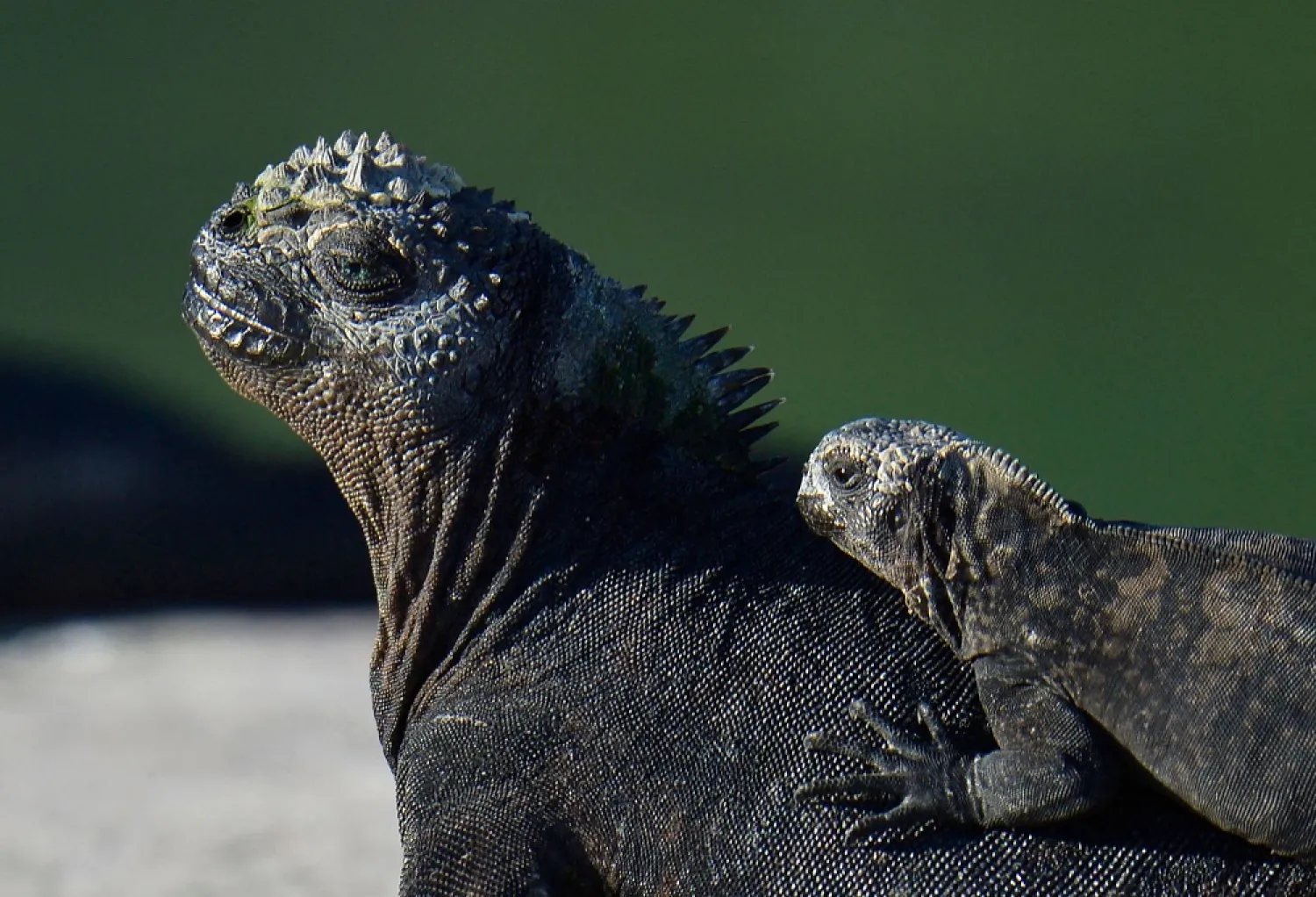
Scientists to Count Pink Iguanas in Galapagos Archipelago for First Time

Iguanas on the Galapagos islands. (AFP)
TT

Scientists to Count Pink Iguanas in Galapagos Archipelago for First Time

Iguanas on the Galapagos islands. (AFP)

The Galapagos National Park (PNG) announced that a scientific expedition plans to count pink iguanas, a species that live around the Wolf Volcano, in the Galapagos archipelago the first time.

Over 10 days, around 30 scientists and park rangers will wander in the park, where live the pink iguanas around the Wolf Volcano, in the Isabella Island (the biggest in the Galapagos), to count the rare reptiles, said PNG on its Facebook page.

Scientists mentioned these reptiles, which spread over 25 square meters only in the archipelago, one time in 2009. Former studies suggest that 350 pink iguanas live there.

"No births have been registered so far," Washington Tapia, director of the US NGO Galapagos Conservancy responsible of the expedition, told AFP.

This expedition aims at "understanding the real status of iguanas and setting plan to conserve them," said Tapia, noting that scientists are also looking for "hybrid tortoises that could contribute to the conservation efforts."

In 2020, a team of researchers found a giant female tortoise in the Wolf Volcano area. It belonged to the Chelonoidis abingdonii family that once lived in the Pinta Island. The famous male tortoise Lonesome George, which died in 2012 for refusing to mate with female tortoises from other species, belonged to this family.

Giant tortoises have settled in the Galapagos archipelago, located 1,000 km from the Ecuador Coast, before 3 to 4 million years ago. These reptiles were among the species that Charles Darwin focused on to enhance his theory of evolution.

The Galapagos archipelago, featured on the UNESCO World Heritage List, is a global reserve known for its unique fauna and flora.


EU Commission Proposes Under-13s Social Media Ban

European Commission President Ursula von der Leyen attends a press conference on the EU regulation on the protection of children online, at the European Parliament in Strasbourg, France, 17 September 2026. EPA/RONALD WITTEK
TT

EU Commission Proposes Under-13s Social Media Ban

European Commission President Ursula von der Leyen attends a press conference on the EU regulation on the protection of children online, at the European Parliament in Strasbourg, France, 17 September 2026. EPA/RONALD WITTEK

European Commission President Ursula von der Leyen on Thursday set out a sweeping plan to keep children safe from online dangers, proposing to ban under 13s from social media and require online services to design safe children's accounts.

The move follows similar initiatives in Australia, Britain, China, India, Turkey and several EU countries underscoring rising concerns about the impact Meta's Facebook and Instagram, TikTok, Google's YouTube and ChatGPT have on children's mental health ⁠and safety.

Australia's challenges ⁠in enforcing its world-first social media ban for children under 16 however could see Europe facing an uphill battle as well.

"Today, our children are engaging with some of the most sophisticated technology ever created, and it was not created with children's well-being ⁠and development in mind," von der Leyen told a press conference, according to Reuters.

She said the proposed EU Kids Act "will set clear boundaries in the digital world just as we do it on a daily basis in the real world".

Under the proposal, which will need to be negotiated with EU countries and the European Parliament in the coming months before it can become law, accounts for children between 13 and 15 will ⁠be ⁠under parental control.

Social media and video-sharing services, online video games, AI companions and chatbots for children below 18 will be subject to a list of dos and don'ts.

These include a ban on addictive features, profiling-based recommender feeds, infinite scroll, reward tricks and unsolicited contact from strangers. AI companions and chatbots must be turned off by default.

Online platforms must design algorithms safe for children and provide easy-to-use parental controls and tools to block and mute users.


Buckingham Palace Hits Back at Claims in Princess Diana Book

Britain's King Charles III attends The King's Foundation's Harmony in Food and Farming Summit, at the Foundation's headquarters at Dumfries House near Cumnock, Ayrshire, Scotland on September 16, 2026. (Photo by Jonathan Brady / POOL / AFP)
TT

Buckingham Palace Hits Back at Claims in Princess Diana Book

Britain's King Charles III attends The King's Foundation's Harmony in Food and Farming Summit, at the Foundation's headquarters at Dumfries House near Cumnock, Ayrshire, Scotland on September 16, 2026. (Photo by Jonathan Brady / POOL / AFP)

Buckingham Palace has hit back at claims by the late Princess Diana's brother that King Charles III acted insensitively following her death in a car crash almost 30 years ago.

The palace issued an unusually strong statement after Charles Spencer claimed in his new memoir that the then-prince, Diana's former husband, said "rest assured, we'll forget her soon enough" days after she died in 1997.

"While we do not comment on books as a matter of principle," a palace spokesperson said late Wednesday, according to AFP.

"His Majesty is mindful that the pain of fraternal grief can cloud reason, affect judgment and color memory in ways others do not recognize, even many years after such a loss."

"Swan Song: Diana, My Sister" is due to be published next week.

In the book, serialized in the Daily Mail, Spencer claims that Charles subjected him to a "stream of anger" after he insisted Diana would not have wanted her sons, princes William and Harry, then aged 15 and 12, to walk in her funeral procession.

"He unleashed down the phone what I have always taken to be his pent-up contempt for Diana, and his horror that the world was so bowled over by her death. 'Rest assured', he hissed, 'we'll forget her soon enough!'," Spencer writes.

Diana, who was extremely popular in the UK, died in Paris at the age of 36 after the car she was travelling in crashed as it tried to get away from paparazzi photographers.

Her death sparked an outpouring of grief in Britain and led to accusations that the monarchy failed to show the appropriate empathy.

UK media likened the language in the palace's statement to the late Queen Elizabeth II's response in 2021 to claims of racism in the royal family from Harry and his wife Meghan.

The queen said that "some recollections may vary".


Indonesia Cash-for-photos Scheme Turns Animal Hunters Into Protectors

This picture taken on September 2, 2026 shows wildlife observer and former poacher Octavius using a mobile phone equipped with a telephoto lens to take pictures of wildlife in a forest near Labian village in Kapuas Hulu, West Kalimantan. (Photo by BAY ISMOYO / AFP)
TT

Indonesia Cash-for-photos Scheme Turns Animal Hunters Into Protectors

This picture taken on September 2, 2026 shows wildlife observer and former poacher Octavius using a mobile phone equipped with a telephoto lens to take pictures of wildlife in a forest near Labian village in Kapuas Hulu, West Kalimantan. (Photo by BAY ISMOYO / AFP)

Indonesian villager Octavius wades through the forest in rubber boots and tattered joggers, ears pricked, eyes peeled, a telephoto lens on his phone primed to capture orangutans, monkeys or birds.

The daily photo hunt earns Octavius and hundreds of others in Borneo cash as part of a conservation program seeking to make animals worth more alive than dead.

Locals on the island have long made money from hunting wild songbirds and selling them, mainly to domestic customers.

The KehatiKu project aims to break that cycle by paying individuals in nine participating villages in West Kalimantan province for photos or recordings of animals instead.

Payments range from 5,000 rupiah (about $0.30) for observing a common bird, to 130,000 rupiah for an endangered orangutan -- the top prize.

The most successful observers earn up to 10 million rupiah a month -- equivalent to about $570, several times an average farmworker's income.

The extra cash "really helps, especially to pay for my children's college", said 50-year-old Octavius, who like many Indonesians uses a single name.

The program, run by environmental consultancy Borneo Futures, began two years ago and produces data on wildlife distribution and population changes.

Most participants are small-scale farmers of rice, cacao, durian and the stimulant kratom.
Early signs suggest the scheme is working.

"People have started to realize that where previously they caught one bird and it was worth 50,000 rupiah, now they just need to take a photo, send it to us, and they can receive a payment of 5,000 to 10,000 rupiah," Borneo Futures Indonesia director Nardiyono told AFP.

"If they take just five photos, they (may) earn 50,000 rupiah, and the bird is still in their environment, still observable, and still able to reproduce, so the potential income from observing birds is far greater than from hunting birds."

That shifting logic has prompted two participating villages to voluntarily introduce hunting bans since the project started, added Nardiyono.

The program is funded by philanthropic foundations and has received about $300,000 to date, according to Borneo Futures.

Half has gone towards development, including a mobile app for uploading animal sightings and an AI system that helps humans verify observations.

So far, users have submitted over 350,000 observations, about half of which have been validated and paid for.

Invalid entries might include multiple observations of the same animal, or a species that is not on the program's list.

In September, Octavius and dozens of others gathered at the tiny office in Labian village -- population 683 -- for their monthly payments.

His share was four million rupiah, or nearly $230.

"This is a side-job; it doesn't interfere" with farming, he told AFP as he showed off a patch where he grows kratom and cacao.

"Sometimes when we're working, when everyone is gathered to collect kratom leaves, we hear birds calling, so we go over, observe them -- if we can take a photo, we take a photo; if not, we just make a sound recording."

The program's model is "likely better for both environmental and social impacts than an unincentivized, top-down conservation project design," said researcher Paul Ferraro of the US-based Johns Hopkins University.

The main challenge will be maintaining funding, he added.

"People may revert to their prior behavioral patterns because the incentive payments are insufficient when the enthusiasm has waned," said Ferraro, an expert in human behavior and public policy.

For now, Borneo Futures has funding secured through 2028, and two more villages will join next month.

It pays for observations of 73 species, including birds, monkeys, wild cats and deer.

Antonia Uneng says she never has to venture too far from her home in Sungai Ajung, a village of fewer than 400 people, for observations.

She bought her first fridge with her earnings, as well as a karaoke machine, complete with flashing lights and two microphones, that occupies pride of place in her living room.

The project has given women in the village a sense of independence, said the 36-year-old part-time nursing assistant, whose husband works abroad.

"I have my own income... so I am not dependent on my husband."

Imelda, a farmer in Labian, goes into the forest daily with friends to record bird sounds and, if they are lucky, orangutans.

"It makes us healthier, walking in the forest," said the 72-year-old.

In the past, some in the community considered wild boar and deer pests for damaging their gardens and crops, she said.

But now, "we really, really want to protect them".