Yemen Crisis Stalls between Peace Consultations, Continuation of Fighting

A Houthi member in military uniform lies against a wall plastered with images of slain militants, Sanaa, Yemen. (EPA)
TT

Yemen Crisis Stalls between Peace Consultations, Continuation of Fighting

A Houthi member in military uniform lies against a wall plastered with images of slain militants, Sanaa, Yemen. (EPA)

UN Secretary-General Antonio Guterres on Friday named Swedish diplomat Hans Grundberg as his new Yemen envoy after a delay of several weeks as China considered whether to approve the appointment, which needed consensus Security Council agreement.

The 15-member council approved Grundberg this week as a replacement for Martin Griffiths, who became the UN aid chief last month after trying to mediate an end to the conflict in Yemen for the past three years.

Grundberg has been the European Union ambassador to Yemen since September 2019. UN officials informally floated his name to council members to solicit views by mid-July and 14 members said they would agree to the appointment, diplomats said.

With the appointment of a new envoy, observers have started to wonder whether peace initiatives would succeed in bringing an end to the conflict. The latest such initiative was proposed by Saudi Arabia and backed by the UN earlier this year.

All peace proposals have so far been met with the Iran-backed Houthi militias’ intransigence. The terrorist militias have opted to forge ahead with military operations in the hopes of making gains on the ground, however, all of their efforts have failed.

Head of the Gulf Research Center, Dr. Abdulaziz Sager said the options for tackling the conflict are either the continuation of the fighting or the issuing of new UN Security Council resolutions that would pressure the Houthis or for the militias to agree to join the legitimate government at the negotiations table.

The fourth option, Sager told Asharq Al-Awsat, lies in the Saudi-led Arab coalition withdrawing from Yemen and leaving it to the Yemenis to determine the fate of their country.

He acknowledged that such a choice would mean the intervention of several countries in Yemen and the consequent deterioration of the humanitarian situation and increased threats to maritime navigation.

China can play a positive role in Yemen due to its good ties with Iran and its recognition of the legitimate government, he remarked.

“China opposes support to any separatist groups and its mediation between Iran, the legitimate government and Arab coalition could yield positive results if it is allowed to go ahead,” he went on to say.

Saudi Foreign Minister Prince Faisal bin Farhan had earlier this week said the Houthis prefer to pursue the military option in Yemen because they want to achieve military superiority on the ground.

Saudi Arabia has been urging the need for them to agree to dialogue and to be part of Yemen’s future, he added.


Colombia Opens Embassy in Jerusalem, Restores Free Trade Deal with Israel

FILE - Colombian President Abelardo De La Espriella speaks during a bilateral agreements signing ceremony with US Secretary of State Marco Rubio in Barranquilla, Colombia, on Sept. 8, 2026. (AP Photo/Fernando Vergara, Pool, File)
TT

Colombia Opens Embassy in Jerusalem, Restores Free Trade Deal with Israel

FILE - Colombian President Abelardo De La Espriella speaks during a bilateral agreements signing ceremony with US Secretary of State Marco Rubio in Barranquilla, Colombia, on Sept. 8, 2026. (AP Photo/Fernando Vergara, Pool, File)

Colombia opened its embassy in Jerusalem on Wednesday, becoming the 10th country to do so, as new President Abelardo de la Espriella reversed his predecessor's break with Israel by also restoring a free trade agreement between the two countries.

Most countries maintain their embassies to Israel in Tel Aviv. Israel regards Jerusalem as its capital, while Palestinians seek East Jerusalem as the capital of a future independent state. The city's ⁠status remains one ⁠of the most contentious issues in the Israeli-Palestinian conflict.

Former Colombian President Gustavo Petro in May 2024 broke diplomatic relations with Israel over its actions in Gaza and had heavily criticized Prime Minister Benjamin Netanyahu.

Petro ⁠had closed Colombia's embassy in Tel Aviv and recalled its ambassador, a move Israel said was antisemitic and a reward for Hamas militants.

Right-winger de la Espriella became president in August.

On Tuesday, the free trade agreement that was terminated by Petro was reinstated.

Israel's Foreign Minister Gideon Saar said: "In just two months, we have reversed most of the ⁠negative ⁠consequences of the Petro administration for Israel-Colombia relations and have even broken new ground ... I thank ... Abelardo de la Espriella for his determination to bring Israel-Colombia relations to an all-time high.”

Colombian Minister of Foreign Affairs Omar Bula Escobar attended the opening of the embassy in Jerusalem.

Several countries have relocated their embassies to Jerusalem since the United States did so in 2018. Among them are Guatemala, Honduras, Paraguay and Somaliland.


Barrack, al-Zaidi Discuss Iraq’s Difficult Path to Stability

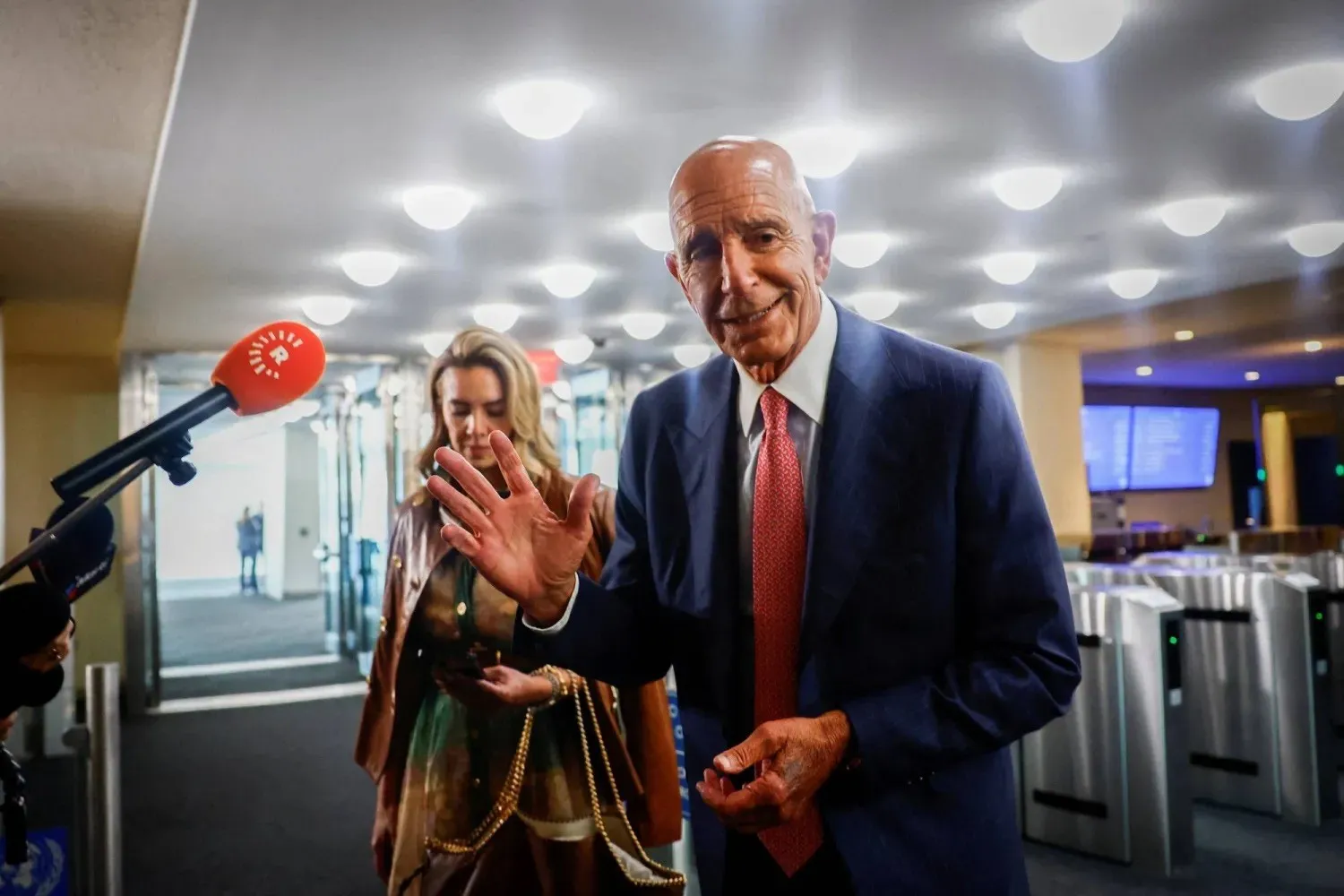
US envoy to Iraq Tom Barrack speaks to the media at United Nations headquarters in New York on September 24, 2026 (Reuters)
TT

Barrack, al-Zaidi Discuss Iraq’s Difficult Path to Stability

US envoy to Iraq Tom Barrack speaks to the media at United Nations headquarters in New York on September 24, 2026 (Reuters)

Iraqi sources have indicated that the issue of weapons held by armed factions was likely among the topics discussed in Baghdad between Iraq’s prime minister, head of the judiciary and US envoy Tom Barrack, who spoke of the “hard road toward” towards achieving stability in the region.

Prime Minister Ali al-Zaidi received Barrack on Monday evening, nearly two weeks after the withdrawal of the US-led international coalition forces from Iraqi territory.

According to observers, the withdrawal could prompt Washington and Baghdad to discuss post-pullout arrangements, particularly amid regional tensions and the possibility of renewed conflict between Washington and Tehran.

The Iraqi Prime Minister’s Office said the meeting between al-Zaidi and Barrack addressed “bilateral relations between Iraq and the United States and ways to strengthen cooperation in various fields.”

They also discussed “the latest developments in the region and efforts to support regional security and stability in a manner that serves the common interests of both countries and eases regional tensions and conflicts.”

The US envoy praised al-Zaidi’s leadership in a post on X.

"Stability is not inherited; it is built by leaders who choose the hard road. Iraq's security and prosperity are the region's. Grateful for his leadership and partnership,” Barrack said.

The envoy’s visit to Baghdad came amid a shift in relations between Baghdad and Washington following the end of the international coalition’s military mission in Iraq late September. The relationship is now expected to transition toward a political and economic partnership, alongside continued security cooperation between the two countries.

Barrack highlighted this shift during a meeting with US Embassy Chargé d’Affaires in Iraq Steve Fagin, saying that US-Iraqi relations are moving from a security-based partnership toward a broader relationship centered on economic cooperation and mutual interests.

Barrack had met Foreign Minister Fuad Hussein in Istanbul on Saturday, where they discussed “bilateral relations between Iraq and the US ... in light of the end of the international coalition forces’ mission in Iraq, as well as prospects for cooperation between the two countries in the coming period,” according to an Iraqi Foreign Ministry statement.

Barrack added that the meeting addressed developments in the region, ongoing conflicts and their implications for security and stability in Iraq and other countries in the region, as well as Iraq’s financial and economic situation and developments related to the Iraqi dinar’s exchange rate.

The US envoy also met in Baghdad with Supreme Judicial Council President Faik Zaidan. According to a statement by the council, the two sides “discussed ideas related to developing relations between the two countries in the legal and judicial fields.”

An official source close to the Coordination Framework alliance did not rule out the possibility that “the visit is an attempt to support al-Zaidi’s government, which is facing intense pressure at this stage, particularly following the decision to devalue the Iraqi dinar.”

Several lawmakers have recently raised the possibility of withdrawing confidence from al-Zaidi and bringing down his government in an attempt to absorb public anger following market turmoil and a sharp rise in the prices of goods and basic commodities after the dinar’s devaluation.

The source told Asharq Al-Awsat that he believed “Washington has come to realize that Iran and its allies in Iraq are seeking to challenge it by pressuring al-Zaidi with the threat of a no-confidence vote. Barrack’s presence may be intended to renew confidence in al-Zaidi’s government, whose leadership has previously been praised by senior US officials, including President Trump.”

The source also did not rule out the possibility that the US official would discuss the issue of weapons held by armed factions, given the importance Washington attaches to the matter.

Bringing all arms under state control is one of the key issues in Iraqi-US talks. During a meeting in Baghdad last June, al-Zaidi and Barrack stressed the importance of completing efforts to end the presence of armed formations operating outside state authority and strengthening Iraqi sovereignty.

Aqil Abbas, a researcher specializing in US affairs, highlighted the significance of Barrack’s meeting with Zaidan, saying that “the US-Iraqi understanding is based on the judiciary serving as the spearhead in efforts to dismantle armed factions, paving the way for the executive authorities to resolve this issue.”

Abbas told Asharq Al-Awsat that Iraqi authorities would likely resort to the judiciary after exhausting negotiations with armed factions and efforts to reach a consensual political solution. This, he said, confirmed that the US strategy remained focused on addressing armed factions through Iraqi institutions.

“The decisive factor in the weapons issue is the firmness of the government and judiciary, as well as the willingness shown by the Coordination Framework forces to deal with this issue,” Abbas said.

He cautioned, however, that “Iraq’s shifting sands may dash Tom Barrack’s hopes. Without a firm US position encompassing Iraq as a whole, we will not see the armed factions disarmed anytime soon.”



Lebanon Steps Up Probe into Seized Explosives, Smuggling Networks

Lebanese Prime Minister Nawaf Salam meets Army Commander Gen. Rodolphe Haykal (Prime Minister’s Office)
TT

Lebanon Steps Up Probe into Seized Explosives, Smuggling Networks

Lebanese Prime Minister Nawaf Salam meets Army Commander Gen. Rodolphe Haykal (Prime Minister’s Office)

Lebanese Prime Minister Nawaf Salam and Interior Minister Ahmad al-Hajjar have stressed the need to continue investigations into recently seized explosives to identify those behind the smuggling networks and bring them to justice, while strengthening security measures to prevent threats to the country’s stability.

Salam met on Tuesday Lebanese Army Commander Gen. Rodolphe Haykal to discuss the security situation, particularly in South Lebanon, the military’s ongoing deployment and its efforts to extend state authority across the country.

The meeting also addressed the recent seizure of explosives in two different areas – in Dahr al-Baidar and Qasr-Hermel.

Salam praised the military’s efforts and urged investigators to identify all those involved, including the parties behind the smuggling operations, and refer them to the relevant judicial authorities.

He reaffirmed his full support for the army, emphasizing the need to strengthen its capabilities to secure Lebanon’s borders, protect citizens and assert state authority throughout the country.

Separately, Hajjar provided details of an explosives shipment intercepted last week at the Dahr al-Baidar checkpoint. He said officers became suspicious of an overloaded gray Dodge Caravan and searched the vehicle, discovering explosive materials. The driver and his passenger were arrested and handed over to the Military Police, along with the seized materials, on the instructions of the relevant judicial authorities.

Hajjar praised the Internal Security Forces and the personnel stationed at Dahr al-Baidar, crediting their vigilance and professionalism for the discovery and arrests.

Chairing a meeting of the Central Internal Security Council, he said the officers’ alertness and operational readiness underscored the importance of proactive security measures in preventing threats.

Hajjar announced that Lebanese Army Intelligence and the Internal Security Forces’ Information Branch would expand the investigation at the request of the public prosecutor at the Court of Cassation.

The inquiry aims to establish the circumstances surrounding the shipment and ensure that anyone found responsible is held accountable under the law.

As a precaution, Hajjar instructed security agencies to tighten procedures at checkpoints and roadblocks, intensify inspections, increase patrols and reinforce their presence to strengthen internal security.