

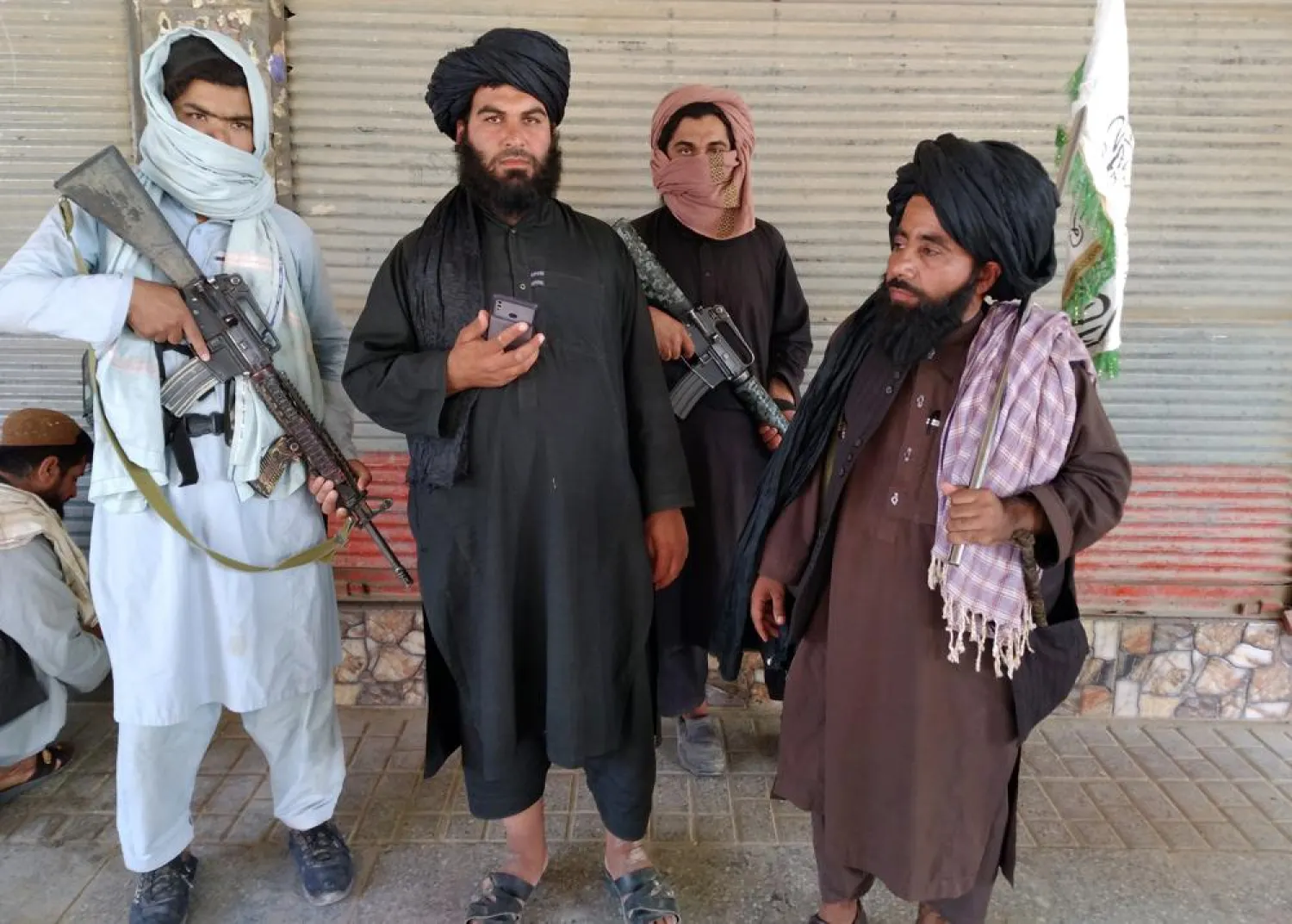

Taliban Take Afghanistan’s Third-Largest City in Onslaught

Taliban militants patrol inside the city of Farah, the capital of Farah province, southwest of Kabul, Afghanistan, Wednesday, Aug. 11, 2021. (AP Photo/Mohammad Asif Khan)
TT

Taliban Take Afghanistan’s Third-Largest City in Onslaught

Taliban militants patrol inside the city of Farah, the capital of Farah province, southwest of Kabul, Afghanistan, Wednesday, Aug. 11, 2021. (AP Photo/Mohammad Asif Khan)

The Taliban captured Afghanistan’s third-largest city and a strategic provincial capital near Kabul on Thursday, further squeezing the country’s embattled government just weeks before the end of the American military mission there.

The seizure of Herat marks the biggest prize yet for the Taliban, who have taken 11 of Afghanistan’s 34 provincial capitals as part of a weeklong blitz. Taliban fighters rushed past the Great Mosque in the historic city — which dates to 500 BC and was once a spoil of Alexander the Great — and seized government buildings. Witnesses described hearing sporadic gunfire at one government building while the rest of the city fell silent under the insurgents’ control.

The capture of Ghazni, meanwhile, cuts off a crucial highway linking the Afghan capital with the country’s southern provinces, which similarly find themselves under assault as part of an insurgent push some 20 years after US and NATO troops invaded and ousted the Taliban government.

While Kabul itself isn’t directly under threat yet, the losses and the battles elsewhere further tighten the grip of a resurgent Taliban, who are estimated to now hold over two-thirds of the nation and are continuing to pressure government forces in several other provincial capitals.

Thousands of people have fled their homes amid fears the Taliban will again impose a brutal, repressive government. Peace talks in Qatar remain stalled, though diplomats met throughout the day.

The latest US military intelligence assessment suggests Kabul could come under insurgent pressure within 30 days and that, if current trends hold, the Taliban could gain full control of the country within a few months. The Afghan government may eventually be forced to pull back to defend the capital and just a few other cities in the coming days if the Taliban keep up their momentum.

The onslaught represents a stunning collapse of Afghan forces and renews questions about where the over $830 billion spent by the US Defense Department on fighting, training those troops, and reconstruction efforts went — especially as Taliban fighters ride on American-made Humvees and pickup trucks with M-16s slung across their shoulders.

Afghan security forces and the government have not responded to repeated questions from journalists over the days of fighting, instead issuing video communiques that downplay the Taliban advance.

Herat had been under militant attack for two weeks, with one wave blunted by the arrival of warlord Ismail Khan and his forces. But on Thursday afternoon, Taliban fighters broke through the city’s defensive lines and later said they were in control.

Afghan lawmaker Semin Barekzai also acknowledged the city’s fall, saying that some officials there had escaped. Witnesses described seeing once-detained Taliban fighters at Herat’s prison now freely moving on the streets.

It wasn’t immediately clear what happened to Khan, who earlier had been described as under attack with his forces at a government building.

Earlier Thursday, the militants raised their white flags over the city of Ghazni, just 130 kilometers (80 miles) southwest of Kabul.

Fighters crowded onto one seized Humvee and drove down a main road, with the golden dome of a mosque near the governor’s office visible behind them. The insurgents, cradling their rifles, later gathered at one roundabout for an impromptu speech by a commander. One militant carried a rocket-propelled grenade launcher.

Ghazni provincial council member Amanullah Kamrani alleged that the provincial governor and police chief made a deal with the Taliban to flee after surrendering. Taliban video and photos purported to show the governor’s convoy freely passing by insurgents as part of the deal.

Afghan Interior Ministry spokesman Mirwais Stanekzai later said the governor and his deputies had been arrested over that alleged deal. The officials could not be immediately reached for comment.

Stanekzai also acknowledged in a video message that parts of Ghanzi had fallen, though he insisted government security forces “do exist” in the city.

The loss of Ghazni — which sits along the Kabul-Kandahar Highway — could complicate resupply and movement for government forces, as well as squeeze the capital from the south.

Already, the Taliban’s weeklong blitz has seen the militants seize nine other provincial capitals around the country. Many are in the country’s northeast corner, pressuring Kabul from that direction as well.

In southern Afghanistan, the Taliban’s heartland, heavy fighting continued in Lashkar Gah, where surrounded government forces hoped to hold onto the capital of Helmand province.

On Wednesday, a suicide car bombing marked the latest wave of violence to target the capital’s regional police headquarters. By Thursday, the Taliban had taken the building, with some police officers surrendering to the militants and others retreating to the nearby governor’s office that’s still held by government forces, said Nasima Niazi, a lawmaker from Helmand.

In neighboring Kandahar, the Taliban attacked a prison in the capital city and freed inmates inside Wednesday night, officials said. On Thursday, Kandahar provincial governor spokesman Bahir Ahmadi acknowledged that the Taliban had entered the capital, also called Kandahar, but said Afghan forces were fighting to push them back.

Niazi criticized ongoing airstrikes targeting the area, saying civilians likely had been wounded and killed.

“The Taliban used civilian houses to protect themselves, and the government, without paying any attention to civilians, carried out airstrikes,” she said.

With the Afghan air power limited and in disarray, the US Air Force is believed to be carrying out strikes. Aviation tracking data suggested US Air Force B-52 bombers, F-15 fighter jets, drones and other aircraft were involved in the fighting across the country, according to Australia-based security firm The Cavell Group.

US Air Force Maj. Nicole Ferrara, a Central Command spokeswoman, acknowledged that American forces “have conducted several airstrikes in defense of our Afghan partners in recent days.” However, she declined to offer any details on the attacks or to discuss the Afghan complaints of civilian casualties.

Even as diplomats met in Doha, Qatar on Thursday, the success of the Taliban offensive called into question whether they would ever rejoin long-stalled peace talks aimed at moving Afghanistan toward an administration that includes members of the current Afghan government and the Taliban. Instead, the group could come to power by force — or the country could splinter into factional fighting like it did after the Soviet withdrawal in 1989.

The government’s High Council for National Reconciliation called for peace talks to resume, saying it had submitted a plan to Qatar, without elaborating.



Trump to Attend Ceremony to Witness Return of US Personnel Killed in Syria

US President Donald Trump speaks to the media - Reuters
TT

Trump to Attend Ceremony to Witness Return of US Personnel Killed in Syria

US President Donald Trump speaks to the media - Reuters

US President Donald Trump and first lady Melania Trump will attend a ceremony on Wednesday to honor US personnel killed in Syria over the weekend by a suspected ISIS attacker.

Trump and his wife will travel to Dover Air Force Base in Delaware to be present for what the Air Force calls the "dignified transfer" of the bodies from overseas back into the United States in the presence of their families. The ceremony is scheduled to take place at 1:15 p.m. EST (1815 GMT), Reuters reported.

Two US Army soldiers and a civilian interpreter were killed on Saturday in the central Syrian town of Palmyra by an attacker who targeted a convoy of American and Syrian forces before being shot dead, according to the U.S. military.

Trump called the incident terrible, vowed retaliation and referred to the three that were slain as "great patriots."

Three US soldiers were also wounded in the attack.

US presidents, vice presidents and dignitaries regularly attend the solemn transfer ceremonies at Dover during times of war or conflict that result in the deaths of US troops. Flag-draped transfer cases are brought off of a military plane with the bodies of the fallen and put with precision in an awaiting vehicle as officials and family members watch and often weep.


Putin Says Russia will Achieve War Goals, Keep Expanding 'Buffer Zone'

Russian President Vladimir Putin attends a meeting with Kazbek Kokov, head of the North Caucasus region of Kabardino-Balkaria, in Moscow, Russia December 16, 2025. Sputnik/Mikhail Metzel/Pool via REUTERS
TT

Putin Says Russia will Achieve War Goals, Keep Expanding 'Buffer Zone'

Russian President Vladimir Putin attends a meeting with Kazbek Kokov, head of the North Caucasus region of Kabardino-Balkaria, in Moscow, Russia December 16, 2025. Sputnik/Mikhail Metzel/Pool via REUTERS

President Vladimir Putin said on Wednesday that Russia would achieve its goals in Ukraine by diplomatic or military means, and would seek to expand a "security buffer zone" there.

"First, the goals of the special military operation will undoubtedly be achieved. We would prefer to do this and address the root causes of the conflict through diplomacy," Putin said.

"If the opposing side and their foreign patrons refuse to engage in substantive discussions, Russia will achieve the liberation of its historical lands by military means. The task of creating and expanding a security buffer zone will also be consistently addressed."

Of the regions of Ukraine that Russia has claimed as its own territory, it currently controls Crimea, around 90% of the Donbas region and 75% of Kherson and Zaporizhzhia, Reuters reported.

In addition, Russia holds some territory in the adjoining regions of Kharkiv, Sumy, Dnipropetrovsk and Mykolaiv. Putin's comments signalled that Moscow would seek further gains on some of these fronts.

With the war at a key juncture as US President Donald Trump pushes hard for a quick peace agreement, Putin said Russia was advancing on all fronts.

But his defense minister, Andrei Belousov, acknowledged that Ukrainian forces were trying to take back control of the northeastern town of Kupiansk - an effort he said was not succeeding.

Ukraine said on Wednesday it had taken 90% of the town, which Russia said it had captured in November.

Putin said people in Europe were being indoctrinated with fears of a war with Russia, and accused their leaders of whipping up hysteria.

"I have repeatedly stated: this is a lie, nonsense, pure nonsense about some imaginary Russian threat to European countries. But this is being done quite deliberately," he said.

Putin has said Russia is not seeking war with Europe, but is ready for war if that is Europe's choice.


Pakistan Says ‘Hostile Countries’ behind False Online Claims Linking it to Australia Shootings

A man waves Pakistan's flag as he along with others gather in support of Pakistan Army, day after the ceasefire announcement between India and Pakistan, in Islamabad, Pakistan, May 11, 2025. REUTERS/Akhtar Soomro
TT

Pakistan Says ‘Hostile Countries’ behind False Online Claims Linking it to Australia Shootings

A man waves Pakistan's flag as he along with others gather in support of Pakistan Army, day after the ceasefire announcement between India and Pakistan, in Islamabad, Pakistan, May 11, 2025. REUTERS/Akhtar Soomro

Pakistan’s information minister said Wednesday that his country has been the victim of a coordinated online disinformation campaign following the mass shooting at Australia’s Bondi Beach.

Attaullah Tarar accused “hostile countries,” including India, of spreading false claims that one of the two attackers was a Pakistani national.

Speaking at a news conference in Islamabad, Tara said Pakistan's leadership strongly condemned Sunday's attack, which killed 15 people in an antisemitic shooting targeting Jews celebrating Hanukkah, The AP news reported.

The minister said misleading information began circulating almost immediately after the attack, with social media posts falsely identifying one of the suspects as a Pakistani national named Naveed Akram. He said the claims spread rapidly across digital platforms and were repeated by some media outlets without verification.

Tarar said subsequent findings, including confirmation by Indian police, established that one of the attackers, Sajid Akram, was from India, while his 24-year-old son, Naveed Akram — who was also involved — was born in Australia.

The minister said the misinformation appeared to stem from a case of mistaken identity, as a Pakistani man living in Sydney shares the same name as one of the two suspects.

“How do we restore the situation to where it was before the Bondi Beach attack?” Tarar asked, adding that the Pakistani man — also named Naveed Akram — had released a video denying any involvement and urging the public not to associate him with the attack.

Tara said the Pakistani man was “a victim of a malicious and organized campaign” and that the disinformation effort originated in India.

There was no immediate response from Indian officials.

Tarar called on media outlets that published the false reports to issue apologies and said Pakistan had not yet decided whether to pursue legal action.

Pakistan and India, nuclear-armed rivals, have a long history of strained relations and have fought three wars since gaining independence from British rule in 1947, most of them over the disputed Himalayan region of Kashmir. The two sides came close to war in May before US President Donald Trump brokered a ceasefire.