

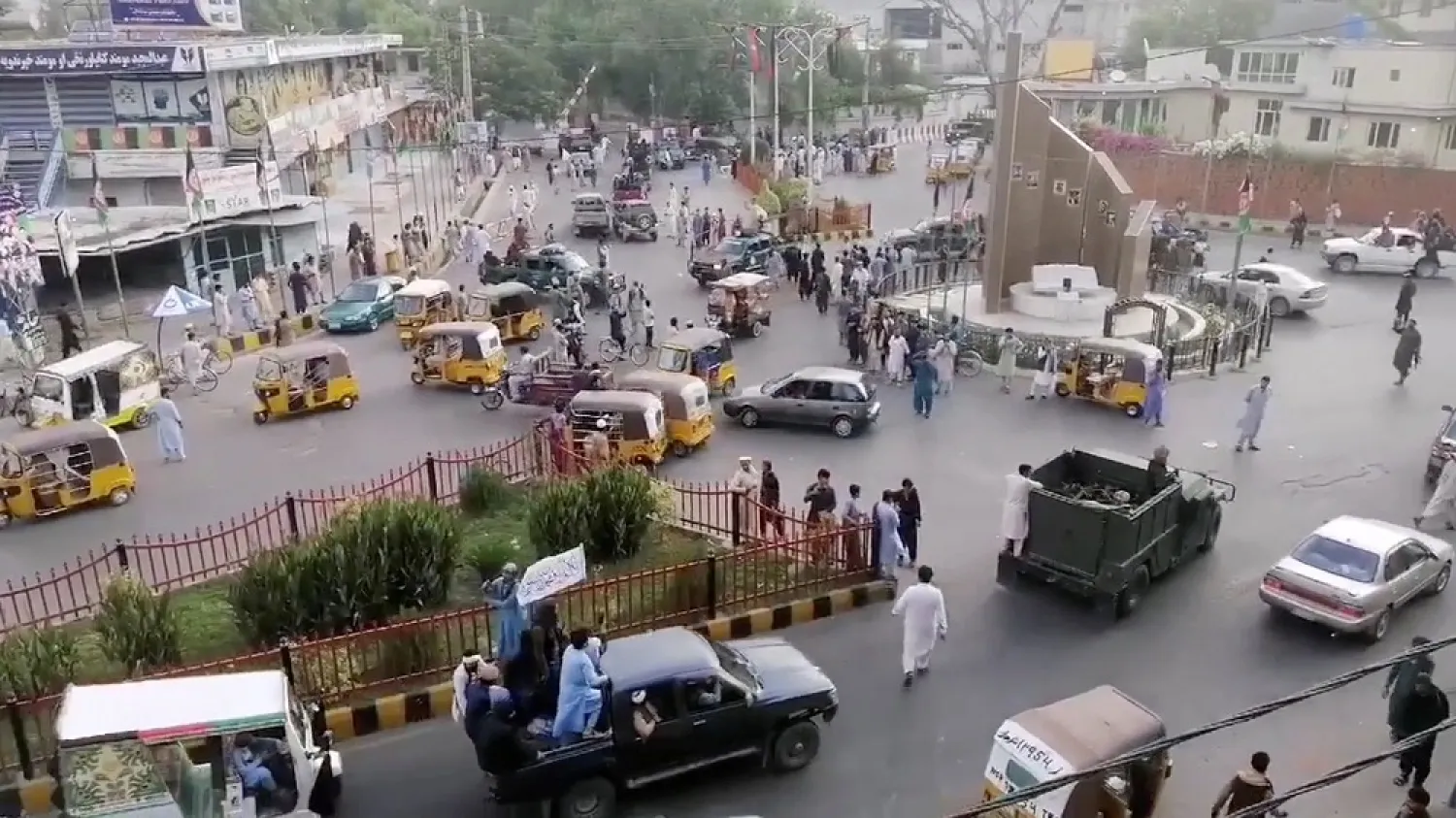

Taliban Declares ‘War Is Over’ as President and Diplomats Flee Kabul

The Taliban declared the war in Afghanistan was over after insurgents took control of the presidential palace in Kabul. (Reuters)
TT

Taliban Declares ‘War Is Over’ as President and Diplomats Flee Kabul

The Taliban declared the war in Afghanistan was over after insurgents took control of the presidential palace in Kabul. (Reuters)

The Taliban declared the war in Afghanistan was over after insurgents took control of the presidential palace in Kabul as US-led forces departed and Western nations scrambled on Monday to evacuate their citizens.

President Ashraf Ghani fled the country on Sunday as the militants entered the capital virtually unopposed, saying he wanted to avoid bloodshed, while hundreds of Afghans desperate to leave flooded Kabul airport.

“Today is a great day for the Afghan people and the mujahideen. They have witnessed the fruits of their efforts and their sacrifices for 20 years,” Mohammad Naeem, the spokesman for the Taliban’s political office, told Al Jazeera TV.

“Thanks to God, the war is over in the country.”

It took the Taliban just over a week to seize control of the country after a lightning sweep that ended in Kabul as Afghan forces, trained for years and equipped by the United States and others at a cost of billions of dollars, melted away.

Al Jazeera broadcast footage of what it said were Taliban commanders in the presidential palace with dozens of armed fighters.

Naeem said the form of the new regime in Afghanistan would be made clear soon, adding the Taliban did not want to live in isolation and calling for peaceful international relations.

“We have reached what we were seeking, which is the freedom of our country and the independence of our people,” he said.

“We will not allow anyone to use our lands to target anyone, and we do not want to harm others.”

A Taliban leader told Reuters the insurgents were regrouping from different provinces, and would wait until foreign forces had left the country before creating a new governance structure.

The leader, who requested anonymity, said Taliban fighters had been “ordered to allow Afghans to resume daily activities and do nothing to scare civilians.”

“Normal life will continue in a much better way, that’s all I can say for now,” he told Reuters via Whatsapp.

A US State Department spokesperson said early on Monday that all embassy personnel, including Ambassador Ross Wilson, had been transferred to Kabul airport to await evacuation and the American flag had been lowered and removed from the embassy compound.

Hundreds of Afghans invaded the airport’s runways in the dark, pulling luggage and jostling for a place on one of the last commercial flights to leave the country before US forces took over air traffic control on Sunday.

“How can they hold the airport and dictate terms and conditions to Afghans?” said Rakhshanda Jilali, a human rights activist who was trying to get to Pakistan.

“This is our airport but we are seeing diplomats being evacuated while we wait in complete uncertainty,” Jilali, who said she had received multiple death threats, told Reuters via Whatsapp from the airport.

More than 60 western countries, including the United States, Britain, France and Japan, issued a joint statement saying all Afghans and international citizens who wanted to leave the country must be allowed to depart.

“The Afghan people deserve to live in safety, security and dignity,” the statement said. “We in the international community stand ready to assist them.”

Aid group Emergency said 80 wounded people had been brought to its hospital in Kabul, which was at capacity, and that it was only admitting people with life-threatening injuries.

In a Facebook post, Ghani said he had left the country to avoid clashes with the Taliban that would endanger millions of residents of Kabul.

Some social media users in Kabul branded Ghani, who did not disclose his location, a coward for leaving them in chaos. A tweet from the verified account of the Afghan Embassy in India said: “We are all hanging our heads in shame.”

Repression
In Washington, opponents of President Joe Biden’s decision to end America’s longest war, launched after the Sept. 11, 2001, attacks, said the chaos was caused by a failure of leadership.

Many Afghans fear the Taliban will return to past repressive rule. During their 1996-2001 rule, women could not work and punishments such as stoning, whipping and hanging were administered.

The militants sought to project a more moderate face, promising to respect women’s rights and protect both foreigners and Afghans.

“We are ready to have a dialogue with all Afghan figures and will guarantee them the necessary protection,” Naeem told Al Jazeera Mubasher TV.

United Nations Secretary-General Antonio Guterres urged the Taliban and all other parties to exercise the utmost restraint, and expressed particular concern about the future of women and girls in Afghanistan.

The Pentagon on Sunday authorized another 1,000 troops to help evacuate US citizens and Afghans who worked for them, expanding its security presence on the ground to almost 6,000 troops within the next 48 hours.

European nations, including France, Germany and the Netherlands, also said they were working to get citizens as well as some Afghan employees out of the country.

Russia said it saw no need to evacuate its embassy for the time being. Turkey said its embassy would continue operations.

American exit
Asked if images of helicopters ferrying personnel were evocative of the United States’ departure from Vietnam in 1975, US Secretary of State Antony Blinken told ABC News: “Let’s take a step back. This is manifestly not Saigon.”

Biden has faced rising domestic criticism after sticking to a plan, initiated by his Republican predecessor, Donald Trump, to end the US military mission in Afghanistan by Aug. 31.

Senate Republican leader Mitch McConnell blamed Biden for what he called a “shameful failure of American leadership”.

“Terrorists and major competitors like China are watching the embarrassment of a superpower laid low,” McConnell said.

Naeem said the Taliban would adopt an international policy of two-way non-interference.

“We do not think that foreign forces will repeat their failed experience in Afghanistan once again.”



Ukraine Can Play Useful Role in Strait of Hormuz, Britain Says

FILE PHOTO: A map showing the Strait of Hormuz is seen in this illustration taken June 22, 2025. REUTERS/Dado Ruvic/Illustration/File Photo
TT

Ukraine Can Play Useful Role in Strait of Hormuz, Britain Says

FILE PHOTO: A map showing the Strait of Hormuz is seen in this illustration taken June 22, 2025. REUTERS/Dado Ruvic/Illustration/File Photo

Ukraine can play a useful role in international efforts to secure the Strait of Hormuz, Britain's armed services minister said, praising its drone technology as among the best in the world.

Britain has organized discussions this month among more than 30 nations on how to reopen the strait, amid an Iranian blockade that has choked oil supplies to the global economy following US and Israeli strikes on Iran, Reuters reported.

President Volodymyr Zelenskiy said this week Kyiv had participated in consultations on safeguarding navigation, drawing on expertise from four years of war with ‌Russia. Ukraine has already ‌deployed more than 200 experts to the Middle East, where ‌they ⁠have downed Iran's ⁠long-range Shahed drones.

"Ukraine has some of the best technology in the world that it's developed here in the war. I think that could provide utility in the Middle East, as we're seeing already against Shahed drones, all the way through to the Strait of Hormuz," Al Carns said during a visit to Kyiv on Friday.

Carns, who served as a colonel in Britain's armed forces before being elected to parliament two years ⁠ago, said his visit was intended to reassure Kyiv that the ‌war in Ukraine remained Britain's top defense and ‌security priority.

He played down tensions within the NATO military alliance following US President Donald Trump's ‌criticism of European allies for not joining the Iran war, saying NATO was ‌still the "backbone of our security".

'REVOLUTION IN MILITARY AFFAIRS'

While Britain is providing funding, training and military capability to Ukraine, Carns said there was also much the UK could learn from Kyiv's battlefield innovations, particularly in drone technology, the use of data and AI.

"It's a revolution in military ‌affairs, and we need to move faster," Carns said.

Incorporating advances in warfare into Britain's 10-year defense investment plan - due late ⁠last year - is ⁠taking time but the report will be ready this spring, Carns said.

Carns urged Ukraine to accelerate exports of its cutting-edge technology to capture a corner of the global market before other nations catch up, and to facilitate learning and development with NATO allies.

Ukraine issued its first export licenses in February. Kyiv hopes to raise funds to expand its defense industry while using its weapons as diplomatic leverage with allies.

However, some industry executives have complained Kyiv is dragging its heels in approving licenses and risks missing the opportunity presented by the Iran war.

"Ukraine needs to speed up its capacity to export," Carns said. "I still believe the best systems sit in Ukraine, but the rest of the world is catching up."

Britain is home to a plant making Ukrainian interceptor drones that started production in February. Another UK-headquartered Ukrainian military tech company, UForce, produces the Magura sea drone.


North Korean Leader Kim Backs China’s Push for ‘Multi-polar World’ in Talks with FM

This picture taken on April 10, 2026 and released by North Korea's official Korean Central News Agency (KCNA) on April 11, 2026, shows Chinese Foreign Minister Wang Yi (L) shaking hands with North Korean leader Kim Jong Un at the headquarters of the Workers' Party of Korea in Pyongyang.  (KCNA / KCNA via KNS / AFP)
This picture taken on April 10, 2026 and released by North Korea's official Korean Central News Agency (KCNA) on April 11, 2026, shows Chinese Foreign Minister Wang Yi (L) shaking hands with North Korean leader Kim Jong Un at the headquarters of the Workers' Party of Korea in Pyongyang. (KCNA / KCNA via KNS / AFP)
TT

North Korean Leader Kim Backs China’s Push for ‘Multi-polar World’ in Talks with FM

This picture taken on April 10, 2026 and released by North Korea's official Korean Central News Agency (KCNA) on April 11, 2026, shows Chinese Foreign Minister Wang Yi (L) shaking hands with North Korean leader Kim Jong Un at the headquarters of the Workers' Party of Korea in Pyongyang.  (KCNA / KCNA via KNS / AFP)
This picture taken on April 10, 2026 and released by North Korea's official Korean Central News Agency (KCNA) on April 11, 2026, shows Chinese Foreign Minister Wang Yi (L) shaking hands with North Korean leader Kim Jong Un at the headquarters of the Workers' Party of Korea in Pyongyang. (KCNA / KCNA via KNS / AFP)

North Korean leader Kim Jong Un voiced support for China’s push to build a “multi-polar world” and called for deeper ties between the traditional allies during a meeting with Chinese Foreign Minister Wang Yi, state media said Saturday.

During the meeting Friday, Kim said his government will fully support Chinese efforts to achieve territorial integrity based on its “one-China principle,” a reference to Beijing’s official position that Taiwan is an inalienable part of China’s territory, according to North Korea’s official Korean Central News Agency.

Kim also outlined North Korea’s position on unspecified regional and international issues of “mutual concern” and said sustained development of ties between the two countries has become more crucial in the current geopolitical environment, KCNA said.

Wang, on a two-day trip to North Korea, said the countries’ relations were entering a “new phase” following a summit last year between Kim and Chinese President Xi Jinping.

Embracing the ideas of a “new Cold War” and a “multi-polarized world,” Kim has sought to break out of international isolation and push a more assertive foreign policy by expanding ties with governments locked in confrontations with the United States.

While Russia has been Kim’s top foreign policy priority in recent years, sending thousands of troops and large weapons shipments to support its war against Ukraine, he has also been cozying up to China, the North’s traditional main ally and economic lifeline.

Kim joined Russian President Vladimir Putin at a World War II ceremony in Beijing in September and held his first summit with Xi Jinping in six years, moves that supported his efforts to portray North Korea as part of a united front against Washington.

North Korea and China last month resumed direct flight and passenger train services, which had been suspended since the beginning of the COVID-19 pandemic in 2020.

Wang arrived in Pyongyang on Thursday in his first visit to North Korea in seven years. He earlier met with North Korean Foreign Minister Choe Sun Hui and discussed ways to facilitate further cooperation and exchanges and holding “in-depth” talks on international issues, state media from both countries said.

The state media outlets did not mention whether Wang and North Korean officials discussed issues related to the US or the ongoing war in the Middle East.

Wang’s trip to North Korea came before US President Donald Trump travels to Beijing for a rescheduled summit with Xi Jinping in May. Some South Korean officials have expressed hope the Trump-Xi meeting could provide a diplomatic opening with Pyongyang.

Kim has suspended all meaningful dialogue with the US and South Korea since the collapse of his diplomacy with Trump in 2019 during the American president’s first term. Kim has since taken a hard-line stance toward South Korea, which he now defines as his “most hostile” adversary, and rejected US offers to resume talks, calling on Washington to drop its demand for North Korea’s denuclearization as a precondition.


Taiwan Spotted Chinese Warplanes as Xi Met Opposition Leader in Beijing

 A man uses his smartphone as a giant screen broadcasts news showing Chinese President Xi Jinping shaking hands with Cheng Li-wun, chairperson of the Kuomintang (KMT), Taiwan's largest opposition party at the Great Hall of the People in Beijing, China, April 10, 2026. (Reuters)
A man uses his smartphone as a giant screen broadcasts news showing Chinese President Xi Jinping shaking hands with Cheng Li-wun, chairperson of the Kuomintang (KMT), Taiwan's largest opposition party at the Great Hall of the People in Beijing, China, April 10, 2026. (Reuters)
TT

Taiwan Spotted Chinese Warplanes as Xi Met Opposition Leader in Beijing

 A man uses his smartphone as a giant screen broadcasts news showing Chinese President Xi Jinping shaking hands with Cheng Li-wun, chairperson of the Kuomintang (KMT), Taiwan's largest opposition party at the Great Hall of the People in Beijing, China, April 10, 2026. (Reuters)
A man uses his smartphone as a giant screen broadcasts news showing Chinese President Xi Jinping shaking hands with Cheng Li-wun, chairperson of the Kuomintang (KMT), Taiwan's largest opposition party at the Great Hall of the People in Beijing, China, April 10, 2026. (Reuters)

Taiwan's defense ministry said on ‌Saturday that it spotted 16 Chinese warplanes operating near the island the previous day, around the same time China's president was meeting the Taiwanese opposition leader.

Late on Friday morning, Chinese President Xi Jinping met Cheng Li-wun, chairwoman of Taiwan's largest opposition party the Kuomintang (KMT) in Beijing, where Xi said he "absolutely would not tolerate" independence for Taiwan, which China views as its own territory.

Cheng has portrayed her visit as a reconciliation mission to lessen tensions, and told Xi ‌she looked forward ‌to the KMT and Communist Party advancing ‌the "institutionalization" ⁠of peace across the ⁠Taiwan Strait.

Taiwan's defense ministry, in its daily report on Chinese military activity in the previous 24 hours, said that 16 Chinese warplanes flew near the island from mid-morning to mid-afternoon on Friday. Xi and Cheng met at 11 am (0300GMT).

Shen Yu-chung, a deputy minister at Taiwan's China-policy-making Mainland Affairs ⁠Council, told reporters in Taipei on Saturday that ‌using military coercion against Taiwan as ‌a means of applying pressure for political negotiations has always ‌been China's "go-to tactic".

"So on one hand we see them ‌sending out messages of peace, while on the other hand they continue to use military force to pressure Taiwan without letup," he added.

China's Taiwan Affairs Office did not respond to a ‌request for comment.

In Beijing, KMT Vice Chairman Chang Jung-kung said that the key to promoting peace ⁠lies ⁠in offering Taiwan's people a choice between peace and reconciliation, or war.

Engaging with China and promoting cross-strait peace yields "peace with dignity," not the bowing of one's head to "shake hands" like Taiwan President Lai Ching-te has said, Chang added, according to a KMT statement.

Lai's office said on Friday night that what the Xi-Cheng meeting sought to highlight was that "Taiwan is part of the People's Republic of China" and to advance "the annexation of Taiwan".

"Taiwan's future can only be decided by the Taiwanese people themselves," Lai's spokesperson Karen Kuo said in a statement.