


Merkel, Putin Spar over Navalny but Vow to Maintain Dialogue

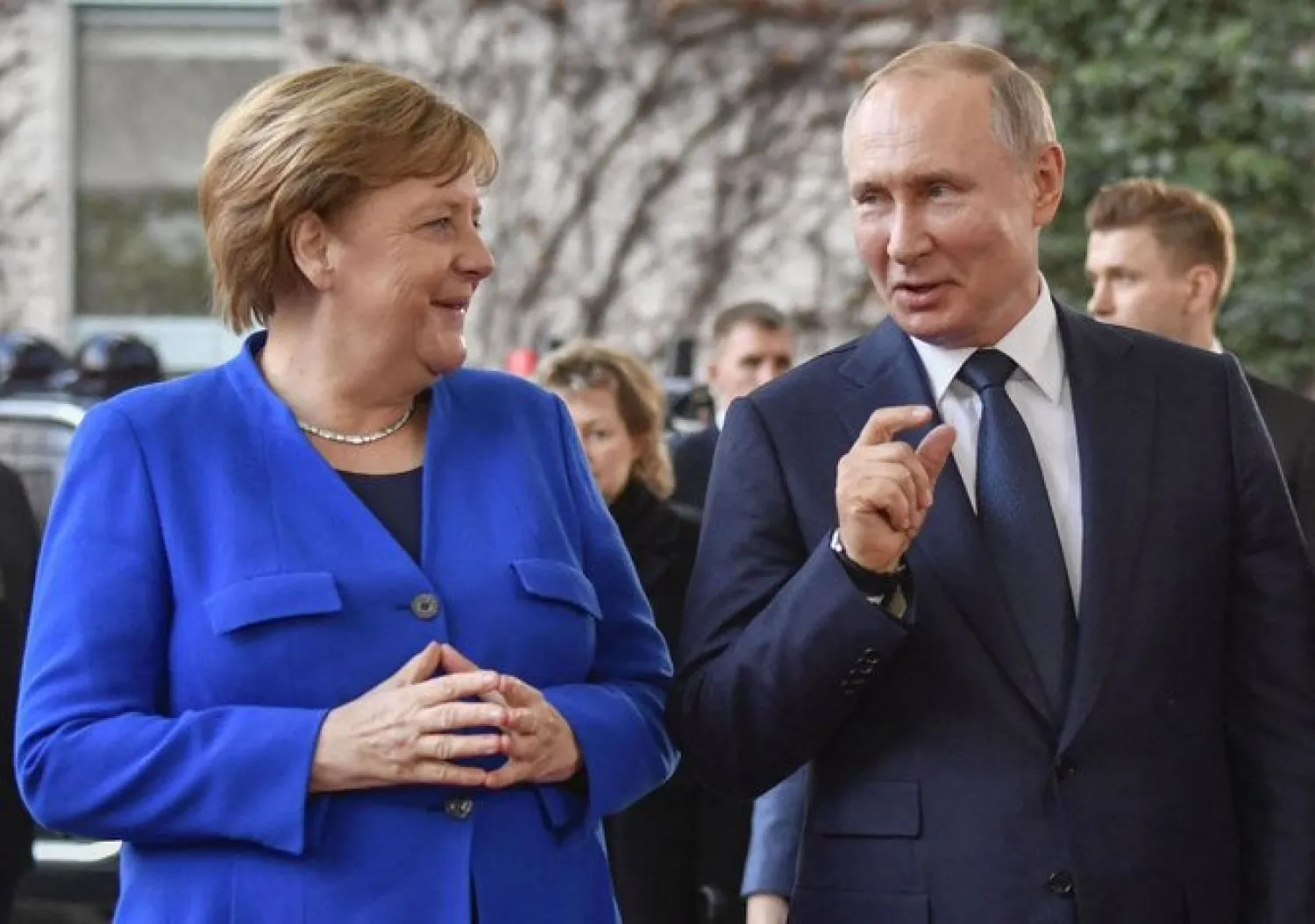
Chancellor Angela Merkel greets Russian President Vladimir Putin upon arrival to the Peace summit on Libya at the Chancellery in Berlin. (File/AFP)
TT

Merkel, Putin Spar over Navalny but Vow to Maintain Dialogue

Chancellor Angela Merkel greets Russian President Vladimir Putin upon arrival to the Peace summit on Libya at the Chancellery in Berlin. (File/AFP)

German Chancellor Angela Merkel and Russian President Vladimir Putin reaffirmed their sharply different views of Russia’s treatment of imprisoned Kremlin critic Alexei Navalny, democratic values and other major topics of dispute Friday but vowed to maintain a dialogue.

Merkel traveled to Moscow as she is nearing the end of her almost 16-year-long leadership of Germany. Despite deep disagreements, she has tried throughout her tenure to preserve close contacts with Putin, who has been in power for more than two decades.

Their meeting Friday came on the anniversary of Navalny falling gravely ill on a domestic flight over Siberia from what European officials would later say was poisoning with a Soviet-developed nerve agent. After the opposition leader was stricken, he was flown to Germany for medical treatment at his wife’s insistence and spent five months there recuperating.

Navalny, who is Putin’s most outspoken critic blamed the Aug. 20, 2020 attack on the Kremlin — an accusation that Russian authorities reject. Upon his return to Russia in January, he was immediately arrested and handed a 2½-year prison term for violating the terms of a suspended sentence from a 2014 embezzlement conviction that he dismissed as politically motivated.

Speaking after Friday’s talks with Putin, Merkel reiterated a call for Navalny’s release, pointing out that the European Court of Human Rights had criticized his 2014 conviction as “clearly disproportionate is unacceptable.”

Putin rejected the criticism, arguing that Navalny’s sentencing wasn’t connected to his opposition activities.

“He was convicted of a criminal offense, not his political activities,” the Russian leader said, customarily avoiding mentioning Navalny by name. “No one should use political activities as a cover for conducting business projects in violation of the law.”

Putin also rejected the accusations of a crackdown on Navalny’s allies in the run-up to Russia’s Sept. 19 parliamentary election. As he has before, he attempted to turn the tables on the West by pointing to the prosecution of people who participated in storming the US Capitol in January.

Putin also scathingly criticized the West over Afghanistan, saying that the Taliban’s rapid sweep over the country has shown the futility of Western attempts to enforce its own vision of democracy.

“It’s necessary to stop the irresponsible police of enforcing its own values on others and attempts to build democracy in other countries based on outside models without taking into account historic, ethnic and religious issues and fully ignoring other people’s traditions,” he said.

Merkel, meanwhile, urged Russia to use its contacts with the Taliban to press for Afghan citizens who helped Germany to be allowed to leave Afghanistan.

Another item on the agenda was the situation in eastern Ukraine, where Germany and France have sought to help broker a peaceful settlement to end the fighting between Ukrainian forces and Russia-backed separatists that has killed more than 14,000 people since 2014.

Merkel, who plans to visit Kyiv on Sunday, made clear that she hasn’t given up hope of progress in the coming weeks on long-stalled peace efforts in eastern Ukraine.

“I will work until my last day in office so that the territorial integrity of Ukraine can be ensured,” she said.

Putin pointed at the increasing number of cease-fire violations in eastern Ukraine and asked Merkel Britain’s police watchdog to reaffirm to Ukrainian authorities during her upcoming trip the importance of honoring their obligations under a 2015 peace deal brokered by Germany and France in Minsk, Belarus.

“We have not yet achieved the aims we wanted to achieve in the Minsk agreement, but it is the format for talks that we have, and we should deal carefully with this format so long as we don’t have anything else,” Merkel said. “Every little bit of progress could be important, but the work we have to do is very, very hard, and there have been disappointments of the most varied kind.”

The German leader and Putin also discussed the nearly finished Nord Stream 2 pipeline that will carry natural gas from Russia to Germany. The project has angered the United States and some European countries, but the US and Germany announced a deal last month to allow its completion.

Putin, who said that just 15 kilometers (about 9 miles) need to be finished, emphasized that the new pipeline offers a much cheaper and safer transit route for Russian gas supplies to Germany and other EU nations.

Merkel emphasized her desire to see Russia extend its transit contract to pump its gas via Ukraine after the current deal expires in 2024. Putin said Russia stood ready to negotiate an extension of the deal but noted that specific details, such as transit volumes, would depend on market demand for the Russian gas in Europe.

Other topics the two longtime leaders discussed included stabilizing Libya, the situation in Syria, efforts to help revive the Iranian nuclear deal and developments in Belarus, where authoritarian President Alexander Lukashenko has relentlessly cracked down on dissent. Three of Belarus’ EU neighbors - Lithuania, Poland and Latvia - have accused Belarusian authorities of encouraging a flow of migrants to destabilize the EU.

Merkel, 67, who grew up in communist East Germany and is fluent in Russian, has always stressed that relations with Russia can only improve through dialogue.

Her visit to Moscow could be one of her last trips abroad as chancellor since she is not running in Germany’s national election next month. It’s not clear when she will step down, because the outgoing government remains in place until a new one is formed.

Putin, 68, speaks fluent German that he polished while serving as an officer in the Soviet KGB secret service in East Germany during the 1980s. He hailed Merkel’s role in developing Russian-German ties and said she would be always welcome to visit after she steps down.

“Germany is one of our key partners in Europe and the entire world thanks to your efforts over the past 16 years,” he said.

“Even though we certainly have deep differences today, we speak to each other -- and that should continue to happen,” Merkel said during the Kremlin talks.



Japan PM Takaichi Reappointed Following Election

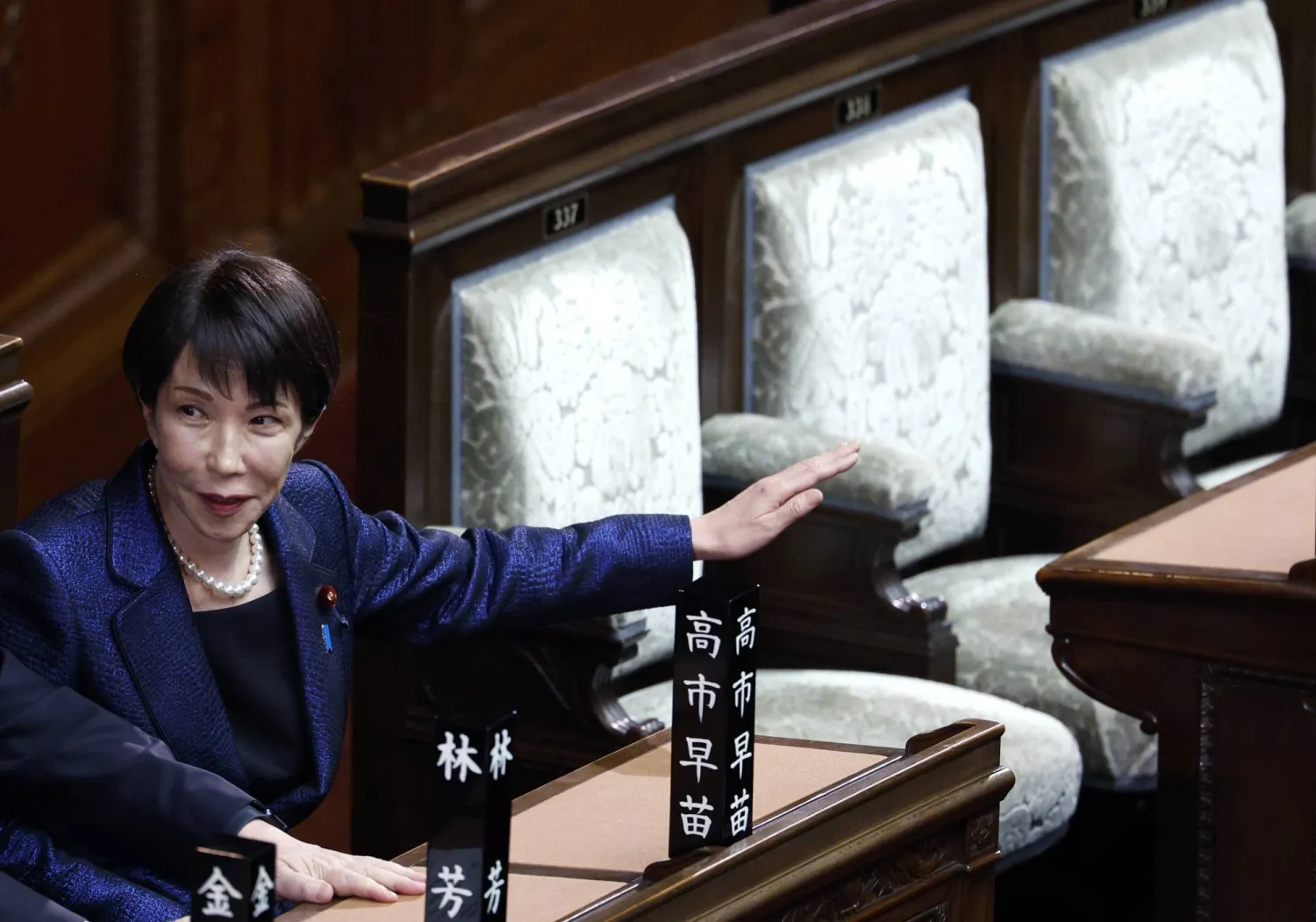
Sanae Takaichi gestures at the Lower House of the Parliament in Tokyo, Japan, 18 February 2026. EPA/FRANCK ROBICHON
TT

Japan PM Takaichi Reappointed Following Election

Sanae Takaichi gestures at the Lower House of the Parliament in Tokyo, Japan, 18 February 2026. EPA/FRANCK ROBICHON

Japan's lower house formally reappointed Sanae Takaichi as prime minister on Wednesday, 10 days after her historic landslide election victory.

Takaichi, 64, became Japan's first woman premier in October and won a two-thirds majority for her party in the snap lower house elections on February 8.

She has pledged to bolster Japan's defenses to protect its territory and waters, likely further straining relations with Beijing, and to boost the flagging economy.

Takaichi suggested in November that Japan could intervene militarily if Beijing sought to take Taiwan by force.

China, which regards the democratic island as part of its territory and has not ruled out force to annex it, was furious.

Beijing's top diplomat Wang Yi told the Munich Security Conference on Saturday that forces in Japan were seeking to "revive militarism".

In a policy speech expected for Friday, Takaichi will pledge to update Japan's "Free and Open Indo-Pacific" strategic framework, local media reported.

"Compared with when FOIP was first proposed, the international situation and security environment surrounding Japan have become significantly more severe," chief government spokesman Minoru Kihara said Monday.

In practice this will likely mean strengthening supply chains and promoting free trade through the Trans-Pacific Partnership (CPTPP) that Britain joined in 2024.

Takaichi's government also plans to pass legislation to establish a National Intelligence Agency and to begin concrete discussions towards an anti-espionage law, the reports said.

Takaichi has promised too to tighten rules surrounding immigration, even though Asia's number two economy is struggling with labor shortages and a falling population.

On Friday Takaichi will repeat her campaign pledge to suspend consumption tax on food for two years in order to ease inflationary pressures on households, local media said, according to AFP.

This promise has exacerbated market worries about Japan's colossal debt, with yields on long-dated government bonds hitting record highs last month.

Rahul Anand, the International Monetary Fund chief of mission in Japan, said Wednesday that debt interest payments would double between 2025 and 2031.

"Removing the consumption tax (on food) would weaken the tax revenue base, since the consumption tax is an important way to raise revenues without creating distortions in the economy," Anand said.

To ease such concerns, Takaichi will on Friday repeat her mantra of having a "responsible, proactive" fiscal policy and set a target on reducing government debt, the reports said.

She will also announce the creation of a cross-party "national council" to discuss taxation and how to fund ageing Japan's ballooning social security bill.

But Takaichi's first order of business will be obtaining approval for Japan's budget for the fiscal year beginning on April 1 after the process was delayed by the election.

The ruling coalition also wants to pass legislation that will outlaw destroying the Japanese flag, according to the media reports.

It wants too to accelerate debate on changing the constitution and on revising the imperial family's rules to ease a looming succession crisis.

Takaichi and many within her Liberal Democratic Party (LDP) oppose making it possible for a woman to become emperor, but rules could be changed to "adopt" new male members.


Türkiye: Ocalan Announces ‘Integration Phase’

Members of the Kurdish community take part in a protest calling for the release of convicted Kurdistan Worker's Party (PKK) leader Abdullah Ocalan in Diyarbakir on February 15, 2026. (Photo by Ilyas AKENGIN / AFP)
TT

Türkiye: Ocalan Announces ‘Integration Phase’

Members of the Kurdish community take part in a protest calling for the release of convicted Kurdistan Worker's Party (PKK) leader Abdullah Ocalan in Diyarbakir on February 15, 2026. (Photo by Ilyas AKENGIN / AFP)

The jailed leader of the Kurdistan Workers Party, Abdullah Ocalan, has said that the Ankara-PKK peace process has entered its “second phase,” as the Turkish parliament sets the stage to vote on a draft report proposing legal reforms tied to peace efforts.

A delegation from the pro-Kurdish Peoples' Equality and Democracy Party (DEM Party), including lawmakers Pervin Buldan, Mithat Sancar, and Ocalan’s lawyer Ozgur Faik, met with the jailed PKK leader on Monday on the secluded Imrali island.

Sancar said that the second phase will be focused on democratic integration into
Türkiye’s political system.

According to the lawmaker, the PKK leader considered the first phase the “negative dimension” concerned with ending the decades-old conflict between the armed group and Ankara.

“Now we are facing the positive phase,” Ocalan said, “the integration phase is the positive phase; it is the phase of construction.”

For the second phase to be implemented, Ocalan called on Turkish authorities to provide conditions that would allow him to put his “theoretical and practical capacity” to work.

The 60-page draft report on peace with the PKK was completed by a five-member writing team, which is chaired by Parliament Speaker Numan Kurtulmuş, and is scheduled for a vote on Wednesday.

The report is organized into seven sections.

In July last year, Ocalan said the group's armed struggle against Türkiye has ended and called for a full shift to democratic politics.


Iranians Chant Slogans Against Supreme Leader at Memorials for Slain Protesters

An Iranian man holds the Iranian national flag during a memorial ceremony for those killed in anti-government protests earlier last month, at the Mosalla mosque in Tehran, Iran, 17 February 2026. (EPA)
TT

Iranians Chant Slogans Against Supreme Leader at Memorials for Slain Protesters

An Iranian man holds the Iranian national flag during a memorial ceremony for those killed in anti-government protests earlier last month, at the Mosalla mosque in Tehran, Iran, 17 February 2026. (EPA)

Iranians shouted slogans against Supreme Leader Ali Khamenei on Tuesday as they gathered to commemorate protesters killed in a crackdown on nationwide demonstrations that rights groups said left thousands dead, according to videos verified by AFP.

The country's clerical authorities also staged a commemoration in the capital Tehran to mark the 40th day since the deaths at the peak of the protests on January 8 and 9.

Officials acknowledge more than 3,000 people died during the unrest, but attribute the violence to "terrorist acts", while rights groups say many more thousands of people were killed, shot dead by security forces in a violent crackdown.

The protests, sparked by anger over the rising cost of living before exploding in size and anti-government fervor, subsided after the crackdown, but in recent days Iranians have chanted slogans from the relative safety of homes and rooftops at night.

On Tuesday, videos verified by AFP showed crowds gathering at memorials for some of those killed again shouting slogans against the theocratic government in place since the 1979 revolution.

In videos geolocated by AFP shared on social media, a crowd in Abadan in western Iran holds up flowers and commemorative photos of a young man as they shout "death to Khamenei" and "long live the shah", in support of the ousted monarchy.

Another video from the same city shows people running in panic from the sounds of shots, though it wasn't immediately clear if they were from live fire.

In the northeastern city of Mashhad a crowd in the street chanted, "One person killed, thousands have his back", another verified video showed.

Gatherings also took place in other parts of the country, according to videos shared by rights groups.

- Official commemorations -

At the government-organized memorial in Tehran crowds carried Iranian flags and portraits of those killed as nationalist songs played and chants of "Death to America" and "Death to Israel" echoed through the Khomeini Grand Mosalla mosque.

Iranian President Masoud Pezeshkian attended a similar event at the Imam Reza shrine in Mashhad.

Authorities have accused sworn enemies the United States and Israel of fueling "foreign-instigated riots", saying they hijacked peaceful protests with killings and vandalism.

Senior officials, including First Vice President Mohammad Reza Aref and Revolutionary Guards commander Esmail Qaani, attended the ceremony.

"Those who supported rioters and terrorists are criminals and will face the consequences," Qaani said, according to Tasnim news agency.

International organizations have said evidence shows Iranian security forces targeted protesters with live fire under the cover of an internet blackout.

The US-based Human Rights Activists News Agency (HRANA) has recorded more than 7,000 killings in the crackdown, the vast majority protesters, though rights groups warn the toll is likely far higher.

More than 53,500 people have been arrested in the ongoing crackdown, HRANA added, with rights groups warning protesters could face execution.

Tuesday's gatherings coincided with a second round of nuclear negotiations between Iran and the United States in Geneva, amid heightened tensions after Washington deployed an aircraft carrier group to the Middle East following Iran's crackdown on the protests.