

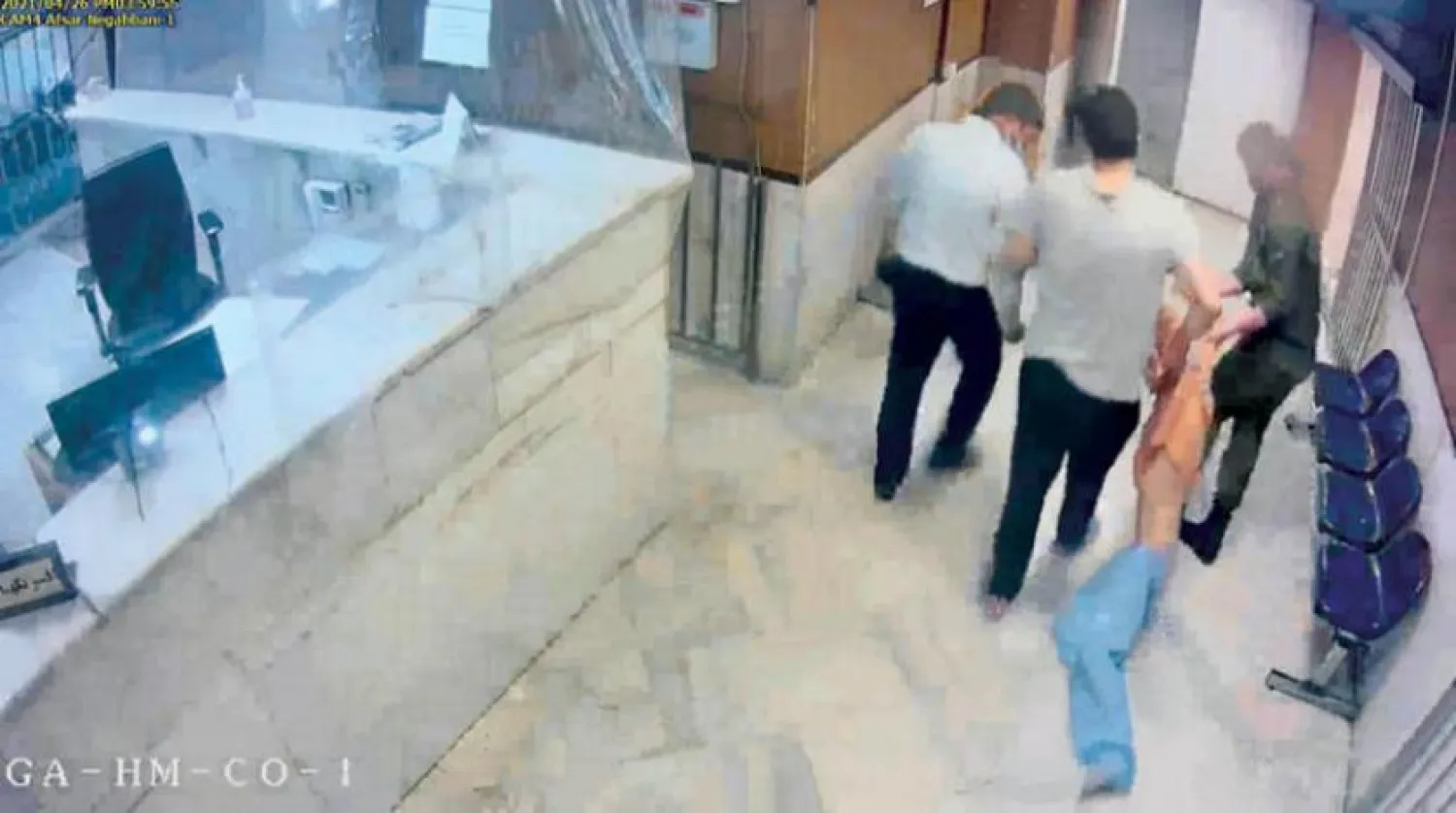

Leaked Footage Shows Grim Conditions in Iran's Evin Prison

In this undated frame grab taken from video shared with The Associated Press, guards drag an emaciated prisoner, at Evin prison in Tehran, Iran. AP
TT

Leaked Footage Shows Grim Conditions in Iran's Evin Prison

In this undated frame grab taken from video shared with The Associated Press, guards drag an emaciated prisoner, at Evin prison in Tehran, Iran. AP

The guard in a control room at Iran's notorious Evin prison springs to attention as one by one, monitors in front of him suddenly blink off and display something very different from the surveillance footage he had been watching.

“Cyberattack,” the monitors flash. Other guards gather around, holding up their mobile phones and filming, or making urgent calls. "General protest until the freedom of political prisoners" reads another line on the screens.

An online account, purportedly by an entity describing itself as a group of hackers, shared footage of the incident, as well as parts of other surveillance video it seized, with The Associated Press. The alleged hackers said the release of the footage was an effort to show the grim conditions at the prison, known for holding political prisoners and those with ties abroad who are often used as bargaining chips in negotiations with the West.

In one part of the footage, a man smashes a bathroom mirror to try to cut open his arm. Prisoners — and even guards — beat each other in scenes captured by surveillance cameras. Inmates sleeping in single rooms with bunk beds stacked three high against the walls, wrapping themselves in blankets to stay warm.

“We want the world to hear our voice for freedom of all political prisoners,” read a message from the online account to the AP.

Iran, which has faced criticism from the United Nations special rapporteur over its prison conditions, did not immediately respond to a request for comment sent to its UN mission in New York. Iranian state media in the country have not acknowledged the incident at Evin.

However, several embarrassing hacking incidents have struck Iran amid ongoing tensions over its accelerated nuclear program and as talks with the West over reviving the atomic accord between Tehran and world powers remain on hold.

Four former prisoners at Evin, as well as an Iranian human rights activist abroad, have told the AP that the videos resemble areas from the facility in northern Tehran. Some of the scenes also matched photographs of the facility previously taken by journalists, as well as images of the prison as seen in satellite photos accessed by the AP.

The footage also shows rows of sewing machines that prisoners use, a solitary confinement cell with a squat toilet and exterior areas of the prison. There are images of the prison's open-air exercise yard, prisoners' bathrooms and offices within the facility.

Much of the footage bears timestamps from 2020 and this year. Several videos without the stamp show guards wearing facemasks, signaling they came amid the coronavirus pandemic.

Though there is no sound in the videos, they speak to the grim world faced by prisoners at the facility. One sequence shows what appears to be an emaciated man dumped from a car in the parking lot, then dragged through the prison. Another shows a cleric walking down the stairs and passing by the man, without stopping.

Guards in another video are seen beating a man in a prisoner's uniform. One guard sucker-punches a prisoner in a holding cell. Guards also fight among themselves, as do the prisoners. Many are crammed into single-room cells. No one wears a facemask.

The account that shared the videos with the AP calls itself “The Justice of Ali.”

It claimed to have “hundreds” of gigabytes of data from what it described as a hack conducted several months ago. It did not answer questions about who was involved in the leak.

The account linked the timing of its leak to the recent election of Iranian President Ebrahim Raisi, a hard-line acolyte of Supreme leader Ali Khamenei involved in the execution of thousands in 1988 at the end of the Iran-Iraq War.

“The Evin prison is a stain on Raisi’s black turban and white beard,” the message on the screens in the prison control room also read.

Iran, long sanctioned by the West, faces difficulties in getting up-to-date hardware and software, often relying on Chinese-manufactured electronics or older systems. The control room system seen in the video, for instance, appeared to be running Windows 7, for which Microsoft no longer provides patches. That would make it easier for a potential hacker to target. Pirated versions of Windows and other software are common across Iran.

In recent months, Iran's railroad system was targeted by an apparent cyberattack.

Evin prison was built in 1971 under Iran's Shah Mohammad Reza Pahlavi. It housed political prisoners then and later, after the 1979 revolution swept the shah from power.

While in theory under the control of Iran's prison system, Evin also has specialized units for political prisoners and those with Western ties, run by the paramilitary Revolutionary Guard, which answers only to Khamenei. The facility is the target of both US and European Union sanctions.

After Iran cracked down on protesters following the disputed 2009 re-election of hard-line President Mahmoud Ahmadinejad, many of the arrested protesters ended up in Evin. Lawmakers later pushed for reforms at Evin, following reports of abuses at the prison — which led to the installation of the closed-circuit cameras.

Problems continued, however. Reports by UN Special Rapporteur Javaid Rehman repeatedly named Evin prison as a site of abuses of prisoners. Rehman warned in January that Iran's entire prison system faced “long-standing overcrowding and hygiene deficiencies" and “insurmountable obstacles for responding to COVID-19.”

“Prisoners of conscience and political prisoners have contracted COVID-19 or experienced symptoms, with many denied testing or treatment or suffering unnecessary delays in receiving test results and treatment,” he wrote.



Türkiye: Ocalan Announces ‘Integration Phase’

Members of the Kurdish community take part in a protest calling for the release of convicted Kurdistan Worker's Party (PKK) leader Abdullah Ocalan in Diyarbakir on February 15, 2026. (Photo by Ilyas AKENGIN / AFP)
TT

Türkiye: Ocalan Announces ‘Integration Phase’

Members of the Kurdish community take part in a protest calling for the release of convicted Kurdistan Worker's Party (PKK) leader Abdullah Ocalan in Diyarbakir on February 15, 2026. (Photo by Ilyas AKENGIN / AFP)

The jailed leader of the Kurdistan Workers Party, Abdullah Ocalan, has said that the Ankara-PKK peace process has entered its “second phase,” as the Turkish parliament sets the stage to vote on a draft report proposing legal reforms tied to peace efforts.

A delegation from the pro-Kurdish Peoples' Equality and Democracy Party (DEM Party), including lawmakers Pervin Buldan, Mithat Sancar, and Ocalan’s lawyer Ozgur Faik, met with the jailed PKK leader on Monday on the secluded Imrali island.

Sancar said that the second phase will be focused on democratic integration into
Türkiye’s political system.

According to the lawmaker, the PKK leader considered the first phase the “negative dimension” concerned with ending the decades-old conflict between the armed group and Ankara.

“Now we are facing the positive phase,” Ocalan said, “the integration phase is the positive phase; it is the phase of construction.”

For the second phase to be implemented, Ocalan called on Turkish authorities to provide conditions that would allow him to put his “theoretical and practical capacity” to work.

The 60-page draft report on peace with the PKK was completed by a five-member writing team, which is chaired by Parliament Speaker Numan Kurtulmuş, and is scheduled for a vote on Wednesday.

The report is organized into seven sections.

In July last year, Ocalan said the group's armed struggle against Türkiye has ended and called for a full shift to democratic politics.


Iranians Chant Slogans Against Supreme Leader at Memorials for Slain Protesters

An Iranian man holds the Iranian national flag during a memorial ceremony for those killed in anti-government protests earlier last month, at the Mosalla mosque in Tehran, Iran, 17 February 2026. (EPA)
TT

Iranians Chant Slogans Against Supreme Leader at Memorials for Slain Protesters

An Iranian man holds the Iranian national flag during a memorial ceremony for those killed in anti-government protests earlier last month, at the Mosalla mosque in Tehran, Iran, 17 February 2026. (EPA)

Iranians shouted slogans against Supreme Leader Ali Khamenei on Tuesday as they gathered to commemorate protesters killed in a crackdown on nationwide demonstrations that rights groups said left thousands dead, according to videos verified by AFP.

The country's clerical authorities also staged a commemoration in the capital Tehran to mark the 40th day since the deaths at the peak of the protests on January 8 and 9.

Officials acknowledge more than 3,000 people died during the unrest, but attribute the violence to "terrorist acts", while rights groups say many more thousands of people were killed, shot dead by security forces in a violent crackdown.

The protests, sparked by anger over the rising cost of living before exploding in size and anti-government fervor, subsided after the crackdown, but in recent days Iranians have chanted slogans from the relative safety of homes and rooftops at night.

On Tuesday, videos verified by AFP showed crowds gathering at memorials for some of those killed again shouting slogans against the theocratic government in place since the 1979 revolution.

In videos geolocated by AFP shared on social media, a crowd in Abadan in western Iran holds up flowers and commemorative photos of a young man as they shout "death to Khamenei" and "long live the shah", in support of the ousted monarchy.

Another video from the same city shows people running in panic from the sounds of shots, though it wasn't immediately clear if they were from live fire.

In the northeastern city of Mashhad a crowd in the street chanted, "One person killed, thousands have his back", another verified video showed.

Gatherings also took place in other parts of the country, according to videos shared by rights groups.

- Official commemorations -

At the government-organized memorial in Tehran crowds carried Iranian flags and portraits of those killed as nationalist songs played and chants of "Death to America" and "Death to Israel" echoed through the Khomeini Grand Mosalla mosque.

Iranian President Masoud Pezeshkian attended a similar event at the Imam Reza shrine in Mashhad.

Authorities have accused sworn enemies the United States and Israel of fueling "foreign-instigated riots", saying they hijacked peaceful protests with killings and vandalism.

Senior officials, including First Vice President Mohammad Reza Aref and Revolutionary Guards commander Esmail Qaani, attended the ceremony.

"Those who supported rioters and terrorists are criminals and will face the consequences," Qaani said, according to Tasnim news agency.

International organizations have said evidence shows Iranian security forces targeted protesters with live fire under the cover of an internet blackout.

The US-based Human Rights Activists News Agency (HRANA) has recorded more than 7,000 killings in the crackdown, the vast majority protesters, though rights groups warn the toll is likely far higher.

More than 53,500 people have been arrested in the ongoing crackdown, HRANA added, with rights groups warning protesters could face execution.

Tuesday's gatherings coincided with a second round of nuclear negotiations between Iran and the United States in Geneva, amid heightened tensions after Washington deployed an aircraft carrier group to the Middle East following Iran's crackdown on the protests.


Independent UN Body Condemns ‘Vicious Attacks’ on UN Expert on Palestinian Rights

United Nations (UN) Special Rapporteur on the occupied Palestinian territories Francesca Albanese looks on at the end of a press conference on the human rights situation in Gaza in Geneva on September 15, 2025. (AFP)
TT

Independent UN Body Condemns ‘Vicious Attacks’ on UN Expert on Palestinian Rights

United Nations (UN) Special Rapporteur on the occupied Palestinian territories Francesca Albanese looks on at the end of a press conference on the human rights situation in Gaza in Geneva on September 15, 2025. (AFP)

An ‌independent United Nations body on Tuesday condemned what it described as vicious attacks based on disinformation by several European ministers against the organization's special rapporteur for Palestine, Francesca Albanese.

In the past week several European countries, including Germany, France and Italy, called for Albanese’s resignation over her alleged criticism of Israel. Albanese, an Italian lawyer, denies making the remarks.

On Friday, the Czech Republic's Foreign Minister Petr Macinka quoted Albanese on X as having called Israel a "common enemy of humanity", and he ‌also called for ‌her resignation.

A transcript of Albanese's remarks ‌made ⁠in Doha on ⁠February 7 seen by Reuters did not characterize Israel in this way, although she has consistently criticized the country in the past over the Gaza conflict.

The UN Coordination Committee - a body of six independent experts which coordinates and facilitates the work of Special Rapporteurs - accused European ministers of relying on "manufactured ⁠facts".

"Instead of demanding Ms. Albanese's resignation ‌for performing her mandate...these government representatives ‌should join forces to hold accountable, including before the International Criminal Court, ‌leaders and officials accused of committing war crimes and ‌crimes against humanity in Gaza," the Committee said.

It said the pressure exerted on Albanese was part of an increasing trend of politically motivated and malicious attacks against independent human rights experts, UN officials ‌and judges of international courts.

US President Donald Trump's administration imposed sanctions on Albanese after she wrote ⁠letters ⁠to US companies accusing them of contributing to gross human rights violations by Israel in Gaza and the West Bank.

UN experts are commissioned by the Geneva-based Human Rights Council to monitor and document specific human rights crises but are independent of the organization itself.

There is no precedent for removing a special rapporteur during their term, although diplomats said that states on the 47-member council could in theory propose a motion to do so.

However, they said strong support for Palestinian rights within the body means that such a motion was unlikely to pass.