


Hezbollah Hammered with Criticism amid Lebanon's Crises

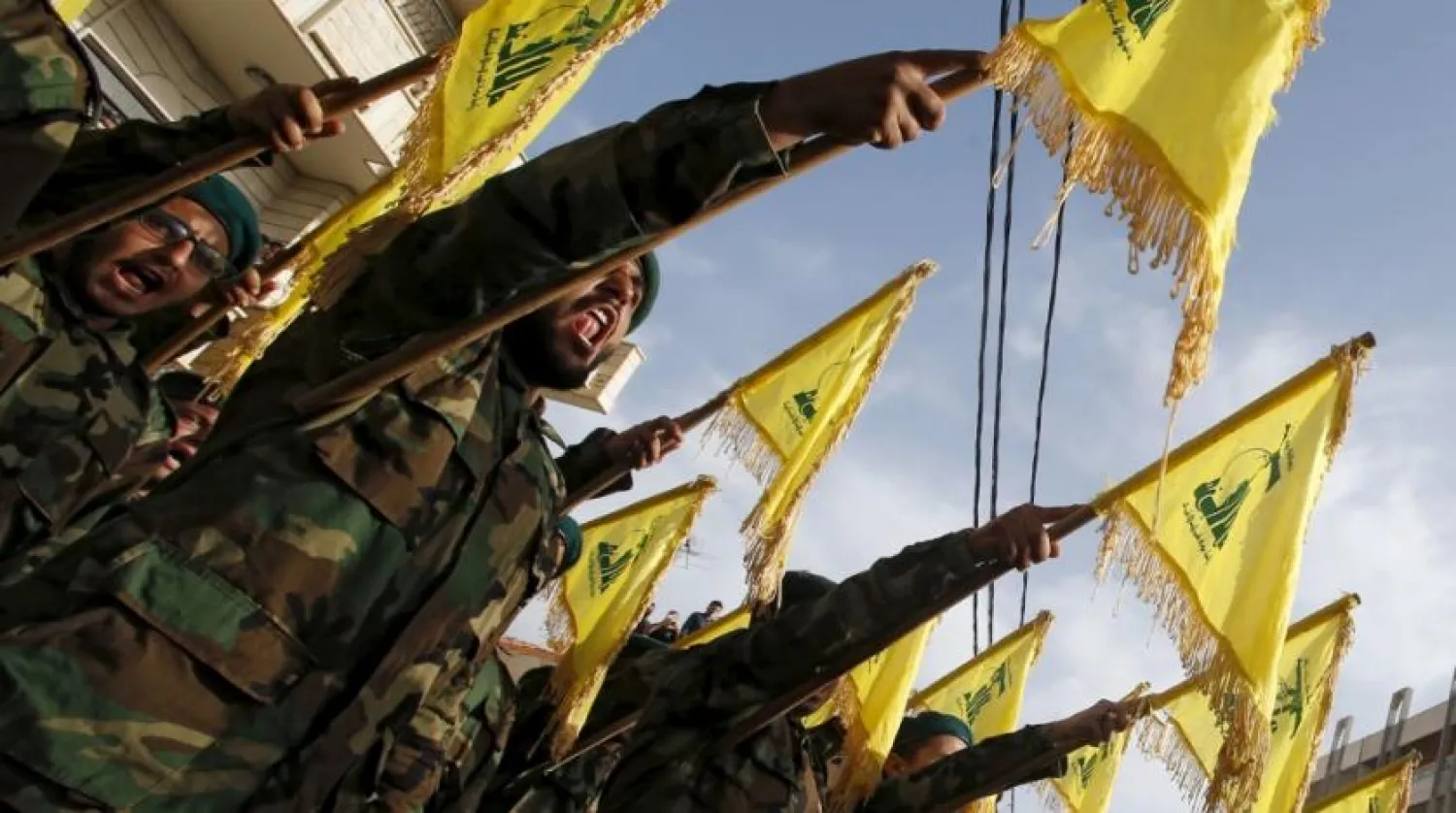
Lebanon’s Hezbollah members carry Hezbollah flags during the funeral of a fellow fighter in al-Ghaziyeh village, southern Lebanon May 26, 2015. REUTERS/Ali Hashisho
TT

Hezbollah Hammered with Criticism amid Lebanon's Crises

Lebanon’s Hezbollah members carry Hezbollah flags during the funeral of a fellow fighter in al-Ghaziyeh village, southern Lebanon May 26, 2015. REUTERS/Ali Hashisho

Driving back to base after firing rockets toward Israeli positions from a border area last month, a group of Hezbollah fighters was accosted by angry villagers who smashed their vehicles' windshields and held them up briefly.

It was a rare incident of defiance that suggested many in Lebanon would not tolerate provocations by the group that risked triggering a new war with Israel, reported The Associated Press.

As Lebanon sinks deeper into poverty, many Lebanese are more openly criticizing Iran-backed Hezbollah. They blame the group — along with the ruling class — for the devastating, multiple crises plaguing the country, including a dramatic currency crash and severe shortages in medicine and fuel.

“Hezbollah is facing its most consequential challenge in maintaining control over the Lebanese system and what is called the ‘protective environment of the resistance’ against Israel,” said Joe Macaron, a Washington-based Middle East analyst.

The incident along the border and other confrontations — including a deadly shooting at the funeral of a Hezbollah militant and rare indirect criticism by the country’s top Christian religious leader — have left the group on the defensive.

The anger has spread in recent months, even in Hezbollah strongholds where many have protested electricity cuts and fuel shortages as well as the currency crash that has plunged more than half the country's 6 million people into penury.

In its strongholds, predominantly inhabited by Shiite Muslims, it is not uncommon now for people to speak out against the group. They note that Hezbollah is paying salaries in US dollars at a time when most Lebanese get paid in Lebanese currency, which has lost more than 90% of its value in nearly two years.

Protests and scuffles have broken out at gas stations around Lebanon and in some Hezbollah strongholds. In rare shows of defiance, groups of protesters have also closed key roads in those areas south of Beirut and in southern Lebanon.

In recent speeches, Hezbollah leader Hassan Nasrallah has appeared angry, blaming the shortages on what he describes as an undeclared Western siege. The chaos in Lebanon, he said, is being instigated from a “black room” inside the US Embassy.

Critics say that rather than push for reform, Hezbollah has stood by its political allies who resist change. They say the group is increasingly pulling Lebanon into Iran’s orbit by doing its bidding, and that US sanctions against Iran and Hezbollah have made things harder.

Where Hezbollah was once considered an untouchable force fighting for a noble cause — the fight against the Israeli enemy — it is now seen by many simply as part of the corrupt political clique responsible for the country’s epic meltdown. Still, when it comes to fighting Israel, the group enjoys unwavering backing within its base of support.

Often criticized for operating as a state within a state, Hezbollah has tried to ease the effects of the crisis on its supporters in similar fashion.

While the government has been working for months to issue ration cards to poor families, Hezbollah has been well ahead. It has issued two such cards to poor families living in Hezbollah bastions, one called Sajjad after the name of a Shiite imam, and a second called Nour, or light, for its fighters and employees of its institutions who number about 80,000.

The tens of thousands carrying Sajjad cards not only can buy highly subsidized products from dozens of shops spread around Lebanon — mostly staples made in Lebanon, Iran and Syria — but can also get medical treatment and advice at 48 Hezbollah-run clinics and medical centers around Lebanon.

Nasrallah is also organizing a sea corridor carrying oil from Iran to Lebanon to help alleviate the fuel shortages, with the first tanker believed to be on its way. The move has been praised by Hezbollah’s supporters and heavily criticized by its opponents, who say it risks bringing more sanctions on Lebanon.

In the border incident, villagers from the minority Druze sect intercepted Hezbollah fighters on their way back after firing rockets toward a disputed area held by Israel. The villagers briefly detained them and the mobile rocket launcher they used after accusing them of putting them at risk if Israel strikes back.

The fighters and the launcher were then handed over to Lebanese troops, who released them on the same day.

Later, Hezbollah angered many Christians after supporters launched a social media campaign against the head of Lebanon’s Maronite Catholic church, the country’s largest, accusing him of treason after he criticized the group for firing the rockets on Israeli positions.

The group has been hammered by accusations from its local opponents. They include silencing its opponents, facilitating smuggling of fuel and other subsidized items to neighboring Syria.

The most serious charge has been a claim by opponents at home that the group brought in the hundreds of tons of ammonium nitrate that exploded at Beirut’s port last year, killing at least 214 people, wounding thousands and destroying parts of the capital.

No direct connection to Hezbollah has emerged, but unsubstantiated theories that tie the group to the stockpile abound. One claim is that Hezbollah imported the chemicals on behalf of the Syrian government, which used them in barrel bombs against opposition-held areas during the neighboring country's 10-year conflict.

“Hezbollah’s agencies are active at the port and this is known to security agencies and all Lebanese. Why is Hassan Nasrallah above questioning?” asked Samy Gemayel, head of the right-wing Christian Kataeb Party recently.

Hezbollah has repeatedly denied any link to the ammonium nitrate. But Nasrallah further angered families of the victims and other Lebanese recently by criticizing the judge leading the investigation into the blast, suggesting he should be replaced.

Nasrallah described Judge Tarek Bitar as “politicized” after he filed charges against some legislators and former Cabinet ministers allied with Hezbollah.

A serious test for Hezbollah came in early August when a funeral of a militant came under fire by suspected gunmen on the southern entrance of Beirut. Three Hezbollah supporters were killed and 16 were wounded in the shooting in the town of Khaldeh.

Hezbollah did not retaliate and instead called on Lebanese authorities to investigate the case.

“An increasing number of Lebanese are realizing that the concept of a Lebanese state cannot coexist with an armed militia serving an outside power,” wrote Michael Young, editor of Diwan, the blog of the Carnegie Middle East Center.



Italy Arrests 7 Accused of Raising Millions for Hamas

Palestinian Hamas members secure the area as Egyptian workers accompanied by members of the International Committee of the Red Cross (ICRC) search for the remains of the last Israeli hostage in the Zeitoun neighborhood of Gaza City on December 8, 2025. (Photo by Omar AL-QATTAA / AFP)
TT

Italy Arrests 7 Accused of Raising Millions for Hamas

Palestinian Hamas members secure the area as Egyptian workers accompanied by members of the International Committee of the Red Cross (ICRC) search for the remains of the last Israeli hostage in the Zeitoun neighborhood of Gaza City on December 8, 2025. (Photo by Omar AL-QATTAA / AFP)

Italian police said Saturday that they have arrested seven people suspected of raising millions of euros for Palestinian group Hamas.

Police also issued international arrests for two others outside the country, said AFP.

Three associations, officially supporting Palestinian civilians but allegedly serving as a front for funding Hamas, are implicated in the investigation, said a police statement.

The nine individuals are accused of having financed approximately seven million euros ($8 million) to "associations based in Gaza, the Palestinian territories, or Israel, owned, controlled, or linked to Hamas."

While the official objective of the three associations was to collect donations "for humanitarian purposes for the Palestinian people," more than 71 percent was earmarked for the direct financing of Hamas" or entities affiliated with the movement, according to police.

Some of the money went to "family members implicated in terrorist attacks," the statement said.

Among those arrested was Mohammad Hannoun, president of the Palestinian Association in Italy, according to media reports.

Interior Minister Matteo Piantedosi posted on X that the operation "lifted the veil on behavior and activities which, pretending to be initiatives in favor of the Palestinian population, concealed support for and participation in terrorist organizations."


Türkiye Holds Military Funeral for Libyan Officers Killed in Plane Crash

The Libyan national flag flies at half-mast in Tripoli on December 24, 2025, after the head of Libya's armed forces and his four aides died in a plane crash in Türkiye. (AFP)
TT

Türkiye Holds Military Funeral for Libyan Officers Killed in Plane Crash

The Libyan national flag flies at half-mast in Tripoli on December 24, 2025, after the head of Libya's armed forces and his four aides died in a plane crash in Türkiye. (AFP)

Türkiye held a military funeral ceremony Saturday morning for five Libyan officers, including western Libya’s military chief, who died in a plane crash earlier this week.

The private jet with Gen. Muhammad Ali Ahmad al-Haddad, four other military officers and three crew members crashed on Tuesday after taking off from Ankara, Türkiye’s capital, killing everyone on board. Libyan officials said the cause of the crash was a technical malfunction on the plane.

Al-Hadad was the top military commander in western Libya and played a crucial role in the ongoing, UN-brokered efforts to unify Libya’s military.

The high-level Libyan delegation was on its way back to Tripoli, Libya’s capital, after holding defense talks in Ankara aimed at boosting military cooperation between the two countries.

Saturday's ceremony was held at 8:00 a.m. local time at the Murted Airfield base, near Ankara, and attended by the Turkish military chief and the defense minister. The five caskets, each wrapped in a Libyan national flag, were then loaded onto a plane to be returned to their home country.

Türkiye’s military chief, Selcuk Bayraktaroglu, was also on the plane headed to Libya, state-run news agency TRT reported.

The bodies recovered from the crash site were kept at the Ankara Forensic Medicine Institute for identification. Justice Minister Yilmaz Tunc told reporters their DNA was compared to family members who joined a 22-person delegation that arrived from Libya after the crash.

Tunc also said Germany was asked to help examine the jet's black boxes as an impartial third party.


Syrian Foreign Ministry: Talks with SDF Have Not Yielded Tangible Results

SDF fighters are seen at a military parade in Qamishli. (Reuters file)
TT

Syrian Foreign Ministry: Talks with SDF Have Not Yielded Tangible Results

SDF fighters are seen at a military parade in Qamishli. (Reuters file)

A source from the Syrian Foreign Ministry said on Friday that the talks with the Kurdish Syrian Democratic Forces (SDF) over their integration into state institutions “have not yielded tangible results.”

Discussions about merging the northeastern institutions into the state remain “hypothetical statements without execution,” it told Syria’s state news agency SANA.

Repeated assertions over Syria’s unity are being contradicted by the reality on the ground in the northeast, where the Kurds hold sway and where administrative, security and military institutions continue to be run separately from the state, it added.

The situation “consolidates the division” instead of addressing it, it warned.

It noted that despite the SDF’s continued highlighting of its dialogue with the Syrian state, these discussions have not led to tangible results.

It seems that the SDF is using this approach to absorb the political pressure on it, said the source. The truth is that there is little actual will to move from discussion to application of the March 10 agreement.

This raises doubts over the SDF’s commitment to the deal, it stressed.

Talk about rapprochement between the state and SDF remains meaningless if the agreement is not implemented on the ground within a specific timeframe, the source remarked.

Furthermore, the continued deployment of armed formations on the ground that are not affiliated with the Syrian army are evidence that progress is not being made.

The persistence of the situation undermines Syria’s sovereignty and hampers efforts to restore stability, it warned.