


PayPal Heats up Buy Now, Pay Later Race with $2.7Bln Japan Deal

The PayPal logo is seen at an office building in Berlin, Germany, March 5, 2019. (Reuters)
TT

PayPal Heats up Buy Now, Pay Later Race with $2.7Bln Japan Deal

The PayPal logo is seen at an office building in Berlin, Germany, March 5, 2019. (Reuters)

US payments giant PayPal Holdings Inc said it would acquire Japanese buy now, pay later (BNPL) firm Paidy in a $2.7 billion largely cash deal, taking another step to claim the top spot in an industry experiencing a pandemic-led boom.

The deal tracks rival Square Inc’s agreement last month to buy Australian BNPL success story Afterpay Ltd for $29 billion, which experts said was likely the beginning of a consolidation in the sector.

“The acquisition will expand PayPal’s capabilities, distribution and relevance in the domestic payments market in Japan, the third largest ecommerce market in the world, complementing the company’s existing cross-border ecommerce business in the country,” PayPal said in a statement on Tuesday.

Fueled by federal stimulus checks, the BNPL business model has been hugely successful during the pandemic and has upended consumer credit markets. These firms make money by charging merchants a fee to offer small point-of-sale loans which shoppers repay in interest-free instalments, bypassing credit checks.

Apple Inc and Goldman Sachs are the latest heavyweights that have been reported to be readying their own version of the service.

PayPal, already considered a leader in the BNPL market, also entered Australia last year, raising the stakes for smaller companies such as Sezzle Inc and Z1P.AX Co Ltd , stocks of which were down in midday trading on Wednesday.

The US payments firm has been among the big winners of the COVID-19 pandemic as more people used its services to shop online and pay bills to avoid stepping out. Businesses, forced to move their stores online, also flocked to PayPal boosting its customer base of active accounts to more than 400 million worldwide.

Buying Paidy will help PayPal expand in Japan, where online shopping volume has more than tripled over the last 10 years to some $200 billion, but more than two-thirds of all purchases are still paid for in cash, PayPal said in an investor presentation.

Paidy, with more than 6 million registered users, offers payment services that allow Japanese shoppers to make purchases online, and then pay for them each month at a convenience store or via bank transfer.

The Financial Times had reported last month that Paidy was considering becoming a publicly listed company.

Paidy, whose backers include Soros Capital Management, Visa Inc and Japanese trading house Itochu Corp, will continue to operate its existing business and maintain its brand after the acquisition.

Founder and Chairman Russell Cummer and CEO Riku Sugie will continue to hold their roles in the company, PayPal said.

The transaction is expected to close in the fourth quarter of 2021, and will be minimally dilutive to PayPal’s adjusted earnings per share in 2022.



SpaceX: Five Key Moments, from First Launch to Starship Megarocket

SpaceX employees celebrate the company's Wall Street debut, the largest initial public offering in US history. TIMOTHY A. CLARY / AFP
TT

SpaceX: Five Key Moments, from First Launch to Starship Megarocket

SpaceX employees celebrate the company's Wall Street debut, the largest initial public offering in US history. TIMOTHY A. CLARY / AFP

More than 20 years after its founding, SpaceX made history Friday with its record-high stock market debut, crowning a unique journey marked by dazzling successes but also catastrophic failures and unfulfilled promises.

Here are five key moments in the company's history:

- 2008: The founding myth -

Six years after its founding, SpaceX launched its first rocket into orbit after multiple failures, taking off in September 2008 from a remote archipelago in the Pacific Ocean.

"I messed up the first three launches; the first three launches failed," co-founder Elon Musk recalled years later.

"Fortunately, the fourth launch -- that was the last money that we had -- the fourth launch worked, or that would have been it for SpaceX. But fate liked us that day."

- 2012: Next stop, ISS -

After the successful launch, SpaceX grew and developed more powerful launchers, including its flagship rocket, Falcon 9, which has become the most widely used rocket today.

Among its creations was the Dragon spacecraft, which docked as a cargo vessel at the International Space Station in 2012, a first by a private company.

Eight years later, the Dragon spacecraft carried its first astronaut to the ISS, beating other aerospace companies like Boeing to becoming the main American transport to the space station.

- 2018: A Tesla in space? -

At the same time, SpaceX in 2015 successfully landed the first stage of its Falcon 9 rocket, ushering in the age of partially reusable rockets.

This was followed by Falcon Heavy, a much more powerful launcher with two Falcon 9 boosters.

To mark its first test flight in 2018, Musk decided to place the car made by one of his other companies, a Tesla, on board.

The image of the red Tesla occupied by a mannequin dubbed Starman -- after David Bowie -- was seen around the world.

Not all SpaceX promises were kept though: that same year, Musk said he would send a group which included Japanese billionaire Yusaku Maezawa around the Moon by 2023, but that never came to pass.

- 2020-2023: Starbase's explosive beginning -

The tech trillionaire ended up prioritizing the development of his megarocket Starship, designed to travel to the Moon and, eventually, Mars.

To complete the project, he bought vast amounts of land in Texas and developed an industrial complex known as Starbase, where he would launch a series of Starship prototypes, most of which blew up into spectacular fireballs.

Musk justified the "rapid unscheduled disassembly" of these rockets, to use the entrepreneur's favorite euphemism for explosions, by saying they were part of the learning process.

- 2024: The unprecedented 'Super Heavy' catch -

In October 2024, SpaceX succeeded in recovering the first stage of Starship, its "Super Heavy" booster, in a unique maneuver that had never been achieved before.

After launching the spacecraft, the booster detached and began its descent, returning to the SpaceX launch pad where a pair of "chopsticks" reached out to catch the booster and bring it to a halt.

The feat, while impressive, is only the first part of SpaceX's plan to make Starship a fully reusable rocket -- a goal it remains in pursuit of while dealing with several technical challenges.


India Clears Way for Self-driving, Safety Car Tech to Reduce Road Deaths

A woman crosses street through a dust storm accompanied by rain in Jammu, India, Thursday, June 11, 2026.(AP Photo/Channi Anand)
TT

India Clears Way for Self-driving, Safety Car Tech to Reduce Road Deaths

A woman crosses street through a dust storm accompanied by rain in Jammu, India, Thursday, June 11, 2026.(AP Photo/Channi Anand)

India has scrapped a license requirement for radar sensors, freeing automakers to adopt technology that helps cars avoid crashes and drive themselves by sensing surrounding objects, in a bid to make some of the world's deadliest roads safer.

The world's third largest car market, India reported more than 177,000 deaths in nearly half a million ⁠road accidents in 2024, the ⁠latest figures show, according to Reuters.

In a notice on Thursday, the government waived the license requirement for radar sensors operating in the frequency band from 77GHz to 81 GHz. That lets companies ⁠enable the technology without the government having to separately assign the airwaves.

Automakers Maruti Suzuki, Tata Motors and Mahindra & Mahindra, stand to benefit from the change, as well the suppliers behind them, such as Germany's Bosch and Continental.

The radar sensors let a car gauge safe distances, and drive features such as emergency braking, adaptive cruise ⁠control ⁠and blindspot warnings, to form a basis for autonomous driving.

The change brings India in line with the United States, the European Union and a global telecoms standard, all of which dedicate the same frequency band to vehicle radar.

That lets carmakers and suppliers tap into the same off-the-shelf hardware worldwide, rather than having to build an India-specific version.


AI Robot Cleaners Leave the Lab for China's Living Rooms

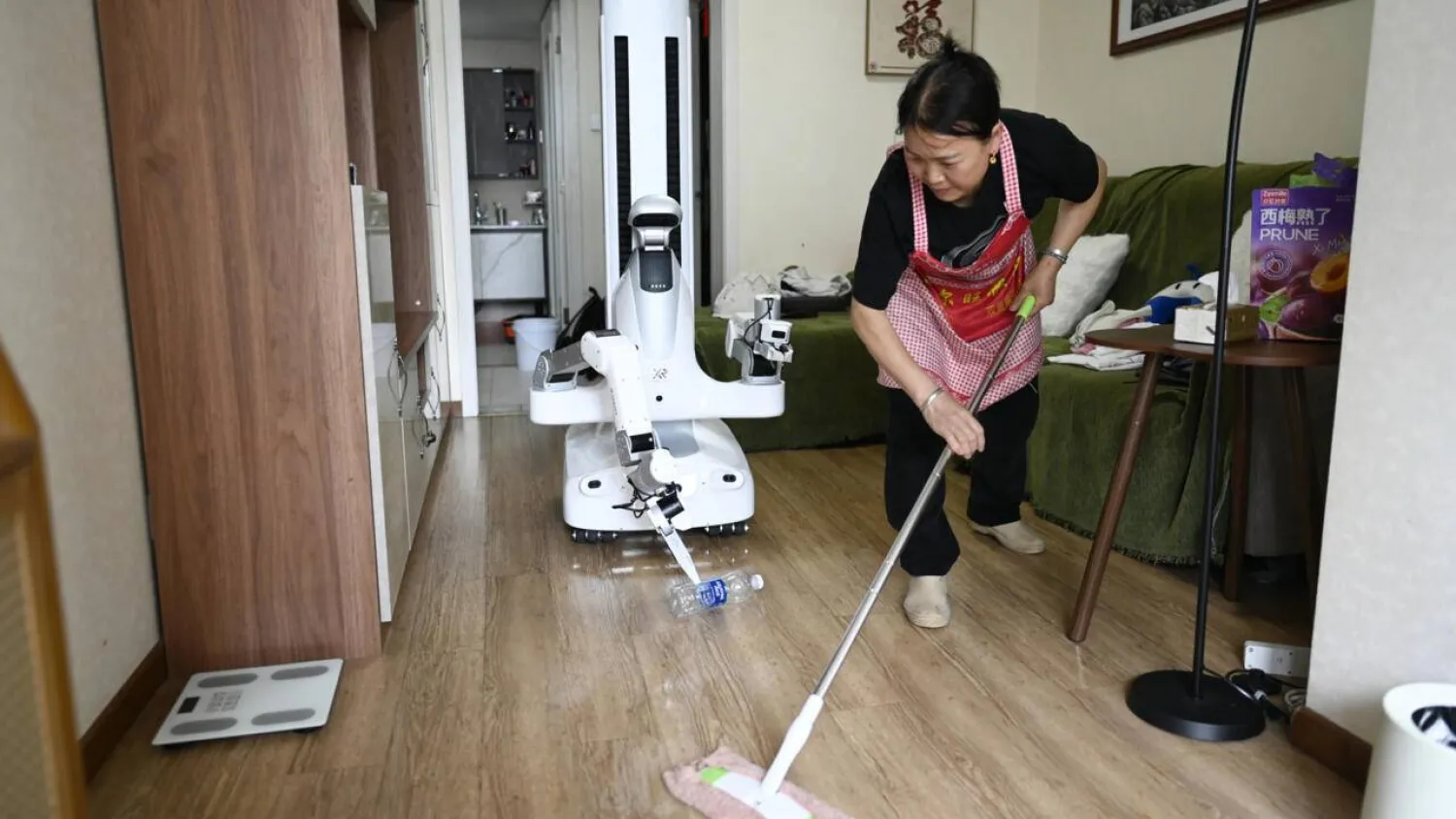
The service is a baby step towards a future in which robots increasingly take over manual labor from humans. WANG Zhao / AFP
TT

AI Robot Cleaners Leave the Lab for China's Living Rooms

The service is a baby step towards a future in which robots increasingly take over manual labor from humans. WANG Zhao / AFP

Beijing cleaner Lin Meiqiong found her work a little easier the day she was paired with an unlikely new colleague -- a tall, wheeled robot with AI-powered tidying skills.

The 56-year-old and her white-and-silver partner, fitted with cameras and two mechanical claws, are part of a new human-robot cleaning service offered by Chinese household help platform 58.com.

It's a baby step towards a future espoused by tech evangelists in which robots increasingly take over manual labor from humans -- though at the moment, such services are largely a data-gathering exercise for companies and a novelty for curious customers.

"It's definitely different," Lin told AFP in between cleaning the kitchen and wiping down windows.

"I used to have to do everything myself," she said. "It's reduced the workload a bit."

The cleaning service, a collaboration between 58.com and Chinese robotics company X Square, costs 149 yuan ($22) for three hours and is available in Beijing and tech hub Shenzhen.

Helped into the apartment by an X Square engineer, the AI-operated Quanta X1 Pro robot uses its cameras to identify areas it could spruce up.

As Lin scrubbed the floor on her knees, it picked up rubbish and folded clothes strewn across a sofa.

Grasping a pair of dark grey trousers, it raised its upper body to stretch the fabric taut, before laying it flat and arranging it into neat halves.

The process took several minutes and resembled a child learning to fold clothes for the first time.

Future iterations of the robot will respond to voice commands and even be able to chat, said the engineer, Hu Bowen.

- 'Better than a lab' -

Around 200 households have booked the service since it was rolled out in March.

Tan Pei, who works in advertising and booked the robot to clean her Beijing flat, said she had chosen the service because she was interested to "see what it could do".

"Even though it's not that perfect, there are still parts of it that surprised me," such as folding a pair of trousers "quite well", she said.

China's robots have wowed audiences with fluid dancing and set-piece martial arts displays onstage, but their application and performance in real-life settings remains limited.

For companies like X Square, the logic of launching an imperfect service lies in data collection for so-called embodied artificial intelligence.

Unlike large language models trained on vast quantities of internet content, robots lack comparable real-world datasets.

"We don't have a robot internet yet," Christoforos Mavrogiannis from the University of Michigan told AFP.

"It is much more informative to put the robot out there and study what happens than staying forever in the lab."

X Square engineer Hu said he sends his robots to work in a "completely unfamiliar environment".

"That is very challenging, but this unfamiliar data is also very helpful for the robot's growth."

As investment into embodied AI booms, similar trials in China include robots directing traffic in cities like Hangzhou or working on factory floors.

On the domestic help front, firm GigaAI also plans to deploy 100 humanoid robots into households in central Wuhan this autumn for free home-service trials.

Investors have poured more than 57.7 billion yuan ($8.5 billion) into China's embodied AI industry so far this year, already soaring past the total for last year as a whole, according to business database ITjuzi.

- 'Very elementary stage' -

But a myriad of hurdles stand in the way of widespread deployment.

As the Quanta X1 Pro's clothes folding demonstrated, robots still can't match human dexterity.

"Even though many companies are working on building better hands and building autonomy for hands, we don't have that yet," the University of Michigan's Mavrogiannis said.

There are multiple regulatory issues even once the physical capability is there.

Privacy will become a big issue, as robots would have access to huge amounts of personal data.

"We don't know where that data is going, where it's located... who is looking at that information," said Valeria Alessandra Macalupu Chira from Queensland University of Technology.

The safety of clients and their homes is another unresolved issue.

"I think we are still at a very elementary stage," said Yang Jianfei from Singapore's Nanyang Technological University.

Robots currently require supervision by humans who can activate emergency stop functions, he noted, and there are not yet recognized industry-wide safety standards.

Experts agree broad adoption seems a long way off.

Asked whether she thought robots would revolutionize her industry, cleaner Lin did not seem too concerned.

"Compared with people, it's obviously still not quite there," she said. "After all, it's a robot."