


Palestinian Teen Describes Brutal Attack by Israeli Settlers

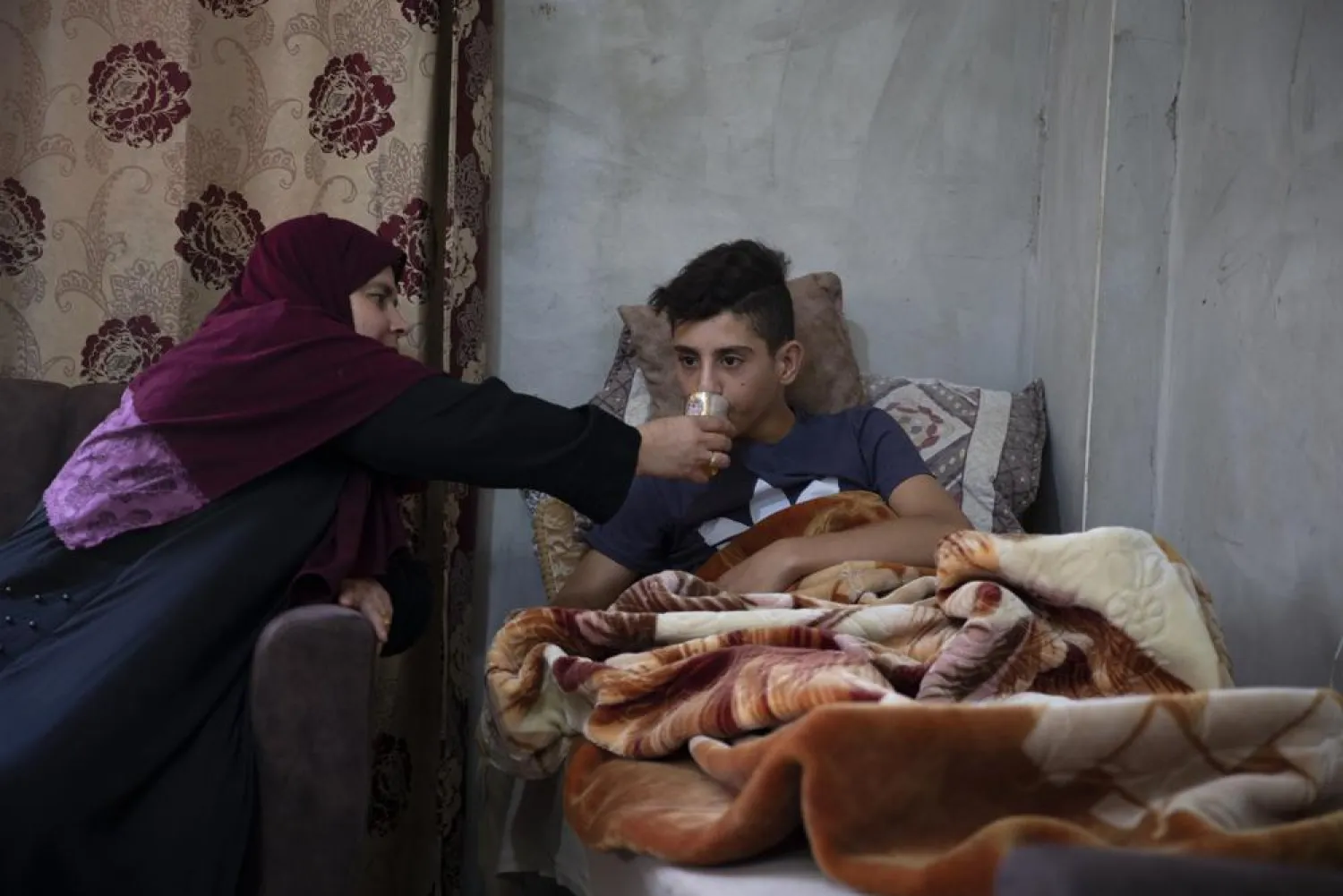
Palestinian youth, Tareq Zubeidi, 15, rests at his house, in the West Bank village of Silat ad-Dhahr, Tuesday, Aug. 31, 2021. (AP Photo/Majdi Mohammed)
TT

Palestinian Teen Describes Brutal Attack by Israeli Settlers

Palestinian youth, Tareq Zubeidi, 15, rests at his house, in the West Bank village of Silat ad-Dhahr, Tuesday, Aug. 31, 2021. (AP Photo/Majdi Mohammed)

More than two weeks after the attack, Tareq Zubeidi still spends most of his time in bed, too scared to leave home even if the wounds on his feet allowed him to walk normally.

The 15-year-old is haunted by the memory of what he describes as a brutal attack by Israeli settlers, who he says beat him with clubs, tied him to a tree and burned the soles of his feet, reported The Associated Press.

“When I sit by myself I start thinking about all of them, and then I start sweating and my heart rate starts to increase,” Zubeidi said.

While there were no witnesses to corroborate Zubeidi's account, the Aug. 17 incident took place in an area that sees frequent violence between hard-line Jewish settlers and local Palestinians.

B’Tselem, an Israeli human rights group that monitors settler violence, said it was not able to verify all the details of Tareq’s account but that “it is clear that the boy was physically and mentally abused.”

The group documented at least seven settler attacks on Palestinians and their property in the area around Zubeidi's village in the last two years. It says that when the Israeli military intervenes, it often sides with the settlers. The Palestinians claim the West Bank, captured by Israel in the 1967 Mideast war, as the main part of a future independent state.

The Israeli military says troops were dispatched to Homesh, a nearby settlement that was forcefully evacuated in 2005, after reports of Palestinians throwing rocks. When the soldiers arrived they found settlers chasing a Palestinian teenager who was later returned to his family, the military said in a statement.

Settler groups with links to Homesh declined to comment or said they were unaware of the incident.

Zubeidi said he and some friends took some snacks up to the hilltop where the settlement once stood and found a place to relax. At around 9:30 a.m. they heard people shouting in Hebrew and looked up to see a small group of settlers coming toward them.

He denied he or his friends threw rocks, saying “I don’t know anything about that.”

Instead, he said, they fearfully ran down the hill toward their village of Silat al-Dhahr. Zubeidi said an earlier knee injury slowed him down, allowing another group of settlers in a car to catch up with him and knock him over as he descended the gravely street that connects Homesh with the main road.

“Four settlers got out of the car and there were two others who were traveling by foot," he said. "One of them had a gun.”

The settlers beat him with wooden clubs before blindfolding him and tying him to the hood of the car, he said. They drove for about five minutes, back up the hill, before the car came to a sudden halt, sending him tumbling to the ground. “Then they started to hit me, spit on me and swear at me,” he said.

He said the settlers tied him to a tree and whipped him with a belt. Then they took him down, cut his legs with a knife and burned the soles of his feet with a car cigarette lighter. In the end, they hit him over the head with a club, knocking him unconscious, he said.

When he came to, he was in an army jeep with an Israeli soldier who he says immediately began threatening him. “He told me that if anything happens in the settlement we will arrest you, and if there is any stone-throwing, you will take full responsibility,” Zubeidi said.

His father, Abdul Razek Zubeidi, said his son was taken to a hospital that afternoon and spent the night there. A medical report said he had bruising on his shoulder and cuts on his feet. Photos taken shortly after the incident appear to show two dark wounds on the soles of his feet.

Abdul Razek Zubeidi said he immediately reported the incident to the Palestinian police, who said they contacted the Israeli army. Abdul Razek said he has heard nothing from Israeli authorities. The family says it has not filed a complaint to Israeli police, fearing it would be a waste of time.

Palestinians in the West Bank live under Israeli military law, giving them few avenues for legal recourse, while the nearly 500,000 Jewish settlers in the territory have full Israeli citizenship.

Homesh was one of four settlements in the West Bank that were evacuated as part of Israel’s withdrawal from the Gaza Strip in 2005. But settlers from another nearby settlement still go the hilltop to study and pray, according to Israeli media.

In addition to the more than 130 settlements authorized by Israel, there are dozens of unauthorized settlement outposts. Israel is reluctant to evacuate them because doing so risks igniting clashes between settlers and soldiers.

The Palestinians and most of the international community view all settlements as a violation of international law, as well as an obstacle to peace, because they threaten the territorial contiguity and viability of any future Palestinian state.

The UN envoy to the Middle East, Tor Wennesland, raised Tareq's case at a meeting of the Security Council last month, describing the incident as a “heinous act” and calling on Israeli authorities to hold the perpetrators accountable.

Tareq's mother, Hanan Zubeidi, fears it could have been much worse.

“Imagine, my son tells me that he was beaten up by them,” she said. "I did not expect to see him alive.”



Israeli Team in Peace Council Reveals Vision for Gaza Reconstruction

A female member of the al-Ghafir family, sits of the debris of the al-Hasayna Mosque as she recites from a copy of the Quran, during the holy month of Ramadan in western Gaza City on February 21, 2026. (Photo by Omar AL-QATTAA / AFP)
TT

Israeli Team in Peace Council Reveals Vision for Gaza Reconstruction

A female member of the al-Ghafir family, sits of the debris of the al-Hasayna Mosque as she recites from a copy of the Quran, during the holy month of Ramadan in western Gaza City on February 21, 2026. (Photo by Omar AL-QATTAA / AFP)

While many observers remain skeptical about the chances of success for President Donald Trump’s comprehensive Middle East peace plan, figures close to the US administration are projecting confidence. Among them are three Israelis selected for key roles in the project, though they do not formally represent the Israeli government.

According to a report in Yedioth Ahronoth, the officials insist the initiative is already underway, with Egypt, Türkiye and Qatar playing influential roles in persuading Hamas to cooperate. Despite skepticism within parts of Israel’s political and military leadership regarding the feasibility of the plan — and the ability of Trump advisers Steve Witkoff and Jared Kushner to implement it — the Peace Council members argue that progress so far is “encouraging.”

The Israeli members of the council are Israeli-Cypriot businessman Yakir Gabay, high-tech entrepreneur Liran Tancman, and Michael Eisenberg, who serves as Prime Minister Benjamin Netanyahu’s representative at the US coordination headquarters in Kiryat Gat.

They contend that Hamas’ agreement to disarm, coupled with reforms to Palestinian school curricula to promote “a culture of peace and tolerance,” would transform Trump’s initiative into “a historic opportunity to turn Gaza into a true Riviera.”

Gabay outlined the first phase: removing 70 million tons of rubble and unexploded ordnance, recycling usable materials, demolishing and sealing hundreds of kilometers of tunnels, and establishing rapid temporary housing in reinforced tents. Parallel efforts would focus on building infrastructure and permanent residential towers.

Plans also include modern hospitals, schools, factories, agricultural zones, road and rail networks, energy and water facilities, data centers, a seaport and an airport. Contractors experienced in constructing millions of housing units across the Middle East would be recruited, with funding reportedly secured. Hundreds of thousands of jobs are expected to be created. In addition to housing and workplaces, 200 hotels are planned.

Tancman, who advises Israel’s national cyber directorate, pledged to introduce advanced technological solutions in cooperation with American, Arab and Palestinian partners. This includes upgrading Gaza’s internet network from 2G to 5G and making access free of charge. Mechanisms for exporting Gaza-made goods are also under development.

A “New Era”?

Officials told Yedioth Ahronoth that reconstruction has effectively begun in Rafah and is expected to take three years. Israel is currently clearing debris, with 100,000 homes slated for construction in the first phase to house 500,000 residents. Infrastructure alone is projected to cost $5 billion. Ultimately, 400,000 homes are planned, with total infrastructure costs estimated at $30 billion, alongside a similar sum for construction.

A senior Peace Council member suggested that if Hamas responds positively, Israel could consider measures such as amnesty for its leaders or even purchasing weapons for cash. “Gaza and its people could enter a new era—connected and open to the world,” he said.

Separately, The Times of Israel cited a US official confirming that funds would not flow before Hamas agrees to disarm, adding that Israel must also act constructively.

An Arab diplomat cautioned that sustained pressure on both sides would be essential to ensure the plan’s success and the establishment of a technocratic administration in Gaza.


Al-Wadiah Border Security Foils Attempt to Smuggle Thousands of Captagon Pills from Yemen 

Members of the Al-Wadiah battalion boast extensive experience allowing them to thwart ongoing smuggling attempts. (Al-Wadiah battalion) 
TT

Al-Wadiah Border Security Foils Attempt to Smuggle Thousands of Captagon Pills from Yemen 

Members of the Al-Wadiah battalion boast extensive experience allowing them to thwart ongoing smuggling attempts. (Al-Wadiah battalion) 

The “Al-Wadiah Port Security and Protection Battalion” thwarted an attempt to smuggle 4,925 Captagon pills bound for Saudi Arabia from areas under Houthi control in Yemen.

Col. Osama Al-Assad, commander of the battalion, said the seizure was made during routine inspection procedures at the land crossing.

Security personnel grew suspicious of an incoming vehicle and, after a thorough search, discovered the pills professionally concealed in an apparent attempt to evade detection.

In remarks to Asharq Al-Awsat, Al-Assad said the confiscated drugs were documented in line with legal procedures and the suspects were referred to the competent authorities for further investigation.

He stressed that coordination with the Saudi side remains strong and ongoing at the highest levels, expressing appreciation to the Kingdom for its continued support to Yemen in general and to the battalion in particular, helping bolster border security between the two neighbors.

In a recent interview with Asharq Al-Awsat, Al-Assad revealed that most drug smuggling networks operating from Yemen into Saudi territory are directly linked to the Houthi militants.

He noted that the battalion had previously arrested a Houthi leader attempting to enter Saudi Arabia using a forged passport and Umrah visa, suggesting the motives were security-related rather than religious.

Regarding the latest operation, Al-Assad said preliminary investigations indicate that most drug shipments intercepted at the crossing originate from Houthi-controlled areas.

He accused the group of relying on drug trafficking as a source of funding for its activities, posing a threat to Yemen’s national security, neighboring countries, and regional stability.

The battalion’s mission includes securing and protecting the Al-Wadiah crossing, combating various forms of smuggling, including drugs, human trafficking, forged documents, and unidentified individuals, and arresting wanted suspects, including members of al-Qaeda and fugitives evading court rulings.


Sudan Government Condemns Ugandan President’s Talks with Hemedti

Hemedti at the presidential palace in Entebbe on Feb. 20, 2026 (President Museveni’s page on X).
TT

Sudan Government Condemns Ugandan President’s Talks with Hemedti

Hemedti at the presidential palace in Entebbe on Feb. 20, 2026 (President Museveni’s page on X).

The Sudanese government has condemned “in the strongest terms” Ugandan President Yoweri Museveni’s meeting with Rapid Support Forces (RSF) commander Mohamed Hamdan Dagalo calling the move “unprecedented” and an affront to humanity and the Sudanese people.

In a statement issued Sunday, Sudan’s Ministry of Foreign Affairs said the ceremonial welcome accorded to Dagalo, known as Hemedti, in the Ugandan capital, Kampala, mocked “the souls of innocent citizens killed in the war, whose dignity was violated and whose property was looted” by the RSF.

The Ministry added that Uganda’s action “contravenes the principles governing member states of regional and international organizations,” particularly the obligation not to offer support to armed groups rebelling against a legitimate government recognized internationally.

Museveni met Hemedti on Friday at the presidential palace in Entebbe, where the two discussed efforts to end the ongoing war in Sudan. The talks also addressed regional and international initiatives aimed at reaching a political settlement to the conflict.

The meeting marked Hemedti’s first prominent regional appearance in several months. According to Dagalo, the discussions included what he described as a “Ugandan vision” for ending the war.

In its statement, Sudan’s Foreign Ministry acknowledged Uganda’s sovereign right to host whomever it chooses in accordance with its national interests. However, it expressed “deep concern” that the meeting could signal a shift in Kampala’s policy toward Sudan.

The Ministry urged the Ugandan government, in the interest of bilateral relations, good neighborliness, and non-interference in internal affairs, to distance itself from the RSF commander and not allow him to use Ugandan territory for political purposes.

Speaking to members of the Sudanese community in Entebbe, Hemedti said his visit came at the invitation of Museveni, who, he claimed, had been asked by Sudan’s government to intervene in efforts to help end the war.

In a post on the social media platform X, Museveni confirmed that he had received the RSF commander at the presidential residence in Entebbe and had listened to a detailed briefing on developments in Sudan.

He stressed that dialogue and a peaceful political settlement remain the only viable path to stability in Sudan and to ensuring security across the region.

Hemedti’s visit to Uganda came just one week after Museveni hosted Malik Agar, Vice Chairman of Sudan’s Sovereignty Council, allegedly as part of regional and international efforts to secure a ceasefire and lay the groundwork for a comprehensive political solution to Sudan’s ongoing conflict.