


Argentina's President Reshuffles Cabinet after Political Crisis

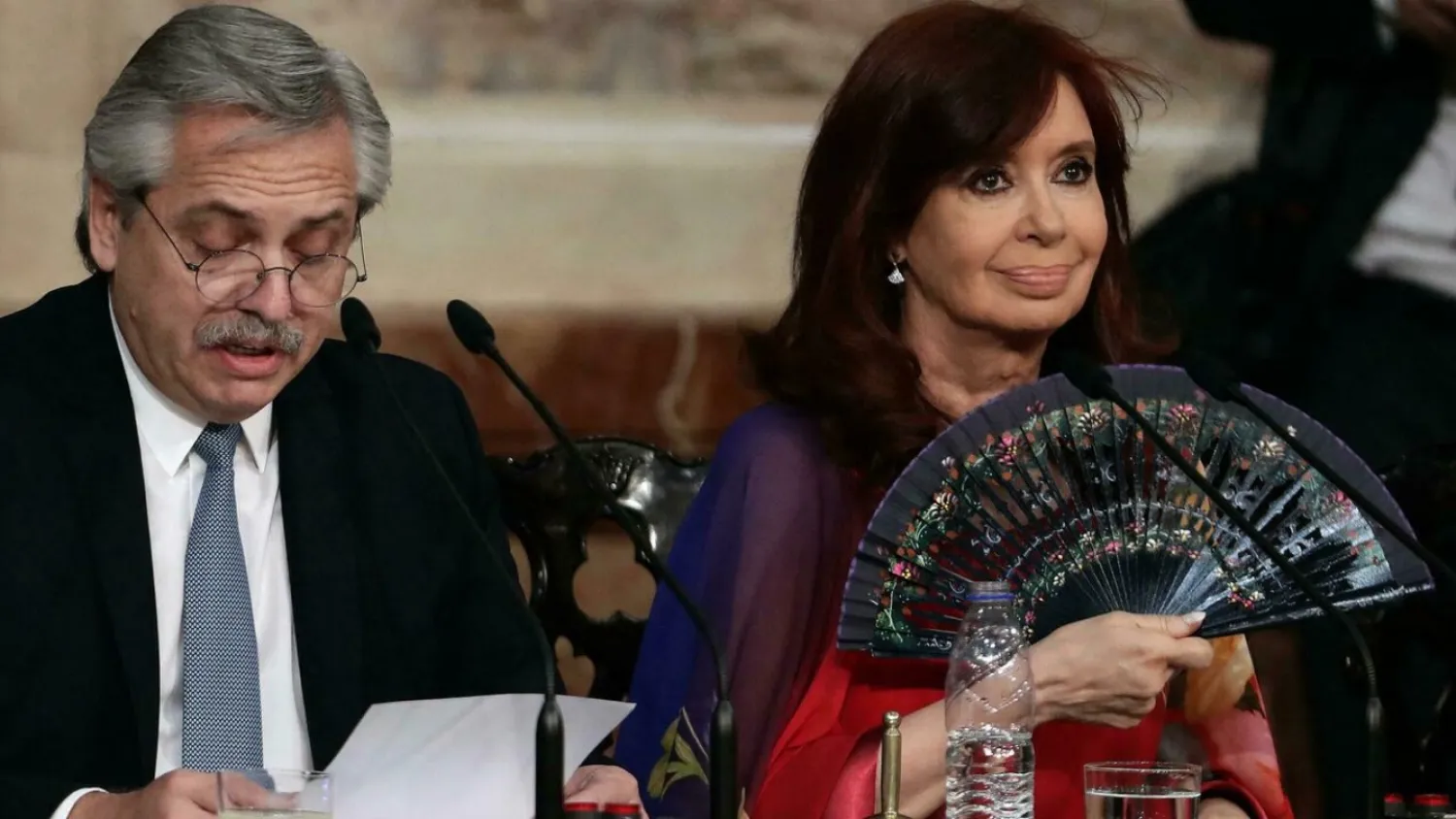
In this file photo taken in March 2020, Argentine President Alberto Fernandez (L) delivers a speech, next to Vice President Cristina Fernandez de Kirchner, ALEJANDRO PAGNI AFP/File
TT

Argentina's President Reshuffles Cabinet after Political Crisis

In this file photo taken in March 2020, Argentine President Alberto Fernandez (L) delivers a speech, next to Vice President Cristina Fernandez de Kirchner, ALEJANDRO PAGNI AFP/File

Argentina's president Alberto Fernandez announced a new cabinet on Friday in a bid to smother a political crisis that pitted him bitterly against his vice president this week after an electoral defeat in legislative primaries.

The reshuffle came one day after Vice President Cristina Kirchner wrote Fernandez to demand one, deepening the crisis gripping the ruling coalition after their poor showing in the weekend primaries, said AFP.

Juan Manzur, governor of Tucuman province, will take over as chief of staff from Santiago Cafiero, one of Kirchner's most controversial officials, the presidency announced.

Cafiero instead became foreign minister, replacing Felipe Sola, who is in Mexico for the summit of the Community of Latin American and Caribbean States, or CELAC, which begins on Saturday.

Due to the crisis, Fernandez canceled his visit to Mexico for the summit and won't attend the United Nations General Assembly in New York next week.

The new ministers joining the cabinet, who will be sworn in on Monday, are Anibal Fernandez (Security), Julian Dominguez (Livestock, Agriculture and Fisheries), Juan Perzyck (Education) and Daniel Filmus (Science and Technology).

Juan Ross was also appointed as the new Secretary of Communication and Press, replacing Juan Pablo Biondi, whom the vice president had openly rejected and accused of organizing "off-the-record operations."

The government of Fernandez and Kirchner, herself a former president, has been going through its most acute crisis yet this week after the weekend's legislative primary elections, in which the ruling Frente de Todos coalition won only 31 per cent of the votes at the national level.

These results put the ruling party's majority in the Senate at risk for the parliamentary by-elections on November 14, as well as any majority in the Chamber of Deputies, with two years of the Fernandez-Kirchner mandate still to run.

The crisis broke out earlier this week, after Interior Minister Eduardo 'Wado' de Pedro and four cabinet ministers offered to step down after a poor showing for Frente de Todos in weekend primary elections. The officials were all close to Kirchner and the move was seen as her attempt to put pressure on Fernandez to reshuffle the cabinet.

"Do you seriously believe that it is not necessary, after such a defeat, to publicly present the resignations and that those in charge facilitate the president to reorganize his government?" Kirchner wrote to Fernandez in a letter, in which she also criticized those who "cling to their chairs."

In the end, De Pedro and the other ministers kept their posts.

The center-right coalition Juntos, of ex-president Mauricio Macri, obtained 40 percent of the votes cast nationwide on Sunday.

It critically made great strides in the province of Buenos Aires, the country's largest electoral district and considered a bastion of Fernandez's party.

Fernandez took power from the incumbent Macri in 2019.

Public discontent with his government has been growing in a country in recession since 2018 and a GDP drop of 9.9 percent last year amid the coronavirus pandemic.

Argentina has one of the world's highest inflation rates, at 29 percent from January to July this year, and a poverty rate of 42 percent.



Chinese-Pakistani Initiative Seeks to Contain Regional Tension

Chang Hua, the Chinese Ambassador to Saudi Arabia. (Chinese Embassy to Riyadh)
TT

Chinese-Pakistani Initiative Seeks to Contain Regional Tension

Chang Hua, the Chinese Ambassador to Saudi Arabia. (Chinese Embassy to Riyadh)

A Chinese diplomat has disclosed that his country is engaged in diplomatic mediation efforts to contain the US-Israeli-Iranian war, in cooperation with Pakistan, through a five-point initiative.

Chang Hua, the Chinese Ambassador to Saudi Arabia, stressed the need for the international community to adhere to an objective and fair stance to contain the escalation, saying the top priority is to achieve peace and promote negotiations.

He explained that his country's foreign minister has held phone calls with his counterparts in the Gulf countries, including Saudi Arabia, as well as Iran, Israel, France, Germany, Egypt, and Türkiye, in addition to visits by Special Envoy Zhai Jun of the Chinese Government on the Middle East Issue to the Gulf countries.

In an interview with Asharq Al-Awsat, Hua said that Chinese Foreign Minister Wang Yi, together with Pakistani Deputy Prime Minister and Foreign Minister Mohammad Ishaq Dar, issued a joint five-point initiative aimed at restoring peace and stability in the Gulf and the Middle East region.

He explained that the initiative is based on three main pillars, which include, a ceasefire, the launch of negotiations, and the provision of guarantees, which means an immediate cessation of hostilities.

The diplomat stressed China's willingness to work with Middle Eastern countries to implement the Global Security Initiative, which contributes to restoring stability to the region, promoting security for its peoples, and supporting world peace.

Beijing Stands by Riyadh

Hua pointed out that China and Saudi Arabia have maintained communication and coordination regarding the situation in the region, explaining that Wang held two phone calls with his Saudi counterpart, Prince Faisal bin Farhan, while Saudi Arabia was the first stop for the visit of the Chinese Special Envoy.

He also said that Beijing supports the efforts of Riyadh and the Gulf countries to preserve their sovereignty, security, and territorial integrity.

Hua lauded the restraint shown by Saudi Arabia and its endeavor to achieve peace and prevent the expansion of the war, stressing his country's willingness to work with the Kingdom to restore stability in the region.

He also affirmed his country's rejection of any attack targeting the Gulf countries and its opposition to indiscriminate attacks that injure civilians, while supporting the legitimate security concerns of the Gulf Cooperation Council countries, including Saudi Arabia.

Saudi Arabia Secures Energy Despite Hormuz Challenges

Hua explained that the war, which has been going on for more than a month, has had major repercussions on regional and world security, affecting the stability of global energy supplies, production chains, and international economic growth.

He affirmed that Saudi Arabia is a major supplier of crude oil to China, pointing to the deepening alignment between the Belt and Road Initiative and Saudi Vision 2030 in recent years, with the strengthening of bilateral cooperation in the field of energy as one of the most important pillars of the strategic partnership between the two countries.

He added that China appreciates Saudi Arabia's positive role in maintaining the balance and stability of the global oil market, explaining that the Strait of Hormuz and its adjacent waters represent a vital corridor for international energy and commodity trade, and that maintaining the security and stability of this region was in the interest of the international community.

He also called on all parties to intensify efforts to reduce escalation and avoid wider disruptions that may affect the security of the global economy and energy supplies.


Israel Says Haifa Residential Building Suffers Direct Hit in Iran Attack

 Israeli security forces and rescue teams work amid the rubble of a residential building struck by an Iranian missile in Haifa, Israel, Sunday, April 5, 2026. (AP)
Israeli security forces and rescue teams work amid the rubble of a residential building struck by an Iranian missile in Haifa, Israel, Sunday, April 5, 2026. (AP)
TT

Israel Says Haifa Residential Building Suffers Direct Hit in Iran Attack

 Israeli security forces and rescue teams work amid the rubble of a residential building struck by an Iranian missile in Haifa, Israel, Sunday, April 5, 2026. (AP)
Israeli security forces and rescue teams work amid the rubble of a residential building struck by an Iranian missile in Haifa, Israel, Sunday, April 5, 2026. (AP)

The Israeli military and medics said on Sunday that a missile fired from Iran hit a residential building in the northern city of Haifa, injuring four people.

The building was hit by a "direct impact of a missile", the military told AFP. When asked if it was a missile fired from Iran, it said: "Yes."

The strike occurred minutes after the military warned it had detected a new round of missiles fired from Iran.

In a separate statement, Israel's emergency service, Magen David Adom, said four people were wounded when a seven-storey building sustained a direct hit.

Images and footage published by MDA show smoke rising from the remains of a flattened building in a densely populated area, and stretchers laid on the road by rescuers for casualties.

The injured included an 82-year-old man, MDA said, adding that he was in a "serious condition".

He was "wounded by a heavy object and the blast", the MDA said, adding that the other three suffered shrapnel and blast injuries.

MDA paramedic Shevach Rothenshtrych quoted residents saying that there were casualties trapped under the rubble on the lower floors, and the 82-year-old was rescued after first responders "managed to move large pieces of concrete with our hands".

His colleague Tal Shustak said that when emergency calls were received, "we were dispatched in large forces to the scene and saw extensive destruction, including glass, smoke and concrete scattered across the ground".


China Ready to Cooperate With Russia to Ease Middle East Tension, Foreign Minister Says

 Russian Foreign Minister Sergei Lavrov speaks during a joint news conference with Egyptian Foreign Minister Badr Abdelatty following their meeting in Moscow, Russia April 3, 2026. (Pavel Bednyakov/Pool via Reuters)
Russian Foreign Minister Sergei Lavrov speaks during a joint news conference with Egyptian Foreign Minister Badr Abdelatty following their meeting in Moscow, Russia April 3, 2026. (Pavel Bednyakov/Pool via Reuters)
TT

China Ready to Cooperate With Russia to Ease Middle East Tension, Foreign Minister Says

 Russian Foreign Minister Sergei Lavrov speaks during a joint news conference with Egyptian Foreign Minister Badr Abdelatty following their meeting in Moscow, Russia April 3, 2026. (Pavel Bednyakov/Pool via Reuters)
Russian Foreign Minister Sergei Lavrov speaks during a joint news conference with Egyptian Foreign Minister Badr Abdelatty following their meeting in Moscow, Russia April 3, 2026. (Pavel Bednyakov/Pool via Reuters)

China is willing to continue to cooperate with Russia at the UN Security Council and make efforts to cool down the Middle East situation, Foreign Minister Wang Yi told his Russian counterpart Sergei Lavrov in a phone call on Sunday. 

Wang said the fundamental way to resolve navigation issues in the Strait of Hormuz is to achieve a ‌ceasefire as soon ‌as possible, adding that China has ‌always ⁠advocated political settlement of ⁠hotspot issues through dialogue and negotiation. 

The foreign ministers' call came ahead of a UN Security Council vote next week on a Bahraini resolution to protect commercial shipping in and around the Strait of Hormuz. 

As permanent ⁠UNSC members, China and Russia ‌should "adopt an objective and balanced ‌approach and seek to win greater understanding and ‌support from the international community," Wang told Lavrov, ‌according to a statement from his ministry. 

A Russian Foreign Ministry statement said the ministers discussed ways to achieve a rapid ceasefire and "launch a political-diplomatic dialogue." 

"Satisfaction ‌was expressed at the coincidence in Russia's and China's approaches on most ⁠issues ⁠on the global agenda, including the situation around Iran, related to the unprovoked aggression of the US and Israel against that country," it said. 

China has repeatedly called for a ceasefire in the Gulf region and Middle East, urging an end to the fighting that has run for more than a month and largely closed the Strait of Hormuz, a critical shipping artery for oil and gas.