



Lebanon Expats Ship Aid as Crisis Bites at Home

Lebanese expats pack their luggage with supplies including medicine each time they travel to their home country, which is running out of everything. AFP
TT

Lebanon Expats Ship Aid as Crisis Bites at Home

Lebanese expats pack their luggage with supplies including medicine each time they travel to their home country, which is running out of everything. AFP

Lebanese expats in the UAE, many of them riven with guilt, are scrambling to ship essential goods and medicine to family and friends in their crisis-stricken home country.

"How can I sit in the comfort of my home in air-conditioning and a full fridge knowing that my people, my friends and family, are struggling back home?" asked Jennifer Houchaime.

"Oh, the guilt is very, very real," said the 33-year-old resident of Dubai.

"It's guilt, shame and nostalgia."

Lebanon's economy has collapsed under a long-running political class accused of incompetence and corruption.

Its currency has plunged to an all-time low, sparking inflation and eroding the purchasing power of a population denied free access to their own savings by stringent banking controls.

Lebanon is running out of everything, from fuel and gas to medicine and bread, and more than three-quarters of its population is now considered to be living under the poverty line.

Social media platforms are filled with posts by Lebanese appealing for contacts abroad to send basic goods such as baby formula, diapers, painkillers, coffee and sanitary pads.

Aya Majzoub, a researcher with Human Rights Watch, said trust in the Lebanese government is at an all-time low.

"It is unsurprising that local and grassroots initiatives have sprung up to fill this gap while bypassing the government that they view as corrupt, inefficient and incompetent," she told AFP.

With no faith in the Lebanese authorities, expats have taken it upon themselves to transport aid.

Houchaime and a number of her Lebanese friends fill their bags with over-the-counter medication and food items every time they travel home.

The Dubai-based airline Emirates is allowing an extra 10 kilos of baggage for passengers to Beirut from certain destinations until the end of this month.

For Dima Hage Hassan, 33, a trip to Lebanon opened her eyes to the unfolding disaster.

"I was in Lebanon, and I had money, and I had a car with fuel, and I went around from pharmacy to pharmacy unable to find medicine for my mother's ear infection," she said.

A fellow Lebanese, Sarah Hassan, packed for her second trip home in less than two months, taking only a few personal items while the rest was supplies for family and friends.

This time, the 26-year-old was taking a couple of battery-operated fans, painkillers, sanitary pads, skin creams, and cold and flu medication.

"A couple of my friends are going as well to Lebanon, so all of us are doing our part."

It's the same story in other parts of the Gulf, where Lebanese have long resided, fleeing from decades of conflict and instability in their own country.

"It's hard not to feel guilty. When I went to Lebanon a month ago, I hadn't been for two years. When I stepped out into the city, I was so shocked," said Hassan.

"Then you come back here to the comfort of your home and everything is at your fingertips... it's such an overwhelming feeling of guilt."



Lebanese Army Arrests Iraqi Man for Impersonating a Security Official

A picture taken from the seaside promenade of the northern Lebanese coastal town of Dbayeh shows the skyline of the Lebanese capital Beirut on March 17, 2020. (AFP)
TT

Lebanese Army Arrests Iraqi Man for Impersonating a Security Official

A picture taken from the seaside promenade of the northern Lebanese coastal town of Dbayeh shows the skyline of the Lebanese capital Beirut on March 17, 2020. (AFP)

The Lebanese army said on Sunday that it had arrested an Iraqi national for impersonating an Iraqi security official in Lebanon, the second alleged high-level imposter caught in recent months.

A military source told AFP that the man had managed to network with Lebanese security and intelligence officials, telling them he worked at Iraq's Beirut embassy.

The scandals have highlighted the fragility of Lebanon's institutions, which are built on a sect-based power-sharing system in a country rife with foreign interference, and where personal connections often play a key role in gaining influence, money and privilege.

An army statement said the Iraqi man was arrested "for impersonating an Iraqi security official on Lebanese territory, as a result of a surveillance and security follow-up operation".

Preliminary investigations indicate that the man was using "forged documents", the statement said, adding that the military uniform he had been using was seized.

The military source told AFP on condition of anonymity that the man "is married to a Lebanese woman and managed to get close to an intelligence official in Beirut, presenting himself as an Iraqi officer in the counter-terrorism branch, and a security attaché at the Iraqi embassy".

The Lebanese intelligence official allegedly helped the man "make contact with security and military officials and meet them", the source said.

The suspect actually works at a popular cafe on the airport road in Beirut's southern suburbs, the source added, after he started out there doing valet parking.

It is the second recent high-level impersonation case to rock Lebanon.

For months, authorities have been investigating an imposter who posed as a prince, extorting several politicians with the help of a religious figure.

The military source said that in the latest case, preliminary investigations into the man and those who met him have not yet uncovered a motive, adding that during the meetings "he promised to provide financial assistance from Iraq".

The case's seriousness owes to the man's ability to "convince intelligence officers of his fake identity", the source added.


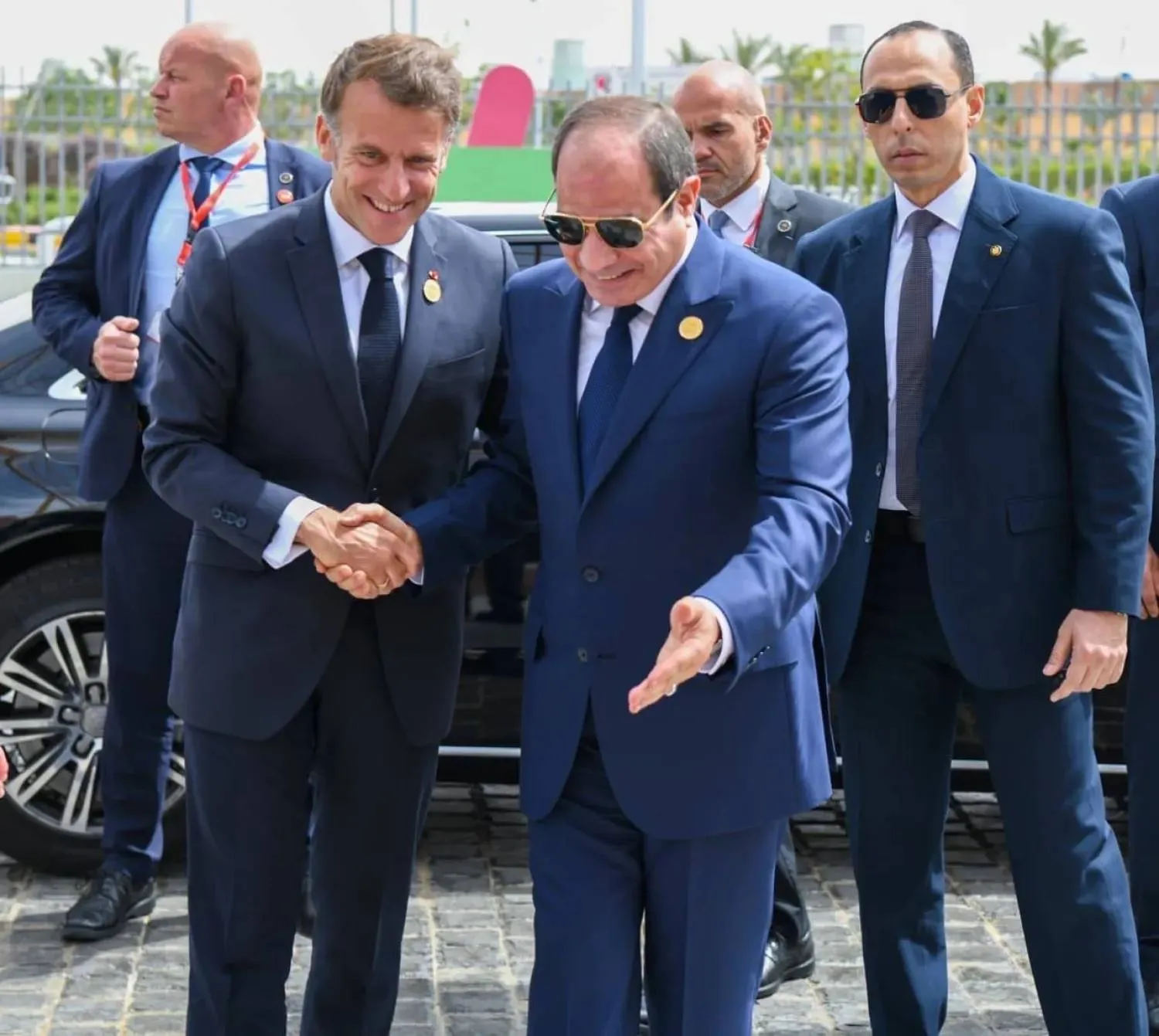
Sisi, Macron Hold Strategic Talks amid Escalating Regional Crises

Sisi welcomed Macron and the two discussed regional developments. (Egyptian Presidency)
TT

Sisi, Macron Hold Strategic Talks amid Escalating Regional Crises

Sisi welcomed Macron and the two discussed regional developments. (Egyptian Presidency)

Egyptian President Abdel Fattah al-Sisi and French President Emmanuel Macron held wide-range talks in Alexandria on Saturday focused on bilateral ties and mounting regional crises, as the two leaders inaugurated the new headquarters of Senghor University.

Macron arrived in the Mediterranean city after landing at Borg El Arab airport to open the campus of the francophone institution, which specializes in African development and leadership training.

The Egyptian presidency said the discussions covered strategic relations between Cairo and Paris as well as regional developments, describing Macron’s visit as a reflection of the “distinguished friendship” between the two countries.

Sisi praised what he called significant progress in bilateral ties, particularly after relations were elevated to a strategic partnership during Macron’s visit to Egypt in April 2025.

According to presidential spokesman Mohamed al-Shennawy, Sisi stressed the need to strengthen cooperation in trade, investment, education, industry and transport in ways that serve the interests of both peoples and deepen ties between Egypt and the European Union.

The talks also focused on regional tensions. Sisi reviewed Egyptian efforts aimed at containing current crises and warned against further escalation and instability, citing their impact on regional and global security as well as supply chains, trade and transport.

He reiterated Egypt’s support for the security and stability of Arab states and rejected any infringement on their sovereignty. Macron, for his part, said he hoped the current regional crisis would be resolved quickly to restore peace and stability to the Middle East.

The leaders also discussed the Palestinian issue, with Sisi outlining Egyptian efforts to preserve the Gaza ceasefire agreement and implement the second phase of the truce. He called for unrestricted humanitarian aid access to the Gaza Strip and for the launch of early recovery and reconstruction efforts.

Sisi also expressed Egypt’s “deep concern” over escalating violations in the occupied West Bank and reiterated support for a Palestinian state based on the June 4, 1967 borders with East Jerusalem as its capital, in line with international legitimacy and the two-state solution.

The discussions further touched on developments in Lebanon, with both sides emphasizing the importance of preserving peace and stability and enhancing Mediterranean cooperation to promote shared prosperity.

French foreign ministry spokesman Pascal Confavreux said Macron’s visit underscored the depth of the strategic partnership between Paris and Cairo and reflected French confidence in Egypt’s regional role.

In remarks to Egypt’s state news agency MENA, he said bilateral relations had gained momentum since the launch of strategic dialogue talks in April 2025, alongside stronger cooperation in priority sectors including the economy, energy and transport, supported by the French Development Agency.

The inauguration ceremony for Senghor University was attended by Burundi Prime Minister Nestor Ntahontuye, Organization internationale de la Francophonie Secretary-General Louise Mushikiwabo, Senegalese Foreign Minister Cheikh Tidiane Niang and African Union Commissioner for Education, Science, Technology and Innovation Mohammed Belhocine.

In his address, Sisi described the opening of the university’s new headquarters as coming at a critical moment marked by growing development challenges and a rising need for effective international partnerships, particularly among Global South countries.

Founded in 1990 on the initiative of the Organization internationale de la Francophonie, Senghor University focuses on African development issues and the training of future leaders across the continent.

Macron described the institution as a center for academic, scientific and cultural cooperation among francophone countries and said the Egypt-France alliance stood for “peace, stability and generosity”.

The French president is due to continue his African tour in Kenya for a France-Africa summit before heading to Ethiopia for talks with Prime Minister Abiy Ahmed.


Israeli Strikes in Gaza Kill Three, Medics Say, Testing Fragile Ceasefire

Palestinians inspect a vehicle struck by an Israeli airstrike in Khan Younis, southern Gaza Strip, Sunday, May 10, 2026. (AP)
TT

Israeli Strikes in Gaza Kill Three, Medics Say, Testing Fragile Ceasefire

Palestinians inspect a vehicle struck by an Israeli airstrike in Khan Younis, southern Gaza Strip, Sunday, May 10, 2026. (AP)

Israeli strikes killed at least three Palestinians in Gaza on Sunday, including two members of the Hamas-run police force, health officials said, in violence that underscored the fragility of a US-brokered ceasefire. 

Medics said an airstrike killed one person in the Maghazi refugee camp, while another killed the head of the criminal police force in Khan ‌Younis, Wessam Abdel-Hadi, ‌and his aide, according to Gaza's Hamas-run ‌interior ⁠ministry. 

Reuters has previously ⁠reported that Israel has heightened its attacks on Gaza's Hamas-run police force, which the group has used to re-establish governance in areas under its control. 

The Israeli military did not immediately comment on either incident. 

PERSISTENT VIOLENCE 

The blast that killed the two police officers left only a mangled metal skeleton where their car ⁠had stood in the Al-Amal neighborhood of Khan ‌Younis in southern Gaza. 

The men's white-shrouded bodies were carried on shoulders through ‌the streets during the funeral. 

A mourner, Ali Mousa, condemned Israel's killing of members of the enclave's police force. 

"Although the ceasefire came into effect several months ago, the occupation continues to target ‌the police officers to cause chaos among the people of the same nation," Mousa told ⁠Reuters. 

"The occupation ⁠aims to create chaos and confusion within the Gaza Strip. This is its sole objective," he added. 

Violence in Gaza has persisted despite an October 2025 ceasefire, with Israel conducting almost daily attacks. 

At least 850 Palestinians have been killed since the ceasefire took effect, local medics say, while Israel says fighters have killed four of its soldiers over the same period. 

Israel and Hamas have blamed each other for ceasefire violations. 

More than 72,500 Palestinians have been killed since the Gaza war started in October 2023, Gaza health authorities say, most of them civilians.