


Palestinian Factions Reject US, UNRWA Conditional Agreement

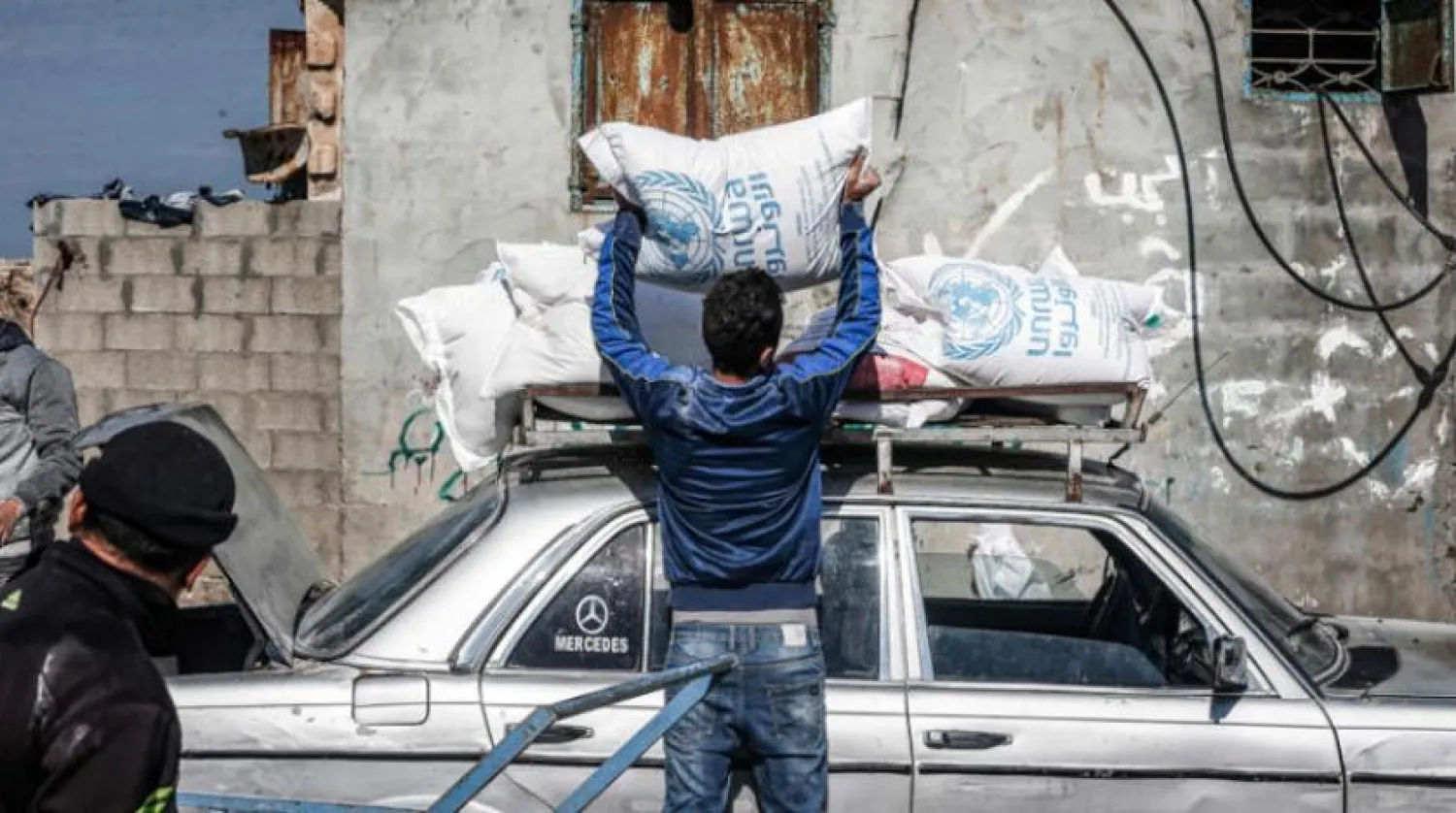
UNRWA aid is handed out in Gaza. (AFP)
TT

Palestinian Factions Reject US, UNRWA Conditional Agreement

UNRWA aid is handed out in Gaza. (AFP)

Palestinian factions handed a legal memorandum to the UN coordinator for the Middle East peace process, rejecting an agreement reached between the United Nations Relief and Works Agency for Palestine Refugees (UNRWA) and Washington on restoring US funding to the agency.

A member of Popular Front for the Liberation of Palestine (PFLP), Maher Mezher, said the memorandum covers all implications from the agreement on the refugees and their right of return.

Speaking at a press conference for the follow-up committee of the National and Islamic Forces in front of the headquarters of the UN Coordinator in Gaza, Mezher said the same memorandum was sent to UN Secretary-General Antonio Guterres and UNRWA Commissioner Philippe Lazzarini.

He confirmed that the factions reject the “malicious agreement” that threatens UNRWA and Palestinian refugees.

The factions will thwart the agreement, vowed Mezher, explaining that it transforms the refugee file from a political affair to a humanitarian one, even describing some refugees as terrorists.

He added that the agreement transforms UNRWA into an intelligence agency that is always keeping tabs on the refugees. The factions will kick off a series of activities in all of UNRWA’s areas of operation to reject the agreement.

On September 9, the Executive Office for Refugees in the West Bank announced that one of the terms of the agreement was to stop UNRWA aid to any refugees who are members of the Palestine Liberation Army or anyone who participates in a terrorist act.

The agreement calls for monitoring Palestinian school curricula and removing any content that does not align with Israel’s views.

In April, the administration of US President Joe Biden decided to restore UNRWA’s funding within an official agreement of $150 million after it was suspended by the former administration of President Donald Trump in August 2018.

UNRWA was established in 1949 by a decision of the UN General Assembly to establish relief and employment programs for displaced Palestinian refugees in five regions, including Gaza, the West Bank, Syria, Lebanon, and Jordan.



Syria's Leader Sharaa in Berlin on Tuesday, Says German Presidency

Syria's President Ahmed al-Sharaa.
TT

Syria's Leader Sharaa in Berlin on Tuesday, Says German Presidency

Syria's President Ahmed al-Sharaa.

Syria's President Ahmed al-Sharaa will be visiting Berlin next Tuesday and meet his German counterpart Frank-Walter Steinmeier, the German presidency said.

The office of Chancellor Friedrich Merz has yet to announce whether they would also hold talks during the visit, which comes at a time when the German government is seeking to step up repatriations of Syrians to their homeland.


US Envoy Opens File on Funds Smuggled from Iraq

Iraqis burn pictures of US President Donald Trump and Israeli Prime Minister Benjamin Netanyahu outside the Iranian consulate in Basra, January 13, 2026 (Reuters). 
TT

US Envoy Opens File on Funds Smuggled from Iraq

Iraqis burn pictures of US President Donald Trump and Israeli Prime Minister Benjamin Netanyahu outside the Iranian consulate in Basra, January 13, 2026 (Reuters). 

Iraqi politicians and observers warn of the potential fallout from a comprehensive review of suspicious financial transactions in Iraq as promised by US envoy Mark Savaya.

Meanwhile, a surprise decision by Iraqi Prime Minister Mohammed Shia al-Sudani, the leading vote-getter in the elections, to relinquish his right to form a government in favor of runner-up Nouri al-Maliki continues to cast a shadow over the leadership of the Coordination Framework, the umbrella alliance of Shiite political forces.

Savaya, who was praised on Wednesday by US President Donald Trump for having done “a great job in Iraq,” announced on Thursday the launch of a comprehensive review of suspicious payments and financial transactions in Iraq.

The review will be conducted in cooperation with the US Treasury Department and the Office of Foreign Assets Control, alongside discussions on potential sanctions targeting networks that undermine financial integrity and finance terrorist activities.

Savaya has not yet made an official visit to Baghdad since assuming his role as presidential envoy to Iraq, although he previously visited the country in a personal capacity. He is of Christian Iraqi origin, and his family left Iraq in the 1990s.

In a statement, Savaya said he was meeting with the US Treasury Department and OFAC to discuss key challenges and reform opportunities in Iraq’s state-owned and private banks, with a particular focus on strengthening financial governance, compliance, and institutional accountability.

According to the statement, both sides agreed to conduct a comprehensive review of records related to suspicious payments and financial transactions involving Iraqi institutions, companies, and individuals linked to smuggling operations, money laundering, and fraudulent contracts and financial projects that fund and enable terrorist activities.

Discussions also included next steps regarding potential sanctions against entities and networks that undermine financial integrity and state authority.

Savaya said relations between Iraq and the United States have never been stronger than they are today under Trump’s leadership.

Iraqi politician and former electricity minister Luay al-Khatteeb told Asharq Al-Awsat that Savaya’s message aligns with statements made by the US chargé d’affaires during his shuttle meetings with political bloc leaders regarding Washington’s official stance should a parliamentary majority vote in favor of undesirable figures.

Al-Khatteeb said the Coordination Framework must act with intelligence, seriousness, and realism by selecting credible figures who exceed US administration expectations and command international respect.

He warned that Iraq’s political scene is deeply unsettled and that the economy is in its worst condition, heading toward collapse if Shiite leaders continue clinging to failed policies and appointing ineffective and internationally unacceptable figures.

“The choices of the Coordination Framework,” he said, “will be the official response and message to the international community - and especially to the US administration - either yielding rewards or exacting a heavy price.”


Doctors Without Borders: Humanitarian Work in Sudan Hampered by Bureaucratic Hurdles

Dr. Javid Abdelmoneim, International President of Doctors Without Borders (AFP) 
TT

Doctors Without Borders: Humanitarian Work in Sudan Hampered by Bureaucratic Hurdles

Dr. Javid Abdelmoneim, International President of Doctors Without Borders (AFP) 

The health system in Sudan is suffering, with massive shortage of medical staff and supplies, said Dr. Javid Abdelmoneim, International President of Doctors Without Borders (MSF).

Speaking to Asharq Al-Awsat, Abdelmoneim said a large number of hospitals have been damaged, or completely out of service, amid widespread disease outbreaks like cholera and measles, pushing an already fragile health system to the brink.

Earlier, the World Health Organization said about 65% of the population lack access to healthcare and between 70 – 80% of health facilities are not functioning due to the ongoing conflict between the Sudanese army and the Rapid Support Forces in April 2023.

Abdelmoneim said assistance in Sudan is urgent, including in the fields of maternal and childcare, treatment of injuries, infant and childbirth, infectious diseases, and malnutrition.

Also, the population in Sudan is in urgent need of safe drinking water, sanitation services, psychological support, and assistance for survivors of sexual violence due to the ongoing humanitarian crisis.

He reported that access to health service facilities remains severely restricted due to insecurity and persistent bureaucratic obstacles.

Abdelmoneim noted that while MSF is not directly affected by these restrictions, other humanitarian organizations face an additional hurdle of limited funding and reduced aid.

Concerning the situation in El Fasher, the official said MSF treated residents who had been trapped in the city, which was under siege by the RSF for approximately 500 days.

After the RSF took control of the city, many survivors fled, often walking 60 km to the nearby town of Tawila, where MSF teams provided emergency medical care.

Abdelmoneim said the survivors arrived exhausted, malnourished, dehydrated, with traumatic injuries, gunshot wounds, and infected wounds.

On their journeys, they saw many dead bodies, and suffered torture, kidnappings for ransom, sexual violence, humiliation, and had everything they owned stolen, he said.

Concerning civilians who were still alive in El Fasher before 26 October, Abdelmoneim said they faced extreme violence including massacres, ethnic cleansing inside the city, and while escaping.

100 Violence Incidents

Abdelmoneim then mentioned the attacks on health care facilities, resulting in deaths and injuries.

He said that since April 2023, MSF has documented 100 incidents of violence targeting its staff, facilities, vehicles and supplies, including looting and destruction of clinics, theft of medicines, assaults, and threats to health workers.