

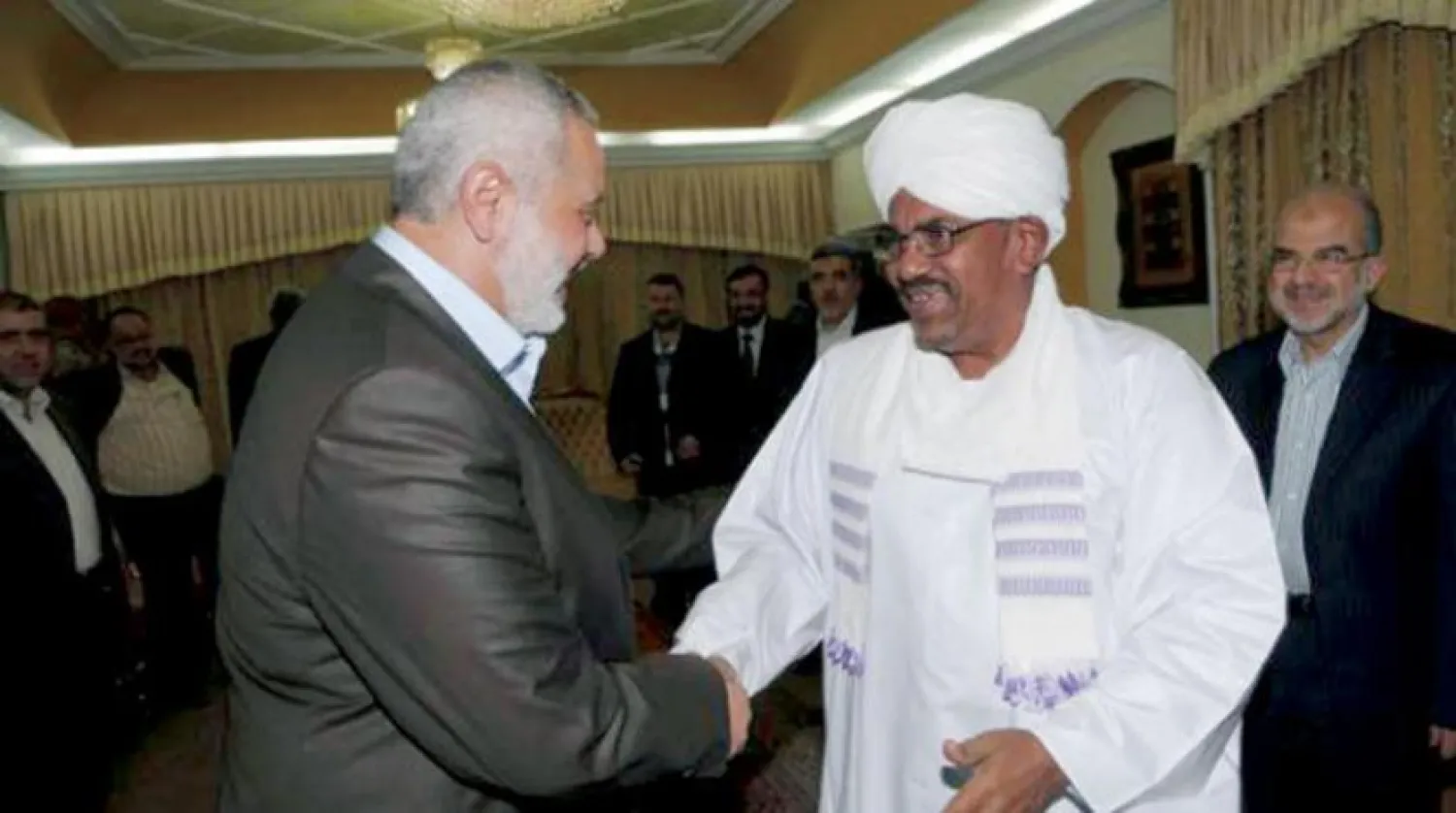

Sudan Closes Door on Support for Hamas

Hamas leader Ismail Haniyeh meets with Omar al-Bashir. File photo: the movement's website
TT

Sudan Closes Door on Support for Hamas

Hamas leader Ismail Haniyeh meets with Omar al-Bashir. File photo: the movement's website

Sudanese authorities have taken control of lucrative assets that for years provided backing for Hamas, shedding light on how the country served as a haven for the Palestinian militant group under former leader Omar al-Bashir.

The takeover of at least a dozen companies that officials say were linked to Hamas has helped accelerate Sudan's realignment with the West since Bashir's overthrow in 2019. Over the past year, Khartoum has won removal from the US state sponsors of terrorism (SST) list and is on course for relief of more than $50 billion in debt.

Hamas has lost a foreign base where members and supporters could live, raise money, and channel Iranian weapons and funds to the Gaza Strip, Sudanese and Palestinian analysts told Reuters.

Seized assets detailed by Sudanese official sources and a Western intelligence source show the reach of those networks.

According to officials from a task force set up to dismantle the Bashir regime, they include real estate, company shares, a hotel in a prime Khartoum location, an exchange bureau, a TV station, and more than a million acres of farmland.

Hamas investments in Sudan began with small-scale ventures such as fast food restaurants before venturing into real estate and construction, according to an official on the task force.

An example was Hassan and Alabed, which started as a cement company and expanded into large real estate developments.

The task force says it was in a network with about 10 other large companies with interlinking share ownership connected to Bashir ally Abdelbasit Hamza that moved large sums through foreign bank accounts.

The biggest was Alrowad Real Estate Development, established in 2007 and listed on Khartoum's stock exchange, with subsidiaries that the Western intelligence source said laundered money and traded in currency to finance Hamas.

Hamza was jailed in April for 10 years on corruption charges and sent to the Khartoum prison where Bashir is being held. The task force said he had assets worth up to $1.2 billion in his name. Hamza's lawyer, who also represents Bashir, could not be reached for comment.

A second network, worth up to $20 million, revolved around the broadcaster Tayba and an associated charity named Almishkat.

It was run by two Hamas members who got citizenship and amassed businesses and real estate, according to Maher Abouljokh, the caretaker brought in to manage Tayba.

Contacted by Reuters, Hamas official Sami Abu Zuhri denied the group had investments in Sudan, but acknowledged an impact from Sudan's political shift: "Unfortunately, there were several measures that weakened the presence of the movement (Hamas) in the country (Sudan) and limited political ties with it," he said.



Syrian Leader Announces Support for Lebanese Counterpart to Disarm Hezbollah

Syrian President Ahmed al-Sharaa attends the Ministry of Awqaf conference titled "Unity of Islamic Discourse" at the Conference Palace in Damascus, Syria, February 16, 2026. (Reuters)
TT

Syrian Leader Announces Support for Lebanese Counterpart to Disarm Hezbollah

Syrian President Ahmed al-Sharaa attends the Ministry of Awqaf conference titled "Unity of Islamic Discourse" at the Conference Palace in Damascus, Syria, February 16, 2026. (Reuters)

Syrian President Ahmed al-Sharaa on Monday declared his support for his Lebanese counterpart Joseph Aoun in the latter's effort to disarm Hezbollah, state media reported.

The Middle East war expanded to Lebanon on March 2, after Tehran-backed Hezbollah fired rockets towards Israel in response to the killing of Iranian supreme leader Ali Khamenei on the first day of US-Israeli attacks on Iran, prompting Israeli retaliation.

Since March 2, Israel has been conducting large-scale air raids on Lebanon and incursions with ground troops, killing at least 486 people according to the Lebanese health ministry.

"We stand alongside Lebanese president Joseph Aoun in disarming Hezbollah," Sharaa said during a video conference with top European officials.

The Syrian army has bolstered its troop deployments on the country's borders with Lebanon and Iraq, a Syrian government source told AFP on Wednesday.

"We have reinforced our defensive forces along the border as a precaution to prevent the repercussions of the conflict from spilling over onto Syrian territory, and to combat cross-border organizations and prevent them from using Syrian soil," Sharaa said.

On Monday, Aoun accused Hezbollah of seeking the "collapse" of the Lebanese state with its decision to launch rockets towards Israel.

Iran-backed Hezbollah was a prominent ally of former Syrian president Bashar al-Assad, sending forces to help him in the civil war.

His brutal rule was brought to an end in December 2024 and he was replaced by new authorities hostile to Hezbollah.


Lebanese President Lashes Out at Hezbollah, Says Open to Negotiations with Israel

Members of the Lebanese Civil Defense inspect a damaged building after an Israeli strike on Beirut's southern suburbs, following renewed hostilities between Hezbollah and Israel amid the US-Israeli conflict with Iran, Lebanon, March 9, 2026. (Reuters)
TT

Lebanese President Lashes Out at Hezbollah, Says Open to Negotiations with Israel

Members of the Lebanese Civil Defense inspect a damaged building after an Israeli strike on Beirut's southern suburbs, following renewed hostilities between Hezbollah and Israel amid the US-Israeli conflict with Iran, Lebanon, March 9, 2026. (Reuters)

Lebanese President Joseph Aoun on Monday accused Hezbollah of working towards the "collapse" of the state, after the pro-Iran group launched an attack on Israel, expressing Beirut's readiness for "direct negotiations" with Israel. 

Begun after Hezbollah launched rockets towards Israel a week ago, Israel's bombing campaign has killed at least 394 people and displaced more than half a million. 

"Whoever launched those missiles wanted to bring about the collapse of the Lebanese state, plunging it into aggression and chaos... all for the sake of the Iranian regime's calculations and this is what we have thwarted so far and what we will continue working to bring down and foil," Aoun told top European officials in an online meeting. 

He added that the party's rocket launches "were an almost transparent trap and ambush for Lebanon, the Lebanese state, and the Lebanese people". 

To stop the war, the Lebanese president proposed a four-point initiative and called on the international community to help implement it. 

It included "establishing a full truce" with Israel, "logistical support" for the army to disarm Hezbollah, and "direct negotiations (with Israel) under international auspices". 

The EU's top diplomat called for a 2024 ceasefire to be upheld to prevent Lebanon from "sliding into chaos," saying Israel's "heavy-handed" response to Hezbollah attacks was further destabilizing the region.  

"Israel should cease its operations in Lebanon," EU foreign policy chief Kaja Kallas said in a statement after crisis talks with a dozen Middle East leaders including Aoun.  

She likewise called for Hezbollah to "disarm and cease all actions against Israel," saying: "Diplomacy and a return to the ceasefire offer the best chance of averting Lebanon from sliding into chaos." 


Israel Says Killed Head of Hezbollah Unit in South Lebanon

This photograph taken during a media tour organized by the Hezbollah shows a man installing a flag of Hezbollah on the balcony of a damaged building at Nabi Sheet town after an Israeli military operation in the Bekaa Valley of Lebanon, on March 7, 2026.  (Photo by FADEL itani / AFP)
This photograph taken during a media tour organized by the Hezbollah shows a man installing a flag of Hezbollah on the balcony of a damaged building at Nabi Sheet town after an Israeli military operation in the Bekaa Valley of Lebanon, on March 7, 2026. (Photo by FADEL itani / AFP)
TT

Israel Says Killed Head of Hezbollah Unit in South Lebanon

This photograph taken during a media tour organized by the Hezbollah shows a man installing a flag of Hezbollah on the balcony of a damaged building at Nabi Sheet town after an Israeli military operation in the Bekaa Valley of Lebanon, on March 7, 2026.  (Photo by FADEL itani / AFP)
This photograph taken during a media tour organized by the Hezbollah shows a man installing a flag of Hezbollah on the balcony of a damaged building at Nabi Sheet town after an Israeli military operation in the Bekaa Valley of Lebanon, on March 7, 2026. (Photo by FADEL itani / AFP)

Israel announced on Monday that its military had killed the head of Hezbollah's Nasr unit operating in part of southern Lebanon during renewed fighting with the Iran-backed armed group.

Defense minister Israel Katz "was briefed on the elimination of the commander of Hezbollah's Nasr Unit", Abu Hussein Ragheb, during an overnight strike, a statement from the defence ministry said, Reuters reported.

The Nasr unit operates in an eastern sector south of Lebanon's Litani River and opened Hezbollah's cross-border attacks on Israel following Hamas's attack in October 2023.